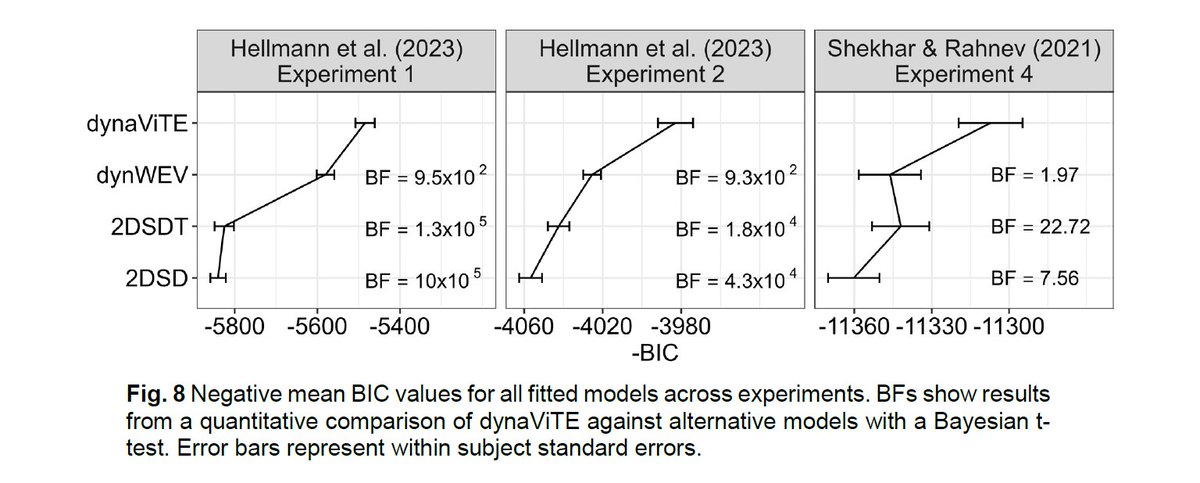
For all who use Bayesian hierarchical models, have a look at our new preprint, out now together with
Linus Hof, Nuno Busch, and Thorsten Pachur at the TU Munich:
https://t.co/mYXgMVUbf4
The good news: We provide a simple, correct computation that accounts for this variability, ensuring accurate group-level inferences. This fix is crucial for reliable conclusions in all cognitive models with constrained parameters.
Happy to share our latest publication, out now in @CognitionJourn, where we find that metacognitive self-beliefs are updated in a suprisingly domain-specific manner. https://t.co/iWCCDUwXwW
⭐️PhD in Cognitive/Computational Psychology⭐️
PhD alert! Do your PhD with me and use Reinforcement Learning to study how misinformation affects us.
Deadline: October 7. Please RT!
For more information: https://t.co/nnW8gnGuT9
Excited to share our preprint & my first PhD output! We found that a manipulation of prior beliefs about task performance causally induces under- and overconfidence: https://t.co/hLkK1eMeNj w/ modeling 🧙��♂️ #PierreleDenmat, #TomVerguts & @KobeDesender at @KULeuven #tweeprint⬇️(1/9)
Excited to share new work with @DobyRahnev where we test convolutional neural networks on a range of perceptual tasks involving stimulus energy manipulations (joint changes in stimulus intensity and variability): https://t.co/62KDTrniCV
(1/4)
Summing up: Human observers seem to make use of all three variables, which would also be used by a Bayesian optimal computation of confidence. However the detailed computations may differ.
Feedback and comments are very welcome!
New preprint together with @ManuelRausch5 about the importance to consider decision time when reflecting on the accuracy of a decision: https://t.co/jZkoW9I3wV
A "short" summary: