"In order to ensure the expeditious review process at the [Journal] I would greatly appreciate it if you could complete your review by June 30, 2008."
Last time I received such a request was from the Journal of Applied Tachyon Containment, ..., or is it "will have received"?!
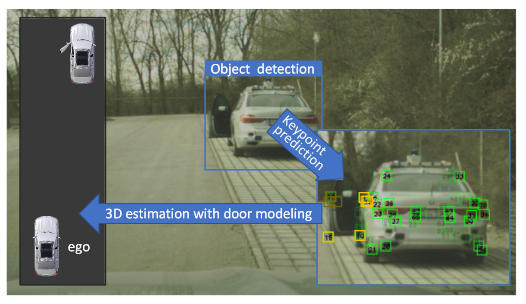
We study the effect that different numbers and configurations of keypoints as well as different neural detection architectures and heuristics (like visibility analysis) have on the door detection performance.
@TBarowski, Brehme, Szczot, Houben, Dynamic Door Modeling for Monocular 3D Vehicle Detection, Intelligent Vehicles Symposium 2021
https://t.co/hMwDtx2rsP
We extend keypoint-based pose estimation of vehicles to dynamic parts to detect which doors are open. 🧵
With first experimental results demonstrated, we propose an automated feedback loop that identifies and generates data from underrepresented (or missing) situations and adds it to the training regimen.
Our paper
Gannamaneni et al., Semantic Concept Testing in Autonomous Driving by Extraction of Object-Level Annotations from CARLA
was accepted at International Conference on Computer Vision, Workshop on Embedded and Real-World Computer Vision in Autonomous Driving
#ICCV2021 🧵
We extend CARLA to generate object-level meta-annotations. This allows for systematic testing and analysis of a state-of-the-art pedestrian detection model where change in performance can be attributed to skin color, size, relative position, and clothing.
This study is a fruitful collaboration within the competency network Machine Learning Rhine-Ruhr (@MLCompetence) including scientists from the University of Bonn, the Technical University Dortmund and the @FraunhoferIAIS. 🧵2/2
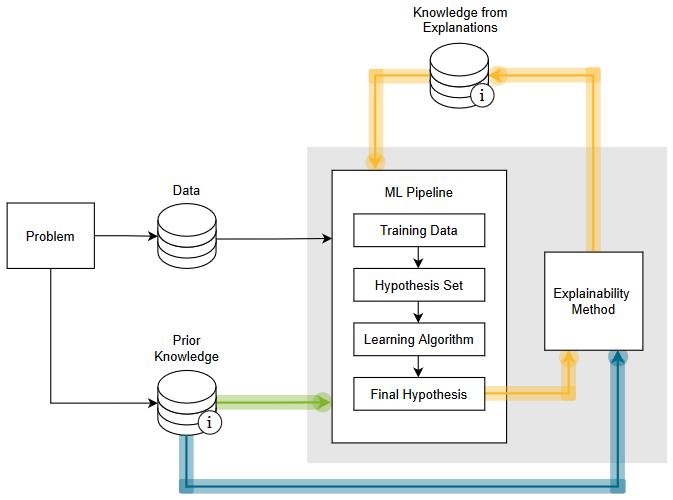
In our new survey
@kbeckh et al., "Explainable Machine Learning with Prior Knowledge: An Overview", 2021
https://t.co/p6wQIBAqV9
we elucidate how prior knowledge benefits or begets explainable machine learning and cover recent research that describe ways to achieve this. 🧵1/2
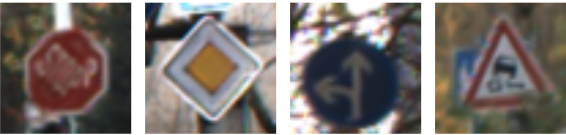
Badly rendered data point or useful piece of data variance?
Horn, Janssen, Houben, "Automated Selection of High-Quality Synthetic Images for Data-Driven Machine Learning: A Study on Traffic Signs", Intelligent Vehicles Symposium 2021
https://t.co/FXhQg3hae4
In our paper, we use state-of-the-art uncertainty measures to derive the "better" portion of a synthetic dataset and show that we can do with only 40% to 5% of the data without losing accuracy.
#OUTNOW: Der #Fraunhofer#KI-Prüfkatalog für vertrauenswürdige #KünstlicheIntelligenz! Mit dem +160 Seiten starken Leitfaden können Unternehmen u. Entwickler*innen KI-Systeme sicher u. verlässlich prüfen u. gestalten.
📖Zum Download: https://t.co/A8kzLysam4
@_KINRW@WirtschaftNRW
Nicht verpassen! 👉 #Keynote von Dr. Maximilian Poretschkin zu »#TrustworthyAI – Obligation or Entrepreneurial Opportunity?« auf der EAA e-Conference.
🗓️ 29. Juni, 9.40 bis 10.40 Uhr, online
🔗 Infos & Tickets: https://t.co/WM20QQAGqH
#KünstlicheIntelligenz#ZuverlässigeKI
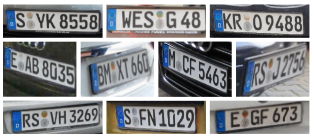
We demonstrate how to replace vehicle license plates on natural images maintaining partial control over the result (e.g. the code and perspective). We validate it by systematic testing of a state-of-the-art license plate reading system.
#ITSC2021#autonomusdriving#AI
Our paper
Kacmaz, Melchior, Horn (@Daniela_R_Horn), Witte, Schoenen, Houben, "Fully Automated, Realistic License Plate Substitution in Real-Life Images"
was accepted for publication at the Intelligent Transportation Systems Conference (ITSC).
(no real license plate shown)
We propose a framework deploying label-to-image synthesis to inspect to what extent we can transfer testing results of semantic segmentation from synthetic to real-life data.
Have a look!
#IEEE#IV2021#IV21#autonomousdriving
Our paper was accepted to the Workshop on Ensuring and Validating Safety for Automated Vehicles at the Intelligent Vehicles Symposium
Rosenzweig, Brito et al., Validation of Simulation-Based Testing: Bypassing Domain Shift with Label-to-Image Synthesis
https://t.co/bMIvPzXLCJ
Soft logic rules can describe common spatial relationships among objects. We use this to robustify semantic image segmentation.
Our CVPR-SAIAD paper: "Plants Don't Walk on the Street: Common-Sense Reasoning for Reliable Semantic Segmentation"
https://t.co/oofv2g70Dd
#CVPR2021