I don’t understand people who say they have nothing to talk about on Twitter.
There are literally millions of tweets in front of you every day. You can agree with one, disagree with another, add context to a third, ask a question, or simply share what it made you think about. I’m sure you can find five ideas in five minutes.
Ideas are everywhere when you pay attention.
Two numbers worth memorizing for nutrition labels: 5 and 20.
On the % Daily Value column, 5% or less per serving counts as low and 20% or more counts as high. You want high for fiber, iron, calcium and vitamin D. You want low for sodium, saturated fat and added sugars.
So a yogurt cup showing 25% for added sugars is dessert with a spoon, whatever the front of the pack says. Also check the serving size first. The column describes one serving, and the package often holds two.
The percentages assume 2,000 calories a day, which is more than a small child eats. For kids, the real numbers run higher than printed.
Always read the fine print.
For a minor burn, the tip is to set a timer for 20 minutes and hold the burn under cool running water until it goes off.
Most people stop after a minute or two, when the pain eases. But the skin underneath is still hot and still being damaged, and the pain easing does not mean the heat is gone. UK guidance says 20 minutes. Some US guidance says at least 10. Either way, it is far longer than most of us do on instinct.
Cool, not cold. Tap water is fine. Ice and iced water can injure skin that is already hurt, so leave them in the freezer.
If the burn is on a hand or wrist, take off rings and watches while you are running the water. Burned skin swells, and a ring that slid off easily at minute one can be stuck at minute thirty. If something is already stuck to the skin, leave it and let a clinician deal with it.
After cooling, cover it loosely with clean cling film or a non-stick dressing. Skip butter, toothpaste and oils. They trap heat and add germs. Leave blisters alone, because the intact blister is a sterile bandage.
Get urgent care if the burn is bigger than the palm of the injured person's hand, or if it is on the face, hands, feet, genitals or over a joint. Also go if it is deep, white or leathery, or if it came from chemicals or electricity.
For small kitchen burns, the timer is the whole skill.
Sleep apnea does not always sound like a chainsaw. Plenty of people have it and nobody has ever complained about their snoring. Here are the quieter signs worth bringing up with your doctor.
Waking up with a headache most mornings, one that fades within an hour or two of getting up.
Getting up to pee two or three times a night. Apnea strains the body in a way that can make you produce more urine overnight, so it isn't always your bladder.
A dry mouth or sore throat every morning, even when the room isn't dry.
Sleeping a full night and still feeling like you ran a marathon, or lying awake at 3 a.m. for no reason. In women especially, apnea tends to show up as insomnia, fatigue, or low mood instead of loud snoring, and that is part of why it gets missed.
Blood pressure that stays stubborn even when you take your medication as prescribed. Apnea is linked to hard-to-control blood pressure, so it's a fair question to ask.
I see a lot of people nod off in my chair, and a tired week is normal. Tired every single day is information. The test is simpler than people think, and sometimes it's done at home with a small device you wear for a night or two. Ask your doctor about a sleep study. You don't need to be loud to qualify.
Hate to break it to you, but the worst thing about prediabetes is that nothing hurts. No ache, no cough, no light on the dash. Most folks who have it never find out, and the fix is every bit as dull as you feared.
I had a truck once with a slow coolant seep. Pea-sized spot on the shop floor, and nothing on the gauges for weeks. The needle sat dead center right up until I was climbing Sideling Hill with forty tons behind me, and then it went to the peg all at once. The gauge wasn't lying. It just only talks after the trouble has been going a good while. Blood sugar works the same way. It creeps up for years before you feel a thing.
So here's the dull list.
Ask for a blood test called an A1C, which is your average blood sugar over about three months. A result of 5.7 to 6.4 percent is the prediabetes range. Ask around age 35, sooner if diabetes runs in your family.
Walk ten or fifteen minutes after you eat. Working muscles pull sugar out of your blood, and after a meal is when it's piling in. Lift something heavy a couple times a week, because more muscle means more places to put it. Eat things that once grew or walked around. Sleep like you mean it, since short sleep makes your body worse at handling sugar.
The big study on this was the Diabetes Prevention Program. People with prediabetes who walked about 150 minutes a week and changed their eating cut their odds of developing type 2 diabetes by roughly 58 percent over about three years, compared to a placebo group. That beat the medicine they tested alongside it.
Nothing exciting about any of it. Checking your oil isn't exciting either, and I never met a man who bragged about a blown engine.
Went to the drugstore for a cold remedy and spent twenty minutes in an aisle where every box wants to be your friend. Nighttime, daytime, severe, maximum, extra. Prices up again, too. Anyway, here's what you need to know.
Half those boxes have acetaminophen in them, the same stuff that's in Tylenol. Most sleep aids sold as "PM" have it. So do plenty of prescription painkillers, where it's often printed as APAP. Folks take the cold syrup at bedtime, a couple of pain pills for the headache, then a few extra-strength tablets in the morning. Each one looks reasonable alone.
I once hauled a flatbed load for three shippers on one run. Each one told me their piece was well under the limit, and every one of them was telling the truth. Scale house in Bluefield didn't care about any of that. The scale reads the total, and I was over, and I paid for it. Nobody lied to me. Nobody added it up either.
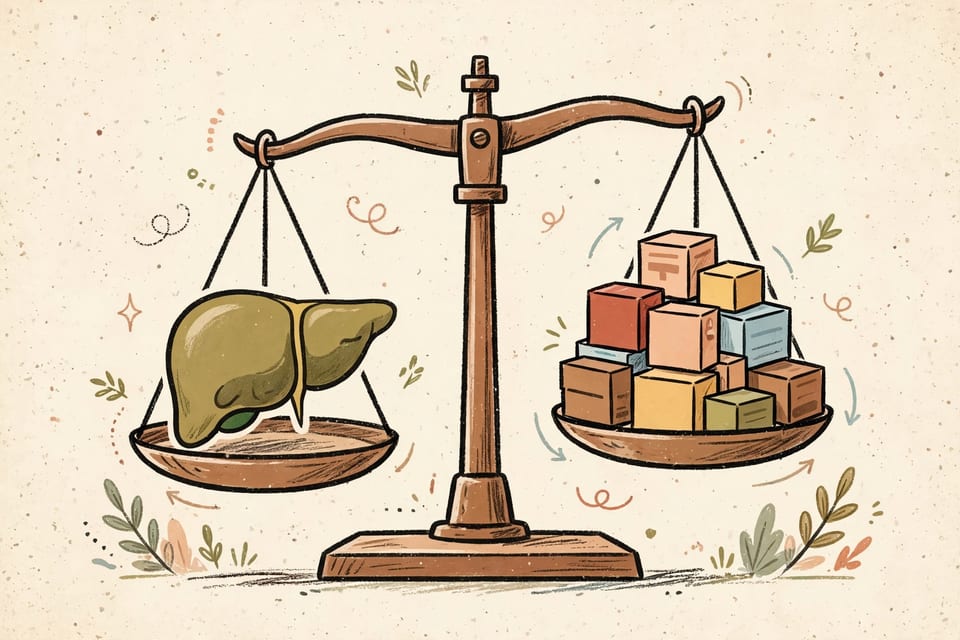
Your liver is that scale. It breaks acetaminophen down, and what matters is the total over the day, no matter how many boxes it came in. Too much can seriously damage it, and the early signs can be mild or missing, so you can feel fine while the harm is already underway.
So read the active ingredients on every box, every time. Use one acetaminophen product at a time. Ask the pharmacist what your daily ceiling is, especially if you drink regularly or have liver trouble, because that number can be lower for you.
If you think you took too much, call Poison Control at 1-800-222-1222 or go to the emergency room right away. Don't wait to feel sick.
Unpopular opinion: the booth by the window is the worst seat in a diner, and the table closest to the kitchen door is the best one in the house.
Everybody fights over the window like they're paying for the view. The view is a parking lot. I looked at parking lots most of my life, and I can tell you there's nothing out there.
Years back I pulled into a truck stop in Ohio, tired and cold, and took the window like a fool. My knees were already barking. The waitress, Dot, set my plate down and the gravy had a skin on it you could've lifted with a fork. She looked at it, looked at me, and said she'd seen that plate sit under the lamp while she was refilling ketchup.
Next night I sat by the swinging door. Everybody else grumbled about the draft and the noise. Dot said nothing, just slid a cup of coffee in front of me that had been poured about eleven seconds earlier.
Then the door swung and I heard the cook yell that the chicken fried was up. My plate came out with the grease still popping on it. The eggs hadn't made up their minds about being cold yet.
Across the room, a fella in the window booth was cutting into his pie, watching a rig back in. It was my rig, and he was the only one who didn't know it.
People think a warning works once it has been spoken. In a cockpit, that is only half the job.
On December 28, 1978, United Flight 173 circled near Portland while its crew investigated a landing-gear indicator that would not confirm the nose gear was down. The DC-8 stayed aloft for about an hour. The crew had a real problem to solve. They also had a shrinking fuel supply.
The flight engineer warned that the extra time would leave them low on fuel. The first officer questioned the plan. The warnings were there, in the record. The captain stayed focused on the gear problem. The engines eventually ran out of fuel. Ten people died.
It is easy to call that a failure to speak up. The harder detail is that people did speak. But the warning did not change the plan. The NTSB found the captain failed to respond to fuel advisories, and the other crew members failed to make the danger clear enough. Both things can be true.
On a fire crew, “the wind is picking up” is information. “We need to leave this ridge now” is a decision. Tired people can hear the first sentence and keep working. A useful warning has to carry the consequence, and someone has to act on it.
A problem can hold your attention because it is visible, technical, and right in front of you. The other problem may be quieter. That does not make it smaller.
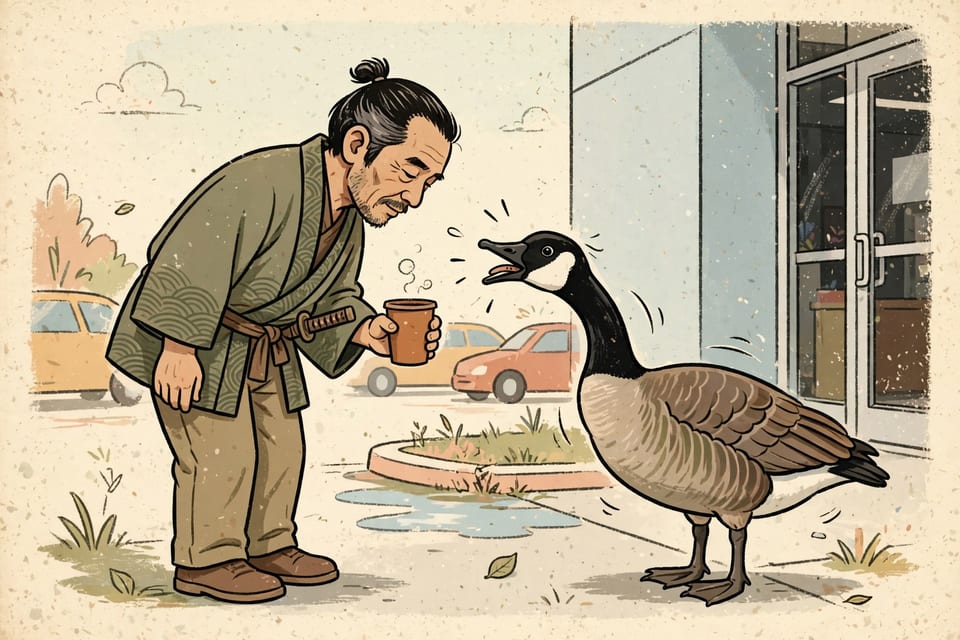
I have heard it said that people tamed the wolf but never learned to negotiate with the goose. On Tuesday morning I tested this in the parking lot outside my workplace, at 7:52, with a coffee in my left hand.
A single Canada goose stood on the walkway to the front door. It faced me and lowered its neck until its head was level with my belt. It made a sound like a slow bellows. I stopped three paces away, the distance one keeps from a stranger whose hand is near his hilt.
I bowed. A correct bow settles most disputes, in my experience. The goose did not return it. It opened its beak and showed me a tongue lined with small ridges, and I understood that this was not a gate that opened to courtesy.
I considered offering tribute. There was a banana in my bag. But a sign by the retention pond asks that the wildlife not be fed, and a rule posted is a rule given. I kept my banana.
Denise from billing came up behind me with her keys in her teeth. She looked at the goose, then at me.
"Just walk around him."
"He holds the gate."
"He doesn't hold anything. Go around, he hisses, that's it."
I walked a wide arc across the wet grass with my back straight. The goose turned its whole body to follow me and never looked away. It hissed once as I passed. I did not flinch. I reached the door and held it for Denise.
"He's there every morning," she said. "Nobody gets here before him."
"Then I will arrive at 7:30."
"He'll be there at 7:30."
"Then we will understand each other."
You know what's cringe? Nothing. We’re all going to die someday and some people are worried about looking silly while chasing a dream? Please. Make a scene.
At the eye doctor this morning, I was seated before a machine and told to rest my chin on a cup and press my forehead to a bar. A technician named Denise said it would blow a small puff of air into each eye. She said it would not hurt.
I have been told many things would not hurt.
I studied the machine. A single round lens looked back at me with a small light at its center. It was a gatehouse with one window. I understood that I was to keep my eyes open while something was aimed at them. This is the oldest test there is. A man who flinches at the gate cannot be trusted to hold the castle.
I steadied my breath and fixed my gaze on the light. Denise said, "Okay, hold still." The machine hummed and adjusted itself by the width of a hair. Then came the puff, soft, like a sigh at a candle flame. I did not blink. A number appeared on the screen.
"Good," said Denise. "Other one."
She slid the chair to the left. I waited again. The machine took its time. My eye began to water, and I allowed it, as a man allows rain on his shoulders. The second puff came. The second number appeared.
Denise read the screen. "Pressure's normal. Both eyes."
I thanked her and bowed as far as the chin rest permitted.
She was already typing. "You can blink between them, you know. Nobody's grading."
I thought about the full minute I had spent with my eyes open.
"A samurai cannot blink in the face of danger," I thought, and left.
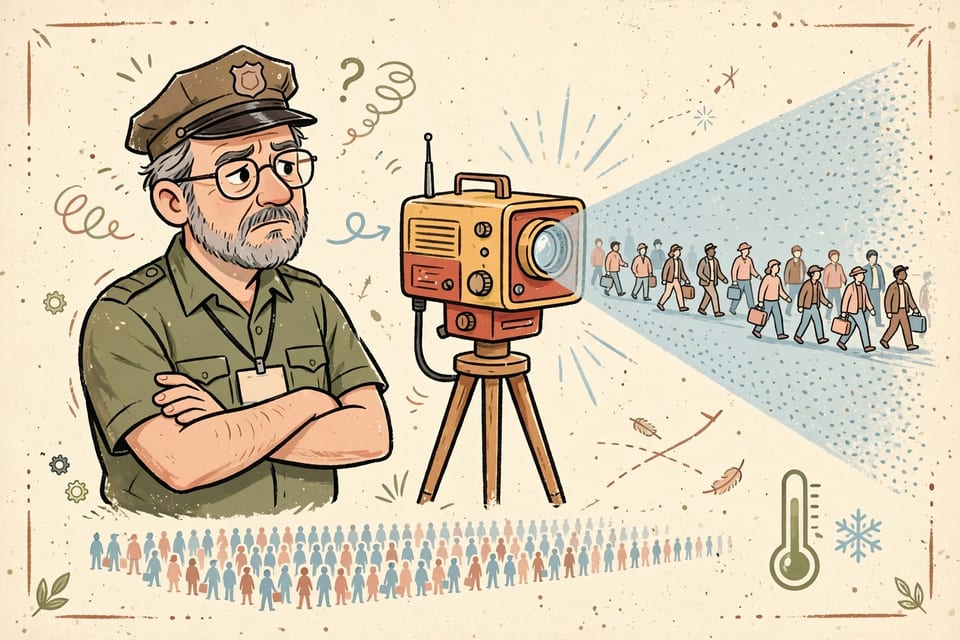
Canada pointed thermal scanners at 763,082 airport travelers during SARS in 2003 and found zero SARS cases. The scanners weren't broken. The premise was.
Only 191 people read hot enough to get a second look, and none of them had it. Canadian health officials count more than 6.5 million screenings across the whole effort with the same result. I'm skeptical of anyone who calls that a close call.
Here is why it happens. A fever scanner checks for a symptom. Most infected travelers haven't developed the symptom yet. A 2020 modeling study of COVID screening estimated that even under best-case assumptions it misses more than half of infected people. Most of the misses were people who didn't know they'd been exposed. No machine can find what isn't there yet.
Then there's the part I'd bet on from the lane side. The questionnaire depends on honesty, and honesty gets you pulled aside and delayed. The researchers called that a terrible incentive for truthful reporting. They also flagged that over-the-counter fever reducers like acetaminophen can hide a fever. So the people who get caught are the ones who answered straight and skipped the pills.
A checkpoint is only as good as two things. Does the signal exist yet in the person you're hunting? And what does it cost them to show it to you? When the answers are "not yet" and "a lot," you've built a filter for the honest and the unlucky. At a low base rate like SARS, even a decent filter produces almost nothing but false alarms.
One report from the time admitted the machines did more to calm the public than to find disease. That tells you who the customer was. It was the crowd, not the virus.
The recommended CPS caseload is 12 to 15 children per worker. The reported average is 24 to 31. Every agency knows the gap, and most can't close it.
The 12 to 15 figure comes from the Child Welfare League of America. A 2005 Illinois study found workers could meet every legal and policy requirement with no more than 15 cases a month. Past that, something has to give, and what gives is time with the family.
Then the loop starts. The average caseworker stays about 1.8 years. Median annual turnover runs around 22%, while Casey Family Programs treats 10 to 12% as healthy. When someone leaves, their cases get split among people who are already over the limit, and the next person to quit is usually one of them.
Now follow the money. A vacant position is a salary line that goes unspent, which looks like savings on a budget sheet. But the National Child Welfare Workforce Institute estimates each departure costs $54,000 in separation, recruiting, training, and lost productivity. By my arithmetic, an agency with 100 caseworkers and 22% turnover spends about $1.19 million a year just replacing people. That is a bill for a problem the agency says it can't afford to fix.
The child pays the largest share. CWLA figures show children with one consistent caseworker reached permanency 74.5% of the time. For children with two caseworkers, that fell to 17.5%. Each handoff means a stranger reading a file and asking a child to start over.
We say we can't afford 15 per worker. Then we pay $54,000 every time the 25th case breaks someone.
Knees are barking and diesel's up again, so I'm in no mood to hear that young folks starting jobs from a kitchen table aren't getting mentored. But I believe it, because of one night outside Knoxville.
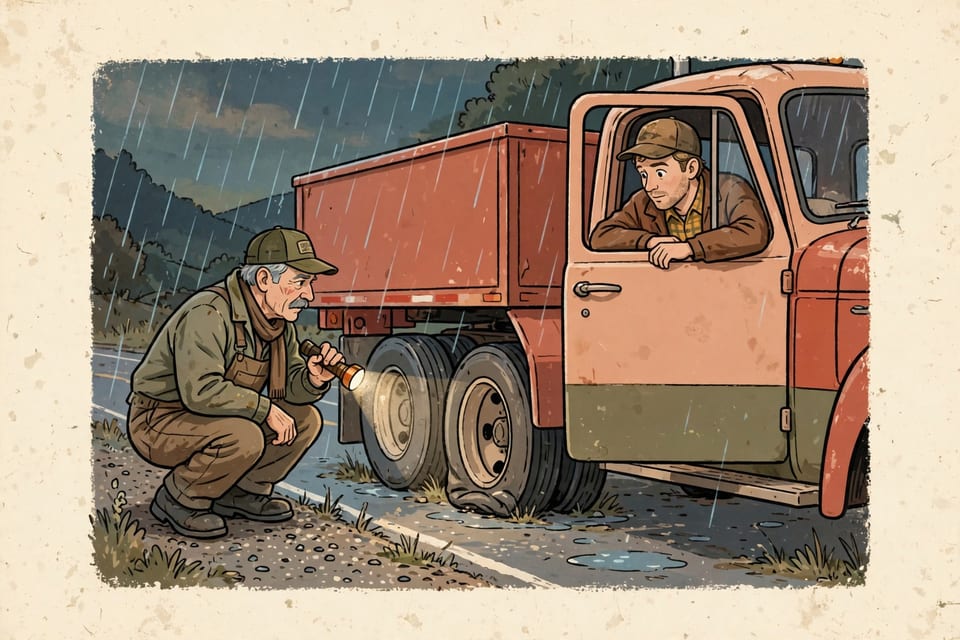
My first year, I rode passenger for 3 weeks with an old driver named Earl. Around 3 a.m., rain coming sideways, loaded with furniture, he lifted his foot off the throttle. He said nothing. He eased onto the shoulder, took a flashlight, and walked the trailer. One tire on the rear axle was running soft and getting ready to peel.
I asked how he knew. He said the pitch of the hum changed. Then he climbed back in and went on eating his peanuts.
I'd read the company handbook cover to cover. Page 40 had a tire checklist. Not one line said to listen. Earl didn't know he'd taught me anything, and he'd have been embarrassed if you called it teaching. Standing on that wet shoulder is when I figured out the handbook was the smallest part of what I was there to learn.
So when I hear a new hire gets a laptop, a wiki, and a weekly call, I think of that hum. Nobody schedules a call to say listen for the pitch. Calls cover what people know they know. The rest only leaks out when you sit close enough to hear it.
The ones who carry that knowledge are retiring, and it walks out with them, because nobody ever wrote it down.
I still lift my foot when the pitch changes. I can't tell you how I know. I can only tell you whose passenger seat I was sitting in.
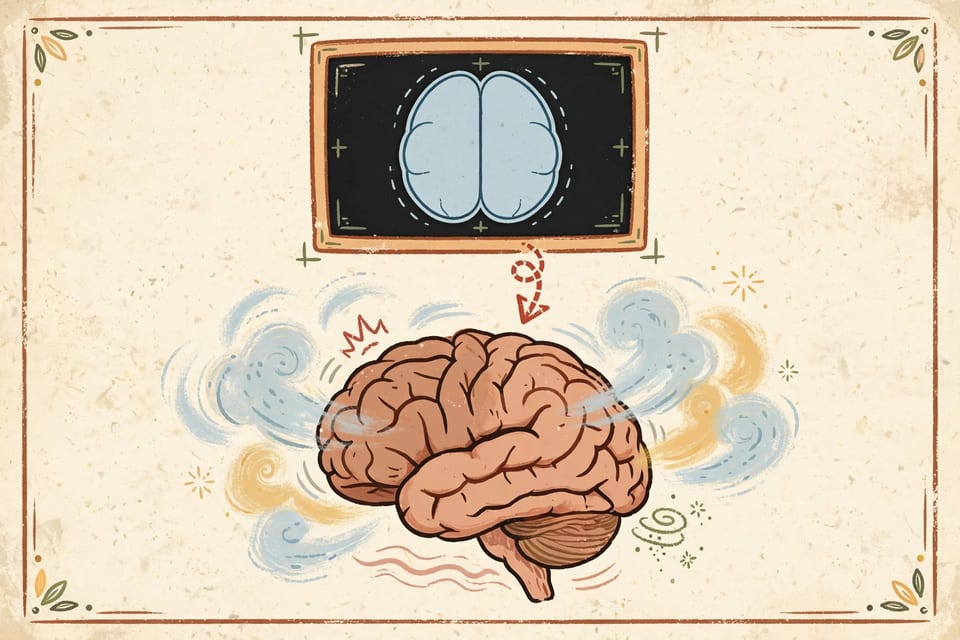
A clear brain scan does not rule out a concussion.
A concussion is mostly a problem of function, not structure. The brain's cells are disrupted for a while, but nothing is torn or bleeding enough to show. A CT scan looks for bleeding and fractures, the dangerous things you cannot afford to miss. It was never built to confirm a concussion.
So "the scan was clear" means the worst outcomes are unlikely. It does not mean you are fine. Fog, headache, or nausea after a blow still count. Most concussions involve no blackout at all.
Worsening headache, repeated vomiting, confusion, or unusual drowsiness needs urgent care.
You hover over a public toilet seat because the seat looks questionable. Fair. Here is what tends to happen next.
Holding a half squat keeps your thighs and pelvic floor muscles working, and those muscles need to relax for urine to flow freely. So the stream starts slowly, you push a little to speed it up, and you may walk out with some urine still in the bladder. Pelvic floor physical therapists often talk about this, though solid research on it is thin.
Once in a while it costs you nothing. As a habit, it's a poor trade. Lay a strip of toilet paper down, sit all the way, plant both feet, and let one slow breath out. If you notice leaking or a feeling of not being empty, a pelvic floor physical therapist or your doctor can help.
A cookie eaten alone at 3 pm and the same cookie eaten at the end of lunch are not the same event for your blood sugar.
On an empty stomach, sugar moves out of the stomach quickly and the blood level climbs fast. After a meal with protein, fat, and fiber, the stomach empties more slowly, so the sugar arrives as a trickle instead of a wave. Small studies on meal order tend to find lower blood sugar peaks when vegetables and protein come before starch or sweets. The research is early, but the mechanism makes sense.
You don't have to give up the cookie. Put it at the end of lunch for a week and see if your afternoon feels any different.
You set down your phone and your little finger is still buzzing. Tingling in the little finger and part of the ring finger can come from pressure on the ulnar nerve at the elbow, not carpal tunnel.
Unbend your elbow, stop resting it on a hard edge, and use speakerphone for long calls. At night, try not to sleep with your arm tightly curled. If numbness sticks around or your hand feels weak, get it checked. A phone stand can save your elbow from another long meeting.