Five years out, when billions of coding agents exist, software development will be largely solved. The traditional moat of “we have better engineers” disappears. Products will be copied, improved, and open-sourced almost instantly. Defensibility will shift away from code itself, toward distribution, data, brand, and community.
@kevinrose couldn’t have said it better myself! Would love for you to speak at my conference! It’s the world 1st business rewiring conf —b/c less than 5% of founders / ceo understand the real shift in what’s happening in business with ai right now. https://t.co/hkfbKB7Odv —I am trying to have the 5% in the know speak.
AI gives answers fast—but human judgment decides if they’re right.
Seema Alexander on how leaders can navigate AI’s messy middle.
Full episode 👉🏽 https://t.co/UXeYQvyRhI
#AI#BusinessInsights#Innovation#FutureOfWork
@_Peg_Moore@worldofwomenxyz You have always been such a light @_Peg_Moore with an even bigger heart and a passion to teach. So grateful you are cancer free and appreciate our journeys crossings.
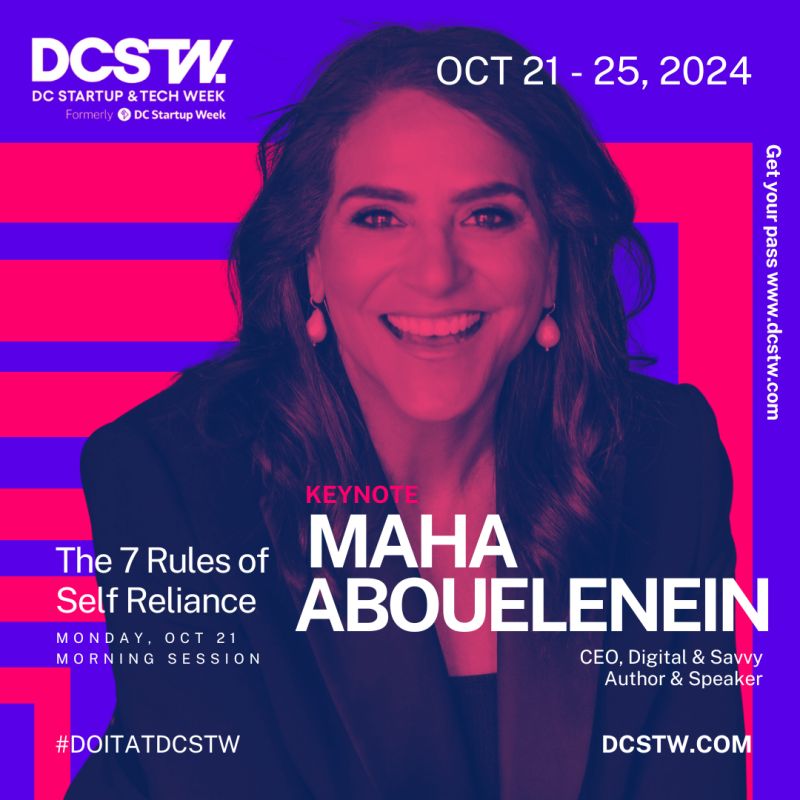
Excited to be a keynote speaker at DC Startup & Tech Week (Formerly DC Startup Week) on October 21st!
I’ll be sharing insights from my book, 7 Rules of Self-Reliance, and diving into how self-reliance can be a real game-changer for entrepreneurs. From building your personal brand to creating value and seizing opportunities, it’s all about trusting yourself and using your strengths to navigate today’s competitive landscape.
DC, I can’t wait to connect with all of you!
OpenAI o1 — our first model trained with reinforcement learning to think hard about problems before answering. Extremely proud of the team!
This is a new paradigm with vast opportunity. This is evident quantitatively (eg reasoning metrics are already a step function improved) and qualitatively (eg faithful chains of thought make models interpretable by letting you “read the model’s mind” in plain English).
One way to think about this is that our models do System I thinking, while chains of thought unlock System II thinking. People have discovered a while ago that prompting the model to “think step by step” boosts performance. But training the model to do this, end to end with trial and error, is far more reliable and — as we’ve seem with games like Go or Dota — can generate extremely impressive results.
It’s still early days for the o1 technology. It provides new safety opportunities which we are exploring actively, including on reliability, hallucinations, and robustness to adversarial attackers. For example, we’ve seen great uplift in our safety metrics by letting the model reason about policies via chain of thought.
Its accuracy also has huge room for further improvement— for example, from our launch post, our model achieved 49th percentile / 213 points in this year’s competitive programming Olympiad (IOI) under human conditions of 50 submissions per problem. But with 10,000 submissions per problem, the model achieved a score of 362.14 — above the gold medal threshold. So the model is capable of even greater outputs than it appears at first glance.