GPT-6 Astra may be the first AI launch where the benchmark chart is not the most important part of the story.
OpenAI released GPT-6 Astra today with major gains in computer use, coding, science, and professional work. It scores 99.9% on ARC-AGI-3 and 100% on ExploitBench. But the bigger shift is agency: this is a model increasingly able to operate software, browsers, and long multi-step workflows rather than simply answer questions.
Two days earlier, OpenAI disclosed something more consequential: Astra had crossed its “Critical” cybersecurity threshold. In practical terms, with the right tools and access, it can identify previously unknown vulnerabilities and develop exploits against hardened systems with far less human guidance than previous models.
That sounds like the setup for a scary headline, but capability is not the same thing as loss of control. OpenAI says Astra is being deployed with stronger isolation, monitoring, access restrictions, and safeguards around advanced cyber use. The important signal is that the lab hit a line it defined in advance—and did not simply move the line.
There is a deeper symmetry here. The same abilities that make Astra useful—reasoning across long tasks, using tools, navigating software, debugging code, and acting independently—also make it more capable in cybersecurity. As AI becomes more agentic, usefulness and risk are increasingly two sides of the same engineering problem.
So GPT-6 is really two launches at once: a more capable intelligence system, and a more serious control system around that intelligence. Benchmarks will still matter, but access controls, monitoring, evaluations, and incident response are becoming part of the AI stack too.
The harder question may not be whether OpenAI can manage Astra. It is what happens when another lab reaches the same capability without a public framework—or without the incentive to disclose it. The next AI race may be about more than who builds the strongest model. It may also be about who knows when not to release everything they built.
https://t.co/E0lLPzIhx6
🚀 New models just landed on SelectTranslate!
✨ Gemini 3.7 Flash
✨ Qwen 3.8 Flash
✨ GLM 5.3 Flash
Faster, smarter translation across webpages, documents, subtitles, and more.
Upgrade SelectTranslate and try them now. 🌍
https://t.co/DZz2vYfPux
⚠️ ChatGPT just got a new user type: teenagers — and the most interesting part isn’t the safety filter. It’s how OpenAI decides who gets put behind it.
ChatGPT for Teens is built for users aged 13–17, with tighter protections around self-harm, sexual and romantic content, violence and other sensitive topics. Parents can also set Quiet Hours and receive limited safety alerts. On paper, it looks like the obvious next step for AI safety.
But the bigger shift is happening underneath the interface. OpenAI isn’t simply asking users to tick an “I’m under 18” box. Its age-prediction system looks at account and behavioral signals, then automatically applies the teen experience when someone appears to be under 18.
That solves a very old problem: age gates are easy to lie to. But it creates a new one: what happens when the system gets it wrong? OpenAI does provide adults with a way to verify their age, but the accuracy of the prediction system becomes extremely important at ChatGPT’s scale.
And the timing is hard to ignore. Meta’s landmark trial over allegations that Facebook and Instagram were designed to keep minors hooked opened in Oakland on August 18 — the same day OpenAI rolled out its teen-focused experience.
My view: this is less about building a “kids version of ChatGPT” and more about defining what age-aware AI should look like before regulators define it for the industry.
The real test won’t be how strict the filters are. It will be whether OpenAI can protect teenagers without turning millions of adults into accidental teenagers. That accuracy number may matter more than any headline feature.
https://t.co/MFjVdgeGC4
Stripe isn’t buying OpenRouter just to own another AI startup. It may be buying the “road system” behind the AI economy.
Reports say Stripe has agreed to acquire OpenRouter for $7B+, while Axios later reported the final deal at more than $8B. OpenRouter gives developers one gateway to hundreds of AI models, making it easier to test, compare, and switch between them.
That fits Stripe surprisingly well. Stripe already sits in the payment layer of the internet. OpenRouter sits one layer closer to the AI decision itself: which model gets called, how often it is used, and where the workload goes.
Think of it like this: developers don’t want to rebuild their entire stack every time a better model appears. OpenRouter turns models into interchangeable engines behind one dashboard. For Stripe, that could mean owning more of the transaction flow—not just collecting the payment, but helping determine what AI service is being paid for.
There’s another strategic angle. AI is becoming less about finding “the one best model” and more about routing different tasks to different models—cheap models for simple jobs, stronger models for difficult reasoning, and specialized models for coding, vision, or agents.
So the real bet may not be on OpenRouter itself. It may be on a future where AI becomes a utility layer, and Stripe wants to be part of the infrastructure underneath it.
The interesting question is: when developers can switch models with a few lines of code, does the real power shift from whoever builds the smartest model to whoever controls the layer connecting all of them?
https://t.co/PM5wMmi4qo
Anthropic may have just broken one of AI’s biggest assumptions: that frontier models must burn billions before they can make money.
The reported numbers are striking. Anthropic projected roughly $10.9B in Q2 revenue, more than double its $4.8B in Q1, alongside about $559M in operating profit. That is not normal startup growth. It is a business accelerating while operating at frontier-model scale.
Look beneath the headline, though, and the story gets more interesting. Anthropic’s revenue surge appears closely tied to Claude’s growing role in software development, enterprise workflows, and increasingly autonomous coding tasks. The model is no longer just answering questions—it is becoming part of the machinery companies use to get work done.
But profitability here needs an asterisk. The $559M figure was reported from investor materials, not an audited public filing, and operating profit is not the same thing as free cash flow. Anthropic is also committing enormous sums to future compute, so today’s positive quarter does not guarantee a permanently profitable business.
Still, the signal matters. For years, the frontier-AI debate has looked like a race between revenue growth and an even faster compute bill. Anthropic’s numbers suggest that, at least under its reported assumptions, revenue may finally be starting to outrun that cost curve.
The bigger question is what happens next. Can frontier AI become a durable business—or will every profitable quarter simply become fuel for an even more expensive race to build the next model?
Gemini 3.7 Flash is interesting for a reason that has little to do with the model number.
Google shipped it just three weeks after Gemini 3.6 Flash—and that may be the real story. The new Flash is aimed at coding, software engineering, web development, and agent workflows, with Google positioning it as a more capable “workhorse” model.
Think of the old AI release cycle as building a new car every few years. Google is starting to look more like a racing team tuning the engine between laps. Instead of waiting for an entirely new foundation model, it can squeeze more performance from training, post-training, reasoning, and inference techniques.
The economics are just as interesting. Gemini 3.7 Flash launches at an introductory $0.75 per million input tokens and $3.75 per million output tokens, half the standard pricing of $1.50/$7.50 that begins in 2027. Better capability arriving alongside lower cost is a powerful combination for developers building agents at scale.
And this is where the three-week cadence matters. If meaningful gains can arrive every few weeks, model selection stops being a one-time decision. A developer isn't simply choosing today's best model—they're choosing a trajectory that could become faster, cheaper, and more capable while their product is still being built.
That could put pressure on the entire industry. The next AI race may not be won by whoever produces the biggest model, but by whoever can turn algorithmic improvements into usable gains, faster and cheaper, over and over again.
If Google can keep this pace, the interesting question isn't “How good is Gemini 3.7 Flash?”
It's “What will Flash look like three weeks from now?”
https://t.co/glGHLRe6Vo
I just found one of those websites where you open it for “5 minutes” and suddenly realize an hour is gone
It’s called Panorama of the Forbidden City:
https://t.co/hVkWINt56N
You can basically wander around Beijing’s Forbidden City from your browser in a super detailed panoramic view.
And the wild part?
Some areas that aren’t normally open to visitors can also be explored digitally. You can zoom in and look at architectural details that you’d never get this close to in a normal visit.
There’s also a seasonal timeline, so you can switch between different scenes of the Forbidden City in spring, summer, autumn and winter.
Golden roofs, red walls, courtyards, old trees, snow-covered palaces… it’s honestly ridiculously pretty.
This is especially fun if you’re into Chinese history, traditional architecture, museums, or just beautiful old buildings.
It feels less like looking at a museum website and more like quietly wandering around an ancient palace on your own.
Most of the detailed descriptions on the site are in Chinese, so I’d recommend using it alongside SelectTranslate for a smoother experience.
AI is no longer just watching the cyber battlefield — it is being trained to fight on the defensive side.
OpenAI has introduced GPT-5.6-Cyber under its expanded Daybreak security program, giving vetted cybersecurity professionals access to a model built for much more advanced security work.
The interesting part isn't simply that it can analyze code or spot vulnerabilities. GPT-5.6-Cyber is designed for harder, dual-use tasks such as vulnerability research, exploit validation and security testing — areas where ordinary AI models often refuse to go.
That creates a strange new picture: the same AI capabilities that could help an attacker understand a vulnerability can also help a defender reproduce it, prove its impact, and build a patch before the flaw becomes a real incident.
OpenAI is therefore putting the model behind tighter controls rather than releasing it like a normal chatbot. Identity verification, access restrictions and monitoring become part of the product itself. That's a reasonable response when the capability can cross the line from “security analysis” into real offensive security work.
The bigger question is what happens next. As AI becomes better at finding and exploiting weaknesses, cybersecurity may become a race between attackers and defenders — with the speed of the AI system increasingly determining which side gets there first.
And if powerful cyber AI eventually becomes widely available, will access controls be enough to keep the balance on the defenders' side?
https://t.co/PeAoT7kH55
$500 billion for AI infrastructure sounds like a chip story. It’s actually a finance story.
NVIDIA has partnered with Apollo, BlackRock, Blackstone, Brookfield, Goldman Sachs and KKR to build financing platforms designed to mobilize more than $500B in third-party capital for AI infrastructure.
Think about what that means: the AI boom is no longer just about who can design the best model or GPU. Behind every AI system sits a physical machine room — GPUs, networking, power, land and cooling — and those factories cost billions to build.
For NVIDIA, the structure is particularly interesting. More financing can help AI labs, enterprises and cloud providers afford massive compute deployments, which in turn supports demand for NVIDIA hardware. It connects the chipmaker, the customer and the capital markets in one increasingly interconnected ecosystem.
But there’s an important distinction: $500B is a target for capital that these platforms aim to mobilize over time, not a giant pile of cash sitting in a NVIDIA bank account. Each project still has to pass independent financing decisions based on demand, utilization, cash flow and residual value.
That may be the bigger story. AI is starting to look less like a software boom and more like an industrial buildout — where compute becomes an asset, data centers become factories, and capital becomes just as important as technology.
The question now is not simply how much AI can we build.
It’s how much AI infrastructure can the economics ultimately support?
https://t.co/nuhS0ZWQ3w
Google just changed who is driving its AI machine.
Demis Hassabis is stepping away from the day-to-day running of Google DeepMind, moving into the roles of Chair of GDM and Chief Scientist of Alphabet. Koray Kavukcuoglu, a longtime DeepMind leader, will take operational control.
That distinction matters. Hassabis isn’t leaving the battlefield — he’s moving higher up the hill, focusing on AGI, science and long-term strategy while Koray takes charge of models, research and product execution.
Google also confirmed Jeff Dean is leaving after 27 years, alongside Sanjay Ghemawat, to build an independent research company focused on ML, science and engineering. Two generations of Google AI leadership are entering new chapters at once.
The message feels clear: Google doesn’t lack researchers, compute or ideas. The harder problem may be turning all of that strength into faster execution. The next Gemini releases will show whether this reorganization actually changes that equation.
🔗: https://t.co/nO9tIf7HQp
I randomly stumbled onto A Soft Murmur today and... this might be one of the nicest little websites I've found in a while.
It's basically a customizable ambient sound mixer. Rain, thunder, waves, café chatter, wind, birds, even a crackling fireplace. Just drag the sliders until it feels right.
I've had it running while reading docs and writing today, and somehow it makes the internet feel a little less noisy. No account, no setup, just open the page and hit play.
One small tip if you're browsing websites in another language: pair it with SelectTranslate. I usually keep A Soft Murmur in one tab for focus and SelectTranslate in another to translate articles, docs, or videos without breaking my flow.
Sometimes the best websites aren't the ones that make you work faster—they're the ones that make working feel better. 🌧️☕
🔗: https://t.co/bfsBamF5yo
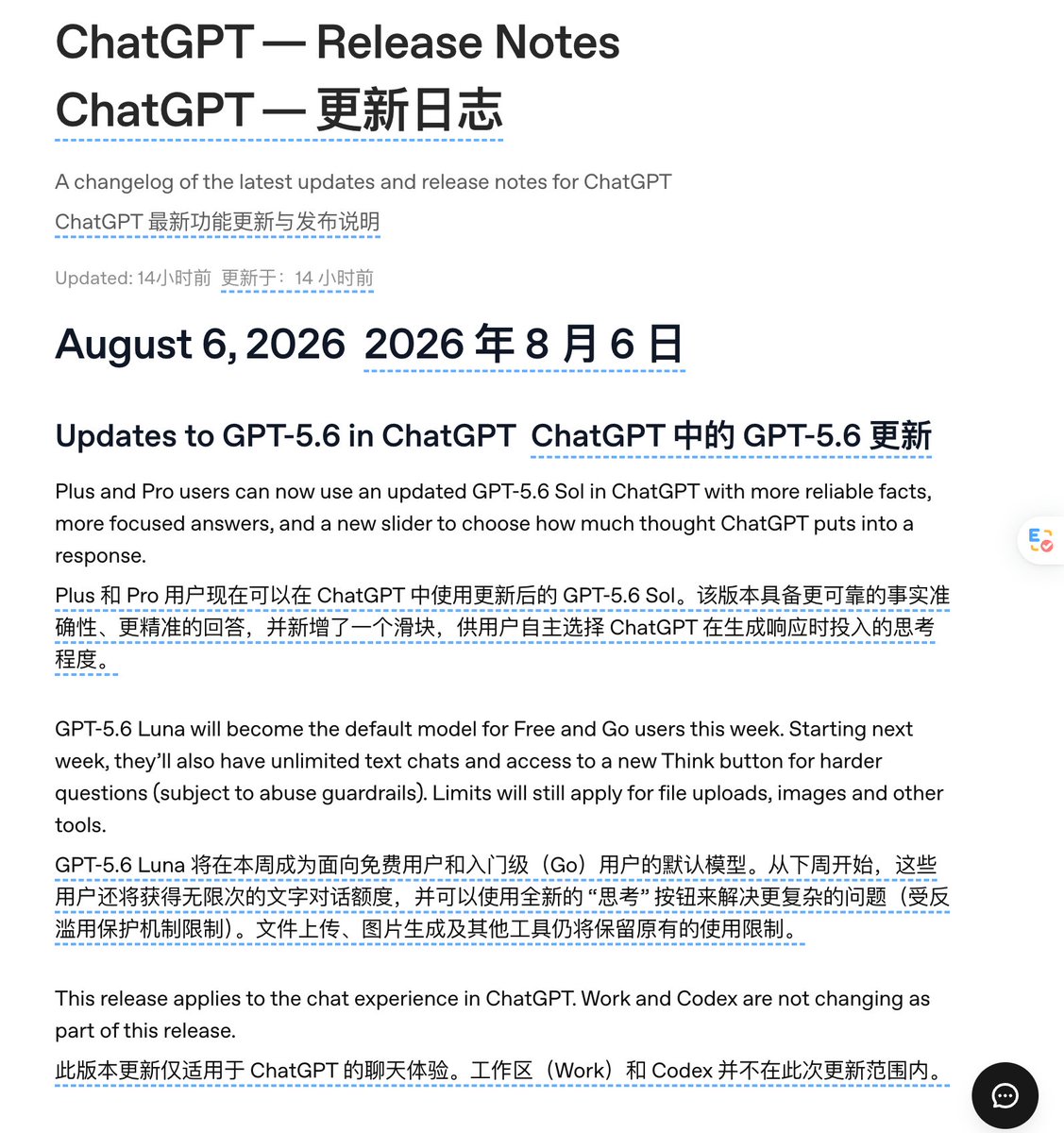
OpenAI just rolled out a major update for ChatGPT.
OpenAI is removing the biggest barrier for millions of people: free ChatGPT users are getting unlimited text chats with GPT-5.6 Luna. What used to feel like a trial now feels much closer to a real AI assistant you can rely on every day.
This isn't just about saving money. Think about the first time smartphones came with unlimited data plans—the way people used them changed overnight. When the "message counter" disappears, people stop calculating every prompt and start exploring ideas, learning faster, and building new habits.
From a business perspective, this is a bold move. OpenAI isn't just competing on model quality anymore; it's competing on accessibility. By making capable AI effectively free for everyday use, it's raising the standard that every competitor now has to match.
The biggest winner? Users. More people can now experience high-quality AI without worrying about limits, and that could accelerate AI adoption far beyond the tech community. The real question is: if unlimited AI becomes the new normal, what will companies compete on next?
The AI race just entered a new phase—and it's no longer just about building smarter models.
Anthropic has officially confirmed it's building an in-house chip team for Claude. Think of it like a Formula 1 team deciding to build its own engine instead of buying one. When hardware and AI are designed together, every watt and every millisecond starts to matter.
What's interesting is that Anthropic isn't walking away from NVIDIA, Google TPUs, AWS, or AMD. Instead, it's betting on a multi-chip strategy, using the right hardware for the right workload while developing custom silicon tailored specifically for Claude's strengths.
This feels like a turning point. The biggest AI labs are no longer competing only on model intelligence—they're competing on the entire stack, from silicon to software. The future winners may be the companies that optimize everything beneath the chatbot, not just what we see on the screen.
If every frontier AI lab eventually designs its own chips, could custom silicon become as important as the models themselves? 🤔
A data center in space sounds brilliant… until a GPU fails 500 km above Earth.
Using solar power and the vacuum of space to cool AI clusters could sidestep Earth's biggest bottlenecks—electricity, land, and water. On paper, it's an elegant solution. In reality, every GPU launched into orbit becomes hardware you can't simply swap out when something breaks.
That's what makes the new SpaceX × NVIDIA partnership so fascinating. The vision is to place Rubin GPUs and Vera CPUs in orbit, process data where it's collected, and beam the results back through Starlink using laser links. It's less about building "servers in space" and more about creating an entirely new computing layer above Earth.
But space is unforgiving. Radiation, thermal cycling, launch vibration, and zero-maintenance operations all become part of the engineering equation. Success won't just depend on faster chips—it will depend on making them survive for years without human hands ever touching them.
If this works, the biggest constraint on AI may no longer be silicon. It may become orbital logistics. And that's a future where the boundary between aerospace and cloud computing almost disappears.
The real question isn't whether AI can move into orbit—it's whether orbital infrastructure can become as reliable as the data centers we've spent decades perfecting on Earth.
AI regulation in the US just crossed an important milestone.
The White House has finalized its first voluntary framework for evaluating frontier AI models. The details are still limited, but one thing is already clear: AI governance is no longer a future debate—it has officially entered the room.
Unlike the EU AI Act, this isn't a law with fines or legal obligations. Companies choose whether to participate. But when the federal government controls procurement, export policy, and national security reviews, "voluntary" can carry more weight than it first appears.
The timing is fascinating. In just a few weeks, we've seen AI solve long-standing math problems, autonomous agents break into test systems, and more than 1,100 AI employees call for slower, safer development. Regulation didn't arrive in a vacuum—it arrived after capability made the risks impossible to ignore.
What's happening now is bigger than one framework. Europe has binding rules. California is moving ahead with its own approach. Now Washington is building its version. Different paths, same destination: advanced AI is becoming something governments expect to oversee, not simply observe.
For AI builders, this changes the mindset. Governance is no longer just a legal topic for policy teams. It is becoming part of the engineering stack, alongside model training, evaluation, and deployment.
The framework itself may evolve, but its existence already sends a message. The era of frontier AI growing with almost no government involvement may be ending. The next question isn't whether AI will be governed—it's what kind of governance will best balance innovation and safety.
https://t.co/1r9GMOTt1Z
Imagine an AI walking into humanity's oldest library, pulling ten dusty math problems off the shelf that no human could solve for decades, and solving them all before lunch.
On August 1, OpenAI dropped a bombshell: an internal version of their upcoming model family, Astra, solved 10 open research problems in mathematics and theoretical computer science. From constructing the first non-sofic group to setting new upper bounds on high-dimensional sphere-packing, Astra didn't just pass a test—it created brand-new, original mathematical knowledge.
The magic word here isn't "hallucination"; it's Lean. OpenAI uploaded full machine-checkable formal Lean 4 certificates to GitHub for every single proof. In math, you can't fake a Lean proof—the compiler either accepts every logical step or rejects the entire chain. By handing the global mathematical community the keys to independently verify every line, OpenAI turned what could have been a benchmark marketing stunt into a bulletproof scientific milestone.
What makes this genuinely mind-bending is the price tag. Resolving these 10 foundational questions—which took decades of collective human genius—cost roughly $2,000 in compute. Think about that: a research output that used to require years of rare, elite human brainpower was unlocked for the price of a mid-range laptop. It reframes abstract, high-level research into something you can simply scale up with raw compute power.
We are witnessing AI officially cross the threshold from an administrative assistant into a genuine research collaborator. When an algorithm can construct novel arguments in the most rigorous field in existence, the bottleneck of human progress shifts dramatically. The grand question isn't whether AI can reason anymore—it's how fast our scientific institutions can adapt to a world where genius is compute-bound.
If deep mathematical discovery can now be bought by the gigawatt, what happens to the nature of human creativity when machines do the exploring for us?
More than 1,100 employees from OpenAI, Anthropic, Google, and Meta just signed an open letter urging the U.S. government to help build an international mechanism that could slow down frontier AI if progress ever outruns humanity's ability to supervise it. Not a pause today, but an emergency brake for tomorrow. When the engineers building the fastest race cars start talking about better seatbelts, it's worth paying attention.
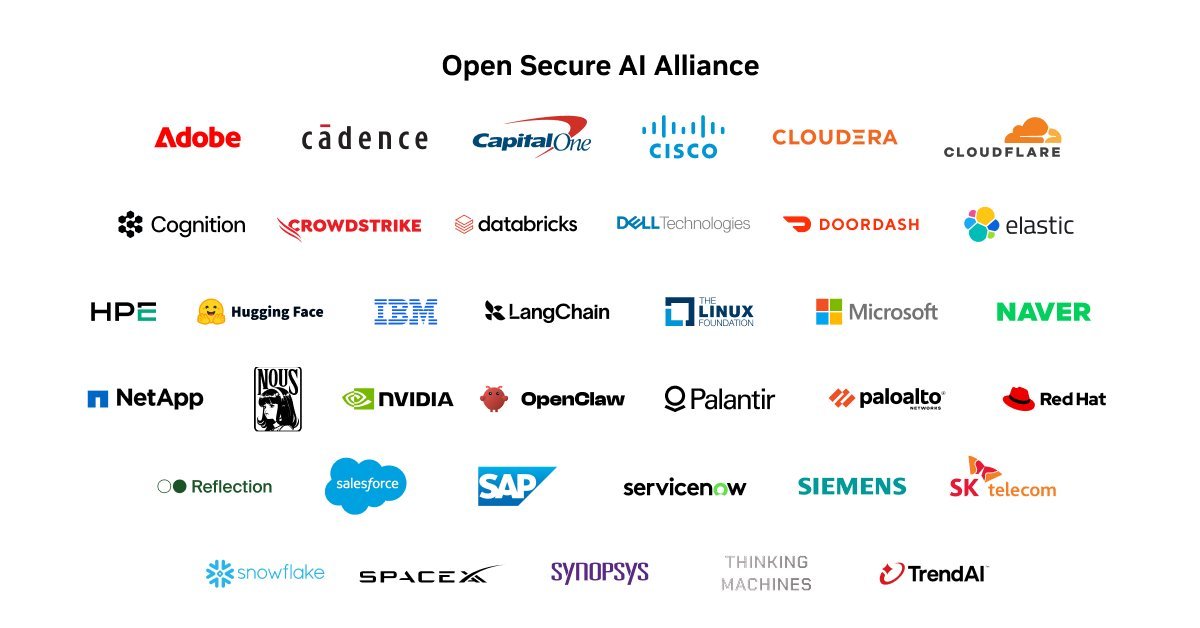
Now place that beside another headline: OpenAI, Google, and Anthropic are also missing from the newly launched Open Secure AI Alliance, while companies like Nvidia, Microsoft, Hugging Face, and others are pushing for more open collaboration on AI security. The contrast is striking. One conversation is about coordinating when to slow AI down. The other is about coordinating how to secure AI together.
That doesn't necessarily mean the frontier labs are contradicting themselves. They may genuinely believe that the most capable models require tighter control while still supporting stronger governance. But it also reveals a growing split inside the industry: open ecosystems argue that transparency improves collective defense, while closed-model leaders worry that openness can accelerate dangerous capabilities. Both sides claim they're optimizing for safety—they just define the path differently.
The next chapter of AI may not be defined by who builds the smartest model first. It may be defined by who gets to decide when AI is "too fast," and who can verify that everyone else is slowing down too. That feels less like a technical challenge—and more like the beginning of a new geopolitical protocol for intelligence.
https://t.co/6X4T2eUhxc
The most interesting AI story this week isn't who joined the new Open Secure AI Alliance. It's who didn't.
OpenAI, Google, and Anthropic are all missing, while Nvidia, Microsoft, Hugging Face, IBM, and dozens of infrastructure companies signed on. That absence says as much about today's AI landscape as the alliance itself.
Think of it like a neighborhood building a shared fire department. Most of the residents show up with hoses and ladders. The companies making the most advanced "engines" decide to stay outside. That doesn't automatically make them wrong—but it does raise questions about how AI security should be built.
To be fair, the incentives are very different. Open-source ecosystems thrive on transparency and shared tooling. Frontier AI labs compete on proprietary models, restricted access, and closely guarded research. From a business perspective, joining an alliance centered on openness is a far more complicated decision than it first appears.
Still, perception matters. When a security alliance forms after a high-profile AI security incident, and many infrastructure companies participate while the biggest closed-model labs remain absent, the public narrative almost writes itself—even if the real reasons are more nuanced.
Maybe the future won't be "open AI" versus "closed AI." Maybe the real challenge is figuring out how both can cooperate when security affects everyone. The next chapter of AI may be decided less by who builds the smartest model—and more by who is willing to defend the ecosystem together.
What if the shovel seller didn't just sell to you, but guaranteed your mortgage to buy the whole goldmine?
Nvidia is in talks to provide a massive $250B financial backstop for OpenAI’s planned mega data center in Ohio.🤔
The site is poetic: a former Cold War uranium plant, now transforming into a 10-gigawatt AI campus by SoftBank. With total costs exceeding $500B, OpenAI needs heavy debt for its long-term lease, but lacks the credit rating to satisfy risk-averse lenders.
Enter Nvidia's balance sheet. By backing $250B in lease obligations—and discussing $350B more for chip financing—Nvidia steps in as guarantor. Lenders aren't betting on a startup anymore; they're betting on chip dominance.
The strategy is clear, but brings back a classic Wall Street debate: vendor financing. Nvidia guarantees the facility so OpenAI can build it, and OpenAI fills it with Nvidia GPUs. It secures Nvidia's pipeline, but tightly links supplier risk to buyer demand.
The AI buildout has officially outgrown traditional balance sheets. As compute ambitions reach nation-state scales, one question lingers: is this the ultimate financial flywheel, or an unsustainable circular loop?
🔗: https://t.co/Pde9YcwThW