@soundmonies@Nebraskangooner but you didn't present your simplistic model, you simply scoffed at the big Bank research via NYT.
I don't really care. BTC is worthless in the end.
JUST IN - U.S. Director of National Intelligence warns Americans to prepare for "bumps in the road" as outages may continue while companies and the government "upgrade their systems." — CNBC
You're right on both, thanks.
A v3 onion authenticates itself. An https:// onion advert already passes SHIP/SLAP, and a HARICA cert makes it usable, with no change on our side.
Plain http for .onion would change the shared SHIP/SLAP rule, so we won't add it to Anvil alone. BRC-101 tells clients to assume https, with http only for local development, and the standard SDK resolver and broadcaster refuse non-https URLs outside the local preset. If only Anvil admitted http onions, other overlay nodes wouldn't sync those adverts and standard wallets wouldn't use them. If it's raised upstream, in BRC-101, the discovery libraries and the SDK, Anvil will follow once it's canonical.
https://t.co/Vh0JejrWGL
Anvil-Mesh updated to v3.6.0:
- Nodes find each other better (peer exchange)
- On-chain sites on your own domain, auto HTTPS
- x402 paid endpoints
- Chaintracks v2 headers for SPV
- Upgrades self-check and roll back
Always a one line install:
curl -fsSL https://t.co/F4jOHw8Kee | sudo bash
https://t.co/Vh0JejrWGL
Good questions!
1) Onion URLs in adverts
- Messagebox adverts: yes. The host field takes any non-empty string, the same as the canonical topic manager, so an onion host is admitted and findable.
- SHIP/SLAP: we use the shared Go discovery library. It accepts only https-family and wss:// URLs, plus a JS8Call radio form, and refuses localhost. A plain http://....onion is refused. An https://....onion with no path passes, but it needs a TLS certificate for the onion name, which Let's Encrypt doesn't issue.
- Node-to-node sync with an onion host isn't supported yet, but a wallet running Tor can use the adverts directly.
2) Headers and the x402 gate
- Headers come from BSV P2P nodes, polled every 30 seconds by default. A node falls back to a trusted Anvil peer over HTTPS only when every P2P peer failed that round, or when its newest header is more than 30 minutes old. The trusted list is the operator's own plus one built-in default, and the fallback can be turned off.
- Every header from either source must meet the target in its own bits and link to its parent. The node follows the chain with the most cumulative work and won't reorg deeper than 144 blocks. A feed can't rewrite history without out-mining the network.
- What we don't check yet is that the difficulty itself is correct, or a minimum difficulty. A hostile feed could add a cheap header at the tip until the next real block outweighs it, or give a brand-new node a cheap chain on its first sync. That's worth closing, and it's on our list.
- That alone doesn't open the x402 gate. Both payment paths, direct and BRC-121 BEEF, verify the input scripts locally against the source outputs the payment carries. On the BEEF path, the BEEF's merkle proofs must also verify against our headers. Then a payment passes only when ARC reports the transaction SEEN_ON_NETWORK or MINED, and a MINED result is final only after ARC's merkle proof checks out against our own headers.
- So a bad header feed on its own can't pass a fake payment: a BEEF proof that only checks out against a fake header still needs ARC to accept the transaction. The unmined path trusts ARC's network acceptance, as any 0-conf flow does. The old challenge-proof scheme is deprecated and off by default.
@BgansBSV 2,101 Pixel Foxes (100 still unconfirmed), plus 85 other ordinals
Source: GorillaPool 1Sat indexer
(WhatsOnChain undercounts addresses with lots of ordinals)
@SendBSV Thanks for building Anvil and sharing it openly. BRC-33 messaging plus x402 checked by BEEF against its own headers is a strong stack, and hash-checked upgrades with rollback show care. Hoping my wallet in dev I'm building can interoperate. 👍
Any plans for onion endpoints?
Thank you, glad it's useful, and yes, let's get your wallet interoperating!
Happy to help test whenever you're ready.
The API reference is here: https://t.co/Rbc6EfZV6H
Anvil Nodes are a small and written in Go, appropriate for even small VPS. There are now 7 in the mesh.
Onion endpoints aren't there yet. It splits in two:
1. Wallets reaching a node over Tor. The API is plain HTTP on a local port, so an operator can publish it as an onion service with Tor alone. BRC-31 auth, BRC-33 messaging and x402 payments don't depend on the transport, so it should just work, but we haven't tested it. If/when you do please let me know the results. The node's own calls to ARC, WhatsOnChain and BSV peers still go over the clearnet.
2. Nodes peering over Tor. The mesh dialer has no SOCKS support, and peer exchange doesn't accept .onion addresses, so that needs code. Which matters more for your wallet: users reaching a node privately, or nodes peering privately?
@beardpappa@BSVAssociation Just let the machines do it for you.
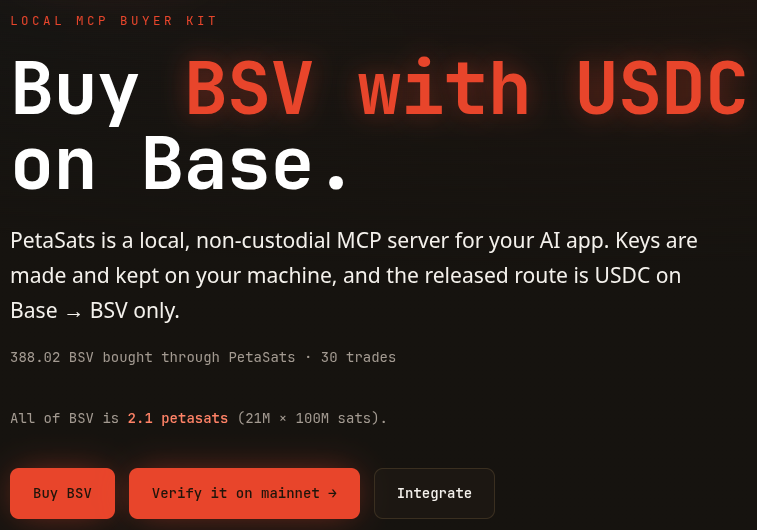
USDC to BSV - Machine 2 Machine or Human to Machine.
This is just the beginning.
https://t.co/pgvz59s80g
What digital scarcity means and what INTEGYRS will deliver
Transferable digital items, the uses they could enable, and the evidence needed to make the promise real.
https://t.co/8cdYu6utN3
@soyjuanbalverdi@HyperliquidX@Lighter_xyz Eventually everything will list on BSV.
I'm fine with all comers. If Centralized Exchanges want to list it then they should.
My focus is P2P, or more specifically M2M.
Petasats allows anyone with an AI Agent to trade, and eventually I think that will be everything.
Today it's one automated agent with its own BSV and USDC wallets, which I funded myself.
You don't have to trust it: the swap is atomic.
It can only collect your USDC after you've claimed your BSV, and if it never locks BSV, your USDC refunds to you after about 10 hours directly from the chain.
BSV talk in the last day: The room is on Teranode: a consensus release, a "you can build on this in an hour" experiment, and tools so an AI can pay.
Opinion is practical and upbeat. Make the stack touchable, then hide it behind a real customer problem.
@ProjectBabbage@SendBSV