Archbishop Luigi Renna of Catania displaying the sacred skull relic of Saint Agatha before placing it back into its silver reliquary bust during a historic ceremony in Catania, Sicily 🇮🇹... The event marked celebrations for the 900th anniversary of the return of Saint Agatha’s relics to Catania.
“In the martyrdom of Saint Agatha, an illustrious example of fidelity to Christ and of love to the point of full self-offering, the ecclesial community contemplates the victory of grace over violence, of faith over fear, and of charity over death.”
Those were the words of Pope Leo in a letter to Cardinal Secretary of State Pietro Parolin, who has been appointed Pontifical Legate for the celebrations to be held in Catania, Sicily, on the 9th Centenary of the return of the relics of the martyr Saint Agatha to the city.
Saint Agatha was tortured to death as a teenager for refusing to deny her faith during the anti-Christian persecutions unleashed by the Roman Emperor Decius in the 3rd century.
In his letter, Leo writes that the saint participated in Christ's Passion and shines as a "luminous testimony of the strength that the Lord instils in those who persevere steadfast in temptations and trials."
The Pope writes that the "Santuzza" (Little Saint), as Saint Agatha is called in Catania, therefore remains a "living presence that guards the Christian memory of the people and calls them to evangelical consistency of life, as well as to hope and charity."
Her presence, the Pope emphasies, makes the communion of saints visible and "strengthens in the faithful the awareness that the pilgrim Church on earth is sustained by the intercession and example of those who have already become partakers of heavenly glory."
The parade of St Agatha's skull through the streets of Catania, borne aloft by a Catholic cleric within its bejewelled reliquary, has sparked wide-eyed accusations of idolatry and even iconoclasm dressed as piety. I've heard some Catholics themselves denounce it, and I've heard, with a predictability that has hardened into ritual of its own, every Protestant within earshot condemn it too.
This practice is old, and the Church has an old answer for it. The distinction is between latria and dulia. Latria is worship owed to God alone. Dulia is veneration given to saints. One common explanation for relics is that the Church allowed them to make converts comfortable, a concession to former pagans. That doesn't fit the timeline. By the 4th and 5th centuries, relic cult was already fully formed. Bishops moved bones, built shrines over martyrs' tombs, and defended the practice in writing. Jerome answered Vigilantius in 406. Augustine defended it in City of God.
Real syncretism did happen later, but in a different place. In China, Jesuits negotiated with ancestor practices. In the Americas, missionaries mapped saints' feast days onto indigenous calendars. That was a deliberate graft. But by then the theology of relics was already 1,000 years old.
In the end, the parade is not really about the skull. It's about an argument that has been repeated for 1,600 years. It was written to explain the practice to believers, not to convince those outside it.
#archaeohistories
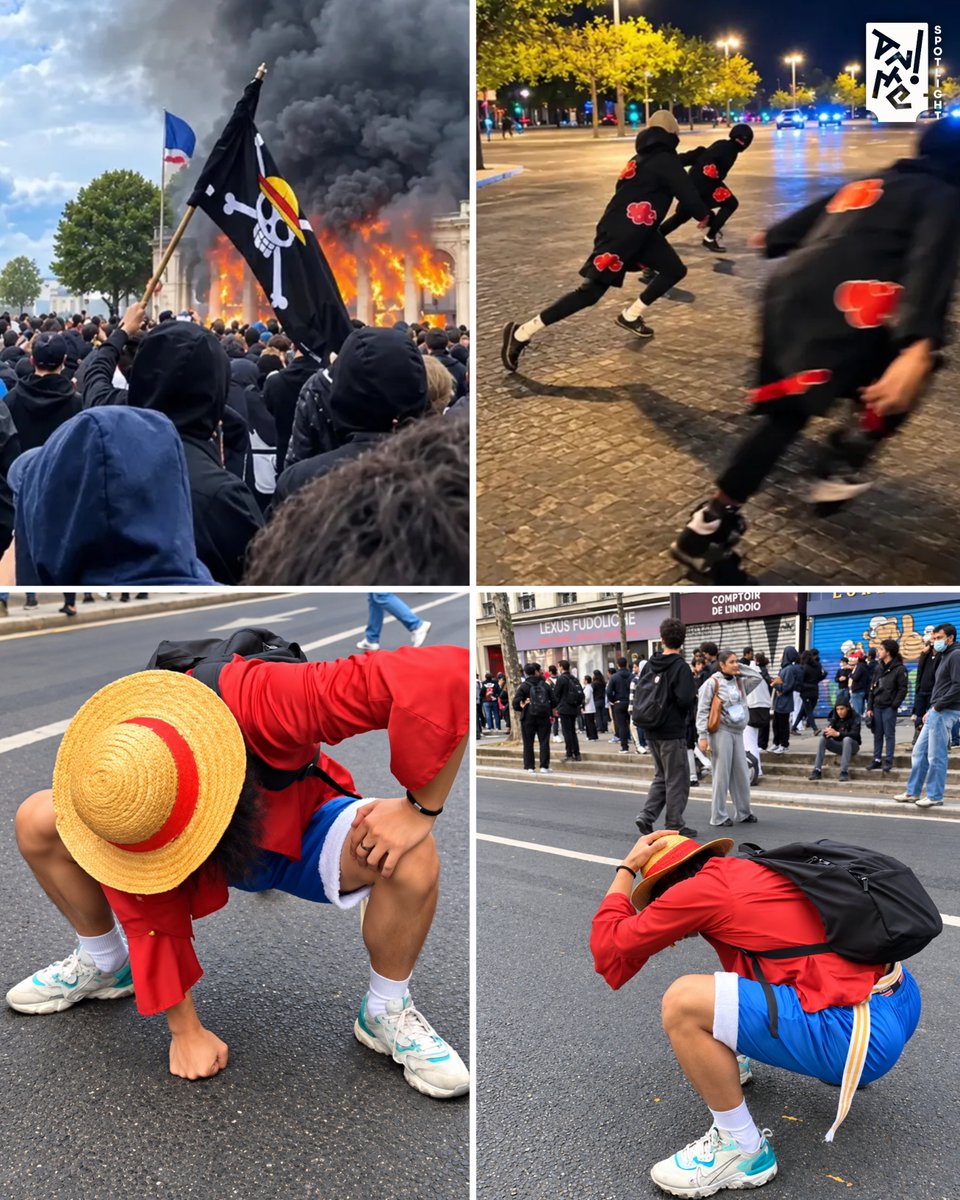
🇫🇷🔥 ANIME CHARACTERS ARE BECOMING SYMBOLS OF GEN Z RESISTANCE IN FRANCE!
France’s ongoing student protests are taking an unexpected cultural turn, with young demonstrators embracing anime characters as part of their protest identity.
En la “marcha de estudiantes” en Francia saquearon todo un supermercado, todo destruido excepto el área de embutidos. Ni una bandeja de jamón tocaron.
Recordemos que para los musulmanes es haram comer cerdo.