“Is this behaviour moving you closer to what you want or further away?”
What a powerful question.
Courtesy of @shaneparrish in his new book #ClearThinking
"I don't care what field you're in, you should be playing with this stuff. It has the potential to impact your role in your career, and the best way to protect against any risk of your career being obfuscated or eliminated from AI is to be the most AI-enabled version of yourself you can possibly be." — @bgurley
Imagine having a personal tutor that perfectly understands your unique set of talents, your learning style, and your potential, and then accompanies you—and only you—throughout your ENTIRE student life.
Unprecedented. This is how you use AI. To bring out the best in humanity.
The story no one is talking about is Elon is entering the AI chip race in a major way.
Three weeks ago he posted that Tesla expects to “build chips at higher volumes ultimately than all other AI chips combined.” He added: “Read that sentence again, as I’m not kidding.”
Now he’s saying AI5/AI6 engineering is his biggest time allocation at Tesla. The CEO of a company that makes 2 million vehicles a year is spending most of his time on semiconductors.
For context on what “all other AI chips combined” means: Nvidia shipped roughly 3.5 million data center GPUs last year. Google has deployed TPUs for a decade and just signed a tens-of-billions deal with Anthropic. AWS announced Trainium is now a “multi-billion dollar business” with over 1 million chips deployed. Microsoft is building Maia. Meta has MTIA. OpenAI just partnered with Broadcom.
Musk is saying Tesla will outproduce all of them. Together.
The math comes from distribution. Every Tesla vehicle needs an inference chip. Every Optimus robot needs one. Every Cybercab needs one. When you’re targeting millions of robots and millions of robotaxis, you hit volumes that dwarf what hyperscalers need for data centers.
Tesla’s AI5 chip, nearing tape-out, is designed for this scale. Musk claims 10x the performance per dollar versus Nvidia Blackwell for inference, at one-third the power draw. The 250W target matters for Optimus specifically. The robot runs on a 2.3kWh battery. At 500W, the brain drains it in under 5 hours, leaving nothing for motors. At 250W, you get a full 8-hour factory shift.
The manufacturing strategy shows how serious this is. Samsung and TSMC are both producing AI5 at US fabs. Samsung’s Taylor, Texas facility got a $16.5 billion contract for AI6. Musk is already talking to Intel about capacity.
Even with three foundries, he says it won’t be enough. He floated building a “TeraFab” producing 100,000 wafer starts per month, scaling to 1 million. TSMC’s entire global operation does about 1.4 million monthly.
The annual cadence tells the same story. AI5 hits volume in 2027. AI6 targets mid-2028. AI7 already in planning. This mirrors Apple’s A-series rhythm, but Apple ships 200 million iPhones. Tesla is planning for millions of robots.
Then there’s space.
Musk confirmed SpaceX will build orbital data centers using Starlink V3 satellites with terabit capacity and laser links. Launches start 2026. Google just announced Project Suncatcher, putting TPUs on solar-powered satellites. Bezos predicted gigawatt-scale space data centers within 10-20 years.
The convergence: Tesla designs inference chips. SpaceX launches satellites that host them. xAI builds models that run on them. Starlink provides connectivity. The entire stack is Musk-controlled.
AI5 will be good. AI6 will be great.
Elon is building a vertically integrated AI chip empire while everyone still thinks Tesla is a car company.
Grok for Education: xAI is thrilled to announce a partnership with El Salvador and @nayibbukele to bring personalized Grok tutoring to every public-school student in the country — over 1 million children. The world’s first nationwide AI tutor program. https://t.co/SB1CCwDLfQ
THE PHYSICS OF MONEY JUST CHANGED FOREVER
For 10,000 years, humanity faced one impossible problem: Energy cannot be stored. Energy cannot be transported. Energy dies the moment it is born unused.
Until now.
Jensen Huang, CEO of the $4.5 trillion company that powers artificial intelligence, just stated what changes everything:
“Bitcoin is taking excess energy and storing it as a new form called currency. You take that currency wherever you’d like. You took energy from one place and transported it everywhere.”
Read that again.
The numbers are staggering.
In 2024 alone, Texas was forced to throw away 8 terawatt hours of wind and solar energy. Brazil discarded 28 terawatt hours in eight months. Globally, over $20 billion in clean energy vanishes annually because grids cannot absorb it.
Bitcoin mining now consumes 211 terawatt hours per year. 52.4% from renewable and nuclear sources. Miners co-locate at stranded energy sites, converting worthless surplus into globally transferable value.
This is not digital gold. This is something physics has never permitted before.
For the first time in human history, energy has become portable. Joules transformed into hashes. Hashes settled into satoshis. Satoshis moved across borders at the speed of light.
The sun sets in Arizona. That captured sunlight arrives in Tokyo as money.
Wind dies in West Texas. That momentum resurfaces in London as settlement.
Critics said Bitcoin wastes electricity. The man whose chips process most of the world’s AI workloads just told you the opposite: Bitcoin is the battery that never existed. The transmission line that needs no wire. The export of energy without the tanker.
The implications are civilizational.
Stranded renewables become profitable. Remote regions become energy exporters. The economics of electricity generation inverts permanently.
Energy is no longer trapped.
Energy is now free.
The Doorman Fallacy
'You have a five-star hotel and it has a doorman, welcoming incoming guests.
McKinsey or Accenture will come in and say, “Your doorman currently costs you X thousand dollars a year. We have defined his or her function as opening the door. We’ll replace said doorman with an automatic door-opening mechanism and an infrared human detector and we’ll save you $30–$40,000 a year.”
They walk away, and they take the credit for the cost savings. Two years later, the hotel’s a catastrophe ... because the doorman was doing multiple things, many of which were human and kind of tacit.
Security would be one; there are no vagrants asleep in the doorway. Hailing taxis, dealing with luggage, recognizing regular guests, providing status to the hotel—there are loads and loads of value creation components to that doorman which aren’t captured in the open-the-door definition."
It's easy to see the visible things, but the invisible things make the difference.
Until March, Saturn had 146 known moons, then astronomers discovered 128 new ones, bringing the ringed gas giant's total up to 274 moons—far beyond any other planet in our Solar System.
This is the coreography of their dance.
[🎞️ thebrainmaze]
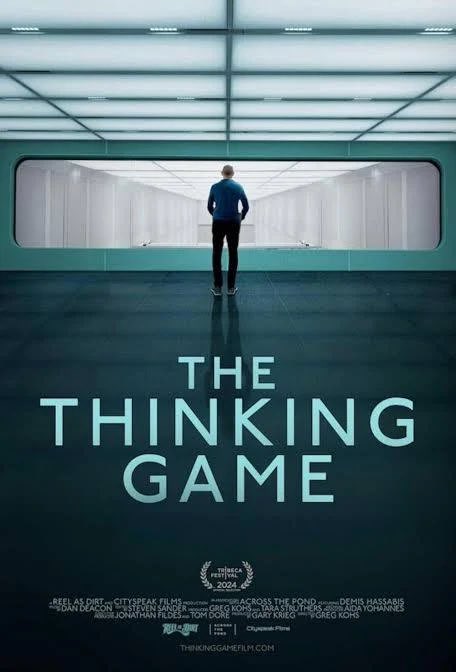
If you haven’t watched “The Thinking Game” yet, do it.
It’s a rare insight into legit genius, as it follows @demishassabis and @ShaneLegg from their earliest moments of prescience, through each of their world changing achievements (up to and including a Nobel).
They’re just really kind ppl too.
I stan ❤️