📍The Caha Pass, County Kerry, a scenic 27km stretch of the N71 road in southwest Ireland, connecting Glengarriff (County Cork) and Kenmare (County Kerry) through the Caha Mountains 🇮🇪⛰️
📸 My heart is in Ireland
#Kerry#Cork#Ireland#Kenmare#Mountains#Cahapass
Speaker Impedance and Amplifier Loading
A guitar speaker marked 8Ω does not present a constant 8Ω load. Impedance combines resistance and frequency-dependent reactance, continuously changing across the audio spectrum. These variations influence amplifier power delivery, frequency response, distortion and electrical damping.
A multimeter measures DC resistance rather than nominal impedance. An 8Ω speaker commonly measures 5.5-7.2Ω. Its impedance rises substantially near mechanical resonance, decreases through the midrange and rises again at higher frequencies due to voice coil inductance. Cabinet construction modifies this behavior.
Cabinet wiring determines the combined electrical load. Series-connected impedances add, while identical parallel-connected impedances divide by the number of speakers. Two 8Ω speakers wired in series produce 16Ω; in parallel, 4Ω. Four 8Ω speakers wired series-parallel produce 8Ω.
In conventional tube amplifiers, the output transformer reflects speaker impedance into the power tube circuit according to the square of its turns ratio. A transformer designed for a 4,000Ω primary load with an 8Ω speaker reflects 2,000Ω with a 4Ω load and 8,000Ω with a 16Ω load on the same output tap.
These changes can affect power-stage distortion, headroom, harmonic content and component stress. Lower-than-specified loads can increase current stress, while higher loads can increase voltage stress. Neither mismatch direction is universally safe.
Conventional solid-state amplifiers generally tolerate higher load impedances but deliver less maximum power. Loads below their specified minimum can cause excessive current, overheating or output-stage failure.
For guitarists, speaker selection involves more than wattage, sensitivity and acoustic character. Different speakers with identical nominal impedances can interact differently with an amplifier, particularly tube designs with relatively high output impedance.
Verify cabinet wiring, combined extension cabinet impedance, power handling and amplifier output settings. Always use speaker cables and follow manufacturer loading specifications.
Sources:
Celestion - Speaker Wiring
https://t.co/2qF4YTYWWM
Aiken - Output Transformers
https://t.co/EojIj2is8z
Imagine you’re having a quiet jar in your local tavern when the door bursts open and a gang of armed men storms in. No warrants, no warnings, then suddenly they surround you. By the time you lower your pint to the counter, you’ve be clubbed across the skull, shackled, and bundled aboard a ship bound for God knows where. Congratulations, you’ve just been "impressed" into the Royal Navy!
This was not a rare event in 18th-century Ireland. It was actually state policy by the most "civilised" empire in the world. Legalised kidnapping by Press Gangs, aka the British Navy’s Impress Service.
These thugs were tasked with keeping ships crewed during Britain’s endless wars. Life at sea was an unappealling occupation, even for those loyal to their war-mongaring monarachs. Low pay, disease, flogging, and death equally likely by friend or foe meant few volunteered. So they took boys and men by force.
Impressment had a shaky legal footing, rooted in the Crown’s so-called right to commandeer the bodies of its subjects for national defence. Over time, Parliament tried to regulate the chaos via formal "Acts." But in reality, in the colony of Ireland, things were simpler. If you looked strong enough to climb a mast, you were fair game.
Port cities like Dublin, Cork, Waterford, and Belfast were prime hunting grounds. The gangs were led by naval officers to offer a veneer of authority and backed by armed sailors. They raided taverns, boarding houses, and even family homes. There is some debate about how often they actually offered the “King’s Shilling”, basically a coin as a deceptive symbolic gesture of consent.
While trained sailors were top targets, plenty of labourers, apprentices, and landmen were swept up to meet quotas. In theory, there were exemptions for clergymen, apprentices, or officially recognised responsibilities. If you were a reasonably fit young bloke living in coastal Irish communities during these perilious times of the empire the risk of kidnapping by the Press Gang was a factor of life.
Families hid sons, communities mounted resistance, and riots broke out. Imagine the boys and men in your life just vanished. Leaving holes in families but also in the local economies. With men as the breadwinners and no way of their new wage getting from the navy to the mouths of their wives and children, kids starved. Desperate women fell into prostitution or forced marriage just to survive.
And always, us Irish were seen as expendable. Fit to row and bleed, kill or drown for an empire that saw Paddy as little more than fodder for their expansionist tendancies. It wasn’t until the end of the Napoleonic Wars in 1815 that impressment began to die out.
Economics and education replaced it mostly by voluntary enlistment and, eventually, more humane recruitment methods. But the legend of “The King’s Shilling" as something accepted at the end of a cutlass remains.
Happy #SuhrSunday! This is my @SuhrCustom Classic S Metallic 2020 Limited Edition in Indigo, now available only through the Custom Shop. It's a shred monster through and through. I love this superstrat!
@Iromg Hi Mike. Spider Stacy from the Pogues here. I’m the one who called your mate Lawrence Fox a Herrenvolk shite on the Pogues twitter account. You’ve been blocked because you’re a soulless right-wing cretin, simple as that. Now fuck off like a good little maggot 🤡
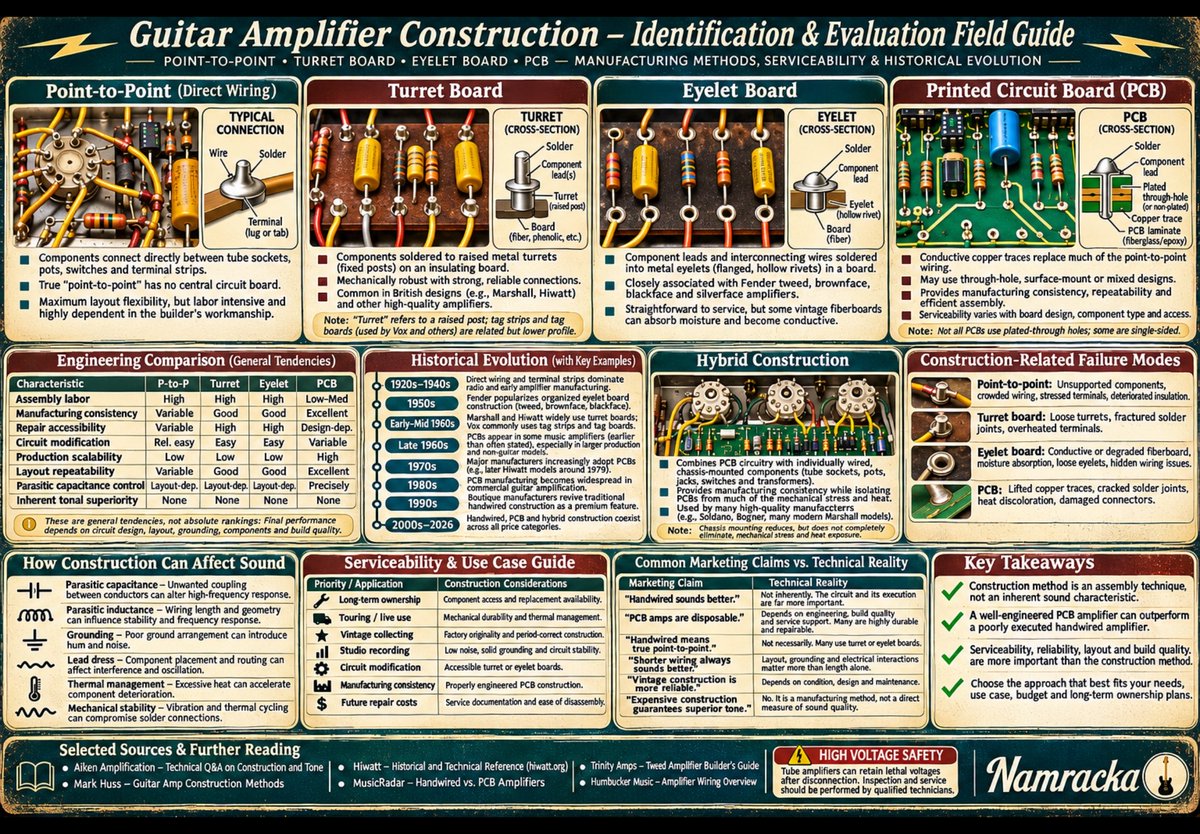
Guitar Amplifier Construction - Point-to-Point, Turret Board, Eyelet Board and PCB
Amplifier construction determines how electrical components are mounted, interconnected and serviced. It influences manufacturing consistency, circuit stability, reliability and long-term ownership costs, but does not inherently determine tonal quality.
Point-to-point construction connects components directly between tube sockets, potentiometers, switches and terminal strips. Common in early radio and amplifier manufacturing, it provides considerable layout flexibility but depends heavily on workmanship and component placement.
Turret boards use raised metal posts secured to an insulating board. Associated with vintage Marshall and Hiwatt amplifiers, turrets provide mechanically secure connections, accessible solder joints and relatively straightforward component replacement.
Eyelet boards use hollow metal rivets as connection points. Fender extensively employed this method in its tweed, brownface, blackface and silverface amplifiers. Aging fiberboards can absorb moisture and develop unwanted electrical conductivity, contributing to noise and instability.
Printed circuit boards (PCBs) replace much of the interconnecting wiring with conductive copper traces. Increasingly adopted during the 1960s and 1970s, PCBs provide repeatable layouts, controlled component placement and efficient manufacturing. Repairability depends on board quality, accessibility and component mounting.
Hybrid construction combines PCBs with independently wired, chassis-mounted sockets, potentiometers and jacks, reducing mechanical and thermal stress on circuit boards.
For guitarists, grounding, lead dress, parasitic capacitance and component placement can influence noise, frequency response and oscillation. These characteristics matter more than whether an amplifier is advertised as handwired.
When purchasing a vintage amplifier, examine construction quality, previous repairs, originality, heat damage, component accessibility and replacement-part availability. A properly engineered PCB amplifier can outperform a poorly constructed handwired amplifier.
Construction is a manufacturing method, not a guarantee of superior sound.
Sources:
Aiken Amplification - Technical Resources
https://t.co/Q9BVDXjQ2w
Hiwatt - Historical and Technical Archives
https://t.co/IU9TFsysAY
Trinity Amps - Amplifier Construction
https://t.co/JDL2Vyck4T
"Trying to leave something behind" by Sean Rowe
This was used as the closing song to the original
movie The Accountant and the lyrics really struck me.
Forgive my version and hear the original.
This song hit me while attempting to sleep last night.
Open-Back Versus Closed-Back Cabinets
A guitar speaker cabinet is an acoustic component that directly influences frequency response, resonance, cone excursion, sound dispersion and perceived playing dynamics. Identical speakers installed in different enclosures can produce substantially different sounds.
Open-back cabinets radiate sound from both sides of the speaker cone. Because front and rear radiation are opposite in phase, partial cancellation occurs at low frequencies. The fundamental frequency of a guitar's low E string is 82.4 Hz, corresponding to a wavelength of 4.16 meters. This explains why cabinet dimensions and rear openings influence bass response.
Closed-back cabinets substantially isolate rear radiation. Enclosed air acts as an additional spring, increasing system resonance and restricting low-frequency cone excursion. Smaller sealed volumes increase air-spring stiffness, while larger sealed volumes reduce it. Greater bass punch does not necessarily indicate deeper bass extension.
Cabinet construction also changes the speaker's frequency-dependent electrical impedance, influencing its interaction with amplifier output impedance, damping factor, negative feedback and output transformers.
Open-back cabinets generally produce more diffuse sound, greater room interaction and spacious clean or moderately overdriven tones. Closed-back cabinets typically provide more concentrated forward projection, stronger bass definition and greater articulation during high-gain playing and palm muting.
For recording, open-back cabinets permit front and rear microphone placement, although polarity and arrival-time differences require consideration. Closed-back cabinets reduce direct rear radiation, facilitating acoustic isolation.
Convertible cabinets allow guitarists to compare both configurations using identical speakers and amplification.
Before purchasing, evaluate sustained chords, low-string articulation, palm-muted passages and off-axis response at realistic playing levels. Cabinet selection should be determined by the sound and playing response desired.
Sources:
Celestion - Cabinet Design
https://t.co/QzvK30H1iP
Jensen - Principles of Guitar Cabinets
https://t.co/7AB74yIfiM