Army Clarifies POW Status of 18 Cambodian Soldiers, to be Repatriated Once Conflict Ends
The Royal Thai Army has clarified the prisoner of war (POW) status of Cambodian military personnel in accordance with international humanitarian principles, affirming full compliance with obligations under the Geneva Conventions.
The Army stated that they will be released and repatriated to their home country once the armed conflict has fully ended (not merely upon a ceasefire).
On 4 August 2025, the Royal Thai Army issued a statement reaffirming its strict adherence to the 1949 Geneva Conventions in handling Cambodian personnel under its control.
The statement follows an armed clash between Thai troops and Cambodian forces in the Ban Sam Tae area, Kantharalak District, Sisaket Province, on 29 July 2025.
The incident occurred after Cambodian forces violated the ceasefire agreement and carried out an attack within Thai territory.
The Thai side was therefore compelled to respond militarily in an appropriate manner to halt the aggression and push Cambodian troops out of the area.
Following the clash, 20 Cambodian soldiers surrendered.
The Royal Thai Army disarmed and detained them in accordance with military procedures, while strictly adhering to international humanitarian standards at every stage.
The incident has attracted wide public attention, with continued dissemination of false and distorted information by the Cambodian side.
To ensure accurate understanding, the Army clarified that Cambodian soldiers who surrendered and are under Thai control have been legally recognized under international law as “prisoners of war” in accordance with the 1949 Geneva Conventions, to which both Thailand and Cambodia are States Parties.
The Conventions clearly stipulate that POW status arises when both parties are engaged in an armed conflict and those detained are members of the armed forces of the opposing state.
The Deputy Spokesperson of the Royal Thai Army further explained that the POW status is not intended as a form of condemnation, but rather as a recognition of the basic rights of individuals in armed conflict. These rights include:
• Protection from violence, torture, coercion, and medical or scientific experimentation;
• Humane treatment free from humiliation or inappropriate public exposure;
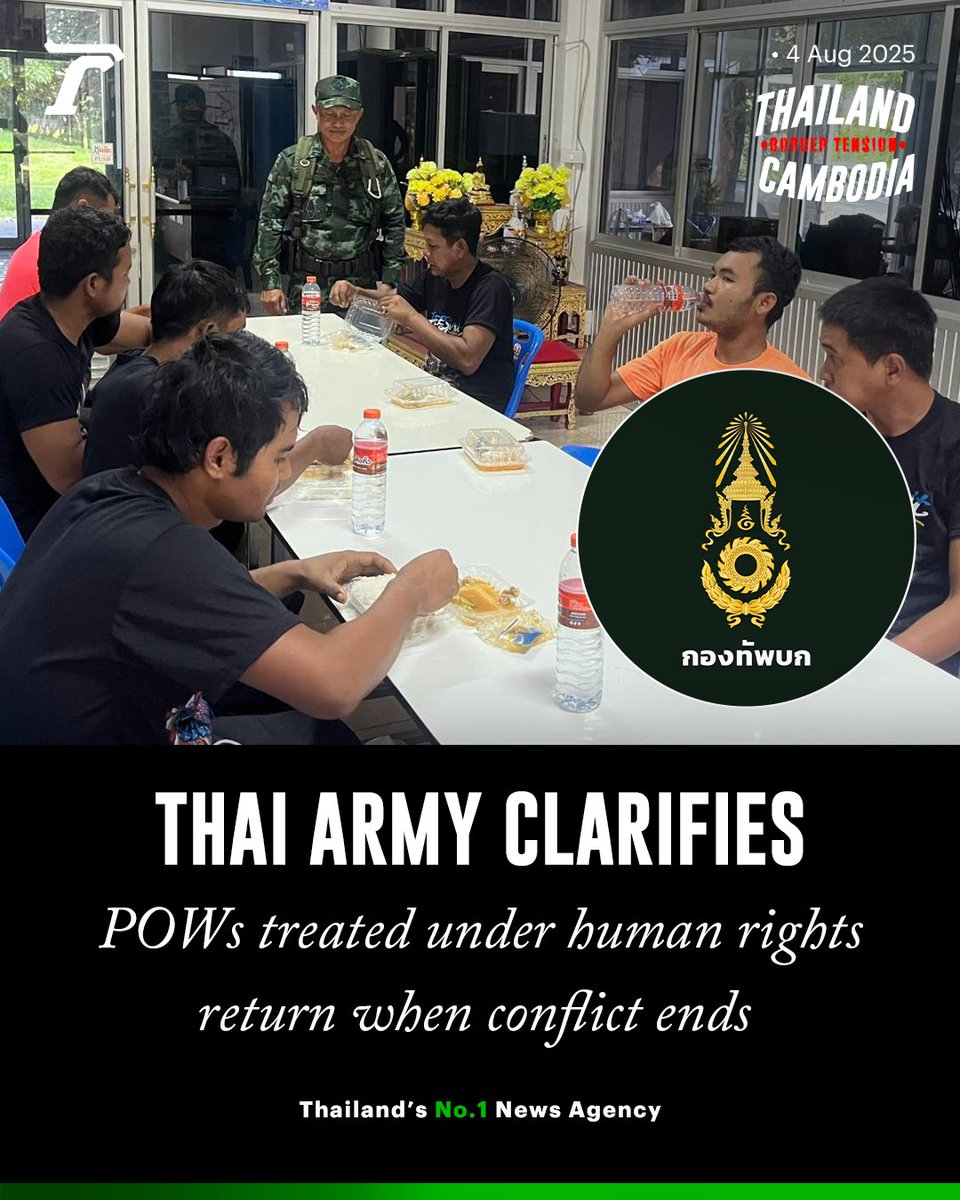
• Provision of essential needs such as food, drinking water, clothing, hygiene, and medical care;
• Prohibition against detaining POWs in facilities under the Criminal Code;
• The right to practice religion;
• Release and repatriation to their home country once the armed conflict has fully ended (not merely upon a ceasefire).
After taking them into custody, the Royal Thai Army moved all POWs from combat-risk zones to a safe area under the responsibility of the 2nd Army Region.
Basic needs such as food, drinking water, clothing, medical check-ups, and healthcare provided by medical teams have been arranged, and treatment has been in full compliance with the framework of international humanitarian law.
On 1 August 2025, the Royal Thai Army repatriated two wounded Cambodian POWs to their home country via the Chong Chom Permanent Border Crossing in Surin Province, after they had received medical treatment in Thailand until they were out of danger and safe to transport.
The remaining 18 POWs remain in Thai custody and will be repatriated once the armed conflict has fully ended, in accordance with the provisions of the Geneva Conventions.
The Royal Thai Army reiterates that “prisoner of war” is a legal status recognized under the framework of international humanitarian law, not a deprivation of human rights. Rather, it is a mechanism for protecting human rights in wartime.
The Army remains committed to the principles of human rights, the rule of law under international standards, and the obligations Thailand has undertaken as a State Party to the Geneva Conventions.
The Army also affirms its commitment to treating enemy personnel, as well as the deceased from the clashes, with strict respect for human dignity.