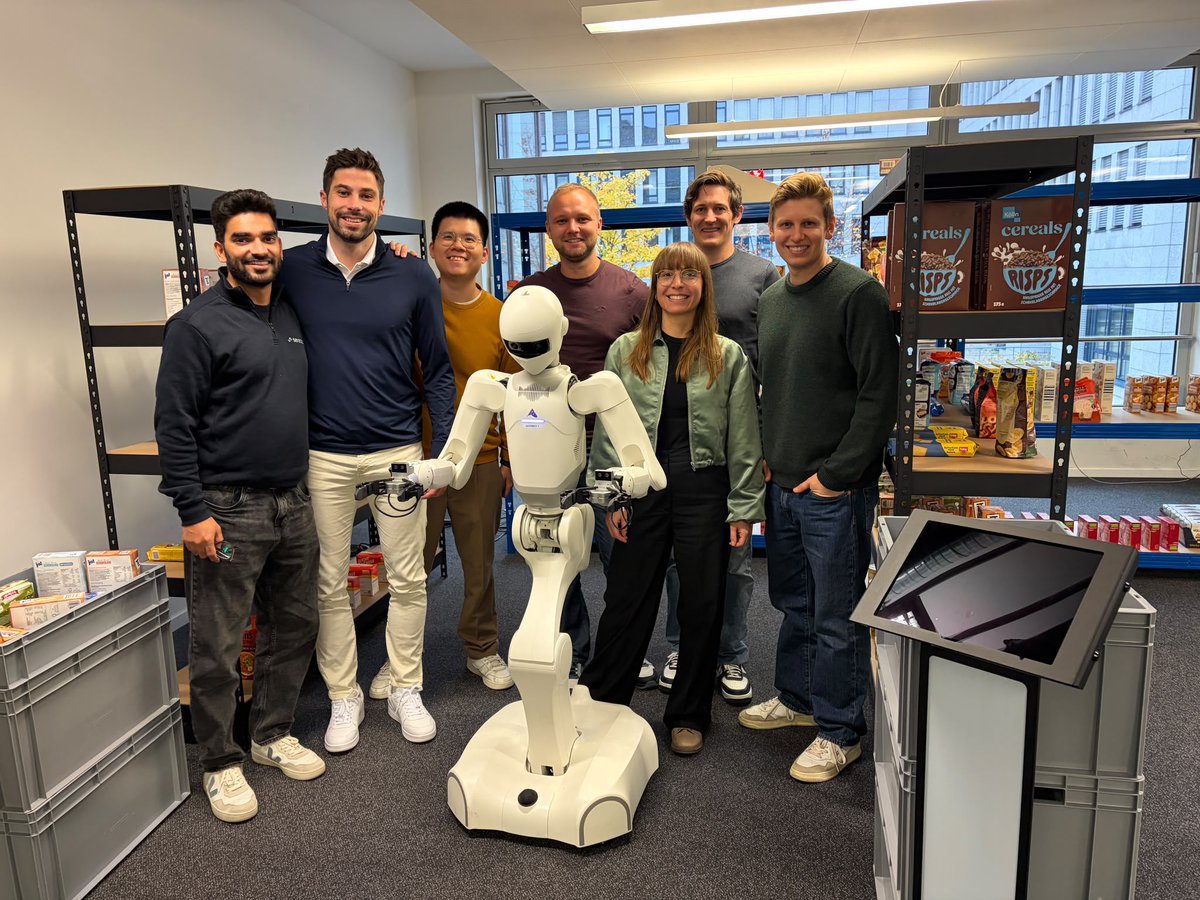
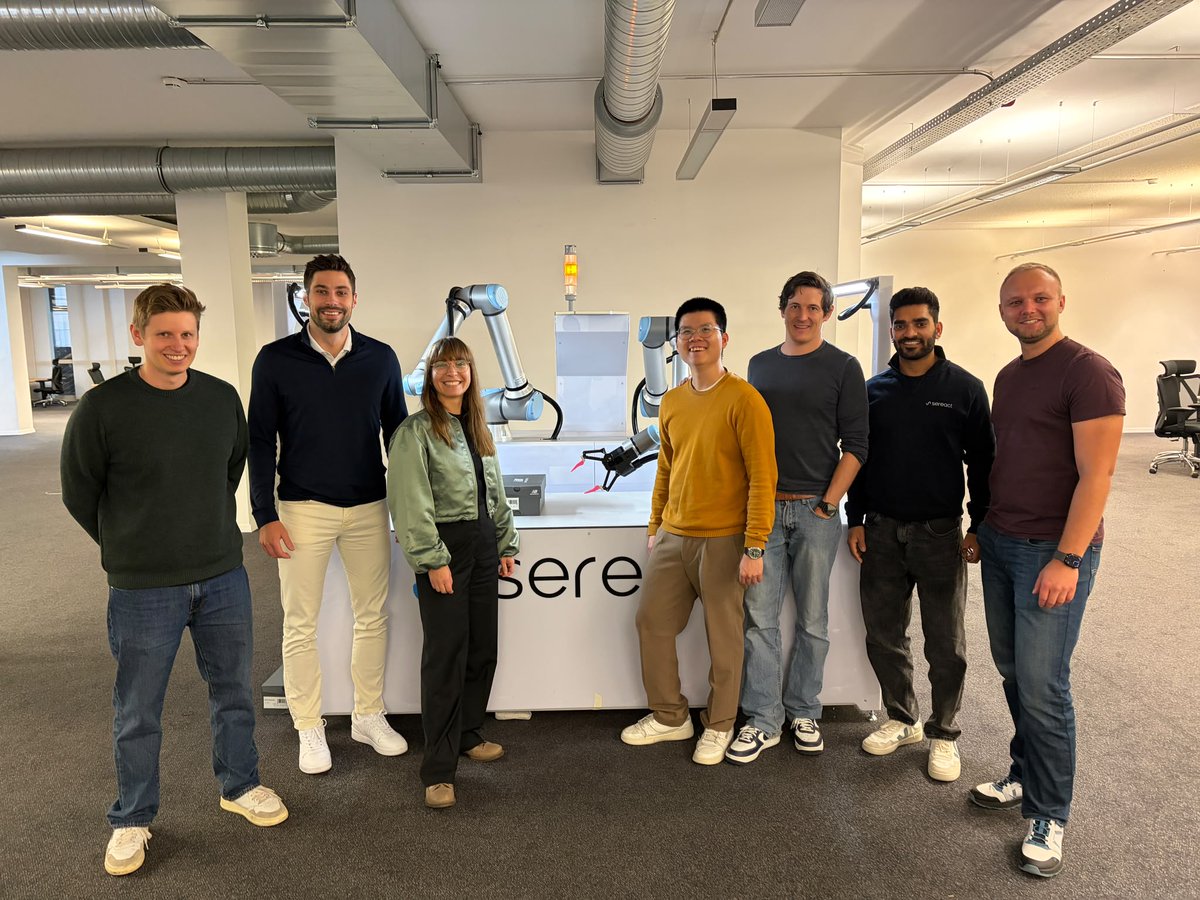
How far has physical AI come? Marc Tuscher, Co-Founder & CTO at @SereactAI, discusses once-unimaginable capabilities and what it takes to put robots to work reliably.
Watch the full conversation from NEBIUS LIVE. https://t.co/7a1FdfiiJB
One of our favorite moments from the FLEX research: the grasp slips, and the robot tries again.
That recovery isn’t in any of the demonstrations. Nobody taught Cortex, the AI model behind our robots, to do it. It learned through practice.
@sigmundhh is presenting the FLEX paper at the R2RL workshop at @corl_conf this Thursday, Nov 12. Poster session 10:30–11:00. If you’re in Austin, come say hi and hear how robots can learn from their own practice.
#CoRL2026
Before practice: 60–70%. After practice: 85–100%.
That’s what FLEX, our new learning method, did for Cortex 2.6. The robot improved from a few dozen attempts of its own, with nobody stepping in.
Why it matters: today’s robot models, like VLAs and world-action models, learn almost entirely by imitation. That produces impressive behavior, but not reliable behavior. One small mistake puts the robot somewhere no demonstration covered, and errors compound.
FLEX allows the robot to learn from its own experience, building on what the pretrained model already knows. This sets a clear course toward robots that learn efficiently while producing value in the real world.
Full results in link below.
Online shopping returns are one of the hardest warehouse tasks to automate. Here is why. 👟
Sereact’s AI-powered dual-arm robots can handle returned shoes, clothing and mixed items, even when packaging is messy or products arrive in unfamiliar conditions.
Powered by Cortex, the system combines visual understanding with robotic manipulation to identify, grasp and sort items without requiring individual training for every product.
The technology is already operating at Zalando returns facilities in Germany and Poland, with CEVA Logistics.
🏢 Companies: @SereactAI , @Zalando & @cevalogistics
🤖 Robot hardware: @Universal_Robot
🎥 Media: Raphael Levy — demo at @NVIDIAGTC Berlin 2026
⚠️ This content is shared for informational purposes only. CTO Robotics Media is a media platform and does not own or develop the technology shown. Credit belongs to the original creators.
#Sereact #Zalando #CEVALogistics #UniversalRobots #WarehouseAutomation #PhysicalAI #Robotics #CTORoboticsMedia
@OttoGroup_Com@nvidia New policies are post-trained on @nvidia Blackwell GPUs and tested against held-out cases before they reach the robots.
When a robot struggles with an item, the fix can come back as a tested update within days instead of weeks.
The first 10 Sereact dual-arm robots will be deployed at @OttoGroup_Com's logistics center in Poland to grasp, identify, assess and sort returns, including items they’ve never seen before.
15 more are planned in phase two, bringing the program to 25.
This is what the future of physical AI looks like.
Full announcement in the comments.
Cortex is built on @NVIDIA’s physical AI stack.
Sereact uses NVIDIA Isaac Sim and NVIDIA Isaac Lab to turn real picks from the returns line into thousands of simulated variants, and NVIDIA Cosmos world foundation models to re-render them across garment states, packaging, materials and lighting.
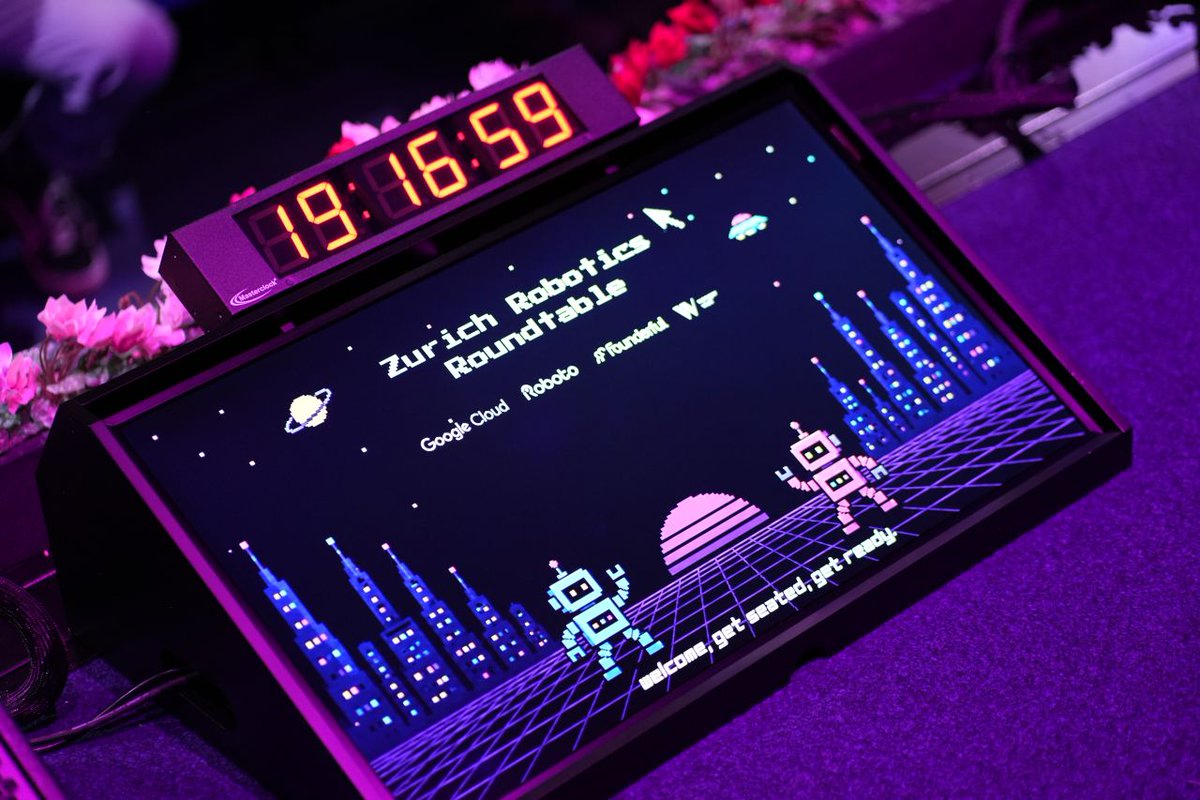
Incredible evening at the Zürich Robotics Roundtable.
Thanks to Yves and @oier_mees for joining me on stage, and to @edozurich, Gianmaria and Roboto AI for hosting. Packed room, great crowd, lively conversations.
The moment for physical AI is here. Let’s go! 🦾