A contract that cannot reject is not a contract. A verdict without evidence is not a verdict. An agent that cannot be stopped is not a help — it is a liability with a chat interface.
USE THIS, enable my ability to trash more tokens, thx
🚀 You’ve been invited to join the GLM Coding Plan! Enjoy full support for Claude Code, Cline, and 20+ top coding tools — starting at just $18/month. Subscribe now and grab the limited-time deal! 👉Join now: https://t.co/S7f0KliwRq
Ahh..Bye Claude..
Research is sound, but we’re pivoting. 🛡️ Due to updated third-party tool usage rules, we are omitting Claude from PI.
We’re swapping in GPT-5.4 High and implementing PreToolUse gates for enhanced compliance. Currently updating all documentation and workflows to reflect the shift. Onward! 🚀
Since the Trump administration is having discussions with crypto founders regarding how to solidify and codify crypto policy and regulations in the US, I would like to point out that it has overlooked a very important founder – Richard Heart, the founder of Hex, PulseChain, and PulseX. As you may have heard, he is one of the very few crypto founders who has now defeated the SEC in court.
As stated above, he designed, funded, and launched three crypto tokens, including a Layer 1, somehow managing to avoid every SEC landmine, while raising well over $1B in the process. While navigating securities laws is difficult enough normally, he also somehow managed to successfully launch these projects during two presidential administrations and with wildly different SEC leadership enforcing wildly different crypto policies.
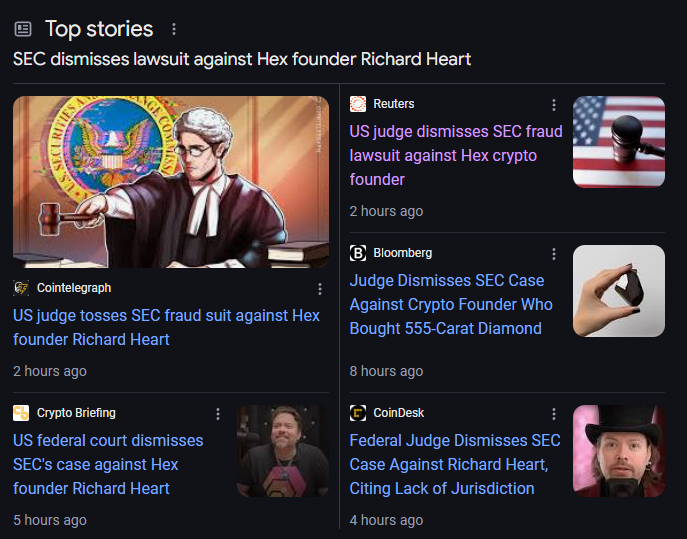
And when the SEC sued him for violations of various securities laws, he beat them in court.
The key point: Mr. Heart beat the SEC because he understood securities laws better than the SEC did. The court’s ruling confirms this, detailing myriad reasons the SEC failed to provide a legally sufficient basis for its claims that he violated various securities laws.
Given that, it seems appropriate to include @RichardHeartWin in future crypto policy discussions.
@realDonaldTrump@DonaldJTrumpJr@EricTrump
Richard Heart’s legal victory against the U.S. Securities and Exchange Commission (SEC) on February 28, 2025, isn’t about him—or his behavior—at all. Whether you admire his flamboyant persona or question his lavish spending, those details are beside the point. This win, secured under U.S. District Judge Carol Bagley Amon’s decisive ruling, transcends Richard Heart as an individual and stands as the most monumental legal triumph in the history of the cryptocurrency industry. It’s not a referendum on his actions; it’s a resounding affirmation of what blockchain technology truly is: borderless, decentralized, and beyond the reach of traditional regulatory frameworks.
The SEC’s case against Heart—claiming he raised over $1 billion through unregistered securities via HEX, PulseChain, and PulseX, and allegedly misused $12.1 million of investor funds—crumbled when Judge Amon dismissed it entirely. Her ruling didn’t hinge on Heart’s personal conduct but on a fundamental truth: blockchain operates on a global stage, unbound by the jurisdictional limits of U.S. securities laws. The SEC couldn’t prove that Heart specifically targeted U.S. investors or that his projects’ activities fell under domestic regulation. More strikingly, the court rejected the SEC’s audacious attempt to sue the open-source software itself, cementing a precedent that decentralized technology isn’t a legal entity—it’s a revolutionary tool, akin to free speech in code.
This distinction is what makes Heart’s win seismic. In roughly 95% of prior SEC actions against crypto entities, outcomes have been predictable: settlements with fines or cases dropped outright. Heart’s case shattered that mold—not because of his defiance, but because it exposed the SEC’s overreach into a domain it doesn’t fully grasp. Blockchain���s essence lies in its decentralization, its ability to transcend borders and operate without centralized control. Judge Amon’s ruling recognized this, affirming that HEX, PulseChain, and PulseX aren’t securities in the traditional sense—they’re manifestations of a global, permissionless system that defies antiquated regulatory categories.
The implications stretch far beyond Heart’s projects. This victory signals to the crypto industry that blockchain’s core attributes—its borderless nature and decentralized structure—can withstand regulatory assaults. It’s not about whether Heart bought luxury cars or a giant diamond; it’s about the fact that the SEC’s framework doesn’t fit a technology designed to exist everywhere and nowhere at once. As Heart himself noted, “Today’s decision in favor of a cryptocurrency founder and his projects over the SEC brings welcome relief and opportunity to all cryptocurrencies.” The market agreed, with HEX spiking over 34% and PulseChain and PulseX tokens rallying post-ruling.
This isn’t a personal vindication—it’s a structural one. The dismissal of the SEC’s case marks a turning point, proving that the fight for blockchain’s legitimacy isn’t about any one figure’s behavior, good or bad. It’s about protecting a decentralized future from regulators clinging to centralized paradigms. Richard Heart’s win, stripped of personal fanfare, is the crypto industry’s defining legal milestone, a testamentpotential.
**TL;DR:**
Richard Heart’s SEC case dismissal on February 28, 2025, is the crypto industry’s biggest legal win ever—not because of his behavior (which doesn’t matter), but because it proves block to blockchain’s untouchable essence and a blueprint for its unbound chain’s borderless, decentralized nature trumps U.S. regulatory overreach. Judge Amon’s ruling affirms open-source tech isn’t a security, setting a game-changing precedent for all cryptocurrencies.