Join our U.S. Stock Investment VIP Community:
https://t.co/4YRviuakXE
$SOXL: Do Not Mistake Short Covering for the Return of Institutional Confidence
One of the most dangerous mistakes investors can make after a market crash is assuming that every powerful rebound represents the beginning of a new bull run.
This is especially true for $SOXL.
After a major semiconductor liquidation, a leveraged ETF can rebound aggressively because its underlying stocks are extremely volatile.
But a rebound can have several different explanations.
It may represent genuine institutional accumulation.
It may reflect short covering.
It may be caused by options dealers adjusting their hedges.
Or it may simply be a temporary reaction after an unusually aggressive selling session.
These are very different market conditions.
The semiconductor leadership test
I would not evaluate $SOXL in isolation.
I would monitor the behavior of major semiconductor companies, including $NVDA, $AMD, $AVGO, $MU, and $INTC.
If these companies stabilize together, it would provide stronger evidence that the semiconductor market is recovering.
If only a handful of heavily shorted or speculative stocks rebound, the broader recovery may be much weaker than the headline ETF performance suggests.
Watch the volatility environment
The November 5 selloff demonstrated how quickly volatility can change.
When volatility rises, leveraged exposure becomes harder to manage.
A trader who buys $SOXL after a large decline may be correct about the eventual direction of semiconductors but still lose money if the recovery takes too long or arrives through a volatile sequence of gains and losses.
My View
I would prefer to see three conditions before becoming aggressively bullish:
Semiconductor leaders regain sustained buying interest.
Market breadth improves rather than depending on a few large companies.
Volatility begins to normalize.
$SOXL offers substantial upside in a favorable market, but it also punishes impatience.
The best opportunity is not necessarily the first rebound.
It is the recovery that demonstrates genuine demand.
#SOXL #TradingStrategy #AIStocks
$SOXL — Why Semiconductor Earnings Matter More Than the Next AI Headline
The sector can be right about AI and still be wrong about valuation.
Join Our U.S. Stock Investment VIP Community:
https://t.co/4YRviuakXE
The semiconductor industry has become one of the central beneficiaries of the AI investment cycle. But the market is beginning to face a more complicated question.
How much of the future growth is already reflected in stock prices?
That question is particularly important for investors trading $SOXL.
The fund provides three times the daily exposure to its semiconductor benchmark. Consequently, its performance is affected not only by the long-term direction of the industry but also by short-term volatility, earnings surprises, and changes in investor positioning.
Consider the difference between two scenarios.
In the first scenario, semiconductor companies report stronger revenue, improve margins, and raise capital expenditure plans because customer demand is exceeding expectations.
In the second scenario, companies continue reporting impressive AI-related revenue, but investors become concerned about financing costs, customer concentration, and the returns on enormous data center investments.
Both environments may contain positive AI headlines. Only one necessarily supports a durable earnings-driven rally.
That is why I would pay particular attention to semiconductor equipment orders, memory pricing, advanced packaging capacity, and the spending plans of hyperscale cloud providers.
The industry's long-term opportunity remains substantial, but expectations can become too optimistic.
For $SOXL traders, the key is to avoid confusing a strong industry narrative with a favorable entry point.
My preference is to see earnings confirmation and more stable market conditions before increasing leveraged exposure.
The goal is not to capture every rebound. It is to avoid being caught holding excessive leverage when the market changes direction.
#SOXL #AIStocks #RiskManagement
$NVIDIA: The AI King Is Facing a New Test — Can Growth Keep Outrunning Expectations?
What happens when the world's most important AI chip company continues to grow at an extraordinary pace, but investors are no longer satisfied with extraordinary results?
That is the question facing $NVDA.
For years, NVIDIA has been one of the clearest beneficiaries of the artificial intelligence boom. Its GPUs became essential infrastructure for companies building large language models, expanding cloud computing capacity, and developing increasingly sophisticated AI applications.
But the investment environment is changing.
The market is no longer asking only how many AI chips NVIDIA can sell. It is increasingly asking whether customers can generate enough economic value from those chips to justify the enormous amount of capital being invested.
That distinction could become extremely important over the next several quarters.
1. The Business Is Strong, but Expectations Are Even Higher
NVIDIA's second-quarter fiscal 2027 results demonstrated the extraordinary scale of its business.
The company reported revenue of $96.2 billion, representing 106% year-over-year growth. Data Center revenue reached $89 billion, up 117% from the same period a year earlier.
Management also provided third-quarter revenue guidance of approximately $108 billion, plus or minus 2%.
These are exceptional numbers by almost any traditional corporate standard.
However, investors should understand an important distinction: a company can deliver excellent financial results and still experience a disappointing stock reaction.
Why?
Because stock prices reflect expectations about the future, not simply the quality of the latest quarter.
When expectations become extremely elevated, even a strong earnings report may not be enough. Investors may demand stronger guidance, improving margins, and convincing evidence that demand can remain durable.
For NVIDIA, the challenge is no longer simply demonstrating that AI demand exists. It must demonstrate that demand can continue expanding at a pace that justifies its valuation.
2. The AI Market Is Expanding Beyond a Handful of Hyperscalers
One of the most interesting developments is the broadening of AI demand.
Initially, much of the infrastructure spending was concentrated among a relatively small group of major cloud providers and technology companies.
That created a potential concentration risk.
If a few major customers slowed their spending, NVIDIA's growth expectations could be affected.
But the next phase of AI adoption may involve a wider range of customers:
Large cloud computing providers.
Enterprise companies developing internal AI systems.
Sovereign AI projects funded by national governments.
AI research laboratories.
Industrial companies integrating AI into physical operations.
Smaller cloud infrastructure providers.
A broader customer base could make NVIDIA's growth less dependent on the spending decisions of a handful of technology giants.
It could also create new opportunities in networking, CPUs, and complete computing systems.
This is important because NVIDIA is no longer competing only as a supplier of individual graphics processors. Its competitive position increasingly depends on delivering an integrated computing platform.
That platform approach is one of its strongest advantages.
3. The Real Competition Is About Total Cost of Ownership
NVIDIA's competitive advantage is substantial, but it should not be treated as permanent or impossible to challenge.
Its software ecosystem, developer tools, networking technologies, and integrated hardware architecture create meaningful switching costs.
However, major technology companies have strong financial incentives to develop alternative solutions.
Custom AI chips, competing accelerators, and increasingly efficient inference architectures could gradually change the economics of the market.
The important question is not simply whether another company can manufacture a chip that competes with NVIDIA.
The more relevant question is whether customers can achieve a lower total cost per useful AI workload.
That includes:
Hardware acquisition costs.
Electricity consumption.
Cooling requirements.
Software optimization.
Data-center utilization.
Performance per dollar.
Long-term operating expenses.
If competing solutions become sufficiently attractive, customers may diversify their infrastructure.
That does not necessarily mean NVIDIA loses its leadership position. It means its pricing power and market share will face more serious scrutiny.
Investors should watch this competition carefully rather than assuming that today's market structure will remain unchanged.
4. The Biggest Risk May Come From AI Economics, Not Chip Demand
There is a difference between companies purchasing AI infrastructure and companies generating sustainable returns from that infrastructure.
Technology companies can continue increasing capital expenditure for several quarters. But eventually, shareholders will want to see measurable financial returns.
Are AI products generating additional revenue?
Are enterprise customers willing to pay for AI services?
Are productivity improvements translating into higher operating margins?
Can cloud providers maintain attractive returns on their infrastructure investments?
These questions matter because the AI industry is becoming increasingly capital-intensive.
If AI monetization develops more slowly than infrastructure spending, investors may begin questioning the sustainability of current investment levels.
That could create pressure across the entire AI supply chain, including semiconductor manufacturers, server companies, networking providers, and data-center operators.
NVIDIA may be one of the strongest businesses in this ecosystem, but it is not completely insulated from a slowdown in customer investment.
5. November 17 Could Become an Important Market Catalyst
NVIDIA's next quarterly earnings report is scheduled for November 17, after the market closes.
This report deserves attention because investors will be looking beyond headline revenue and earnings.
I would focus on five areas:
First: Revenue guidance. Is demand continuing to accelerate, or is growth beginning to normalize?
Second: Gross margins. Can NVIDIA maintain its strong profitability while transitioning to increasingly complex computing systems?
Third: Data Center demand. Are major customers continuing to expand their infrastructure commitments?
Fourth: Product execution. Can NVIDIA deliver its next-generation platforms on schedule and at commercial scale?
Fifth: Customer returns. Is AI spending translating into meaningful economic value for the companies purchasing its products?
A strong report could reinforce confidence in the AI infrastructure cycle.
But if management delivers results that are merely in line with already elevated expectations, the market could still react negatively.
That is the risk of owning a high-expectation stock.
6. What Could Go Wrong for NVIDIA Investors?
Despite its competitive advantages, I see several risks that deserve attention.
Valuation risk: Even excellent earnings growth may not protect the stock if investors decide its valuation already reflects too much future success.
Capital expenditure risk: If major cloud providers reduce spending or delay infrastructure projects, the entire semiconductor ecosystem could feel the impact.
Competitive risk: Custom accelerators and alternative AI architectures could gradually reduce customer dependence on NVIDIA.
Regulatory and geopolitical risk: Export restrictions and international technology policies could limit access to certain markets.
Execution risk: As NVIDIA expands into more complex integrated systems, supply-chain coordination and product execution become increasingly important.
None of these risks automatically means the long-term AI opportunity is disappearing.
However, they explain why investors should distinguish between a strong company and an attractive entry price.
Those are two different investment decisions.
My View
I remain constructive on NVIDIA's long-term business prospects, but I would not confuse industry leadership with unlimited upside.
The company has a powerful competitive position, a broadening customer base, and exposure to one of the most important technology transformations of this generation.
However, the next phase of the AI trade will likely require more than impressive chip shipments.
Investors will want evidence of sustainable demand, attractive infrastructure economics, and measurable returns on AI investment.
My approach would be disciplined:
I would watch the November 17 earnings report closely, pay particular attention to forward guidance and Data Center demand, and avoid chasing sharp price movements simply because AI sentiment improves for a few sessions.
If the business continues delivering strong growth while customer economics remain healthy, $NVDA.NE could retain its leadership position.
But if expectations continue rising faster than the underlying economics, even the strongest company in the industry can experience a painful valuation reset.
The AI opportunity may still be enormous. The real question is whether the stock price already reflects too much of that opportunity.
$SOXL — The Semiconductor Rebound Needs Confirmation
This is Stock Market Insights. I'll see you next time.
Join our U.S. Stock Investment VIP Community:
https://t.co/4YRviuakXE
Good morning, investors. Let's take a different perspective on $SOXL today. Instead of focusing on the potential upside, I want to discuss whether the semiconductor market has actually found a floor.
Thursday's decline was driven by concerns about AI infrastructure regulation, data center construction and stretched technology valuations. The Nasdaq lost 5.52%, while the S&P 500 declined 4.36%.
Friday's opening recovery was encouraging. The Nasdaq gained 1.23% at the opening bell, and chip stocks participated in the rebound. However, a recovery following forced selling does not necessarily mean institutional investors have returned with long-term conviction.
There are three things I would monitor.
First, are semiconductor stocks recovering together, or are gains concentrated in a handful of large companies?
Second, are trading volumes supporting the rebound?
Third, are investors becoming more comfortable with the long-term economics of AI infrastructure?
These questions matter because SOXL magnifies daily movements in the semiconductor sector. If the underlying index remains unstable, the ETF can expose investors to substantial losses.
My view is that patience currently has value. I would rather miss the first part of a recovery than enter a leveraged position before the broader market confirms its direction.
Retirement planning should remain separate from short-term leveraged trading.
Thank you for your attention. May God grant us wisdom and peace. I'll see you next time.
#SOXL #ChipStocks #RiskControl
$SOXL | Don't confuse a bounce with a bottom
Join our U.S. Stock Investment VIP Community:
https://t.co/4YRviuakXE
One lesson from the recent market turmoil is that a sharp rebound does not automatically confirm a market bottom.
$SOXL is particularly sensitive because its leveraged structure magnifies daily semiconductor movements. When major holdings such as $NVDA, $AMD and $MU experience heavy selling, the ETF can face enormous pressure.
I would focus on whether the underlying sector can regain stability, whether selling pressure is easing and whether buyers are returning with meaningful conviction. A one-day recovery is interesting, but a sustainable trend requires follow-through.
In this environment, protecting capital is a trading strategy, not a sign of weakness.
This is Stock Market Insights. I'll see you next time.
#SOXL #MarketVolatility #CapitalProtection
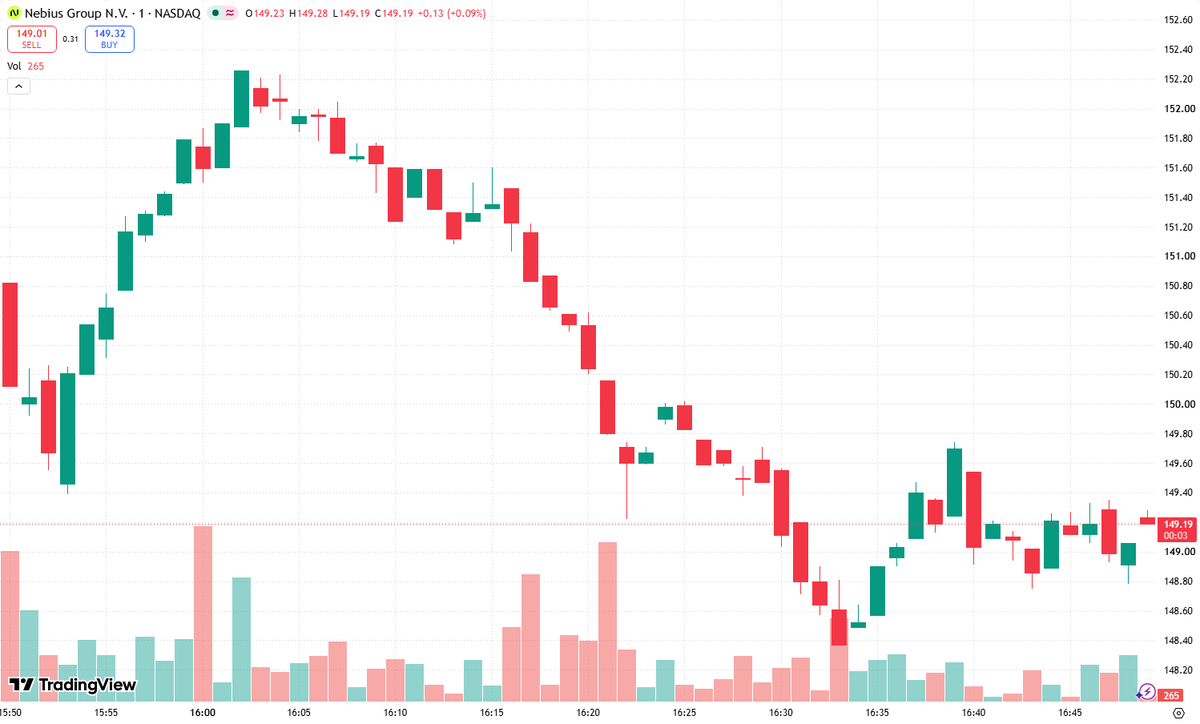
$NBIS JUST BROKE THE ATH CEILING! 🚀 Blue sky breakout! 🌕
Where are the bears now? Watching from the sidelines while the bulls plant their flag in uncharted territory. 💸
NEW HIGHS. ZERO HUMILITY. LET’S GO!
#Stocks#AI#BullMarket
$NBIS JUST SMASHED ITS ALL-TIME HIGH! Blue sky breakout! 🚀 NO CEILING, NO BRAKES—JUST PURE BULL ENERGY. 🌕 Where are the bears now? STILL WAITING FOR THAT DIP? 💸 THE BULLS OWN THE SKY!
#NBIS#AI#Stocks
$SOXL — Market Sentiment
🚨 $SOXL: Don't Confuse a Semiconductor Rally With a Safe Trade.
📢 Join our U.S. Stock Investment VIP Community:
https://t.co/4YRviuakXE
AI demand has created powerful opportunities across chipmakers, but leveraged ETFs magnify both positive and negative daily moves. The underlying index's direction is only part of the equation; volatility and holding period matter too.
Three risks deserve attention:
A sudden correction can magnify portfolio losses.
Volatility can weaken multi-day returns.
Concentrated exposure increases dependence on one sector.
My View: I'm cautiously bullish on semiconductor fundamentals, but I won't chase $SOXL simply because the sector looks exciting. I want confirmation from the underlying index and disciplined position sizing. Send me a DM if you have a different market view.
This is Stock Market Insights. I'll see you next time.
#SOXL #ChipStocks #TradingStrategy
# 07. AI Networking Is Becoming the Next Battleground: Why Arista and Broadcom Deserve Attention
**Join Our FREE U.S. Stock Market Community:** Get daily AI semiconductor and data center investment insights.
https://t.co/4YRviuakXE
When investors talk about AI, GPUs usually dominate the conversation.
But as AI data centers expand, networking, switching, and high-speed connectivity are becoming increasingly important.
That puts companies such as $ANET and $AVGO on the radar.
### 1. AI Servers Need More Than GPUs
Thousands of GPUs must work together.
If network latency is too high or data transmission capacity is insufficient, the entire computing cluster becomes less efficient.
That makes switches, networking chips, and high-speed interconnect technology critical parts of AI infrastructure.
### 2. Arista's Opportunity
$ANET is positioned to benefit from demand for high-performance data center networking.
Investors should monitor customer capital spending, order growth, and product competitiveness.
### 3. Broadcom's Competitive Advantage
$AVGO operates across semiconductor and infrastructure software markets.
Its custom AI chips and networking products provide exposure to the expanding AI ecosystem.
### 4. Where Are the Risks?
If AI capital spending slows, networking equipment orders could also weaken.
Customer-designed chips and increasing supplier competition may also affect industry profitability.
**My Take:**
The AI opportunity extends far beyond GPU manufacturers.
Networking infrastructure is another important growth area.
However, investors should look for confirmed orders, strong margins, and sustainable customer demand rather than relying entirely on industry enthusiasm.
---
$SOXL — Watch Semiconductor Breadth Before Calling a Recovery
🔥 Join Our U.S. Stock Investment VIP Community
Get market insights, stock discussions, and trading ideas with our community.
👉 Join here:
https://t.co/4YRviuakXE
November 4 opening price: $70.05. Dow 52,784.48 | S&P 500 7,655.43 | Nasdaq 25,643.36.
I would not judge the semiconductor sector by one or two popular stocks.
A healthier rally usually requires participation from multiple parts of the supply chain: chip designers, foundries, memory companies, equipment manufacturers, and related technology businesses.
If only a small group of heavily weighted names is carrying the market, the move may be more fragile than it looks.
This matters even more for $SOXL because leverage magnifies daily movements. Traders should examine sector breadth and volatility instead of assuming that a green Nasdaq automatically means a strong semiconductor setup.
My conclusion: wait for broader confirmation. There is no need to turn a market bounce into a high-risk position before the evidence improves.
Which company do you like better? If you could choose only one, which would you buy, and which would you avoid for now? Share your reasoning in the comments.
This is Stock Market Insights. I'll see you next time.
$SOXL: A Strong Semiconductor Market Doesn't Automatically Make a 3x ETF Suitable for Long-Term Investing
Today, I want to send a warning to investors who are heavily exposed to semiconductors.
Many people are bullish on AI and companies such as Nvidia, AMD, Broadcom, and Micron. They then turn to $SOXL as a way to amplify those views.
But there's an important distinction:
Being bullish on semiconductors doesn't automatically mean you should own a 3x leveraged ETF.
$SOXL targets three times the daily performance of its underlying semiconductor index. It is designed to amplify daily returns, not guarantee three times the index's cumulative return over longer periods.
Here's a simple example.
Suppose an index falls 10% on day one and rises 11.11% on day two. The index is approximately back where it started.
But if a 3x product experiences a 30% loss on the first day and gains approximately 33.33% on the second, it still hasn't recovered its original value.
That's the effect of volatility drag.
SOXL carries three major risks:
A broad semiconductor selloff can produce amplified losses.
Repeated market swings can erode its value through compounding effects.
The longer the holding period, the less reliable it becomes to estimate returns by simply multiplying the index's performance by three.
I don't question the long-term growth potential of AI and semiconductors.
But I would treat SOXL as a short-term trading instrument that requires strict position management, not as a core long-term investment.
Being right about the market direction doesn't guarantee a profitable trade.
Which company do you like better? If you could choose only one, which would you buy, and which would you avoid for now? Share your reasoning in the comments.
This is Stock Market Insights. I'll see you next time.
Join our U.S. Stock Investment VIP Community:
https://t.co/4YRviuakXE
07. $SOXL: When the AI Trade Gets Too Crowded, I Start Paying More Attention to Downside Risk
If you've been following semiconductor stocks recently, you may have noticed something.
When market sentiment becomes extremely bullish, investors often stop discussing risk and start calculating how much higher stocks can go.
That's exactly when I become more cautious.
Today, we're looking at $SOXL again. This time, the focus isn't predicting an immediate semiconductor crash. It's understanding the risks of using leveraged exposure in a highly volatile market.
First, SOXL isn't an investment in one individual chipmaker. Its performance depends on the broader semiconductor index, which includes companies involved in chip design, manufacturing equipment, and related businesses.
Second, AI may offer substantial long-term growth, but not every company in the supply chain will benefit equally.
Rising GPU demand doesn't mean every semiconductor company will experience the same earnings growth.
Finally, leveraged ETFs also involve derivatives, financing costs, and daily rebalancing.
My biggest concern is investors increasing their SOXL positions after the semiconductor market has already experienced a major rally, simply because they're afraid of missing out.
My risk-management rules are straightforward:
Don't increase exposure before the broader trend is confirmed.
Reduce leverage when market volatility rises sharply.
Pay attention when major semiconductor stocks start weakening together.
Determine your maximum acceptable loss before entering a trade.
I can be bullish on the AI industry without being bullish on every semiconductor rally.
You can be patient with long-term AI investments. You must be disciplined when trading SOXL.
Which company do you like better? If you could choose only one, which would you buy, and which would you avoid for now? Share your reasoning in the comments.
This is Stock Market Insights. I'll see you next time.
Join our U.S. Stock Investment VIP Community:
https://t.co/4YRviuakXE
$NBIS JUST SMASHED ITS ALL-TIME HIGH! 🚀 Blue sky breakout! Where are the bears now? Still writing their doom threads while we plant flags on the MOON! 🌕💸 BULLS OWN THE SKY!
#NBIS#AI#Stocks
The Real Crisis Behind Apple's Earnings: AI Demand Is Driving Up Memory Costs, and Even Consumer Electronics Giants Are Feeling the Pressure
Apple's latest earnings report once again demonstrated the strength of its business model.
Revenue grew, earnings exceeded expectations, iPhone sales remained strong, and its Services business continued to expand. Yet the market reaction was far less optimistic than the financial results themselves. $AAPL fell in after-hours trading, signaling that investors are no longer focused solely on how many products Apple sells, but on how much profit those products can generate going forward.
The most important takeaway from this earnings report isn't Apple's revenue growth. It's how rising memory chip prices are reshaping profit distribution across the entire consumer electronics industry.
According to the company's reported fiscal fourth-quarter 2026 results, Apple generated $114.5 billion in revenue, up 12% year over year. Earnings per share came in at $2.10, up 14% from a year earlier. Both figures exceeded market expectations.
Looking at the business breakdown, the iPhone remained Apple's primary growth engine, generating $57.6 billion in quarterly revenue, up 17% year over year. Meanwhile, Services revenue reached $31.6 billion, an increase of 10%, setting another all-time record.
From an operational standpoint, this was an impressive earnings report.
But here's the problem: revenue growth does not necessarily translate into stronger profit margins.
Apple is facing a situation that has been relatively uncommon in the past: it's selling more products, but manufacturing costs and AI-related expenses are also rising rapidly.
The company's overall gross margin reached 47.9% this quarter. However, that figure included approximately one percentage point of benefit from tariff refunds. Excluding this one-time factor, the underlying gross margin was approximately 46.9%.
Even more concerning, management expects gross margin to decline to 45%��46% next quarter.
Rising memory chip costs are one of the primary sources of pressure. In addition, the rollout of the next-generation Siri AI features will increase related computing and operating expenses.
This reveals a broader shift across the technology industry.
Over the past several years, Apple has enjoyed significant advantages in cost control thanks to its enormous purchasing power, mature supply chain, and strong brand premium. But AI data centers are now consuming substantial amounts of capital and production resources across the global memory industry.
Although server HBM, high-performance DRAM, and the memory products used in smartphones are not exactly the same, they are connected through shared production resources and capital allocation decisions.
As memory manufacturers direct more resources toward higher-margin AI products, consumer electronics customers may also face higher procurement costs.
In other words, the benefits of the AI boom are not being distributed equally across the industry. Upstream suppliers may gain stronger pricing power, while downstream device manufacturers are left absorbing greater cost pressure.
Apple has already begun taking steps to address the situation.
This year, the company adjusted prices across certain Mac, iPad, and iPhone products, passing some of the cost pressure on to consumers. Apple is also securing manufacturing resources in advance to protect future product supply.
Management disclosed that manufacturing purchase commitments increased by $33 billion between the end of June and the end of September.
That figure deserves attention.
It reflects not only Apple's preparations for future product demand, but also how intense competition for supply chain resources is becoming.
However, securing procurement resources in advance does not mean Apple can completely avoid rising costs. If upstream suppliers continue raising prices, Apple will still need to balance product pricing, sales volume, and profit margins.
For investors, this could become one of the most important indicators to watch when evaluating Apple's earnings quality over the next several quarters.
Another issue that cannot be overlooked is the commercialization cost of AI.
Apple is gradually integrating AI features into the iPhone, Mac, and other devices, hoping to encourage users to upgrade their hardware while further strengthening ecosystem loyalty.
But developing and operating AI features requires significant computing resources.
For services involving cloud-based inference in particular, Apple must cover not only infrastructure and computing expenses but also manage the timing of revenue recognition from related services.
This means AI could increase operating costs first, with revenue growth taking longer to materialize.
If AI features successfully encourage device upgrades and service subscriptions, the upfront investment may prove worthwhile. But if user engagement and willingness to pay fall short of expectations, those investments could create sustained pressure on profit margins.
Of course, Apple is not a company lacking financial flexibility.
It has enormous cash flow, a mature global supply chain, and exceptional brand strength. Even with rising memory costs, Apple has the resources to ease the pressure through pricing adjustments, supply chain optimization, and changes to its business mix.
But the question the market really needs to consider is this: Can Apple continue delivering the same stable profit growth model it has maintained in the past?
From an industry perspective, this earnings report also offers an important reference point for other technology companies.
For memory manufacturers such as $MU, Apple's comments suggest that rising memory costs are already beginning to influence the business decisions of major downstream customers. If demand from AI data centers remains strong, memory suppliers could gain even greater pricing power.
That doesn't mean memory stocks are guaranteed to keep rising. Investors still need to monitor future capital expenditures, capacity expansion, product pricing, and industry inventory levels. If a large wave of new production capacity comes online, the current supply-demand balance could change.
As for $AAPL , I don't think an after-hours decline alone is enough to conclude that its long-term growth thesis has changed.
There are three key areas worth watching:
First, will consumers maintain their purchasing frequency after iPhone price increases? If sales growth begins to slow, Apple's ability to pass higher costs on to customers could become more limited.
Second, how long will memory chip prices remain elevated, and can Apple stabilize hardware gross margins through long-term procurement agreements and supply chain adjustments?
Third, can AI features genuinely translate into device upgrades, Services revenue, and greater ecosystem value, rather than simply increasing cloud computing expenses?
My view is that Apple isn't facing a collapse in demand. Instead, its growth model is entering a new phase in which costs are becoming a much bigger challenge.
The development of the AI industry could still create significant long-term opportunities for Apple, but this technological revolution is also reshaping how profits are distributed across the supply chain.
Upstream memory manufacturers are benefiting from stronger demand tied to AI infrastructure, while downstream device makers are facing higher hardware procurement costs and AI operating expenses.
Over the next several quarters, the market may become less focused on rewarding revenue growth alone and place greater emphasis on profit margins, free cash flow, and the actual returns generated by AI investments.
For investors, **
🇺🇸 U.S. STOCK MARKET COMMUNITY 📈
🔥 JOIN OUR FREE WHATSAPP STOCK DISCUSSION GROUP!
👇 CLICK HERE TO JOIN NOW:
https://t.co/4YRviuakXE
Are you passionate about the U.S. stock market? Looking for a place to exchange ideas and stay updated on the latest market developments?
You're welcome to join our growing community of stock enthusiasts and individual investors!
📊 What We Discuss:
✅ Daily U.S. Stock Market News & Updates
✅ Trending Stocks & Market Developments
✅ Technical Analysis & Chart Patterns
✅ RSI, MACD, VWAP & Moving Averages
✅ Support & Resistance Levels
✅ Bullish & Bearish Market Perspectives
✅ Trading Strategies & Risk Management
✅ AI, Technology, Semiconductor & Other Hot Sectors
Whether you're a beginner or an experienced trader, there's always something new to learn.
💡 Share your thoughts, ask questions, exchange trading experiences, and learn from other stock enthusiasts.
🚀 Don't trade alone. Join the conversation and grow your market knowledge together!
👇 JOIN OUR FREE WHATSAPP COMMUNITY TODAY:
https://t.co/4YRviuakXE
Free educational discussions. No guaranteed profits. Always do your own research.
$SOXL — Watch the Quality of the Semiconductor Rebound
Good morning, investors. Today's recovery in U.S. technology stocks is encouraging, with the Nasdaq opening approximately 1.2% higher. Still, the semiconductor sector needs more than a temporary bounce to establish stronger confidence.
For $SOXL , I would focus on whether major semiconductor companies recover together or whether gains remain concentrated in a few large names. Because the fund resets its leverage daily, consecutive volatile sessions can create substantial losses even when the underlying index eventually recovers. I am cautiously optimistic about a stabilization attempt, but I would prefer confirmation from broader sector participation before increasing exposure.
🚨 $SOXL: Don't Let Yesterday's AI Optimism Blind You to Today's Risk.
Semiconductors remain central to the AI infrastructure boom, but a bullish industry narrative doesn't guarantee a profitable leveraged trade. $SOXL's latest October 30 session showed just how quickly three-times exposure can work against traders.
Three warning signs:
A major semiconductor correction can produce disproportionate losses.
Daily leverage creates compounding risk during volatile, directionless markets.
Crowded bullish positioning can accelerate selling when expectations change.
I don't hate semiconductor exposure. I hate pretending that leveraged exposure is a long-term substitute for owning quality businesses.
My strategy is to demand confirmation from the underlying sector before considering another aggressive entry. If you're trading $SOXL, I'd like to hear your risk-management approach. Send me a DM.
#SOXL #TradingStrategy #TechStocks
Market Insights | November 2 U.S. Stock Market Morning Briefing
Good morning, everyone. Welcome to Market Insights.
A new trading week is about to begin. Before looking ahead, let's review how the U.S. stock market performed last Friday. October 30 was the previous trading session, and all index figures below reflect official closing prices in Eastern Time, not intraday quotes.
Last Friday, U.S. stocks experienced a significant pullback. The Nasdaq Composite closed at 25,437, down 2.86%. The S&P 500 finished at 7,580.07, down 1.82%, while the Dow Jones Industrial Average settled at 51,770.31, down 1.09%. All three major indexes finished lower, with technology stocks bearing the brunt of the selling.
The main driver of this decline was not simply short-term profit-taking. The market is beginning to reassess the cost of AI investment, the timeline for generating returns, and the pressure that massive spending could place on the cash flows of major technology companies.
Intel plunged approximately 28.6% in a single session, putting significant pressure on the semiconductor sector. Meanwhile, defensive sectors such as energy, consumer staples, utilities, and healthcare held up relatively better. There are signs of capital shifting toward more defensive areas, but it is still too early to conclude that a sustained sector rotation is underway.
Macroeconomic Outlook: The Market's Biggest Concern Is the Return on AI Investment
From a macroeconomic perspective, this correction reflects both shifts in sentiment and a reassessment of fundamentals.
On October 28, the Federal Reserve kept the federal funds rate unchanged at 3.75%–4.00%. However, its statement made clear that inflation remains elevated, and two policymakers favored a rate increase. This means investors should not interpret a rate hold as a guarantee that rate cuts are coming next. The longer interest rates remain relatively high, the harder it becomes for growth stocks to escape valuation pressure.
On the economic growth front, the preliminary estimate showed that U.S. GDP expanded at an annualized rate of 3.4% in the third quarter, up from 2.2% in the second quarter. This suggests that economic activity remains resilient.
However, September CPI rose 3.7% year over year, while headline PCE inflation increased 3.6% and core PCE rose 3.1%. Inflation remains well above the Fed's 2% target. In other words, the U.S. economy is not showing clear signs of recession, but inflation is not fully under control either. This combination makes it more difficult for the Fed to pivot quickly toward monetary easing.
In my view, the most important shift in the market right now is that investors are moving from asking, "How much growth can AI generate?" to asking, "How much profit can AI actually produce?"
In the past, investors were willing to assign premium valuations to chip orders, data center construction, and capital expenditure plans. Now, they want to know when those investments will translate into revenue, earnings, and free cash flow.
If companies continue to report solid revenue growth while capital expenditures climb and free cash flow comes under increasing pressure, their stocks could fall even when earnings growth remains positive.
This means the recent technology sell-off should not be dismissed as nothing more than a temporary bout of negative sentiment. It reflects both position adjustments and valuation compression, as well as a broader reassessment of earnings quality across the AI supply chain.
Over the next several weeks, growth stocks could recover if major technology companies demonstrate that AI is generating sustainable revenue without significantly weakening cash flow. On the other hand, even if AI demand continues to expand, valuations could remain under pressure if investment returns fail to materialize.
Major Financial Headlines Today
1. Intel's Outlook Triggers a Sharp Sell-Off Across Semiconductor Stocks
After reporting quarterly results on October 29, Intel issued revenue guidance for the following quarter that fell short of market expectations. The company also indicated that it would not achieve positive cash flow this year.
Investor concerns extend beyond the company's individual results. PC demand, memory costs, and the pressure that AI infrastructure spending is placing on industry resources are also weighing on sentiment.
On October 30, $INTC fell approximately 28.6%. $AMD and $NVDA dropped approximately 10.9% and 4.2%, respectively, while the semiconductor index declined about 7.2%.
This shows that investors are reassessing chipmakers' margins, cash flow, and future demand rather than simply buying into the long-term AI narrative.
2. Amazon's Cloud Business Delivers Strong Growth, but Massive Capital Spending Remains in Focus
Amazon reported third-quarter net sales of $201.9 billion, up 12% year over year. AWS revenue increased 39.3% year over year, reaching an annualized revenue run rate of $184 billion, while operating income came in at $28.1 billion.
At the same time, the company expects capital expenditures of approximately $220 billion in 2026.
This raises an important question for investors: AWS is growing rapidly, but can such massive infrastructure investments continue to translate into profits and cash flow?
For $AMZN, the market will be watching not only AWS growth but also returns on investment and changes in free cash flow.
3. Alphabet Reports Strong Cloud and AI Growth, but Its Stock Still Faces Selling Pressure
Alphabet reported third-quarter revenue of $127.6 billion, up 25% year over year. Google Cloud revenue surged 103% to $30.7 billion, with an operating margin of 31.8%.
Operationally, cloud computing and enterprise AI services delivered impressive growth.
However, the market remains concerned about the scale of AI infrastructure spending, future depreciation costs, and whether Google's search business can maintain its competitive advantage as AI products evolve rapidly.
For $GOOGL, revenue growth is encouraging, but investors still need to see whether AI investment can generate stable and sustainable profits.
4. Meta's Capital Spending and Free Cash Flow Deserve Attention
Meta reported third-quarter revenue of $64.6 billion, up 26% year over year. However, the company also disclosed approximately $34.9 billion in quarterly capital expenditures and negative free cash flow of $2.1 billion.
It's important to note that quarterly operating expenses included approximately $9.9 billion in legal settlement-related costs. Therefore, it would be inaccurate to attribute the entire change in net income to AI investment.
Nevertheless, the relationship between capital spending and cash flow is clearly a major concern for investors.
For $META, advertising growth provides an important source of funding. But if AI investment continues to expand, investors will demand stronger evidence that these expenditures can generate corresponding returns.
5. Microsoft's Results Show That Cloud Demand Remains Strong
Microsoft reported quarterly revenue of $92.3 billion, up 19% year over year, while operating income reached $45.9 billion, an increase of 21%.
These results suggest that demand for enterprise software, cloud computing, and AI-related services remains strong.
Microsoft must now demonstrate that AI commercialization can continue to drive Azure revenue and support overall profit margins.
For $MSFT, the key metrics going forward will be Azure growth, AI monetization, and returns on data center investment—not simply quarterly revenue growth.
6. Binance Security Incident Shakes the Cryptocurrency Market
On October 30, Reuters reported a major security incident involving Binance, with approximately $6.3 billion in assets affected. Bitcoin briefly fell toward $76,000, while Ethereum also weakened significantly.
It's important to note that reports have differed regarding the scope of affected assets, actual losses, and the amount subsequently recovered.
On October 31, Binance said it had used company funds to cover approximately $6 billion, while the remaining portion involved less liquid assets that were still being addressed.
The incident is another reminder that cryptocurrency risks extend beyond price volatility. Exchange security, custody arrangements, and liquidity risks are equally important.
7. Energy Stocks Hold Up Relatively Well, Supported by Results From Traditional Energy Companies
Exxon Mobil reported third-quarter adjusted earnings per share of $4.23, operating cash flow of $25.7 billion, and free cash flow of $19.1 billion. Chevron reported third-quarter adjusted earnings of $10.4 billion.
These results show why traditional energy companies with relatively clear cash flow and shareholder-return profiles may continue attracting investor interest when technology stocks come under pressure.
On October 30, the energy sector gained approximately 1.9%, making it one of the strongest-performing sectors of the day.
However, oil prices and energy stocks remain sensitive to geopolitical developments, supply-and-demand dynamics, and global economic expectations. A single day's gains should not be mistaken for confirmation of a long-term trend.
Bonds, Gold, Silver, and Market Sentiment
Turning to the bond and precious metals markets, the U.S. 10-year Treasury yield fell to approximately 4.93% on October 30, down around 0.06 percentage points from the previous day. This suggests that some capital moved toward relatively safer assets.
The U.S. Dollar Index stood at approximately 101.96. Gold futures settled at around $3,884.90 per ounce, down approximately 3.63% for the session.
As for silver, I have not found sufficiently reliable and consistent settlement data for October 30, so I will not provide an unverified price.
One detail worth noting is that Treasury yields declined while gold also sold off. This suggests that defensive positioning did not simply translate into a broad rush toward gold. Investors were still adjusting allocations across different asset classes.
In terms of market sentiment, the VIX volatility index rose approximately 12.9% to close at 19.42, indicating growing concern about short-term volatility.
However, this does not automatically signal systemic financial risk. The current environment looks more like a concentrated repricing of technology valuations, expected returns on AI investment, and corporate cash flow.
Sector performance also suggests that capital is moving away from high-valuation growth stocks and toward some industries with more stable cash flow. Whether this rotation continues will need to be confirmed over the next several trading sessions.
Investment Strategy: Don't Rush to Call the Bottom. Wait for the Market to Send a Signal.
Given the current market environment, is this the right time to buy the dip in technology stocks?
My view is that investors should not automatically treat consecutive declines as a low-risk buying opportunity.
Stocks such as $NVDA, $AMD, $INTC , and $AVGO remain exposed to long-term demand for AI computing. However, their near-term share prices will still be influenced by industry earnings expectations, capital spending, and valuation changes.
A more disciplined approach would be to wait for prices to stabilize, trading volume to gradually return toward normal levels, and key support areas to demonstrate meaningful buying interest before considering phased entries.
For $MSFT, $GOOGL, $AMZN, and $META, I am paying closer attention to cloud growth, AI product monetization, capital expenditures, and free cash flow.
These companies still have growth opportunities, but the market's expectations are becoming more demanding.
If revenue growth can cover infrastructure investment while margins and cash flow remain stable, valuations may find renewed support. But if capital spending continues to accelerate without a clear return, investors should become more cautious.
For short-term trading, I favor reducing exposure moderately, especially in highly volatile small-cap technology stocks and semiconductor-related names driven primarily by market sentiment.
Keeping some cash in your account does not mean giving up on opportunities. It gives you flexibility if the market continues to correct.
Don't rush into fully invested positions during a series of declines, and don't assume the trend has reversed simply because the market rebounds for one day.
Looking ahead, I see four areas worth monitoring:
AI and semiconductors: Focus on orders, gross margins, and cash flow rather than chip demand alone.
Cloud computing and data centers: Watch whether enterprise AI services are actually generating revenue.
Healthcare and utilities: These sectors may offer some defensive characteristics during periods of increased market volatility.
Energy: Monitor oil prices, corporate earnings, and capital returns.
In the U.S. Treasury market, yield movements will remain important because they influence growth-stock valuations. Gold and silver are also worth monitoring, but investors should avoid making directional decisions based solely on short-term safe-haven sentiment.
Several upcoming economic releases could influence market direction this week:
November 2: U.S. October ISM Manufacturing Index.
November 3: September Job Openings and Labor Turnover Survey (JOLTS).
November 4: ADP employment data and the ISM Services Index.
November 5: Preliminary third-quarter productivity and unit labor cost data.
November 6: October nonfarm payrolls report, the most important economic release of the week.
November 10: October CPI report.
Employment, wage, and inflation data will influence expectations for the Federal Reserve's next policy move and could become important catalysts for another round of growth-stock repricing.
If the market begins showing the following signals, I believe investors could consider gradually increasing their exposure to growth stocks:
The Nasdaq and semiconductor sector stop consistently making new short-term lows.
Rebounds are supported by stronger trading volume rather than relying solely on short covering.
Earnings guidance and cash flow from major technology companies support their capital spending plans.
Treasury yields avoid a sustained and rapid move higher.
Conversely, if employment and inflation data push rate expectations higher again, or major technology companies continue lowering their earnings outlooks, position management should take priority over chasing returns.
Closing Thoughts: Stay Patient and Keep Investing With a Long-Term Plan
In today's market briefing, we focused on the technology sell-off, returns on AI investment, Federal Reserve policy, corporate cash flow, and the key economic releases coming over the next several days.
My central message is this: Long-term opportunities still exist, but short-term uncertainty is increasing.
Don't lose confidence because of one major sell-off, but don't ignore the risks just because of a one-day rebound.
We continue to make steady progress on our retirement plans, aiming to turn our investment goals into reality through more disciplined asset allocation and long-term planning.
Our institutional accounts are also now open. Anyone interested is welcome to learn more and make a decision that suits their individual circumstances after fully understanding the associated risks and account rules.
We are also building a new investor community. Everyone is welcome to join the discussion, exchange trading strategies, and share the latest market developments.
Finally, I'd like to leave you with a reminder from Scripture:
"To everything there is a season, and a time to every purpose under the heaven."
There are times when markets rise and times when they correct. Some opportunities require patience, while some decisions require wisdom.
May we remain peaceful, patient, and disciplined through market volatility, without allowing short-term price movements to pull us away from our long-term plans.
Thank you for your attention today and for your continued trust and support. May the Lord grant you wisdom, peace, and blessings.
We'll meet again after today's U.S. market close to review market performance and discuss new opportunities and risks.
This is Market Insights. See you tomorrow.
$SOXL | 3x Leverage Is Not the Same as Owning Semiconductor Stocks
The biggest risk with $SOXL is leverage. It targets three times the daily performance of a semiconductor index, amplifying gains when the sector rises but also magnifying losses when it falls. During periods of sharp volatility in semiconductor stocks, consecutive up and down sessions can create compounding drag. Long-term returns may differ significantly from three times the index's cumulative performance.
My strategy is to treat $SOXL as a short-term trading instrument, not a core long-term portfolio holding. I would only consider a trade when the semiconductor trend, trading volume, and broader market risk appetite are all improving. If the sector remains under pressure from valuation compression and capital expenditure concerns, leverage can quickly magnify losses. Don't let a short-term trade turn into an unintended long-term position.
$SOXL: DON'T CONFUSE A SECTOR RECOVERY WITH A SAFE TRADE!
The latest semiconductor correction exposed how quickly leveraged exposure can become dangerous. $SOXL is designed to deliver three times the daily performance of its underlying semiconductor index, not three times its long-term return.
Three reasons I'm watching downside risk:
A prolonged chip-sector correction can compound ETF losses.
Volatility can erode returns even when the underlying index eventually recovers.
Weak earnings guidance from major chipmakers can trigger additional selling.
My outlook remains cautiously bullish on semiconductors over the long run. However, I need stabilization, improving market breadth and stronger buying confirmation. Take some chips off the table. There is no prize for surviving the biggest drawdown.
Want to discuss leveraged ETF strategies? DM me.
#SOXL #ETFTrading #StockMarket
🚨 $SOXL: THE BIGGEST MISTAKE IS THINKING EVERY DIP DESERVES A BUY!
Friday's $77.05 close followed a brutal 24.75% decline. The session reached $84.08 on the upside and $70.23 on the downside. Volume was approximately 179.63M shares. <Cite refs={["turn618031search7"]}/>
Three things worry me:
Broken structure: The previous $97.95 low has been decisively lost.
Volatility: Large daily swings make poorly sized positions especially dangerous.
Compounding: A 3x daily ETF isn't designed to deliver three times the long-term index return.
My semiconductor outlook remains cautiously bullish, but the ETF needs stabilization first. Take some chips off the table.
#SOXL #TradingPsychology #StockMarket