The West has never recovered from the Great War.
Consider what it does to a civilisation when entire generations of its best and brightest, its most honourable and courageous, are destroyed fighting a futile war against their brothers.
They were not just soldiers.
They were fathers and sons, poets and engineers, labourers and aristocrats.
The Old World died with them in the trenches.
The survivors, and the sons they raised, were conditioned to despise the very things that had built their world – law, order, honour, strength, religion, and war – which they blamed for their suffering.
And what is the product?
Modern man.
Modern man is the sociological product of this civilisational trauma. He is disconnected from tradition, suspicious of anything resembling strength, and taught to elevate passivity and tolerance to supreme virtues.
But we know who we are.
Modern man must realise that "Life is warfare", and suffering is an inescapable part of the human experience, and we will rebuild the world they lost.
No tengo claro en qué momento “ciencia” pasó a ser sinónimo de “alarmismo pesimista anti-humanista”.
Porque si uno piensa en la concepción de la “ciencia” del siglo XVIII y del XIX era exactamente lo contrario, pecaban de sobre-optimistas creyendo que la ciencia era la solución a los problemas de la humanidad y la mejora de las condiciones de los hombres.
Sin embargo, a partir de la segunda mitad del siglo XX, “ciencia” parece sinónimo de lo contrario: de un pesimismo y alarmismo muy cansino y falso.
No, la humanidad no está “destruyendo el planeta” ni se aproxima un “apocalipsis” ni nada que se le parezca.
Think Slow. Then find out who did it.
TMOG puts CPU, memory, disk, network, energy, and the responsible process in one native view. Free edition: no account, no expiration. Windows, macOS, and Linux.
Built by the original author of Windows Task Manager.
Try it on your own hardware: https://t.co/XhCuN5sxdR
The Transmission Problem.
Every civilization faces the same final question. Not the barbarian at the gate – that can be fought. Not the economic collapse – that can be recovered from. The question that cannot be survived if answered wrongly: did you pass it forward?
The torch changes hands or it doesn’t. The light doesn’t go out dramatically. It goes out quietly, generation by generation, when the transmission fails – when what was built is not explained, when what was defended is not named, when what was beautiful is not shown to the child who would have loved it if someone had taken the time.
1. The transmission mechanism is the most important institution in any civilization – and the least visible. Not the army, not the economy, not the government. The father who takes his son to the edge of the kingdom at dawn and says: everything the light touches is our kingdom, and one day you will stand here with your own son. The teacher who hands the student a book and says: this will change how you see everything, and it changed how I see everything, and someone handed it to me. The civilization that knows what it is and says so, clearly, to the next person in the chain. The torch doesn’t pass itself. Someone has to carry it, deliberately, to the next set of hands.
2. The long march understood this before the West did. Gramsci’s insight was precisely about transmission – the ruling class maintains power not through force but through controlling what the next generation is taught to think is natural. Capture the school, the university, the media – the transmission mechanisms – and the cultural hegemony reproduces itself automatically, without enforcement, because the next generation never learns that it could think otherwise. The march didn’t attack the civilization directly. It attacked the transmission. Which is more efficient and more permanent – because a civilization that has lost the ability to transmit itself is defeated without ever being confronted.
3. The family is the primary transmission mechanism – and therefore the primary target. Not because the family is politically significant in itself but because it is where the first transmission happens: the values, the stories, the sense of what is worth admiring and what is worth fighting for. The child who grows up in a family that knows what it is and says so becomes a person who knows what they are. The child who grows up in a family that has been taught that its own values are suspect, its own history shameful, its own civilization merely one option among many – that child is already a partial transmission failure. Multiply across a generation and you have what we are currently living through.
4. The school is the secondary transmission mechanism – and the most completely captured. The curriculum that replaced the canon with the critique of the canon. The teacher replaced by the facilitator. The examination replaced by the self-expression. The standard replaced by the affirmation. This is not incompetence – it is the long march’s most successful operation. Deconstructing a civilization’s transmission mechanism produces, reliably and by design, a generation with nothing to transmit. That was the point. The generation that cannot read the primary sources cannot assess the argument that the primary sources are oppressive. It simply accepts the conclusion, because it has no access to the evidence that would allow it to disagree.
5. The culture is the tertiary transmission mechanism – the stories, images, music, and beauty that transmit the civilization’s values below the level of argument. Homer transmitted Greek civilization for centuries before anyone theorized about what Greek civilization was. Shakespeare transmitted the English-speaking world’s understanding of human nature for four hundred years. The fairy tale transmitted the moral grammar of European civilization to children too young for philosophy. The long march captured this too – Hollywood, the prize committees, the arts funding, the music industry – and replaced the transmission with its own content. The child who grows up on a cultural diet produced by the captured mechanism is being transmitted to. The question is what is being transmitted.
6. This series is an act of transmission. Not primarily an argument – an attempt to pass forward the vocabulary, the framework, the sense of what the civilization is and what it is worth, in the format that reaches the person who will not read the primary sources but who will read this. The secondhand dealer in ideas, in Hayek’s formulation – making thinkable for millions what the primary producer made possible. Every piece is a link in the chain. The chain runs from Homer to Aristotle to Cicero to Augustine to Aquinas to Montesquieu to Burke to Tocqueville to Hayek to this feed to the person reading it now. The chain is only as strong as its weakest link. The weakest links are the ones the long march attacked. This is an attempt at repair.
7. The transmission problem has one solution and it is not institutional – it is personal. You cannot transmit a civilization through a policy. You can only transmit it through a person who has received it and passes it forward deliberately, to a specific other person, in the full knowledge that the chain depends on this act. The father and the son at the edge of the kingdom. The teacher and the student with the book. The writer and the reader with the vocabulary. Every act of genuine transmission is an act of civilizational resistance – because the managed reality depends on the chain being broken, on each generation starting fresh without the inheritance, on the past being made inaccessible so that the present can be managed. Break the managed access to the past. Pass it forward. To your children first. Then to everyone else.
The torch changes hands or it doesn’t.
You are holding it now.
Seis meses de prisión por quemar los bosques de Quito. Cuarenta días por abusar de una niña,esas son las leyes y normas que nos impuso el marco constitucional que garantiza la impunidad de los criminales
In the United States today, letting a six-year-old walk three blocks to the park alone
will get the police called on you for child neglect.
Parents wait in ninety-minute lines of SUVs outside schools to pick up their teenagers.
Now stand on a residential street corner in Tokyo at 7:45 a.m.
A group of six small children approaches.
The oldest is maybe ten years old.
The youngest is a six-year-old first grader.
They wear bright yellow safety hats and neat leather Randoseru backpacks.
There is not a single parent walking with them.
They walk in a tidy single file along the green painted safety lane on the side of the road.
They hold hands when crossing small alleys.
The older children constantly look back to make sure the little ones haven't stumbled.
At the main intersection, a retired grandfather wearing a neon green volunteer vest
stands holding a yellow handheld stop sign.
As the children approach, oncoming cars come to a complete, gentle halt ten feet back.
The children cross, turn toward the waiting drivers,
bow their heads in unison, and say:
"Arigato gozaimasu!"
The drivers smile and wave back.
This is not a fairytale. This is every Tuesday morning in every neighborhood in Japan.
A society has truly made it not when its wealthy citizens drive armored tanks,
but when a six-year-old child can walk a mile through a major metropolis
protected by nothing more than a yellow cotton hat
and the watchful love of an entire community.
I remember when I first visited Singapore 🇸🇬, I was shocked to witness something I experienced as a kid in America 🇺🇸: children walking long distances by themselves without fear of adults.
I saw the same thing in Japan 🇯🇵 later on (albeit at a much larger scale) & realized that this is what defines a successful community, city, town or nation.
Forget the politics! If kids can safely walk down the street without fear of being harmed, then that is an ultimate life win.
The World Economic Forum – The People Who Decided They Should Run Everything.
Every year in January, the most important people in the world travel to Davos, Switzerland — a ski resort — to discuss the problems facing humanity. They arrive on private jets. They stay in five-star hotels. They are protected by five thousand soldiers and police. They eat very well. They talk about inequality, climate change, and the need for ordinary people to consume less. Then they fly home on private jets.
This is not satire. This is the schedule.
1. Klaus Schwab founded the World Economic Forum in 1971 – a German professor who decided that the solution to the world’s problems was to get the people who ran the world’s largest corporations into a room with the people who ran the world’s governments, and have them agree on things before anyone elected them to agree on things. If you control the conversation before the democratic process begins, you control the outcome without being subject to it. Davos is where the agenda is set. Everything after is implementation.
2. The Young Global Leaders program is the masterpiece. Founded in 2004, with its predecessor, Global Leaders for Tomorrow, running since 1993. Together the programs have formed: Justin Trudeau, Emmanuel Macron, Jacinda Ardern, Mark Zuckerberg, Tony Blair, Gordon Brown, Angela Merkel, and the health ministers who designed most of the Western world’s COVID response. The pipeline runs continuously. The list is published on the WEF website. This is not a conspiracy theory. It is an alumni directory.
3. The program works because it operates before power, not after. By the time a Young Global Leader becomes a prime minister or finance minister, they have already spent years in the same rooms, sharing the same assumptions, networking with the same people. They don’t need to be told what to do. They already know – because they were formed together, in Davos, before anyone gave them the job. The Fabian Society permeates institutions over generations. The WEF does it in a long weekend, with better catering.
4. The Great Reset — announced in 2020 with timing that should give everyone pause — is the program stated plainly. "You will own nothing and you will be happy." Build Back Better. The Fourth Industrial Revolution. The language is always the language of inevitability: this is happening, the question is only how to manage it. The managed future, designed by the people in the ski resort, for the people who were not invited.
5. The irony is structural. The people most loudly "concerned about inequality" meet in one of the most expensive places on earth. Those most "concerned about climate change" arrive by private jet. Those most "concerned about democracy" design systems insulating them from democratic accountability. The gap between the speech and the life is visible from orbit. They don’t notice it. Or they notice and calculate, correctly, that nobody who matters will say so.
6. What Davos actually produces is "consensus" – the consensus of people who have implicitly agreed before arriving, because people who disagree don’t get invited. Climate policy, AI regulation, tax harmonization, digital currency – these are not debated at Davos. They are shaped there. The debate happens later, when implementation is already underway.
7. The Young Global Leaders are the tell. A program that identifies, selects, and forms the next generation of leaders before they become leaders is not a networking event. It is a formation pipeline. The Jesuits understood that if you form a person before they have power, you own what they do with the power. The WEF understood the same thing and built it into a global institution.
The question is simple:
Who decided Klaus Schwab should select the world’s next generation of leaders?
Nobody.
He just started doing it.
And the people who run things let him – because increasingly, the people who run things were people he had already formed.
Did you choose them?
Ed Sheeran le dijo que NO a la bandera de Palestina y los músicos lo abandonaron en pleno recital. ¿Qué hizo? Se los pasó por los huevos y siguió tocando
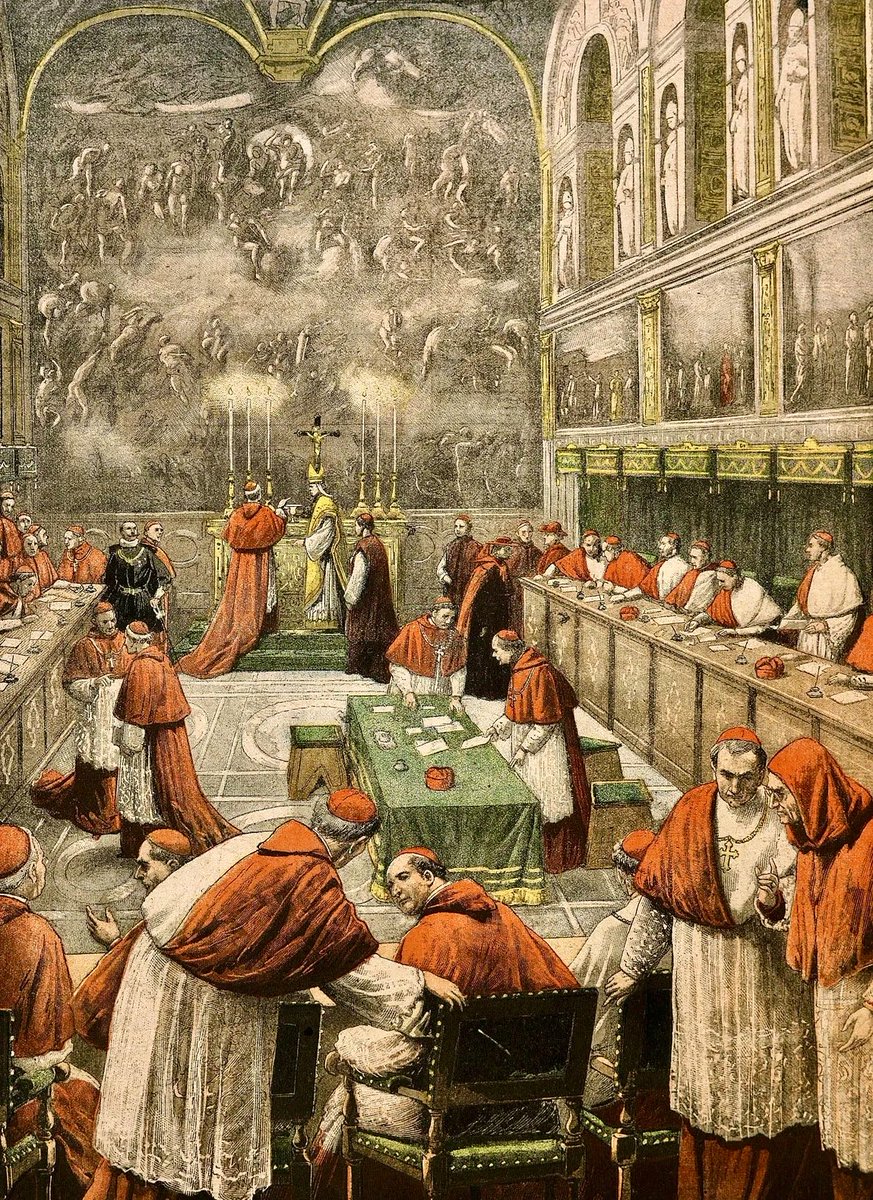
The Council of Western Civilization – Lessons from the College of Cardinals
One body in Western history solved the problem we are trying to solve: how to build something that outlives its founders, cannot be bought, and still speaks with one voice. It managed it for a thousand years. Here is how.
A hundred and twenty men, each one named. Not a movement, not a secretariat. Small enough that every member is personally answerable for what the body decides, large enough that no three of them can carry it.
The office outlives the man. Members die, resign, lose their nerve, and it continues – because what is carried is the mandate, not the personality. This is the hardest discipline for any body founded by remarkable people, and the reason most such bodies dissolve in one generation.
Chosen by function, not by nation. The first genuinely international institution in Europe: a Pole and an Argentine seated with Italians and Africans. A body drawn from one country is a national lobby.
Succession settled long before it is needed. The rules for choosing the next man were written when nobody yet had a stake in the answer. Every institution that leaves this until the founders are old hands the question to the people least able to answer it honestly.
Doctrine judged, never persons. A verdict on a practice, not on a man. Every tribunal that began judging people ended by judging the wrong ones.
And no divisions at all. Stalin asked how many, and received his answer within a lifetime: a Polish pope helped bring down the empire that asked. The lesson is not about faith. It is that a body with no power to compel, offering nothing but a judgment it will not withdraw, can outlast states that have everything else.
One thing we have to do differently. They sealed the doors; we publish everything. Their authority came from above and had to be protected from princes. Ours comes only from being right in public, and can be destroyed by the suspicion that anything is hidden. They needed a locked conclave. We need an open record.
Everything else, we are reading from their notes.
They know what they are doing. They build organizations. Institutes, oversight bodies, advisory councils, ethics boards – staffed, funded, and installed before the technology they will govern is finished.
And so should we…
While we argue, they are building positional advantage.
That is Gramsci’s method applied to the newest thing on earth, and it works for the same reason it always works: whoever staffs the body that decides the rules will still be there after every election, every news cycle, every founder moves on.
And what about us?
We post. We are right. We are read by millions. And we have built almost nothing that will still exist in twenty years without us personally carrying it.
That asymmetry is the whole game. An argument dies with the attention span. An institution outlives its founders, hires, trains, accredits, publishes, and keeps a seat at the table by default.
So we build too. Not a movement, not a hashtag – bodies with names, rules, members, and successors. The Council. The schools. The prizes. The fellowships. The parallel institutions that don’t need anyone’s permission to exist, and won’t need ours to continue.
They understood something before we did: the future is not decided by who is right. It is decided by who is in the room when the rules are written.
So let’s be in the room. Better: let’s build the room.