Terafab’s 1 TW compute target makes power delivery the tighter constraint than process IP. SpaceX has already said the Grimes County site will run on its own gas turbines plus large battery arrays rather than the grid, because fab equipment needs voltage stability inside roughly ±1–2%. That setup fits the broader pattern where AI capacity is increasingly limited by firm power and interconnection timelines, not just wafer starts.
Goldman still sees US data-center demand jumping 38% in both 2026 and 2027 — +12 GW, then +17 GW — even after push back. Year-end capacity is now 64 GW (raised) and 90 GW (cut). The near-term build is intact; the power to run it is the scarce part.
Hyperscalers have already locked ~8.5 GW of nuclear from existing and restarting US reactors: Amazon up to 1.92 GW at Susquehanna, Microsoft 835 MW at the Crane restart, Meta multi-GW with Constellation and Vistra. Single AI campuses are already 500–950 MW of IT load.
Goldman Sachs expects U.S. 🇺🇸 data-center power demand to grow 38% in both 2026 and 2027, adding 12 GW and 17 GW, respectively.
Updated year-end capacity forecasts:
2026: 64 GW, raised from 59 GW
2027: 90 GW, lowered from 95 GW
Morningstar DBRS: Nvidia’s ~$500bn financing partnerships with Apollo, BlackRock, Blackstone, Brookfield, Goldman Sachs, and KKR are credit-positive for NVDA and data-center operators.
The setup is meant to pull long-duration institutional capital into AI compute so labs, cloud providers, and operators can buy/operate Nvidia systems without funding the full stack on their own balance sheets.
For Nvidia:
1. Broader customer base and better revenue visibility
2. Reinforces the hardware + CUDA ecosystem
3. Supports residual values if chips stay transferable and software-supported
4. Contingent exposure is capped (up to ~25% of qualifying financings, ~$125bn max) and depends on structure, collateral, and how much residual-value risk third parties actually take
For data-center operators:
1. Easier access to capital for high-density compute, power, cooling, and networking
2. Credit benefit skews to those with secured power, disciplined pre-leasing, and strong counterparties
3. Easier money also raises overbuild and utilization risk if supply runs ahead of monetizable demand
Caveats that matter: this is not a fully committed fund. Benefits assume sustained demand, equipment that holds value, and limited contingent liabilities on Nvidia. Overcapacity, pricing pressure, and obsolescence are still live risks. Hyperscalers get mixed effects (balance-sheet flexibility vs. less funding advantage). AMD/Intel and non-Nvidia stacks face relative funding headwinds.
AI compute is being treated more like a financeable asset class. The credit outcome still hinges on who actually holds the residual risk.
Img Source: Morningstar
The utilization risk sits with whoever holds the take-or-pay GPU commitments, but the real spread also depends on whether the rest of the rack can actually be stood up. Long lead times on storage and packaging mean even financed capacity can stay idle longer than the demand forecast assumes, so the market-maker has to underwrite both token volume and delivery of the supporting hardware.
$IREN’s edge is still the power, not just the GPUs.
Bernstein analysis of conditional base-load capacity available for new contracts shows IREN at 2,000 MW—roughly double $CIFR (1,000 MW) and well ahead of $GLXY (830), $CLSK (585), $MARA (480), and $CORZ (274). That is ~40% of the group total.
Approved, grid-connected power is the scarce asset; the same megawatt can support far higher revenue in GPU cloud than in traditional colocation or mining.
Cooling is mixed, not a limitation.
Horizon 1 (50 MW IT, direct-to-chip liquid-cooled) with NVIDIA GB300 NVL72 was delivered to and accepted by Microsoft under the ~$9.7B contract and received NVIDIA Exemplar Cloud status. Horizons 2–4 add another 150 MW of the same liquid-cooled GB300 NVL72 setup targeted for later 2026.
Separately, IREN is deploying air-cooled Blackwell systems (Dell order) into existing halls for faster fill on other contracts. NVL72 racks (~120 kW) require liquid cooling; air-cooled HGX-style systems do not. IREN runs both.
The 2 GW of uncontracted power is what lets them keep converting sites into higher-value AI capacity (Microsoft liquid-cooled build + air-cooled and additional liquid halls) rather than being capped by current GPU orders. Execution and offtake still matter, but the power position is already in place.
The 57 GW shortfall and cancelled projects show why already-energized power, not just GPU orders, sets the residual value. $IREN, $NBIS and $CRWV only capture that scarcity premium if their offtake holds through the same staged-prepayment and next-generation reset risks that are already compressing spot inference elsewhere. Enterprise contracts buffer margins, but they do not create the watts.
The OpenRouter open-weight price war looks like the demand-side version of the residual-value problem. Providers in Finland, the Philippines, and Southeast Asia can undercut because their power and shell costs are lower, so list prices compress toward variable cost. On the supply side, fixed contracts and staged prepayments only protect margins if the buyer actually funds the later tranches and if the next GPU generation does not reset secondary prices. Otherwise the same capacity that was “pre-sold” becomes the cheap inventory feeding the race to zero. Enterprise stickiness is the remaining buffer, but it does not change the spot economics on OpenRouter.
Guys, did you see the inference price war for open weight models in openrouter? It’s bloody war to compete on the lowest price. Reminds me of electricity.
I keep hearing inference is huge margin but then it seems it’s a war to zero at openrouter nowadays. I finally understand why openrouter charges 5.5%.
I keep hearing stories of data centers in Finland, Philippines and Southeast Asia that are just cheap, cheaper and cheapest?
I wonder how US neoclouds cope with this? I mean enterprise is a good market I’m sure.
The 3x wafer intensity is the mechanism that keeps the commodity residual tight even as HBM mix rises. Samsung’s larger non-HBM base is what still monetizes a 4Q contract step if prices hold; SK hynix’s 50% HBM allocation already captures most of the premium. Same 2027 residual as the pre-sold HBM book: incremental cleanrooms do not arrive until late 2028, so the bits stay gated by shell and tools rather than by orders. $MU $SKHY
HBM is eating DRAM wafer capacity. One HBM bit uses roughly 3x the wafer of DDR5, so allocating 30% of wafers yields only about 13% of bits. Commodity supply stays tight even as HBM ramps.
October 2026 snapshot: Samsung 700k wafers/month (DRAM 39%, HBM 33%), SK hynix 550k (DRAM 25%, HBM 50%), Micron ~350k (DRAM 23%, HBM 18%).
TrendForce sees HBM blended ASP +121% in 2027 and commodity DRAM contracts +10–15% in 4Q.
If prices hold, the largest residual wafer base monetizes the squeeze. If only the HBM premium survives, the mix favors SK hynix. $SKHY $MU
The unpaid-compute problem from staged prepayments and buyers who can’t close later payments is the same financing exposure that shows up in residual value. Fixed contracts look firm until the counterparty fails or the next GPU generation resets secondary prices, and both can reprice capacity faster than any commodity framing. The open question is how much of the current book is actually backed by balance-sheet capacity versus term sheets that never fully fund.
The $42B facility locks in Anthropic as a major 2027 customer and reinforces Broadcom’s custom-silicon edge, but it also creates real vendor-financing exposure if Anthropic’s returns don’t cover the lease commitments. Revenue visibility looks strong near term; the key watch item is whether the credit risk stays contained. What part of the structure concerns you most?
The $51 billion is the committed-CPU analogue of the pre-sold 2027 HBM book, not incremental demand on top of AMD’s own guide.
Morgan Stanley’s 6.75 million Venice units at a blended ~$7,691 implies that figure only if the allocation clears. Channel checks say 2027 is already booked and 2028 orders are being taken. AMD has not confirmed it. At Citi, management framed 2027 data-center revenue at about $70 billion, with AI GPUs in the low $40 billions and server CPUs the rest. On the Q2 call, server CPU growth was guided above 70% in 2027 off a higher base. A $51 billion Venice print is most of the CPU line and a large share of the segment, so it has to sit inside that mark rather than stack on it.
Same residual as the memory book. SP7 is still a Q4 2026 ramp, SP8 H1 2027, Venice-X and Verano H2. The visibility is TSMC 2nm allocation, packaging, and whether the host sites have firm power. Agentic workloads are shifting the CPU:GPU ratio and prices are already reported up more than 40%, but a sold CPU contract does not print a watt or an HBM stack.
Serving translation: pre-allocation, not unrestricted bit growth. Watch whether the next AMD print reconciles Venice to the ~$70 billion data-center guide, and whether 2028 orders survive the same overbooking cuts that showed up last cycle.
$AMD
$AMD to Make $51B in Revenue Solely From EPYC CPU Shipments in 2027
Morgan Stanley has forecast EPYC 9006 shipments of 6.75 million units in 2027, up from about 1.25 million in 2026
Assuming AMD’s entire 2027 capacity is already sold and that the 31 planned SP7 and SP8 products average $7,691 each, that volume would imply roughly $51 billion in revenue
@michael_chomsky I agree. There's also the problem of residual value. When new GPUs are introduced, the old GPU prices fell down and the sellers makes less profit because of the fixed contract
The spot-to-contract gap and the December 9 buyback window sit on top of the same constraint Micron already marked: most of calendar 2027 HBM is committed and incremental cleanrooms do not come online until late 2028. Free-cash-flow conversion can support repurchases, but the residual is still shell and tool-in rather than unrestricted bit growth.
Consensus has operating profit rising faster than revenue, from about $0.8T to $1.2T to $1.3T, with Samsung, SK hynix and Micron still taking the large majority. That pricing-power mark sits on top of Micron’s print that most of calendar 2027 HBM is already committed and that incremental cleanrooms do not come online until late 2028.
The flat $ 1.5T-to-$1.6T step in the Bernstein consensus sits on Micron’s own point that incremental cleanrooms do not come online until late 2028 and that the bulk of calendar 2027 HBM is already committed at higher prices. Revenue can stay capped even if AI storage demand keeps rising if the extra wafers are still gated by shell and tool-in rather than by orders.
Nasdaq Private Market (2 Oct): AI infrastructure bonds have softened since their 7 Aug note. Beignet Investor (Meta-backed, $27.3bn, A+) trades $92.1 / 7.5% vs $97.8 / 6.9%. Sopaipilla Investor (Meta-backed, $12.5bn, A+/AA-) $99 / 7.7% vs $104.7 / 7.1%. CoreWeave 9.75% of 2031 ($2.75bn, B1/B) $87 / 13.4% vs $92 / 11.9%.
Three facts that matter for the compute book:
1. Execution is now the residual, not just tenant credit. Project Jupiter (2.45 GW, STACK/Blue Owl for Oracle to serve OpenAI) drew a force majeure notice on 24 Sep over gas-pipeline permitting. Related loans were already quoted 89–91 the week before. Lenders want lease-start timing, who eats delays, whether power is actually secured, and whether debt service continues if the shell is late. Capacity contracts have limited value if the site cannot get electricity on schedule.
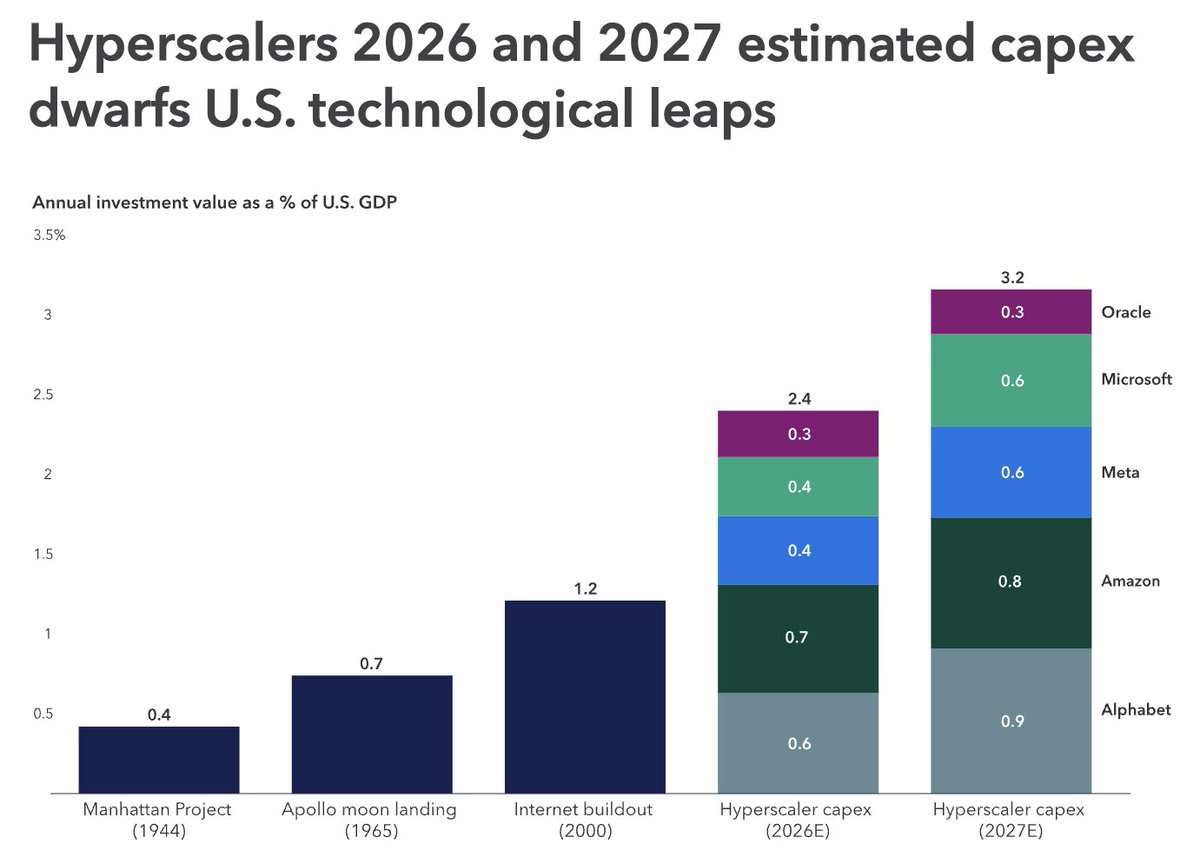
2. Off-balance-sheet is the larger book. NPM flags roughly $ 1.2tn of non-commenced leases and about $ 3tn of total commitments across the large tech names. Hyperscaler balance-sheet leverage is still low. Capex is projected above $ 1tn annually by 2027. The question is whether AI earnings cover existing debt, new debt, and that lease stack.
3. Supply is still clearing, at a wider concession. Bank of England, citing Morgan Stanley, puts 2026 AI-related issuance near $ 450bn, roughly double 2025. September still printed a $ 22bn chip-backed loan (Blackstone/Alphabet AI venture), $ 11bn SoftBank HY, and $ 2.3bn CleanSpark HY (trading $99 / 8.1%). The 10-year Treasury up about 50 bp to ~5.3% accounts for roughly half the price drop since 7 Aug.
Serving translation: the print is selectivity, not a failed auction. Debt is pricing construction, power, residual value, and duration. NPM does not read this as the infrastructure cycle breaking. Watch whether the next hyperscaler-backed deals clear inside the recent concession, and whether force-majeure language starts moving lease-start dates on the uncommitted tail.
https://t.co/GfKmqMtMX8
Capital Group (1 Oct): five hyperscalers have issued $240.7B of IG debt YTD through 31 Aug. Add SpaceX and Nvidia and the total is $290.7B. They expect another >$25B from the five in the last four months of 2026.
Three facts that matter for the credit book:
1. Scale vs Treasuries. Alphabet, Amazon, Meta, Microsoft and Oracle printed $240.7B through August, of which $66B is non-dollar. SpaceX and Nvidia USD issuance takes dollar paper to $224.5B and the all-currency total to $290.7B. All 10-year Treasuries issued in 2026 through the same date: $321B.
2. Absorption, not a failed auction. Bloomberg US Corporate Index spreads ended August at 78 bp, unchanged from the start of 2026. The book has taken the supply. Widening is in 10+ year hyperscaler bonds and other AI-related issuers. Capital Group attributes that to current issuance plus the market pricing more of it, not to a broad IG rejection.
3. The residual is still ahead. They see more than $25B from the five in Sep–Dec 2026, and $100–200B of US IG dollar issuance from the same names in 2027–28. Consensus has AI capex exceeding operating cash flow in 2027–28, with operating cash flow turning positive in 2029. Revenue is not yet locked to the debt.
Serving translation: the print so far is absorbed supply. Spread widening on the long hyperscaler curve is an issuance mark, not evidence the auction failed. Watch whether the next >$25B clears at the same concession, and whether 2027–28 stays inside the $100–200B band once cash-flow coverage is the constraint.
$GOOGL $AMZN $META $MSFT $ORCL $NVDA
Img Source: Capital Group