A number of people are talking about implications of AI to schools. I spoke about some of my thoughts to a school board earlier, some highlights:
1. You will never be able to detect the use of AI in homework. Full stop. All "detectors" of AI imo don't really work, can be defeated in various ways, and are in principle doomed to fail. You have to assume that any work done outside classroom has used AI.
2. Therefore, the majority of grading has to shift to in-class work (instead of at-home assignments), in settings where teachers can physically monitor students. The students remain motivated to learn how to solve problems without AI because they know they will be evaluated without it in class later.
3. We want students to be able to use AI, it is here to stay and it is extremely powerful, but we also don't want students to be naked in the world without it. Using the calculator as an example of a historically disruptive technology, school teaches you how to do all the basic math & arithmetic so that you can in principle do it by hand, even if calculators are pervasive and greatly speed up work in practical settings. In addition, you understand what it's doing for you, so should it give you a wrong answer (e.g. you mistyped "prompt"), you should be able to notice it, gut check it, verify it in some other way, etc. The verification ability is especially important in the case of AI, which is presently a lot more fallible in a great variety of ways compared to calculators.
4. A lot of the evaluation settings remain at teacher's discretion and involve a creative design space of no tools, cheatsheets, open book, provided AI responses, direct internet/AI access, etc.
TLDR the goal is that the students are proficient in the use of AI, but can also exist without it, and imo the only way to get there is to flip classes around and move the majority of testing to in class settings.
Say hello to GPT-4o, our new flagship model which can reason across audio, vision, and text in real time: https://t.co/MYHZB79UqN
Text and image input rolling out today in API and ChatGPT with voice and video in the coming weeks.
@AmazonHelp@amazon@ajassy My name is unique enough, so you should be able to look up my account. Some questions
- Why is the item still showing up as next day delivery.
- Why are you not resending the item if it got lost
- Why are you not demoting the listing if the vendor selling the item is at fault.
This is my third time with @amazon package delivery. @ajassy , looks like they have even stopped trying. Do not want a refund, deliver the #$%&ing package
Happy birthday to @SpaceX! What a day!
HUGE congratulations to the entire team for this incredible day: clean count (glad the shrimpers could get out in the nick of time!), liftoff, hot staging, Super Heavy boost back and coast (and likely a couple engines making mainstage during landing burn!), clean ship ”insertion” and coast, payload door cycling and prop transfer demo (to be confirmed!), and ship entry!
Already, more than 100,000 Amazon selling partners have used our GenAI listing tools to quickly and easily create high-quality product pages on https://t.co/Z6kkwemSCr.
Now, we’re making it even easier with a new GenAI feature that lets sellers create Amazon listings for products they already sell on their website by just pasting in a link to the product’s page. Our GenAI will automatically turn it into optimized listing content for our store, saving sellers time and helping customers easily find products they’ll love. https://t.co/ajhX1FAiTv
Imagine the following:
You're a man who serves as Chairman of the Board of a large University who led the search for the recently hired president.
Your wife runs a non-profit in the DEI space. She is the only full-time employee of the organization, serving as Founder, CEO, and CFO. You serve as Treasurer.
The non-profit ostensibly sells two principal products in the DEI space:
1. "Evidence-based 'how-to-guides' and
2. "The most comprehensive intersectional analytics platform of its kind..."
but the non-profit has no revenues.
It relies entirely on contributions to fund its operations, which principally consist of your wife's salary and some other ancillary overhead.
There have been only two contributors to the non-profit, the University whose board you chair, which has contributed:
2018 $100,000
2019 $300,000
2020 $150,000
2021 $600,000
2022 $789,000
and a donor advised fund (DAF) affiliated with you which has contributed:
2018 $0
2019 $0
2020 $0
2021 $10,000
2022 $20,000
Doesn't this seem very strange?
What if the University was @MIT?
What if the Chairman was Mark Gorenberg?
What if the non-profit is https://t.co/6XEtf7DgO4?
Why are there so many conflicts/scandals concerning DEI organizations?
All of the above can be found in MIT's and https://t.co/4dOX2C32hc's IRS Form 990s which are available and summarized here:
https://t.co/a7T7aOd0cM
Today, we’re announcing new capabilities across our AI stack, empowering organizations to build, use and successfully adopt generative AI to fuel their digital transformations. https://t.co/CclgWOSCZ3
Today developers can start building with our first version of Gemini Pro through Google AI Studio at https://t.co/rCsWHcHvEe.
Developers have a free quota and access to a full range of features including function calling, embeddings, semantic retrieval, custom knowledge grounding, chat functionality and more. It supports 38 languages across 180+ countries. Gemini Ultra is coming early next year. We’re excited to see what you build! https://t.co/6rUrrgKvKe
OMG, the AI Winter Break Hypothesis may actually be true?
There was some idle speculation that GPT-4 might perform worse in December because it "learned" to do less work over the holidays.
Here is a statistically significant test showing that this may be true. LLMs are weird.🎅
. @zacharynado pointed out this stat we'd put in the white paper that in retrospect deserves calling attention to. During our Gemini Ultra training run, we had a goodput measure of 97% (goodput: the time spent computing useful new steps over the elapsed time of the training job). It's good to move forward almost all the time.
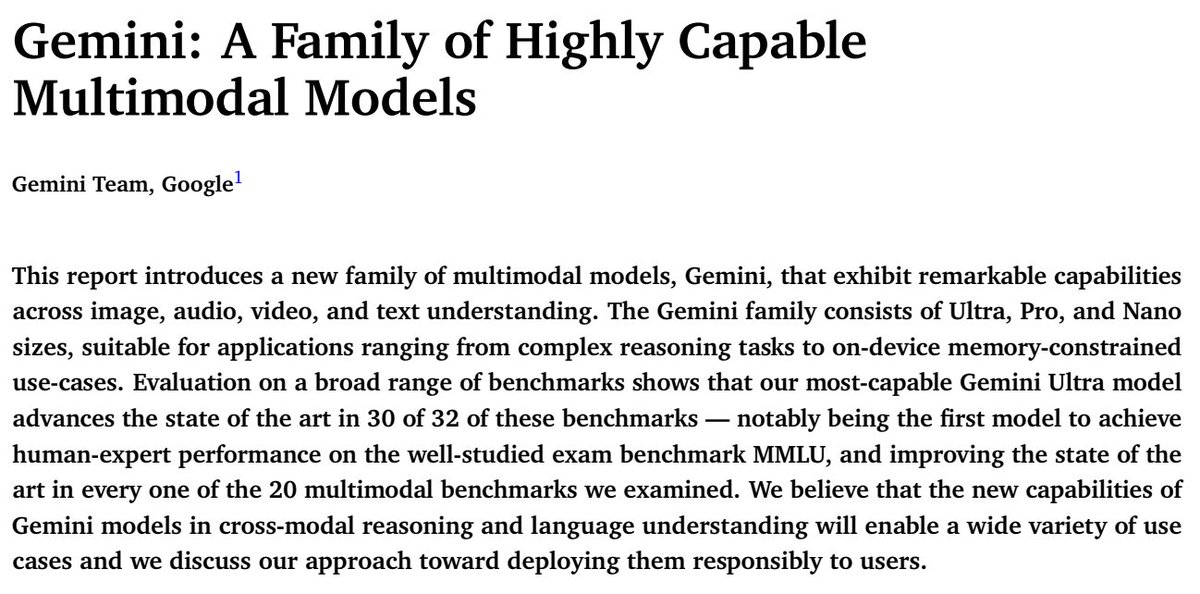
I’m very excited to share our work on Gemini today! Gemini is a family of multimodal models that demonstrate really strong capabilities across the image, audio, video, and text domains. Our most-capable model, Gemini Ultra, advances the state of the art in 30 of 32 benchmarks, including 10 of 12 popular text and reasoning benchmarks, 9 of 9 image understanding benchmarks, 6 of 6 video understanding benchmarks, and 5 of 5 speech recognition and speech translation benchmarks. Gemini Ultra is the first model to achieve human-expert performance on MMLU across 57 subjects with a score above 90%. It also achieves a new state-of-the-art score of 62.4% on the new MMMU multimodal reasoning benchmark, outperforming the previous best model by more than 5 percentage points.
Gemini was built by an awesome team of people from @GoogleDeepMind, @GoogleResearch, and elsewhere at @Google, and is one of the largest science and engineering efforts we’ve ever undertaken. As one of the two overall technical leads of the Gemini effort, along with my colleague @OriolVinyalsML, I am incredibly proud of the whole team, and we’re so excited to be sharing our work with you today!
There’s quite a lot of different material about Gemini available, starting with:
Main blog post: https://t.co/NzSycJl7aE
60-page technical report authored by th Gemini Team: https://t.co/CEdMRyYSLo
In this thread, I’ll walk you through some of the highlights.
Several years ago, when we started pursuing building our own chips, a lot of folks thought this was nuts. We heard a lot of the same refrains you often hear—why make this investment, why invest in a team and all the other fixed costs to develop your own chip when you can buy from other suppliers? And, while we knew we’d partner with those other companies for the foreseeable future, if your customers are telling you they’re thirsty for better price-performance, and you’re driven by what makes customers’ lives better and easier every day, you explore options to make it so.
We realized pretty quickly that designing our own chips was going to be the best path to delivering this value for customers. We were lucky to find and join forces with the amazing Annapurna Labs team, who started with a chip (named Nitro) that offloaded security, networking, and some other virtualization functions from our servers so customers could use more of the server than they could before. Then, that team built a generalized CPU chip, Graviton, which has been very popular and impactful for customers, before embarking on building custom AI chips—Trainium (for training) and Inferentia (for inference)—which are also off to a strong start.
Am very excited about our most recent chip releases at AWS re: Invent: Graviton4 and Trainium2. Graviton4 marks the fourth generation we’ve delivered in just five years (you can see the evolution from left to right in the image below), and it’s the most powerful and energy efficient multipurpose chip we have built to date. And with the surge of interest in generative AI, Trainium2 will help customers train their ML models faster, at a more advantaged price-performance. I’m really proud of the pace of innovation our teams are delivering on and what it is making possible for customers! https://t.co/yxP2Cotz8D
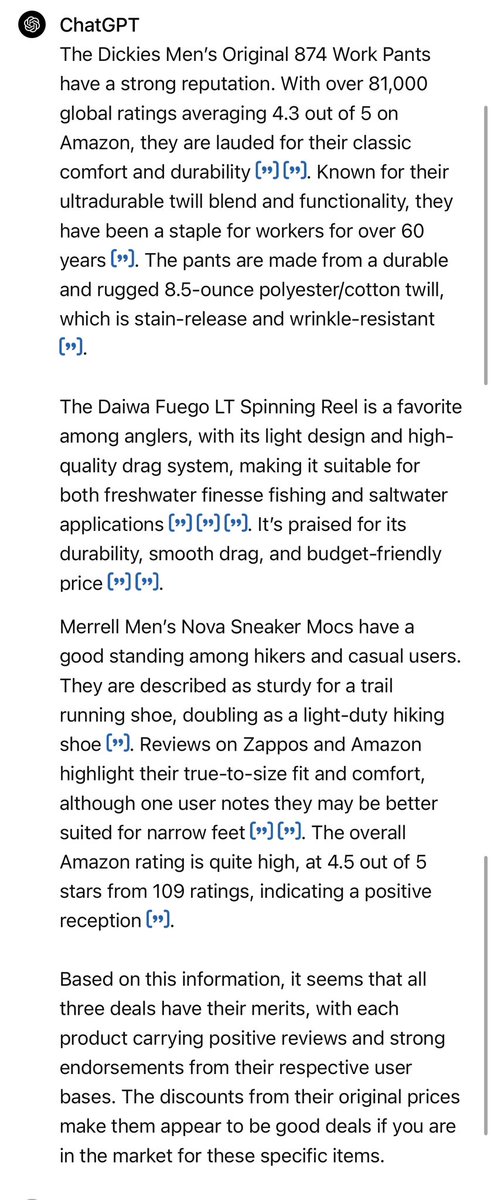
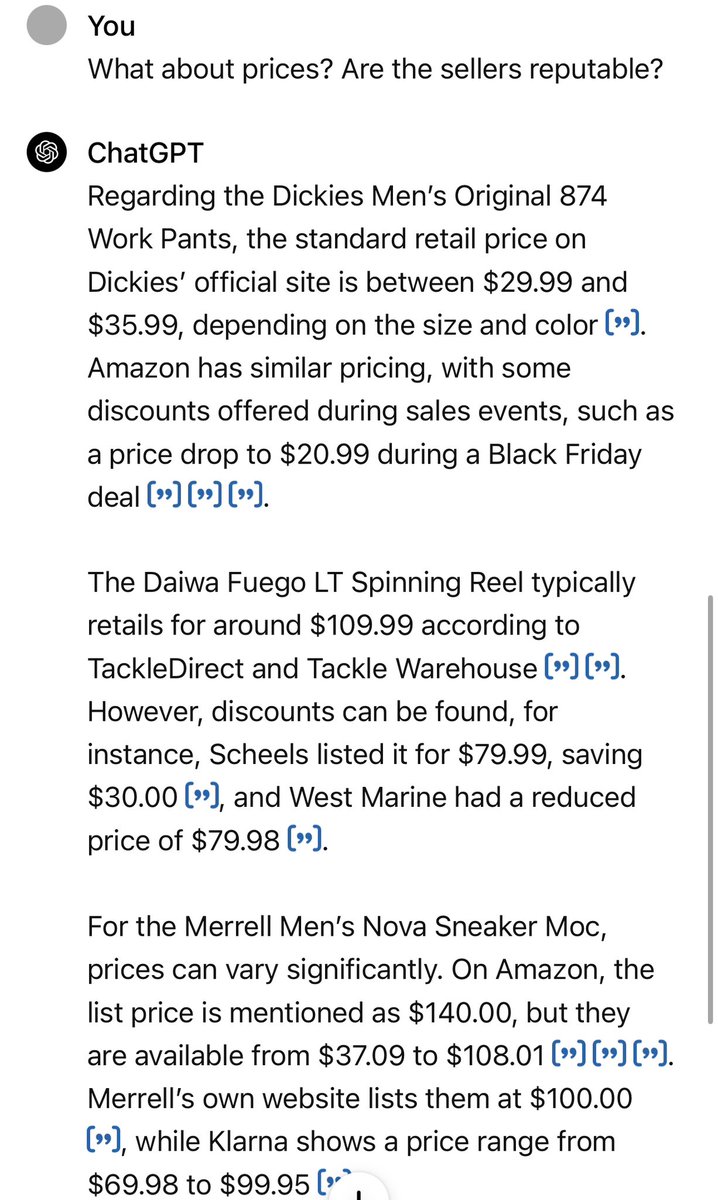
LLMs are going to change retail.
“GPT-4, here is a screenshot of Black Friday deals. Do research on them and tell me what you find. Are these good prices?”
I didn’t see hallucinations (though i am sure they are possible) and the links all went directly to the right pages.














![victorshares's tweet photo. 🚨 Google just launched Duet AI.
It might overtake ChatGPT and Copilot.
7 features that you won’t believe are possible:
[ Bookmark for later 🧵 ] https://t.co/1hwFGbijDX](https://pbs.twimg.com/media/F_3lvQXacAA4Hrp.jpg)