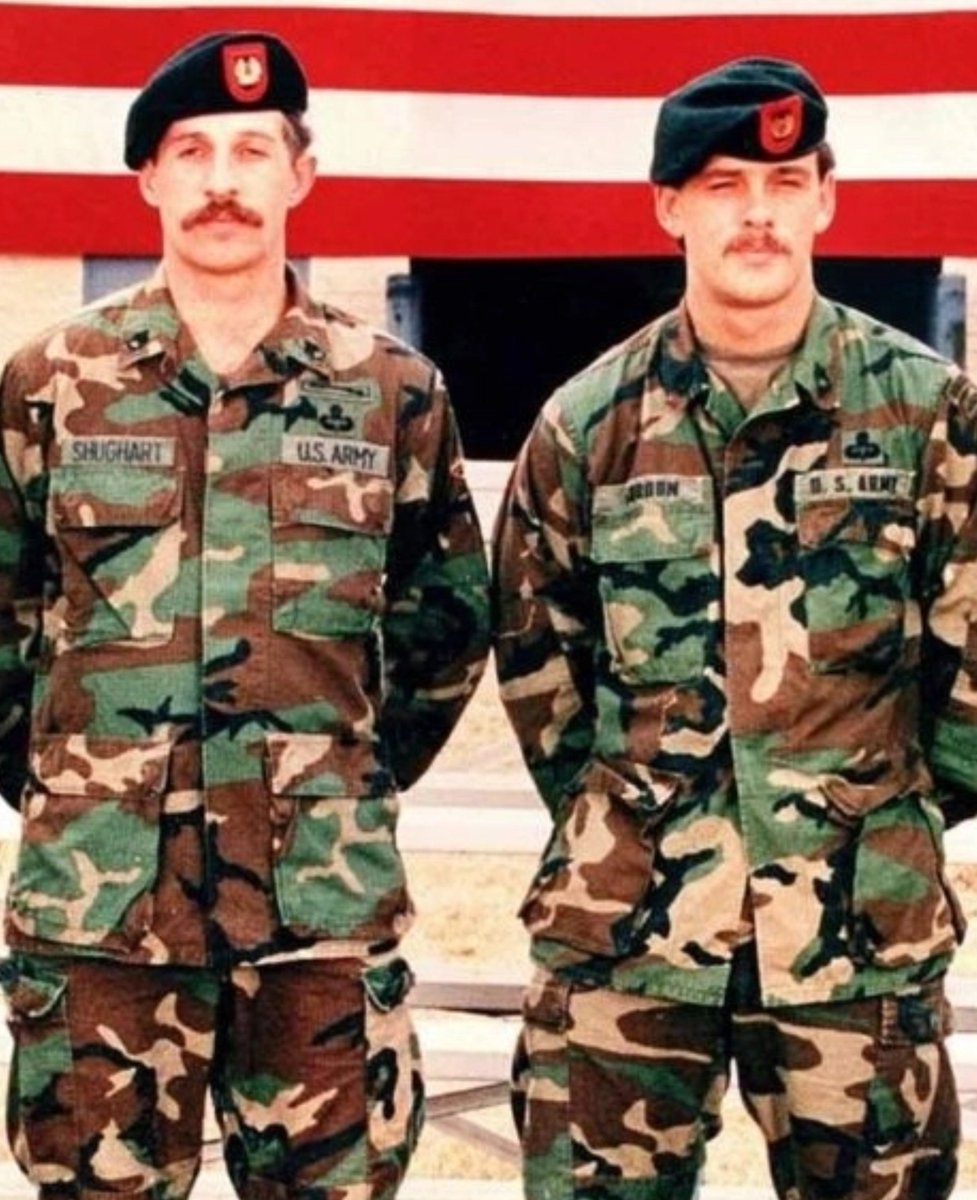
33 years ago this weekend, two Delta Force snipers made a choice almost nobody would make.
Master Sergeant Gary Gordon was 33, from Lincoln, Maine, with a wife and two young kids at home. Sergeant First Class Randy Shughart was 35, a farm kid from Newville, Pennsylvania.
On October 3, 1993, they were in a Black Hawk circling over Mogadishu when another Black Hawk, Super 64, was shot down. Pilot Mike Durant was alive in the wreckage with a broken back and a crushed leg. His crew was hurt. There were no friendly ground forces anywhere near them, and hundreds of armed militia and locals were already converging on the crash site.
From the air, Gordon and Shughart could see exactly what was coming.
They asked to be dropped in. Command said no.
They asked again. No again.
They asked a third time and finally got the green light.
Their helicopter set them down nearby and they fought their way to the wreck on foot. Two men, carrying only what they had on them. They pulled Durant out of the cockpit, set him up in a safer position, and started holding off the crowd.
For a while, it worked. They kept the mob back with precise, steady fire while the numbers against them kept growing.
Shughart was killed first.
Gordon kept fighting alone. When he was nearly out of ammunition, he went back to Durant, handed him a rifle, and told him good luck. Then he went back out. He was killed minutes later.
Durant was captured, beaten, and held for 11 days. He came home alive. He has said for decades that he's only here because of those two men.
In 1994 Gordon and Shughart were posthumously awarded the Medal of Honor, the first since Vietnam. The Navy later named two ships after them, the USNS Gordon and the USNS Shughart.
They didn't stumble into that fight. They watched it from above, understood the odds, and asked three times to go anyway.
Gary Gordon and Randy Shughart. Remember their names.
I resigned from Anthropic today. I spent the last three years doing pretraining research at both OpenAI and Anthropic. Neither company is acting responsibly. They are racing straight to self-improving superintelligence and gambling with our lives. More thoughts below.
The last football jersey Mike Macdonald ever put on was a high school one.
And he never got to wear it for the last game.
Six months ago he won the Super Bowl.
Centennial High School in Roswell, Georgia. Macdonald is a linebacker and fullback who keeps getting stingers, those nerve injuries that shoot fire down your arm.
Then, practicing for what would have been the final game of his high school career, he tears his ACL.
That's it. That's the whole playing career. No college ball. No walk on story. Done at 17.
So he did the only thing he could think of. He started hanging around his own team's coaching staff, unofficially, breaking down what he couldn't play in.
Then he went to the University of Georgia. As a FINANCE major. Football was over.
Except he couldn't leave it alone.
While still an undergrad, he took a job coaching linebackers and running backs at Cedar Shoals High School in Athens. A college kid, coaching high school defense on the side.
He graduated from Georgia's business school with honors. He had a clean, lucrative path in front of him.
Then he sat his dad down and said he wanted to be a football coach.
His father, a business guy, told him no. Straight up. His words about the profession: "Coaching is a tough, tough world."
Macdonald did it anyway.
In May 2010 Georgia hired him as a student assistant, running the offensive scout team. The lowest job in the building. Mark Richt's read on him: "It didn't take long to trust him enough to give him more."
He worked his way to defensive quality control. Got a master's degree. And then, after the 2013 season, his time was up.
He was 26 years old and unemployed.
His own description of that moment: "I graduated college without a job, which was a little scary."
So he gave up. Genuinely, actually gave up.
Mike Macdonald accepted a job at KPMG. Signed the offer letter. He was leaving football for corporate consulting, exactly like his father had suggested.
Now here's where the whole thing turns on a coin flip.
A year earlier, Macdonald had interviewed with the Ravens for a SCOUTING internship. And he blew it, because when the director of college scouting asked about his goals, Macdonald told the truth. He said he wanted to be a coach.
He didn't get the job. Somebody else did.
But he stayed in their files.
So in 2014, when John Harbaugh decided to start a coaching intern program, somebody remembered the Georgia kid who said he wanted to coach.
Two weeks after signing that KPMG offer letter, Macdonald called the recruiter, told them thanks but no thanks, got in his car, and drove to Baltimore.
His take on it now: "Talk about luck of the draw."
He was the lowest guy in the building. Shared an office with two other interns. Drew up opponents' plays on cards so real coaches could use them in practice.
And then he just kept climbing.
Defensive assistant. Defensive backs coach. Linebackers coach. Michigan defensive coordinator under Jim Harbaugh. Back to Baltimore as DEFENSIVE COORDINATOR at 34.
On January 31, 2024, the Seattle Seahawks made him the youngest head coach in the NFL.
Year two, he built the best scoring defense in football at 17.2 points per game, with a franchise record point differential of plus 191. Seattle won 14 of its last 15 including the playoffs and finished on a 10 game winning streak.
February 8, 2026. Super Bowl LX. Levi's Stadium.
His defense sacked Drake Maye six times, picked him off twice, and forced a fumble.
Seahawks 29, New England 13.
At 38 years old, Mike Macdonald became the third youngest head coach ever to win a Super Bowl. He is 3-0 in the postseason.
And here's the detail that finishes it.
Mike Macdonald was born in Scituate, Massachusetts.
The team he beat for the Lombardi Trophy was his hometown New England Patriots.
His own words on the field afterward: "I believe God called me to be a coach and I listened to Him."
A kid who never played a down of college football. Who tore his ACL before his last high school game. Who was two weeks into a consulting job before he turned around.
World champion.
Follow @thesportsontap, we post a story like this every day.
بفيلم #TheOdyssey في مشهد الحوريات انقالت اقوى جملة سمعتها بحياتي ومن يومها وانا افكر فيها، عميقة بشكل خيالي
أوديسيوس يربط نفسه بساري السفينة عشان يسمع أغنية حوريات البحر (السيرينات)، الأغنية اللي محد سمعها وطلع منها حي. واحد من البحارة سأله: "شلون كانت؟" فرد عليه:
"All the things you wanted to be, and then all the things you wished you never wished for. It was a delicious itch you want to scratch, but you find it under the skin, and you can't reach it. So the delicious itch becomes unbearable. It told you what you most want is what you most can't have, and what you most can't have is what you already had and lost."
"كل الأشياء اللي كنت تتمنى تصير … وبعدين كل الأشياء اللي تمنيت إنك ما تمنيتها أصلًا. كانت مثل حكة لذيذة تبي تحكها، بس تكتشف إنها تحت الجلد، وما تقدر توصل لها. ومع الوقت، هالحكة اللذيذة تصير عذاب. كانت تقول لك إن أكثر شي تبيه هو الشي اللي مستحيل تحصله، وإن أكثر شي مستحيل تحصله … هو الشي اللي كان عندك وخسرته."
بمعنى اخر هي ذاك الصوت اللي داخل راسك، اللي يقنعك إن الحياة اللي ما عشتها كانت أحسن من الحياة اللي عايشها الحين. الصوت اللي يهمس لك:
"لو إني اخترت قرار غير … لو إني ما تركت هالعلاقة… لو إني كملت…الخ" ويخليك تدريجيًا تغيب عن واقعك
وأعتقد هذا السبب اللي يخلي اللي يسمعها ما يعيش، مو لأنها تقتل الجسد، لكن لأنها تسرق حضورك
إذا طول عمرك تتحسر على حياة ما عشتها، مستحيل تعيش الحياة اللي فعلًا عندك بكل تفاصيلها
عندما شاهدت Troy قبل 22 عامًا، تمنيت أن أكون محاربًا… أما بعد The Odyssey … فأكثر ما أتمناه، هو أن نعيش جميعًا بسلام… وهذا هو الفرق، بين الفيلمين… الأول مليء بالحماس، والثاني مليء بالنضج.
Si sigues esta cuenta, sabes que no hay traducción de posts en inglés ni copypaste de PFF y ESPN. Es análisis propio, en español, todo con lógica defendible.
Si llegaste por el mundial quédate que lo mejor a penas está por venir. Vamos.
RT si te quedas para la NFL.