One YouTube video got a Valorant pro signed to China's best team. If you're a player, here's why content is the most underleveraged career advantage in esports:
Australian player @signedworld spent months making pro Valorant breakdown videos on YouTube. Then he made one about EDward Gaming, analyzing their playstyle and what they needed to fix.
It went viral on Bilibili. Days later he signed with EDG.
EDG has only lost one game since he joined. Now they're in the upper finals of VCT Masters London.
The conventional path to a pro contract runs through ranked performance and Tier 3 grinds. Signed found a different path; he made it impossible for the right people to not know who he was and what he understood.
There are thousands of players with similar stats. Content is what makes the right people find you before you find them.
Each of these videos produced by esports organizations have millions of views. What they have in common is that none of their thumbnails explain what you're about to watch.
Thumbnails fail when they explain to the viewer the premise before they feel it. The videos that perform best convey their meaning for viewers to understand the stakes in under a second.
All four of these videos make it so that a complete stranger feels the tension before they understand the context.
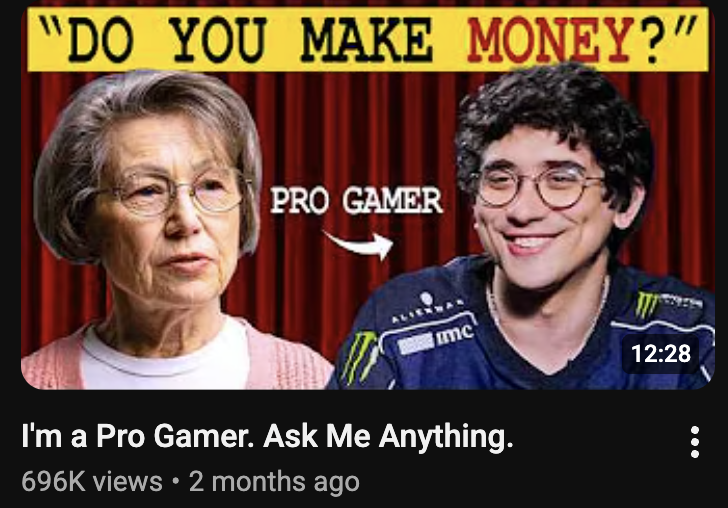
Team Liquid's most viewed League of Legends video isn't about League of Legends. There's a reason why it worked.
Notice how this title is made for a casual YouTube viewer and not an esports fan. There is no mention of Team Liquid, League of Legends, or esports. Anyone who has ever heard of a "pro gamer" understands the concept, giving viewers zero friction to click.
The thumbnail then amplifies what the title already established. A grandmother and a pro gamer are polar opposites with no obvious connection, which creates an immediate curiosity response in anyone scrolling. But it only works because the title already made the video understandable.
Humans have half-second attention spans: the best performing videos make you feel something before you click within a second of scrolling. Titles and thumbnails exist to incite that reaction.
Recently several people have reached out about content strategy and audience development work. Today I'm opening up to select advisory or long-term roles for teams/creators serious about audience growth.
Past client work has netted 300M views + 1M followers. DM and let's talk!
LOUD is the largest esports organization in Brazil. So why does their Instagram feed feature almost no competitive content at all?
Every post on their page is cultural: LOUD focuses mostly on Reels featuring skits, trends, and personality-driven content featuring their members and celebrities. A casual Brazilian viewer sees these posts and immediately resonates with what they're looking at.
Every bit of this is intentional. Despite Brazil having some of the most loyal fans globally, an audience built only on esports has a ceiling; the only way up is to center the brand on wider youth culture.
Most teams treat every platform as a center for match results. LOUD recognized that Instagram is a cultural and lifestyle platform by design. The feed is built for audiences that would never follow an esports team but might follow LOUD.
LOUD's next million followers won't come from esports at all.
@statsmeisterVLR although i havent done a deeper dive on those yet i am a massive advocate for national teams and viewership is definitely a tenet of that. I do plan to examine them properly at some point though!
G2 is seen as one of the best VCT teams in the world while the Valorant community calls them boring. But what do you actually know about G2’s players outside of match day?
Almost nothing, and their content tells you why. G2’s YouTube channel has 30K subscribers despite consistent international attention for years on end.
Nearly everything they produce ties back to match results, like voice comms and competitive vlogs. This is content that only lands if you already follow the VCT and G2 closely enough to care about the result behind it.
The broader Valorant playerbase has never been given a reason to care about G2 as people outside of competition. Content that only lands if you already follow the league speaks exclusively to an audience already inside the pipeline and does nothing to fill it from outside.
G2 being seen as boring is a legibility - not personality - problem because casual viewers have never been shown who G2 is outside of match day.
Paper Rex posted the same short on Instagram, TikTok, and YouTube Shorts with near identical follower counts across all three. How did Instagram double the performance of the other two?
The answer lies in how each algorithm is designed.
This PRX short is inherently shareable. It's designed as content people immediately want to send to someone they know. Instagram's algorithm rewards that behavior and boosts content shared between users. Shareability for Instagram's algorithm is what doubled performance.
TikTok and YouTube aren't built around that same sending behavior. Both prioritize showing content to people based on what they've watched before. PRX's format performed well in pure discovery, but viewers engaged differently. There were more comments because the natural response for these viewers is to react rather than passing it along.
Every algorithm produces different behavioral outcomes. How you distribute your content determines which behaviors you actually get.
Really appreciate the inside context! The long-term management stability piece is exactly what gets lost when orgs optimize for competitive performance alone. I agree that the sustainability point you closed on is the real industry implication if this model scales beyond CR and potentially even into the West. Hope the post contributes to that conversation in some small way
Esports tournaments exist to deepen fan investment for publishers and teams alike. Japan's Crazy Raccoon built a different model entirely, and it doesn't depend on tournaments at all. So what is CR doing differently?
CR uses its streamers and creators as a discovery layer, including casual streams and custom games between creators and pros. Existing streamer audiences encounter CR's esports players through personality before they ever encounter them through competition.
Once audiences resonate with those personalities, competitive attachment follows. The audience finds the esports through the person, not the other way around.
Here's why this works: Japanese audiences have spent decades developing deep parasocial loyalty through idol culture, extending most recently into Vtuber communities. CR's model directly plugs into a behavior that audiences already have.
Japanese organizations are structuring this deliberately. They're aligning incentives with Vtuber talent so that the creator's parasocial infrastructure builds organizational brand equity rather than just individual following. In the long term, audience attachment transfers to the org instead of leaving with roster moves.
This is a culturally specific pathway to the same destination in fan loyalty for teams over the long term. What Western teams can take away from CR is to ask what cultural infrastructure already exists that esports hasn't learned to plug into yet.
What do you notice about NRG's most popular Valorant videos? None of them are about esports.
Not a single one of their most popular videos require knowing who NRG is, what their roster looks like, or whether they're winning competitively.
These viewers didn't arrive as NRG fans. They arrived through formats legible to anyone who plays Valorant.
Some fraction of that audience converted into organizational followers through repeated exposure. This is the superfan pipeline: casual viewers enter through universally legible content, repeated exposure builds attachment, and a small cohort converts into fans of the team who drive organizational loyalty.
Most esports content speaks only to people already inside the pipeline while ignoring the wider audience above it. The content that actually builds fans of teams is the content that doesn't require you to be one yet.
Fans of esports teams are made by content that meets them before they care.