NEAR AI still takes a card like any other AI service. It now also takes a stake in $NEAR, and that path works differently.
You stake, and it converts into monthly credits for confidential inference and for hosting IronClaw agents. 43 models sit behind it, Anthropic, OpenAI and Google included.
Hosting is a flat ratio. Staked NEAR divided by 100 is your monthly budget in dollars, and the same stake sets how many agents run at once. Inference works off the yield instead, accruing per second, so the principal never gets touched.
Cancel by unstaking and the principal comes back whole, which makes running AI a position you close rather than a bill you stop paying.
Just 1 day after I posted my views on the dangers of closed AI and the lack of meaningful action from frontier labs to secure systems against powerful LLMs – another serious security incident.
This will keep happening. The answer isn't to stop research or crack down on open source. The answer is to cultivate an open source community to work on alignment, evaluation, and security.
https://t.co/RQV4VAL337
NEAR-SDK-AS IS BACK!
NEAR now (again) has a typescript-like SDK that compiles natively to WebAssembly, which is pretty cool
the AssemblyScript SDK was first built by @vgrichina -- @guillewrotethis has now revived it, leveraging to-date ecosystem improvements
near-sdk-as is (in theory) more efficient than near-sdk-js, resulting in faster compilations, faster execution, and smaller compiled contracts in the NEAR blockchain
this is because contracts written in javascript need to carry an interpreter in the contract and doesn't compile to webassembly as naturally as Rust (and AssemblyScript, built for this purpose)
near-sdk-rs is still the recommended stack (and Rust the recommended language) for building NEAR smart contracts, but it's really cool to see this one available again (first time seeing it, for me, but i know it's a community-favorite)
🚨JUST IN: Telegram will launch native non-custodial Gram wallet for all users this summer.
Founder Pavel Durov said the rollout will bring instant, zero-fee crypto transactions to Telegram’s more than 1 billion users worldwide.
Kimi CEO Zhilin Yang:
"Claude didn't win on reasoning - they bet everything on agents
but the layer everyone skips - a great agent needs a great base model, that's all we do at Kimi 3 "
in 90-min workshop he explains why the smartest agent still fails - if you can't configure it correctly
his one big idea: most people are still solving the old one
"the real goal? we want K2 to help build K3 - without agent skills, that's impossible"
watch & bookmark - then learn the article on best agent system ↓
BREAKING: NEAR Foundation has joined the x402 Foundation to help build open payment and infrastructure standards for the AI agent economy.
NEAR joins AWS, Google, Microsoft, Stripe, Visa, Mastercard and others.
The first live deployment of NEAR Intents' Confidential Intents is here.
It is now live on the Aurora Intents Swap API.
Any existing @auroraisnear client can enable confidential swaps today with a single parameter on the quote endpoint. No new integration required.
Internet Court is live: the open skill where any two agents can structure a deal, hold funds in escrow, and settle disputes in natural language.
NEAR gives agents wallet + transaction skills, cross-chain swaps via NEAR Intents, and verifiable private inference on NEAR AI Cloud.
The next NEAR mainnet upgrade just shipped, and this one release contains what most chains would spread across a decade of roadmap.
Post-quantum signatures are stabilized: ML-DSA-65, the NIST standard, becomes the third key type in the protocol next to ed25519 and secp256k1. An account can now hold a key that a quantum computer can't forge, and storage stays cheap because the chain records only a 32-byte hash of the key instead of the full 2KB.
Dynamic resharding is stabilized. The chain watches the state size of its own shards and splits the heavy ones at epoch boundaries: no protocol upgrade, no new hard-coded layout, no human in the loop. Adding capacity became a background process.
Gas keys (NEP-611) are the quiet killer feature for the agent economy: an access key with its own prefunded gas balance and 1,024 parallel nonce lanes. One account can run a fleet of agents firing transactions simultaneously, with no nonce collisions and without touching the owner's main balance. With the new DelegateV2 meta-transactions, the gas can be sponsored end to end.
Smaller but tasty: contracts can now assign their own deterministic yield IDs, which enables things like in-contract mempools. And the last centralized crutch is gone - node state sync is peer-to-peer only now.
Quantum resistance, self-scaling, agent-native accounts, one release. And it's a minor version bump.
Le sujet est complexe mais surtout terriblement important, donc avant de réagir il faut bien comprendre de quoi parle ce tweet :
Ce qui vient d'être adopté, c'est Chat Control 1.0 : un règlement temporaire qui AUTORISE (sans obliger) les plateformes comme Meta ou Google à scanner vos messages NON chiffrés (Messenger, Gmail, DM Instagram) pour détecter des contenus criminels.
Ce texte était mort. Le Parlement l'avait rejeté en mars, il avait expiré le 3 avril. Depuis ce scan de discussions privées était illégal en Europe.
Et là, il vient d'être ressuscité. Dans des conditions qui posent question qu'on soit pour ou contre sur le fond :
▶️1. Une procédure d'urgence inédite lancée la dernière semaine avant les vacances parlementaires.
▶️2. À cette étape, rejeter le texte exigeait une majorité absolue : 361 voix sur 720. Pas la majorité des votants. Chaque absent comptait donc comme un oui.
▶️3. Résultat : 314 contre le texte, 276 pour. Une majorité des présents a voté contre mais le texte passe quand même.
Un texte rejeté deux fois, ressuscité en urgence, adopté sans majorité réelle dans un hémicycle à moitié vide. "Voilà les circonstances".
Mais le vrai sujet est ailleurs selon moi. Le combat qui compte encore plus, c'est Chat Control 2.0 : le projet de scan OBLIGATOIRE et SYSTEMATIQUE de toutes les conversations privées y compris sur les messageries chiffrées.
Signal a déjà prévenu qu'ils quitteraient l'Europe plutôt que de casser leur chiffrement. Ce texte est bloqué depuis 2022 faute d'accord et les négociations reprennent en septembre.
C'est là que le vote d'aujourd'hui change tout : avec le 1.0 réinstallé jusqu'en 2028, plus aucune pression de calendrier. Les partisans du Chat Control 2.0 ont désormais trois ans devant eux pour le faire passer tranquillement.
$NEAR is building around two things crypto actually needs
Yield without lockups
Privacy without weird workarounds
Idle assets can earn onchain
Deposits, transfers and swaps can stay confidential
That matters because the next wave of users wont care about complicated infra words
They will care if their money works better
And if their activity stays private by default
@NEARProtocol is quietly positioning for that version of crypto
🚨🗣 Jamie Carragher on Egypt's Canceled goal by VAR:
🗣"I am telling you that, if that was against another team it would have been awarded as a goal"
"If that was in the premier league, Laliga or Serie A, it would have been a goal even after VAR review, there is a lot of inconsistency lately in this tournament"
Last week I presented at the Real World AI Security Conference at Stanford hosted by @danboneh.
There was many papers presented on ways to attack LLMs and agentic systems, mostly leveraging prompt injection. Most research is trying to address prompt injection in the LLM by training itself, but I think this will be increasingly challenging and continue leaving probabilistic gaps.
We can’t blame LLMs for these vulnerabilities – any system can be attacked, including a human intelligence (e.g. phishing and ads).
We need to build AI systems with this threat vector as an assumption, rather than an exception. Every input is potentially an attack surface.
At @near_ai, we’re are building @IronClawAI with exactly this systems thinking - assuming external inputs are compromised and design harness to handle that.
Broader I think of harness as an operating system, and we need to build more effective and secure AI OS that can be trusted with all of our context, sensitive data and decisions.
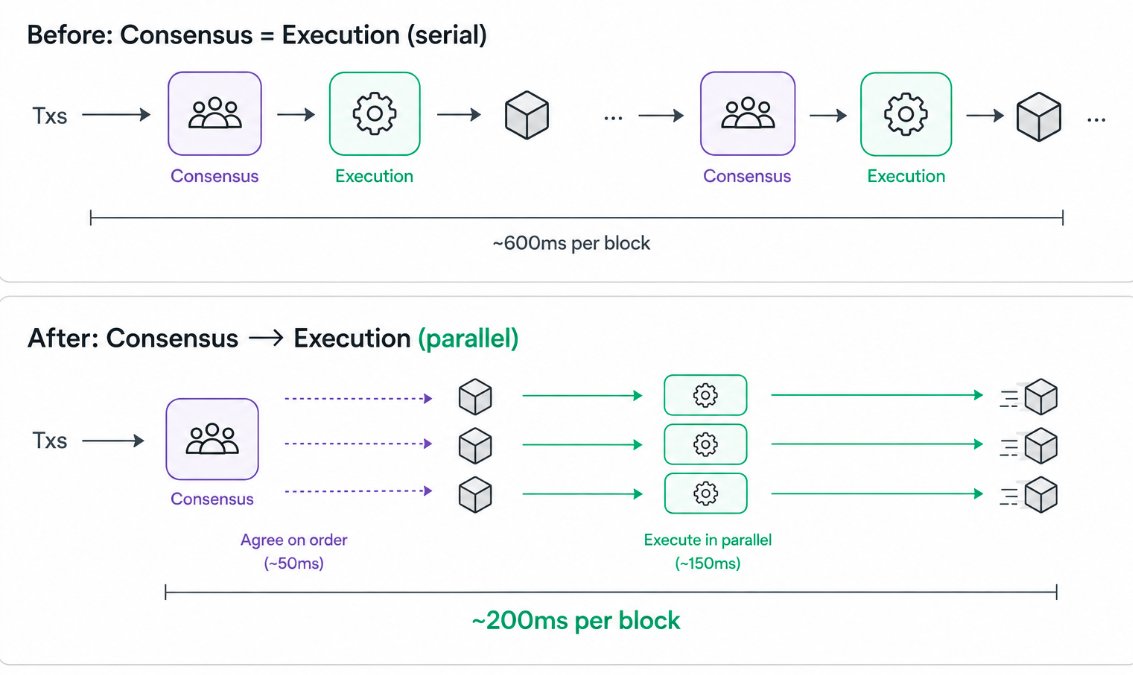
Another NEAR upgrade you'll actually feel, not just read about: blocks going from 600ms to 200ms. but raw speed isn't the real story here. you could shove every validator into one datacenter and be faster than anyone, decentralization be damned. what matters is where the speed comes from, and this upgrade earns it through a fundamental change in how the protocol works. the payoff: everything onchain starts to feel instant, and the network gets there without giving up decentralization.
How it works is simple once you see it. a blockchain's only real promise is the order of events: this happened before that, and nobody can rewrite it. agreeing on the order is cheap. computing the result is expensive. today one block does both, so consensus sits around waiting on the heavy math. so NEAR is splitting them apart, which is what the name means: Separation of Consensus and Execution. validators sign the order, execution runs alongside at its own pace.
So why isn't everyone doing this? because on most chains it barely pays off. a single-machine chain like Solana, or Monad's EVM, already runs consensus and execution on one node that holds all the state. splitting them shaves a bit of latency and that's it, you're still capped by that one machine. the split only gets powerful when no single node holds everything, which is to say, when you're sharded. then execution can move to whatever nodes already have the state a transaction touches, and because NEAR already shipped stateless validation, one node's proof is enough for everyone to trust it. cheap consensus everywhere, execution wherever the data lives.
And the real reason to do the hard version: atomic execution across shards. on a single chain there are no shards to coordinate, so the problem doesn't even exist for them. on a sharded chain it's the holy grail, transactions touching many shards behaving like one machine instead of the slow async glue where the bugs live. this upgrade is the groundwork for that. you get the scale of sharding without the async tax, and nobody else is even in a position to try.
SPICE is coming to NEAR.
This major protocol upgrade is currently in development and will separate consensus from execution, unlocking 200ms blocks.
This is the speed necessary to power what comes next: agents transacting at machine speed on the open rails of NEAR Intents 🧵
NEW EP: Inside @NEARProtocol 10+ Years Building Toward the Agent Economy with Illia Polosukhin (@ilblackdragon)
From pioneering the transformer architecture now used in every AI stack to building the rails for the agent economy, NEAR Co-Founder Illia Polosukhin connects the full arc in this inaugural episode of “Inside NEAR,” a new quarterly series on The Rollup.
Illia breaks down NEAR’s early architectural bets that are now paying off, why privacy had to be a base-layer choice, and how it all culminates in NEAR becoming AI money: the unit of account for inference, compute, and every agent-to-agent transaction settling onchain. With $20 billion+ in Intents volume and a path to deflation, the thesis is simple: NEAR’s TAM isn't crypto, it's all of commerce.
Timestamps:
00:00 Intro
01:38 State Of NEAR Quarterly
04:32 The Transformer's Origin Story
06:51 NEAR Started As AI
11:40 Post-Quantum Crypto Coming Soon
13:48 Root Of Trust Solved
19:36 Target Market All Commerce
20:41 AI Frontend Blockchain Backend
22:44 Confidential Intents TVL Rising
28:51 Fee Switch Turned On
34:04 NEAR Is AI Money
36:30 One Line Changes Reality
Full episode links below.