@ValueAddedRS Also at the same time PSA relaunched their standard teir and opened their European hub in Frankfurt, same parent company, maybe just trying to move traffick back to PSA?
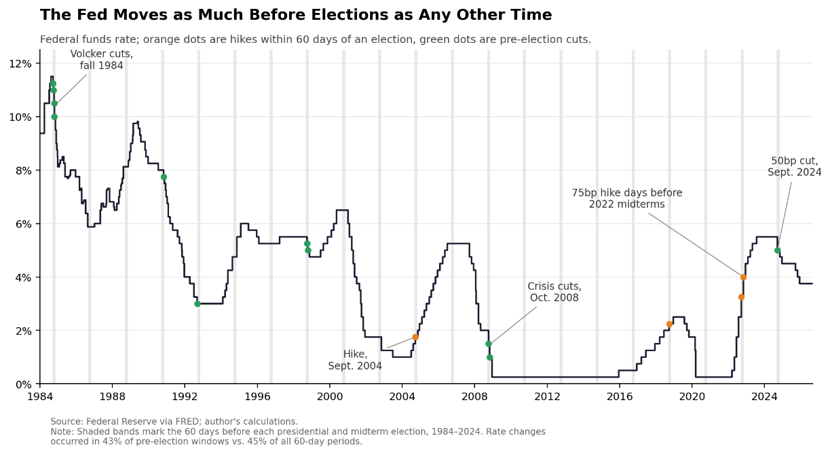
Last time the Fed hiked before an election? 2022 midterm under Biden.
From 1984 to 2024, the Fed adjusted rates (up or down) within 60 days of an election (43%) as often as in any other 60-day period (45%).
@sarah_cone The issue with this framing is that the messenger is not a neutral actor. If a push for regulation is framed as a bigger danger, what is the conclusion? That power continues to consolidate in those that own the technology. As always, balance is the answer, and Thiel offers none.
AI will cure cancer and it will kill us all are not contradictory positions, they are both rhetorical methods to make the exact same argument: the future is defined by AI. You are a satellite revolving around the AI sun, at best.
These undefined prognostications of future omnipotence distract from accountability in the present. This rhetoric has two effects 1) it distracts from today’s upside down value capture versus value creation equation 2) it forces a psychological centering of AI and AI companies at the expense of humans and the rest of the world’s institutions.
Any technology’s utility is a function of our ability to control it, not its raw hypothetical power without controls. Chemotherapy requires precision to kill cancer and not kill a host. Nuclear reactors are defined by their controls more than the reaction itself. That a given technology’s utility is bound by the precision of its controls was Palantir’s fundamental insight at its inception: the amount of security the US government can guarantee its citizenry is defined by how much it can guarantee rights to privacy more so than the raw capability to identify threats. If you do not enhance both privacy and security, your product is a toy. AI is not the first technology that couples control with utility.
In the present, the models are voraciously consuming knowhow like a parasite eating its host until both die. Every company I speak to is sprinting to control a spend:outcomes ratio that exploded on them before they could learn how to govern it. They are observing their intellectual assets eroding like a sand castle into the ocean. They are stuck between being upside down on value leakage, yet being told they have no agency over their future.
The inevitability of the arrival of a deity forces individuals to define themselves as a function of that deity. Nobody wants to be that luddite who tells you the Wright Brothers will never fly. Nobody wants to run Polaroid or Blockbuster. No young person wants to be a part of the permanent underclass. Forward leaning humans are psychologically berated into defining their skillsets and objectives as a function of AI. Their careers are lottery tickets. They define utility through how good they are at tickling a model. “Ride the exponential” is a mantra that allows you to be “good” in a moral sense, without earning it.
If you dare to expose yourself as a luddite that is not getting results today, well that is a “skill issue,” or you simply aren’t using enough tokens. This propaganda pursues an inevitable centering of AI, with humans as peripherals. The only thing you have real agency over in the future? Using more tokens of course.
I think if you are going to virtue signal about protecting our future, you should also own the implied vice that comes with your position. Prognostications of armageddon are inextricably linked with acceptance of the bad things that exist in the world today.
350,000 people die of sepsis in hospital settings in the US alone every year. Life expectancy in the US has flatlined over the last 20 years while healthcare spending per person has doubled. 30-40% of the food supply is wasted while 18% of households with children experience food insecurity. 19.5% of drinking water is lost in transit to consumers. A significant portion of the world’s energy supply is threatened by a fanatical regime because the strait of Hormuz is still contested. Putin’s death machine continues to slaughter Ukranians every single day as technological efficacy literally defines meter over meter of protected or conquered land. The CCP has 230 times the shipbuilding capacity of the United States and the implied ability to control the world’s commerce and security. $1.7 trillion of excess, unproductive working capital is locked up in the top 1000 companies in the US, capital that is not producing goods and services for every day Americans. Americans paid over $250 billion in credit card interest at over 20% APR last year and more than half of savers earn less than 3% interest on their savings. Real wages have stagnated, middle-wage workers real income is up only 6% since 1979 while low-wage workers are down 5%. We have a shortage of ~7 million homes in the US. 8.5 million acres burned in wildfires so far this year. As of year end 2025 2,060 gigawatts of generation and storage capacity were waiting for grid interconnects (double the capacity of the existing power fleet). I digress.
We are making real progress against each of these miseries, and many more, because of the incredible progress in AI systems over the last several years.
Perhaps ironically, success in all of these domains is a function of how precisely controlled the models are. For the cognitive labor humans know how to wield to achieve real world outcomes today, open source or off-frontier small models are already at parity for at least a plurality of use cases on a price/performance basis. Those customers reliably outperform the frontier when they incorporate their own proprietary data and decision traces. The most consistent pattern I see over and over again is real world use cases shrink their reliance on general purpose AI’s over time. They encode deterministic knowledge and/or post-trained models on smaller model footprints. It is empirically a wildly optimistic future with AI as an accelerant for the pluralistic, wonderfully diverse means of advancing the human condition against problems you can measure and make progress against today.
We should also own that these horrible challenges persist because these systems are not yet good enough to fully solve them. They are worth improving.
The bay area is abdicating responsibility for the world as it is today while claiming ownership of the world as it might be tomorrow. DC and our political leaders are polarizing into zero sum positions. These are the luxury beliefs of children. Build something people need today, at a price they are willing to pay when not pressured by the social herd, if you want the opportunity to do it again in the future.
@aj_geo_analysis Yeh but they’ve also announced that Saudi ships are not blocked in the Red Sea. The assumptions you’re using are not based on what’s happening on the ground in this one.
@altcap Can you explain your flip flip over the past month more in depth? From the US will be destroyed by China is AI development slows to everyone needs to slow down now?