What Has Changed in Tigray?
We are witnessing something unusual in Tigray as town after town, residents come onto the streets to welcome ENDF/TPF forces after the TPLF is pushed out. What first looked to me like an isolated reaction in southern Tigray has continued farther north, with the crowds appearing to grow along the way.
When Alamata, the first major town to fall, was taken, I initially thought the explanation was straightforward. The TPLF had long faced political difficulties in the area, and many residents were already hostile toward it.
Mekelle surprised me. Even then, I wondered whether the crowds were largely urban youth sympathetic to Getachew Reda, or whether some of the scenes had been encouraged by pro-government networks.
But as similar scenes appeared in different cities and towns, including today in Adigrat, where we saw the largest crowd so far, that explanation became increasingly difficult to sustain on its own. What I first thought could be explained locally was beginning to look like a wider pattern.
That pattern becomes even more striking when compared with 2020. When the ENDF entered Tigrayan towns then, the dominant images were empty streets, fear and uncertainty, with nothing resembling the public welcomes we are seeing six years later as the TPLF retreats. The contrast raises a much larger question about what has changed inside Tigrayan society during the years in between.
Some of that change may reflect exhaustion with TPLF rule. After decades of political dominance, the organisation has been weakened by internal division, disputes among political and military leaders, accusations of corruption and abuse, and another round of mobilisation. Families that already paid an extraordinary price during the previous war may simply have reached the limits of what they are prepared to sacrifice under the same political leadership.
Yet dissatisfaction alone does not fully explain why people are willing to express themselves so openly. People can lose confidence in a political movement and still remain quiet when they believe its armed forces may return. Coming onto the streets carries personal and political risk. The growing willingness to do so may therefore indicate that fear of a TPLF return is also receding and that some residents are beginning to see the balance of power inside Tigray differently.
That changing perception is probably reinforced by the composition of the forces entering these towns. Residents are seeing ENDF soldiers alongside the Tigray Peace Force, whose members carry Tigrayan symbols and include fighters and commanders from the region. Their presence gives the change of power a recognisably Tigrayan dimension and may make it easier for communities shaped by the experience of the previous war to accept.
Years of conflict have also left many people exhausted. When fighting moves away, roads reopen, businesses begin functioning and ordinary life starts returning, relief itself can bring people onto the streets. The same crowd can include people disappointed with the TPLF, people hopeful about a political alternative and people whose immediate concern is simply that their children should not live through another war.
Getachew Reda’s return to Mekelle should be understood within this changing political mood. The reception he received suggests that there is still space for Tigrayan political leadership outside the current TPLF establishment, particularly among constituencies frustrated with the direction of the old leadership.
For Getachew, however, the moment also carries a warning from his own recent experience. During his leadership of the interim administration, he enjoyed considerable goodwill, especially among younger Tigrayans, and had an opportunity to turn that support into a durable political base. He failed to use that momentum before the old establishment and influential military actors regained the initiative. If another opening is emerging, he will need to understand that public goodwill becomes politically meaningful only when it is organised and translated into a credible alternative. He has already seen how quickly such an opportunity can disappear.
These scenes cannot tell us exactly how far the change extends across Tigrayan society. But after Alamata, Mekelle and the succession of towns farther north, it is becoming increasingly difficult to treat what we are seeing as a passing reaction to one military advance. The repetition itself is politically significant in a region where the TPLF once enjoyed an unusually strong identification with the defence of Tigrayan political interests.
The deeper question is whether that relationship is now beginning to weaken. The TPLF may be losing territory, but the more consequential loss would be the assumption that Tigrayan society will naturally return to it once the battlefield settles. If that assumption is fading, the struggle over what replaces it may become the defining political contest inside Tigray after the war.
While global attention is fixated on the war in the Middle East, and some of us are focused on Ramadan, here are some less-reported yet significant developments in Ethiopia.
• You might recall that the federal government moved much of its military to the northern theater with the aim of “neutralizing” the Tigray/Eritrea threat. Yet, the war has not broken out, primarily due to the outbreak of fighting in the Middle East. However, claims by some diplomats that the army has been withdrawn from the Tigray border and redeployed to Amhara are not accurate. The army remains positioned along the Tigray and Eritrea borders (Afar and Humera). Field commanders have been instructed to maintain battle readiness to launch offensive as soon as the Middle East situation clears.
In the mean time, the prolonged reduction of ENDF deployment in Oromia and Amhara is being effectively exploited by rebel movements in both regions.
• Fano has delivered severe blows to regime forces in Amhara, overrunning several towns in Gonder, capturing hundreds of regional paramilitary personnel, militia members, and civilian government administrators. Several senior commanders of the former regional special police force are among those killed. Much of Gondar has fallen under Fano control.
Fano’s latest campaign is significant for two reasons:
a) Despite the regional security office training and deploying over 100,000 paratroopers and militia to fill the vacuum left by the ENDF’s departure, Fano has managed to overrun these forces, killing a number of reputed senior commanders. This suggests either a serious lack of motivation or significant infiltration of government forces by Fano. In short, it appears much of the regional security forces’ loyalty may not lie with the government but rather with the rebels.
b) The campaign clearly signals continued expansion of the battlefield further south, rather than toward Tigray/Eritrea as envisioned by Abiy Ahmed.
In related news, senior leaders of the Amhara Prosperity Party, including the Deputy Prime Minister, are reportedly planning to stand for election in the regional capital, Bahir Dar, rather than in their traditional rural constituencies where they previously contested elections.
- In Oromia, the OLA has also continued attacks against regional security militia forces deployed to fill the vacuum left by the ENDF, forcing the government to resort to intensified air bombardments using drones and helicopter gunships. Notably, these airstrikes are being carried out within a 100 km radius of the capital, particularly in East Shewa and North Shewa zones. For instance, as many as 30 air attacks have been conducted in Adami Tulu woreda of East Shewa in the past week alone.
What prompted Abiy barrage of air attack? Over the last year, the OLA has been moving much of its fighters and battle tested commanders from Western and Southern provinces to Shewa and Arsi zones, silently strengthening its position in the strategic central Oromia. Thus, they are not only taking full advantage of vacuum left by ENDF to rout regional security forces, but also fortifying their positions in central Oromia not to be dislodged even when ENDF return in full force to Central region. The government wants to prevent such fortification but air bombardment without being reinforced with ground operation might not be sufficient deterrence.
The two rebel movements’ continued success in overpowering regional security forces in Amhara and Oromia will force the federal government to make a choice regarding the planned war against Tigray/Eritrea: either redeploy the ENDF back to the two regions to contain the rebels, or proceed with launching the offensive against Tigray/Eritrea in the hope of a quick victory. As the Middle East war prolongs, waiting further for its outcome may no longer be an option.
Drumbeating for another war?
A few weeks ago, I warned that Abiy was preparing for another war - this time with Eritrea. If anyone had doubts, the article published on Al Jazeera under the byline of former President Mulatu Teshome - whose authorship I strongly doubt - only reinforces my point.
#NoMoreWar
#NotInOurName
انا لله و انا اليه راجعون
The guardian of the Ka’bah and keeper of its key, Dr. Saleh bin Zain Al-Abidin Al-Shaibi has passed away this morning
The deceased was the 109th Guardian of the Ka’bah since the Conquest of Makkah
This is a national disaster! This report from East Gojam of Amhara state says of 996 schools only 32 have been operating. And only 13,000 kids out of 549,996 have been able tp attend school. This is all due to the ongoing civil war!
BREAKING: IRAN SAY THEY ARE FOLLOWING INTERNATIONAL LAW AND ACTING IN SELF DEFENSE
"Conducted on the strength of Article 51 of the UN Charter pertaining to legitimate defense, Iran’s military action was in response to the Zionist regime’s aggression against our diplomatic premises in Damascus. The matter can be deemed concluded. However, should the Israeli regime make another mistake, Iran’s response will be considerably more severe. It is a conflict between Iran and the rogue Israeli regime, from which the U.S. MUST STAY AWAY!"
The Somali people, from coast to coast, are our closest partners, economically and socially. There is no interest Ethiopia can sustainably advance at Somali’s expense and vice-versa because our security and economic opportunities are too interdependent.
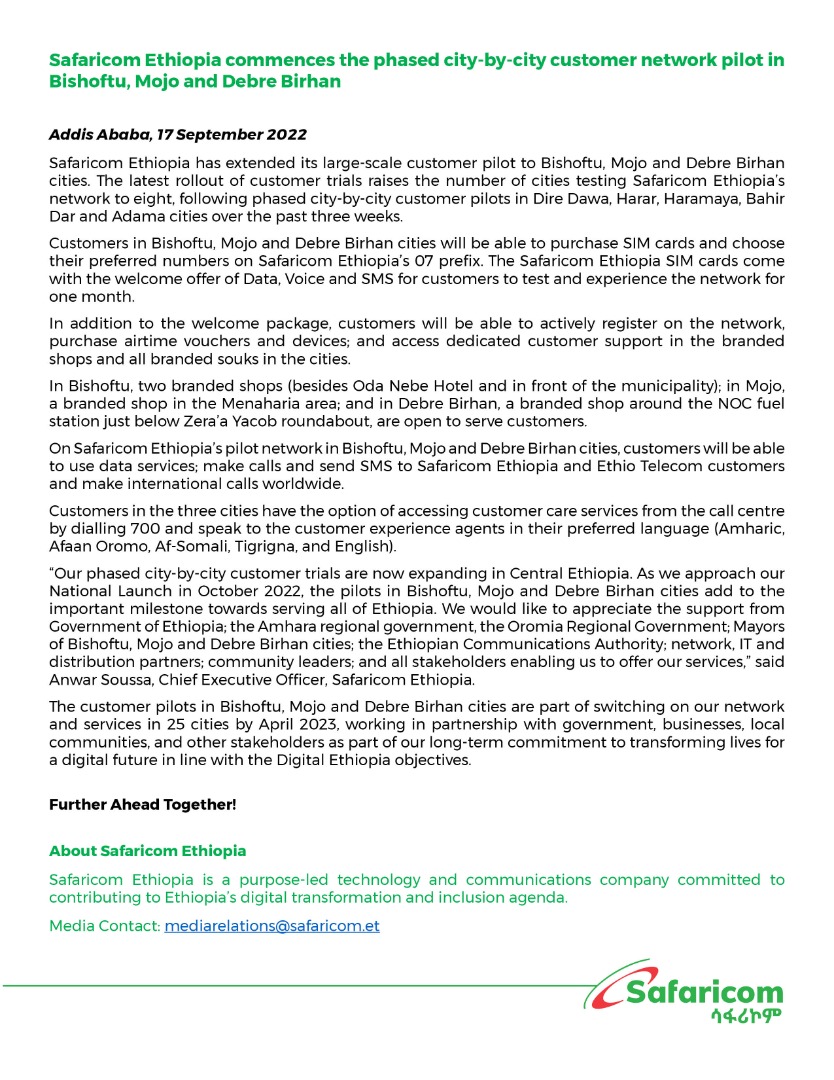
Failed Telecom company before it started
Biased and corrupted recruitment process of
@SafaricomET
We was concerned about @SafaricomPLC
as usual...
via @addisstandard
https://t.co/KAZMdjMP82
1/4 Congratulations to William Ruto for being affirmed as the 5th president of Kenya. In addition to deepening democracy in your own country, we hope you will build on President Kenyatta’s efforts to end the civil war, restore peace to Ethiopia and help secure stability
4/4 struggling to establish peaceful, credible and fair electoral process. Congratulations Kenyans. After long ups and downs, you have made it to electoral democracy. Don’t take it for granted. Protect and strengthen it!
3/4 from you. The conduct of the electoral body in managing the election process and the Supreme Court in adjudicating the post election dispute is incredible. The professionalism, impartiality and efficiency the two bodies displayed sets example for countries still
2/4 in our region. Mr Raila Odinga, you have played an indispensable role towards democratization of Kenya. Your amazing resilience and commitment to the electoral process for decades have made it possible for Kenyans to consolidate democratic politics. We have a lot to learn