Energy Abundance, AI Power & Data Centers, NBA, & Rap posts. Background in equity & credit markets, startups, & IB. Personal views NOT employers. NOT advice.
Would love to see this same curve plotted against calendar time and training cost ($ or FLOPs). Evenly spacing model releases makes the recent drop look like a vertical takeoff, but without the denominator you can't tell how much is algorithmic efficiency vs. throwing an order of magnitude more capex at the cluster.
We decided to provide more transparency into pretraining progress at OpenAI for the sake of moving toward shared safety bars. In “Perplexity and Intelligence” I argue for common limits based on perplexity and other measurements, with progress beyond them gated on our ability to understand AI behavior.
https://t.co/XX35m5vq89
no one's saying they don't exist, the issue is whether they exist at a scale that is widely generalizable and quality enough to guarantee output success. there's a reason companies with good KPIs succeed more than worse ones. knowing what to measure, set goals against, and evaluate progress is a skill.
Excited to see this play out! Pointing out that unverifiable domains are harder to scale than coding has people somehow thinking I'm overly bearish, when it's really just a realistic view of how RL works. Code gives you clear, binary pass/fail signals. Writing, business strategy, and design have subjective quality and much longer real-world feedback loops. E.g., does this code work vs. does this PPT slide effectively convey our business strategy?
The gains we're seeing in those areas are real, likely driven by transfer learning from verifiable reasoning and better rubric-based RL technique. The encouraging part is watching labs attack the verification bottleneck head-on - let technologists cook and come up with innovation.
We'll see how far it goes, but the real unlock comes down to two things: nailing which evals actually map to real-world value, and automating verification rigorously enough that models improve on the substance instead of just gaming the judge.
Yes, it is reasonable to expect AI models struggle more with unverifiable domains, but I do think it is worth noting that we also see very large gains in domains without automatic verification as well.
Here are human evaluations of AI in writing, business problems, design, etc.
Apple is all about the integrated ecosystem experience. They always design things end-to-end and want it to remain an apple closed-loop experience. think they prefer to build from the ground up. something must've changed on how they measure ai capabilities to decide now the time is right.
imagine a lot of $, talent, and org focus will be thrown at it. super excited to see them in the face and hope it becomes a real focus vs. others that fell flat (e.g., car, VR headset, etc.).
Lots going on in energy! TL;DR: I'm optimistic and everything will be fine.
Last week, every major grid operator answered FERC on large loads and they all roughly point in the same direction. DCs that can “flex” will get connected first. PJM, MISO, NE, and NY all proposed some version of “non-firm” service, where you get on the grid sooner if you accept curtailment when prices spike and/or the system gets tight. DCs will also pay for the upgrades they cause. Much of this (and more) is in the permitting bill that passed the Senate last week.
As part of this, I expect designs to push toward DCs that stay grid-connected but carry their own gen & batteries on site. The batteries let a campus ride through faults instead of tripping offline (PJM already proposed making ride-through mandatory so one fault doesn’t cascade into a big load drop). I suspect they’ll also be "encouraged" to provide grid-forming support that steadies voltage, freq, etc. nearby, so a big load = an asset to the grid operator. Additionally, queues will shrink as study fees & collateral reqs flush out more speculative projects.
In Texas, TCEQ started issuing permits again after a ~2 mo freeze, and SpaceX was first out the door. However, this is purely temporary BTM & new grid connections are still on hold until ERCOT finishes its audit in Dec.
Incoming Gov. Hinojosa has promised a data center moratorium until the legislature passes new protections, but her asks on power & water are generally aligned with what “good” DC developers have already proposed or are doing. Chiefly, no water or power cost increases for local communities. Tax breaks and union labor will be the real negotiation, but, cautiously, I expect they'll find an agreement here given what's at stake.
All of this is to say, I think we are reaching some sort of consensus and I’m increasingly more positive on DC buildout in the USA. We had a surge of activity and it took time for institutions to catch up, but I think we’re close to a good place that can handle it, while also refurbishing & growing our industrial base.
Candidly, what will be important going forward is that industry leaders (Google, Meta, Ant, OAI, Crusoe, SpaceXAI, etc.) don't give politicians a reason to fight them over something relatively unimportant, like tax breaks or NDAs. There's also greater national issues around transmission (much needed, and often an inter-state issue) and supply chain policy that I think we should see coalitions form around. IMO, these will be the important focus areas as vertical integration and broader scale continue to grow.
Disagree? lmk why
Great thoughts. Ultimately, the bet comes down to stacking s-curves vs. double or nothing on compute. It's worked thus far but scale gets bigger every time.
In 3Q, AWS/GCP/Azure added +$13.5B of revs q/q, UP from +$12.8B prior Q, while public neoclouds (of which CRWV + NBIS account for ~90% on a rev basis) added +1.65B, UP from +0.75B in 2Q. Together, the cloud layer added +15.15B, UP from $13.55B prior Q.
This compares to ANT + OAI adding +$32.5B in 3Q NNARR (~$8.125B GAAP revs), DOWN vs +$37.5B (~$9.375B GAAP revs) in 2Q.
The cloud layer is the one investing the capital, and its NNARR is not showing softness. Yes, 1Q -> 2Q cloud rev $s added nearly doubled (+$6.95 in 1Q -> +$13.55B in 2Q) as lab NNARR went from +$20.5B 1Q -> +$37.5B 2Q. However, lab share of cloud revs added has fallen sequentially all year 1Q ~74% -> 2Q ~69% -> 3Q ~54%.
Cloud revs are not as levered to lab ARR as the market believes, as open tokens take share + clouds wrap CPU/storage/security/observability/etc. managed services around the tokens. The clouds can and will continue investing heavily in CapEx as long as their own growth trajectories justify it.
I also believe it’s utterly myopic to extrapolate a single quarter/half of lab NNARR as your model to u/w LT revenues. OAI/ANT NNARR $s were flat 1Q-3Q 2024 before reasoning models were released. And in Q4 ‘25, lab NNARR slowed dramatically (the % growth rate in NNARR vs prior Q NNARR), growing +50%, +66%, +50%, respectively, 1Q, 2Q, 3Q, vs +12% in 4Q. And then we had the “Claude Code moment”.
In some ways, agent teams - emerging before your very eyes and unlocking the Millennium problem proofs - are akin to inference-time reasoning, in that the former scales out compute horizontally by breadth of agents while the latter scales compute vertically by more reasoning for a single agent. If you listen to “people in SF”, they will tell you there has been an acute transition in capabilities over the last few months due to agent fleets. While I am not convinced agent teams represent the same magnitude of capability leap as test-time reasoning, there is clearly “something there”.
The other area where capabilities are improving rapidly is physical AI, where Astra + Fable 5.2 are meaningful improvements in actuating the physical world. The TAM is much larger than desk job automation and the market doesn’t get this … yet.
And finally, you’re blind if you don’t see AI cyber defense spend will go straight vertical next year.
On top of this, diffusion requires systemic adjustment and rewiring. Will the F500 be organizationally capable of absorbing more or less net new token spend in 1Q ‘29 or 4Q ‘26? And will AI-natives which spend 30-100%+ of wages on tokens represent a larger or smaller share of GDP in 2030 vs 2026 and hence have a larger or smaller mix effect on token spend at such time?
As always… gl and gg.
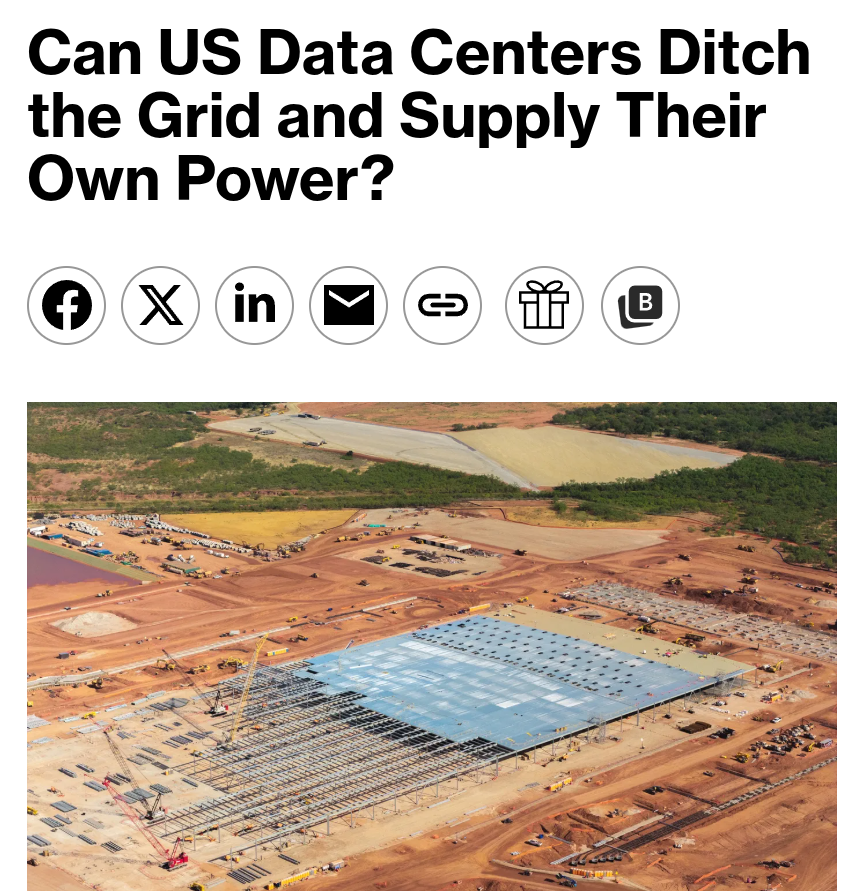
Bloomberg: Self-powered data centers ("behind-the-meter") are mostly still plans:
developers have announced about 90GW of their own power plants for US data centers ("behind-the-meter"), but only about 2GW of that, around 2%, actually runs so far.
The grid keeps power flowing when one machine fails because it draws on many plants and lines, while a single on-site plant has no such backup.
AI workloads also swing demand within seconds, enough to damage some on-site generators, and solar plus batteries would need almost 1,800 hectares to run a 100MW Texas data center just 98% of the year.
So developers build extra gas capacity, pay over $100 per megawatt-hour against about $90 for grid power, and mostly treat their own plants as a bridge until the grid connection arrives.
AI overview is natively integrated well into Google search and chrome
Hydrogen is rapidly fast and good for daily search
Neon tasks is good for agentic task, research, and writing
Works well for agentic code in Antigravity (this is probably the biggest area for improvement relative to Codex and Claude)
Google has its mojo back for sure
Getting this amount of compute turned on, cooled and working reliably is incredibly hard.
The cash shortage is also going to be nuts next year. Even cumulative industry delays of a few months between paying for compute and getting it reliable enough to generate revenue will mean hundreds of billions of incremental dollars just for working capital. Where will that come from?
IMO this is as big of a deal as the signature of the first PPA.
Kaitlin is one to watch, she's got a strong vision of buyer-led investments into the shared system with shared benefits, and is utterly relentless.
Think we all agree that AI is still dramatically underpenetrated across the broader economy and will get embedded into most workflows over time. The debate on the next leg of the revenue curve is what happens in the meantime when today's spend is heavily skewed to a tiny cohort of power users. This is why I'm so focused on what happens with coding and the s-curves elsewhere to offset any *even temporary* optimization in coding.
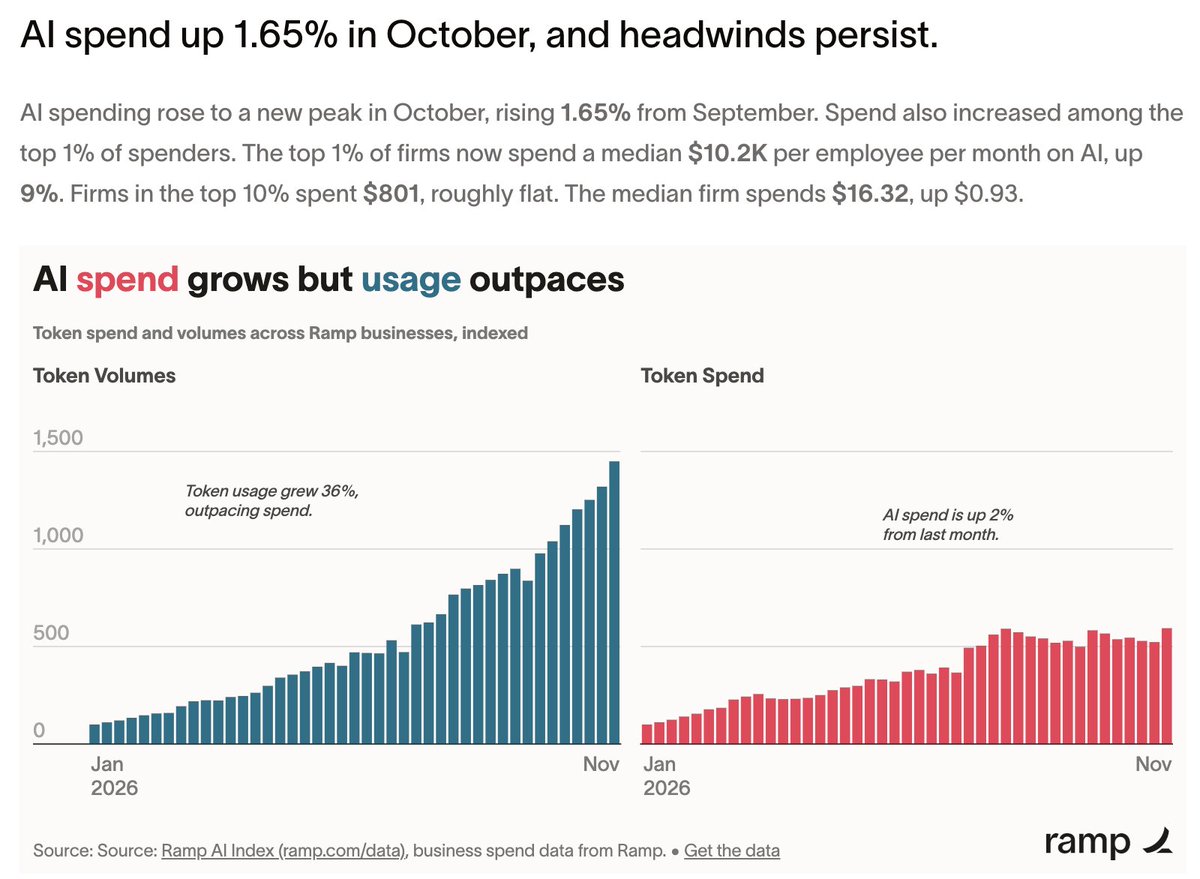
In October, 56.8% of US businesses on Ramp paid for AI, yet 1% of firms drove 80% of the spending Ramp observes on OpenAI and Anthropic (largely VC-backed firms in tech, finance, and technical services). Median monthly AI spend per employee was $10,200 for the top 1% (+9% MoM), $801 for the top 10% (roughly flat), and $16.32 for the median paying firm, a ~625x gap. Part of that gap is accounting: app-layer resellers like Harvey buy model access to serve thousands of external legal users, so their $10,200/employee includes COGS for end customers alongside internal tooling. Even so, it concentrates lab billings in a small set of buyers who can route workloads elsewhere.
=Key: On an 80/20 base, every 1% drop in top-group spend takes 4% growth from the other 99% to offset:
>Top 1% flat (0%) -> bottom 99% has to double (+100%) to get 20% total growth. Top 1% down 20% -> bottom 99% has to grow 80% just to stay flat, and 180% for 20% growth.
>Overall AI spend on Ramp rose 1.65% in October (OpenAI token spend +2.1%, Anthropic +0.5%) while average price per million tokens fell 21%. Engineering was 72% of classified spend and remained below summer highs, while customer support rose from 0.8% in June to 13.3% in October. Cheaper routing hasn't shown up in the dollars yet: frontier models still gained share in October, from 67.7% to 69.5%.
On the other side, heavy-user intensity can keep pulling away. OpenAI's Nov 18 report on its own researchers showed over two-thirds averaging a daily peak of 4+ concurrent agents (including subagents) by mid-October and over 10% at 16+, with *list-price* usage at $2,400/day median and $23,000/day at the 90th percentile (OpenAI notes that partly reflects shifts to pricier models and harness changes).
=Whether outside corporate P&Ls pay anywhere near that intensity, and how much of Ramp's top-1% spend is backed by recurring customer revenue vs. the next VC round once buyers optimize routing, is what decides the next leg.
Token demand can be price elastic in volume and still be a problem for lab economics in dollars. Jevons only saves the model layer if durable moats hold up as supply scales. Right now, value capture is getting harder, not easier.
This is the stacking s-curves vs. bullwhip on compute debate. A soft landing requires new enterprise use cases to stack seamlessly before the current one saturates. That gets much harder under broader competition and in end markets without clean evals, where training and value-based pricing are bottlenecked by data labeling and verification rather than raw compute.
Look at Ramp's Nov AI Index (with the standard caveats on sample and enterprise read-through):
>Avg price per million tokens fell 21% last month Token volume is outpacing spend; Oct token spend grew just 0.5% m/m for Anthropic and 2.1% for OpenAI >Engineering (72% of classified spend) is stuttering off summer highs despite rising usage New fronts like customer support (13.3% of spend, up from 0.8% in June) naturally skew toward faster, cheaper models
Normalizing component margins in 2028-30 helps unit costs (and is a great point btw), but it does not solve who captures the surplus if pricing power erodes faster than new high-value S-curves materialize.
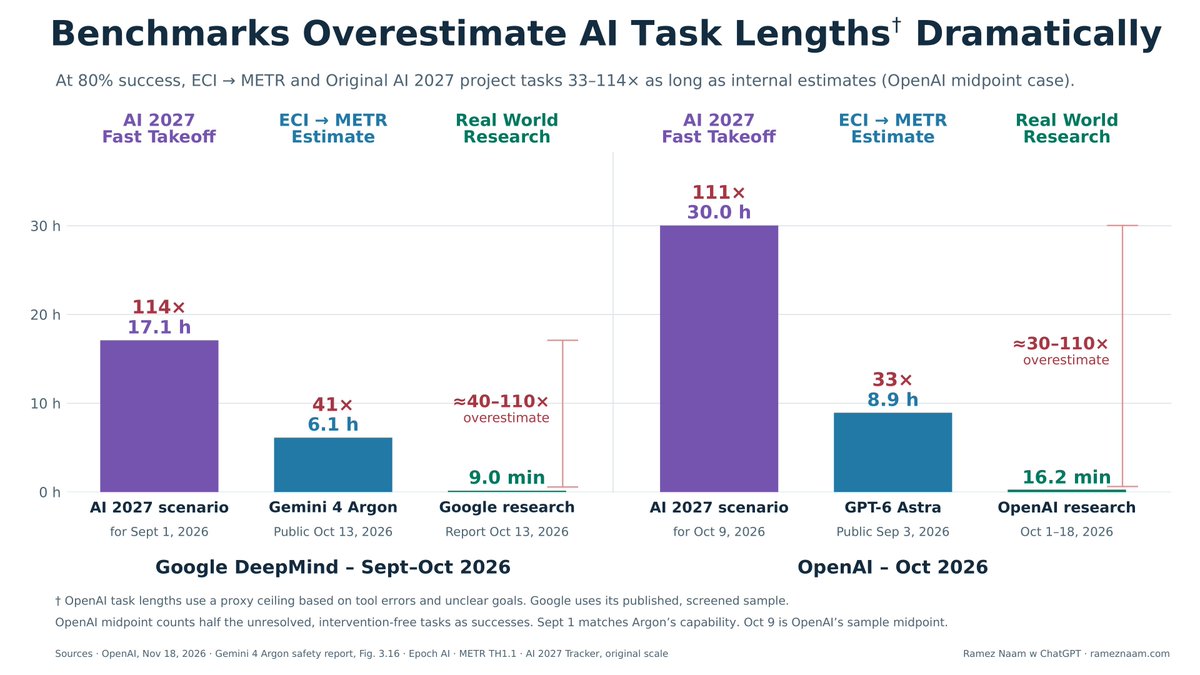
New from me: The most important graphs in AI are wrong. Specifically, measures of the length of task AIs can autonomously accomplish are dramatically different than real-world data from inside OpenAI and Google. 🧵
https://t.co/IbKK0ybQjV
@mailboxmoney6@ShanuMathew93 Advanced conductors can raise line capacity 50% to 110% within existing rights-of-way, with projects taking 18 months to 3 years.
@galacticbarrier I’m not bearish or bullish, just debating but this side steps the point
We’re all saying it’s going to be massive but the rate of diffusion can be slower than it’s been given the expansion to beyond domain verifiable workloads