Nahid Islam’s UK visit and reported meeting with Jamaat leaders at Cambridge Central Mosque raises serious questions.Who is behind these growing Islamist political networks linking #BD and the UK—and what is their real agenda? #BD must not be handed over to extremist politics
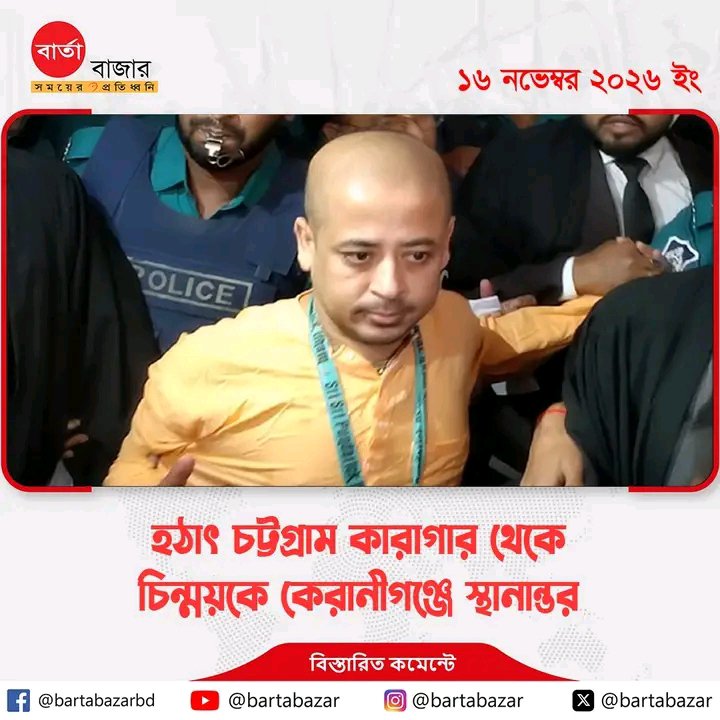
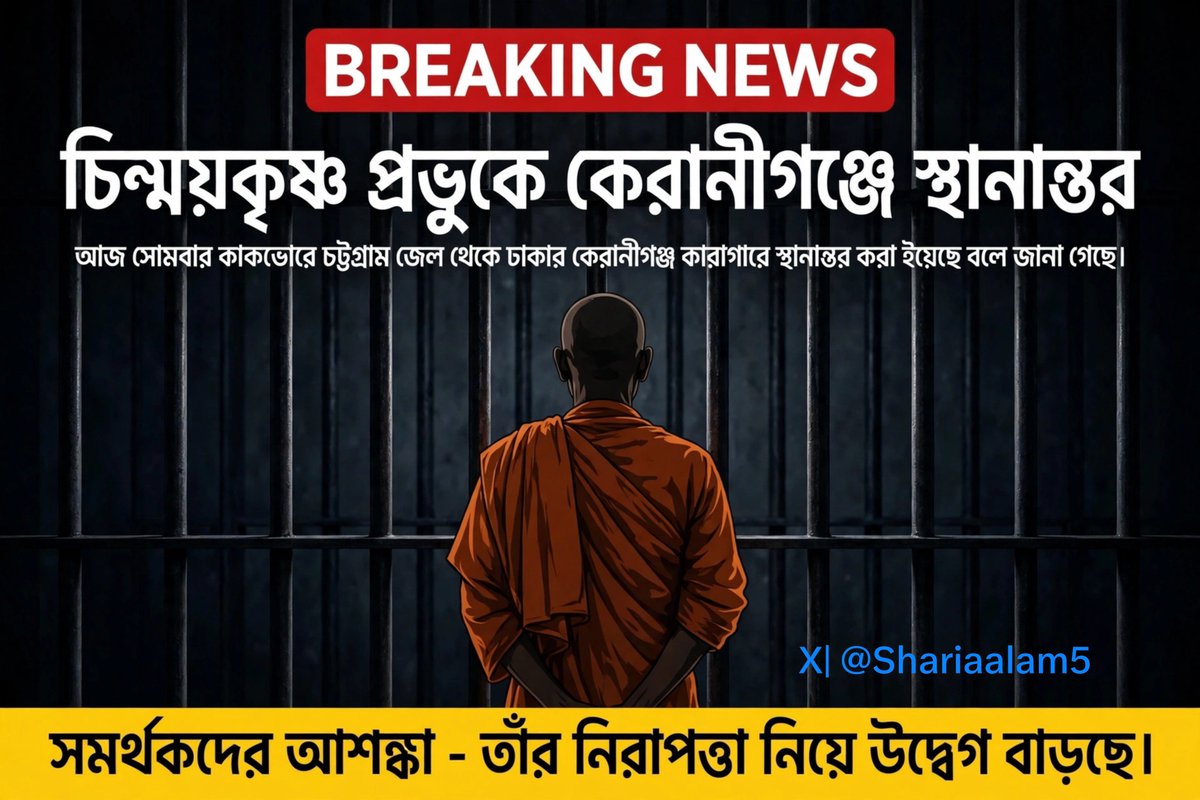
Chinmoy Krishna Prabhu secretly transferred early Monday from Chattogram Jail to Keraniganj Prison, Dhaka. Supporters fear a planned move, alleging he could be killed if Sheikh Hasina fails to return in December. Growing anxiety over his safety.
16-11-2026
Chinmoy Krishna Prabhu secretly transferred early Monday from Chattogram Jail to Keraniganj Prison, Dhaka. Supporters fear a planned move, alleging he could be killed if Sheikh Hasina fails to return in December. Growing anxiety over his safety.
16-11-2026
Chinmoy Krishna Prabhu secretly transferred early Monday from Chattogram Jail to Keraniganj Prison, Dhaka. Supporters fear a planned move, alleging he could be killed if Sheikh Hasina fails to return in December. Growing anxiety over his safety.
16-11-2026
Chinmoy Krishna Prabhu secretly transferred early Monday from Chattogram Jail to Keraniganj Prison, Dhaka. Supporters fear a planned move, alleging he could be killed if Sheikh Hasina fails to return in December. Growing anxiety over his safety.
16-11-2026
Following the announcement that Sheikh Hasina would return to Bangladesh in December,the Awami League,Chhatra League,and Jubo League—representing the party and its affiliated wings—have come together in Tungipara,Gopalganj,and opened a central Awami League office there
16-11-26
The elder brother left this world after joining the movement..."
The younger brother came out on the street and said, "They are beating my brother, we are not afraid of the police shooting. If he dies, we are gone."
A freedom fighter over 70 was garlanded with shoes, his mobile snatched, handed to police and jailed. He says freedom fighters are being humiliated like this across the country. This was never what this country wanted. The nation will not accept this humiliation.
The 'nartaki' (cabaret-style) dance performed by 'Monamimadam'—an agent of the militant 'deep state'—at the University of Dhaka, the nation's premier institution of higher learning, is a truly disgraceful and scandalous incident.
@sajeebwazed Bangabandhu's daughter has never bowed to fear. She who returned after the tragedy of 1975 cannot be stopped by any malign force. #OnceAgainSheikhHasina
Bangabandhu's daughter has never bowed to fear. She who returned after the tragedy of 1975 cannot be stopped by any malign force. #OnceAgainSheikhHasina
The Return of a Statesman: India's Principled Stance and Dhaka's Double Standards
----
More than two years have passed since 5 August 2024. Throughout this long period, Sheikh Hasina, daughter of Bangabandhu Sheikh Mujibur Rahman, Bangladesh's founding leader and Father of the Nation, and five-time elected Prime Minister of Bangladesh, has had to remain away from her beloved homeland. In July, she told Reuters that she would return home in December. She stands firm on that commitment today. Her application to the Bangladesh mission in New Delhi for a passport and national identity card shows that this is no mere rhetoric. Drawn by her bond with the land and its people, a leader of the masses is preparing to come home.
The decision to return is Sheikh Hasina's own. She has never practised a politics that waits for anyone's permission. Still, it matters how India, the country that has stood by her in this difficult time, views the question. On this issue, both New Delhi's principled stance and Dhaka's double standards are now plain to see.
▪️ A Relationship Tested by History
Sheikh Hasina's relationship with India is not an arrangement with any single government. Whether the Congress, the Janata Party or the BJP has governed in New Delhi, the course of this relationship has not changed. It began in 1971. Just three months after victory, Indian troops withdrew from Bangladesh at Bangabandhu's request, and with that, the relationship's first principle was written: respect for sovereignty.
After 15 August 1975, Sheikh Hasina and Sheikh Rehana, orphaned overnight, had no way back home. In those dark days, the then Government of India stood by them and arranged for them to live in New Delhi. Nearly six years later, in 1981, she returned to Bangladesh by her own decision, defying the reluctance of the military ruler of the time. India stood by her in hard times, but it never set her course. Today, history has come full circle.
▪️ India's Principled Stance Towards a Guest Statesman
A report by BBC Bangla's New Delhi correspondent, published on 12 November and citing policymaking circles, paints a clear picture. Sheikh Hasina's position rests on two points: she will return home, and once back, she will face the legal battle head-on. She has never practised a politics of hiding. On both questions, New Delhi agrees with her.
In December 2024, the interim government sought her return through a diplomatic note. India has yet to say either yes or no to that request. New Delhi's position is that this is a legal matter and will be resolved through legal means. Behind this lies a long-standing principle of diplomatic ethics: a guest statesman on one's soil cannot be handed over as a prisoner to political opponents. When Sheikh Hasina arrived in India, she was not a convicted person. She was the recently departed Prime Minister of a sovereign nation. India has upheld the dignity and respect due to her.
When Bangladesh's State Minister for Foreign Affairs cites precedents of returning prisoners "in handcuffs", it is no longer the language of diplomacy but the language of vengeance. No responsible state can respond to such language.
▪️ India's Expectations: A Safe and Dignified Return, and Standards of Justice
In his 12 November report, BBC Bangla's New Delhi correspondent Subhajyoti Ghosh wrote that government officials in New Delhi have indicated to the BBC that India has two principal expectations regarding Sheikh Hasina's return.
First, according to the BBC report, Sheikh Hasina arrived in India aboard a Bangladesh military aircraft. India therefore believes that the responsibility for bringing her back should also rest with the Bangladesh Army. This could be done by sending a military aircraft, or she could be received at a point along the land border. The report also notes that New Delhi is ready to make the necessary arrangements.
Second, the BBC reports that Bangladesh must guarantee that Sheikh Hasina will be allowed to appeal against her death sentence and that her trial on the charges relating to the events of July will begin afresh. An official in New Delhi told the BBC: "We can never knowingly send her forward to be hanged." In his words, India would want that trial to take place under the scrutiny of the international community and the global media.
The same report states that India is extremely careful to ensure these expectations are not seen as foreign interference in Bangladesh's judicial system, which is why it has made no public comment on the matter. This reflects respect for Bangladesh's sovereignty.
Nor are these conditions anything new. Article 36 of our Constitution guarantees every citizen the right to re-enter Bangladesh. Article 12(4) of the International Covenant on Civil and Political Rights (ICCPR) protects the right to enter one's own country, and Article 14 guarantees the right to a fair trial. Bangladesh itself is a state party to this covenant. India, therefore, is imposing nothing. It is simply reminding us of commitments we have made ourselves.
▪️ Why India Holds This Position
India's stance is not a favour to any particular individual or political party. It reflects the diplomatic courtesy of one of the world's largest democracies and a principled position towards a long-standing friendly nation, one rooted deep in history and shared ideals.
Solidarity with the forces of the Liberation War. In 1971, India stood by nearly ten million Bengali refugees, and soldiers of the allied forces gave their lives on this soil. India's relationship with the party that led the Liberation War is therefore no passing political calculation. It springs from the history of both nations' birth.
A shared belief in secular politics. Secularism is one of the four founding principles of Bangladesh's 1972 Constitution, born of the Liberation War, alongside nationalism, socialism and democracy. It is a cornerstone of India's Constitution as well. Since 5 August, the neighbouring country has watched with concern the attacks on minorities and the spread of extremism in Bangladesh. It naturally regards the principal political force of a secular Bangladesh as essential to the balance of the region.
Regional security. Under Sheikh Hasina's government, militant and separatist strongholds were firmly rooted out of Bangladesh's soil. This was not done to please anyone, but for Bangladesh's own security, and the entire region reaped the benefits.
Diplomatic reliability and international standing. For India, consolidating its position on the global and regional stage and retaining the international community's trust as a dependable diplomatic partner is vitally important. Honouring principled commitments in a moment of crisis is the true test of that trust and reliability. This stance is therefore not only about preserving a friendship; it is about safeguarding India's diplomatic dignity, credibility and international standing.
▪️ A Friendship of Equal Dignity and Mutual Respect
Sheikh Hasina's diplomacy proves that friendship and national interest can be protected together. The 1996 Ganges Water Sharing Treaty stands among her most notable diplomatic achievements. In 2015, under her leadership, the Land Boundary Agreement was implemented, and the residents of the enclaves gained citizenship and a nation to call home. In 2014, the delimitation of the maritime boundary with India through international arbitration secured Bangladesh's rights over a vast area of sea. She never gave up the demand for a fair share of the Teesta's waters at any meeting. Advancing friendship while upholding national interest: this is the strength of Sheikh Hasina's diplomacy. The relationship between these two sovereign nations rests on equal dignity and mutual respect.
▪️ Dhaka's Double Standards
The BBC Bangla report of 12 November reveals another significant point. Several officials from India's Ministries of Home and External Affairs told the BBC that, in their assessment, however loudly Dhaka demands her return, it is in fact not interested in opening the way for Sheikh Hasina to come home. Citing those officials, the report says the government is already under pressure from an energy crisis and garment workers' protests, and fears that Sheikh Hasina's return could heighten political instability in the country.
Publicly, demands for extradition, diplomatic notes and threats of handcuffs. Yet when Sheikh Hasina herself wants to come home, the government quietly does not want her back. This is the double standard.
▪️ Final Word
Sheikh Hasina's return is a statesman's own decision, and the constitutional right of every citizen. Just as after 1975, India today has stood by her in difficult times, but has not set her course. The friend of 1971 has held firm on principle: it will not hand over a guest statesman as a prisoner, nor will it interfere in Bangladesh's judicial system. All it has asked for is a safe and dignified return and a guarantee of justice, which Bangladesh has already promised through its own Constitution and international human rights treaties.
The question now rests entirely with Dhaka. Sheikh Hasina is ready, and India respects her decision. The current government demands her return in public while working behind the scenes to block her path home. The time has come for that mask to fall.
Bangabandhu's daughter has never bowed to fear. She who returned after the tragedy of 1975 cannot be stopped by any malign force.
Roudra Rudra
Political & Security Analyst
#SheikhHasina #Bangladesh
What does the Bangladesh-Pakistan football match reveal about the country’s shifting political &cultural landscape?
How does the display of Liberation War-related memorabilia by supporters in Dhaka bring the memory of 1971 to the forefront of the debate over BD national identity
No one should be dragged from home, beaten, or paraded for political beliefs. Extrajudicial violence is unacceptable. Perpetrators must face investigation and prosecution by police and courts. Equal rule of law applies to all sides.
Azimpur, Dhaka | Video Exposes Brutal Assault on Awami League Leaders
Disturbing footage reportedly shows four Awami League leaders dragged from their homes, publicly assaulted and paraded through the streets solely over their political affiliation. While the victims were jailed, the alleged attackers enjoyed impunity.
Amid the ban on Awami League, such incidents raise grave concerns over politically motivated violence, the weaponisation of law enforcement and the systematic suppression of dissent.
Who will hold the perpetrators accountable?
#Bangladesh #HumanRights
@sajeebwazed No one should be dragged from home, beaten, or paraded for political beliefs. Extrajudicial violence is unacceptable. Perpetrators must face investigation and prosecution by police and courts. Equal rule of law applies to all sides.
Bangladesh Chhatra League's emergency organizational directive: Chhatra League is providing full support to the nationwide morning-evening lockdown program announced by Bangladesh Awami League on Thursday, November 19, based on 8-point demands.
Nayan, an extortionist leader from the so-called 'Jubo Dal' in Bangladesh, has spent the last 17 years living under various aliases and disguises! It hardly suits him to be making such grand statements now. I will say just this��it is only a matter of time.
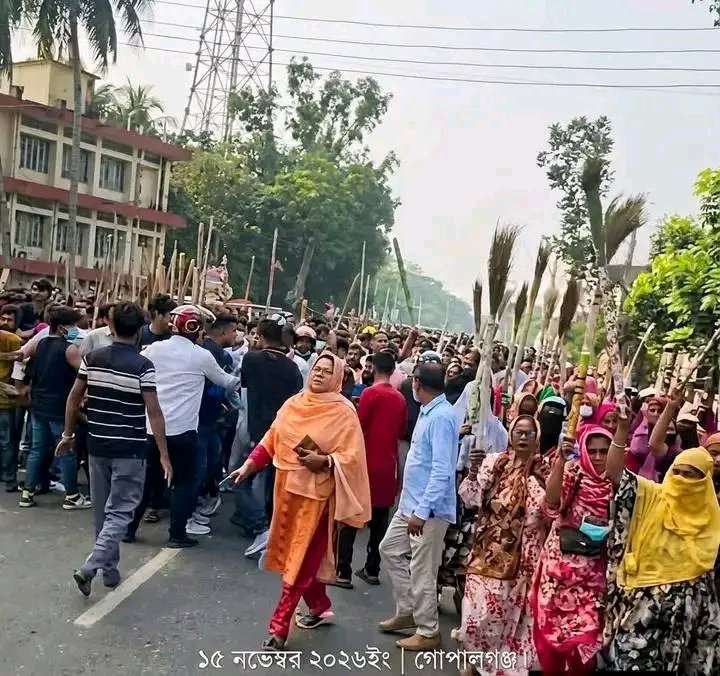
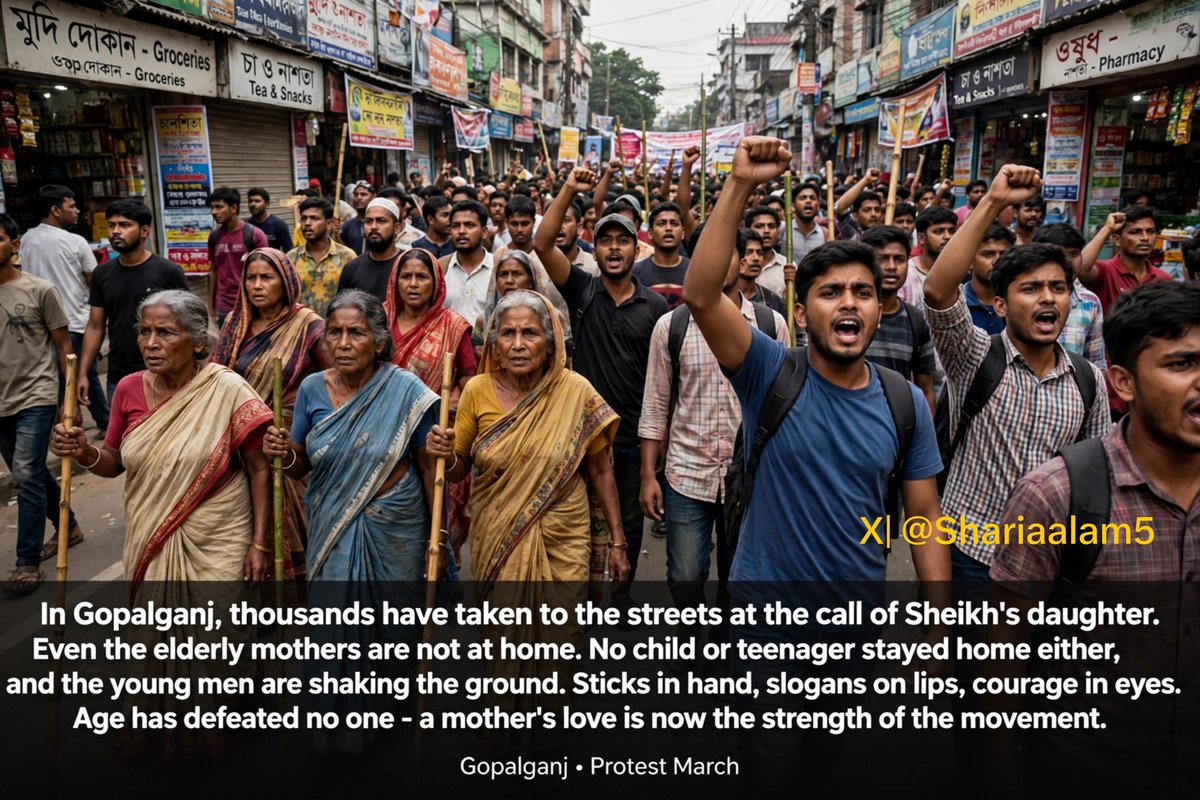
In Gopalganj, thousands marched at Sheikh's daughter's call.Mothers, children,youth all joined with sticks, slogans, courage. Meanwhile, the government allegedly shut down mobile network and carried out mass killings and mass arrests with police, BGB, SBR.
In Gopalganj, thousands took to the streets at the call of Sheikh's daughter. Elderly mothers left home, no child or teenager stayed behind, and young men shook the ground. Sticks in hand, slogans on lips, courage in eyes. A mother's love is now the movement's strength.
In Gopalganj, BD, even the elderly mothers are not at home! They have taken to the streets at the call of the Sheikh's daughter. With sticks in their hands,slogans in their mouths, courage in their eyes. Age has not given in, the love of a mother is now the power of the movement.
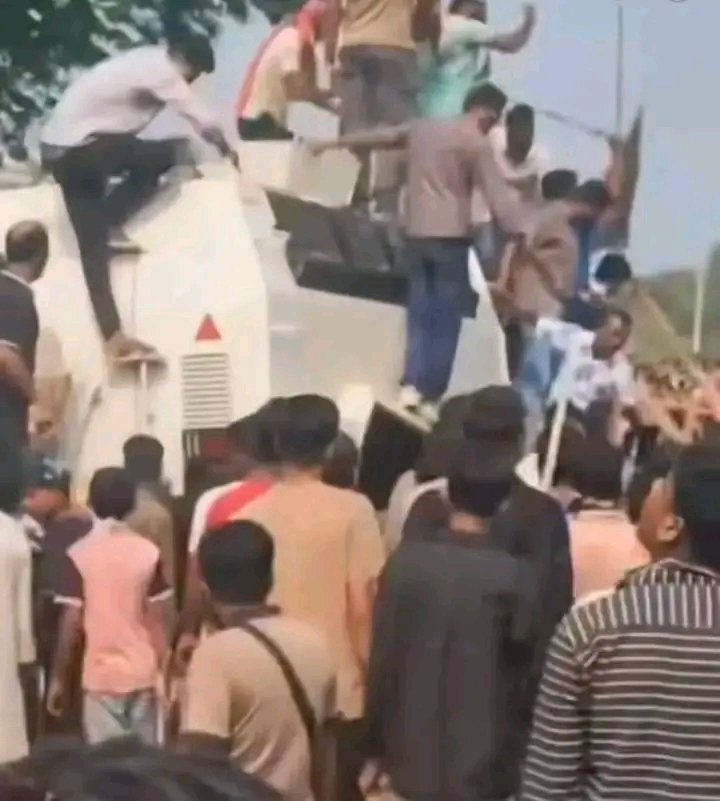
Today, the general public, the party of the masses, Awami League, took over the army tank in Gopalganj.
Brave Bengalis, take up arms and liberate Bangladesh!
✊Uttal Gopalganjbasi_💥🤝
Will return home with victory _InshaAllah