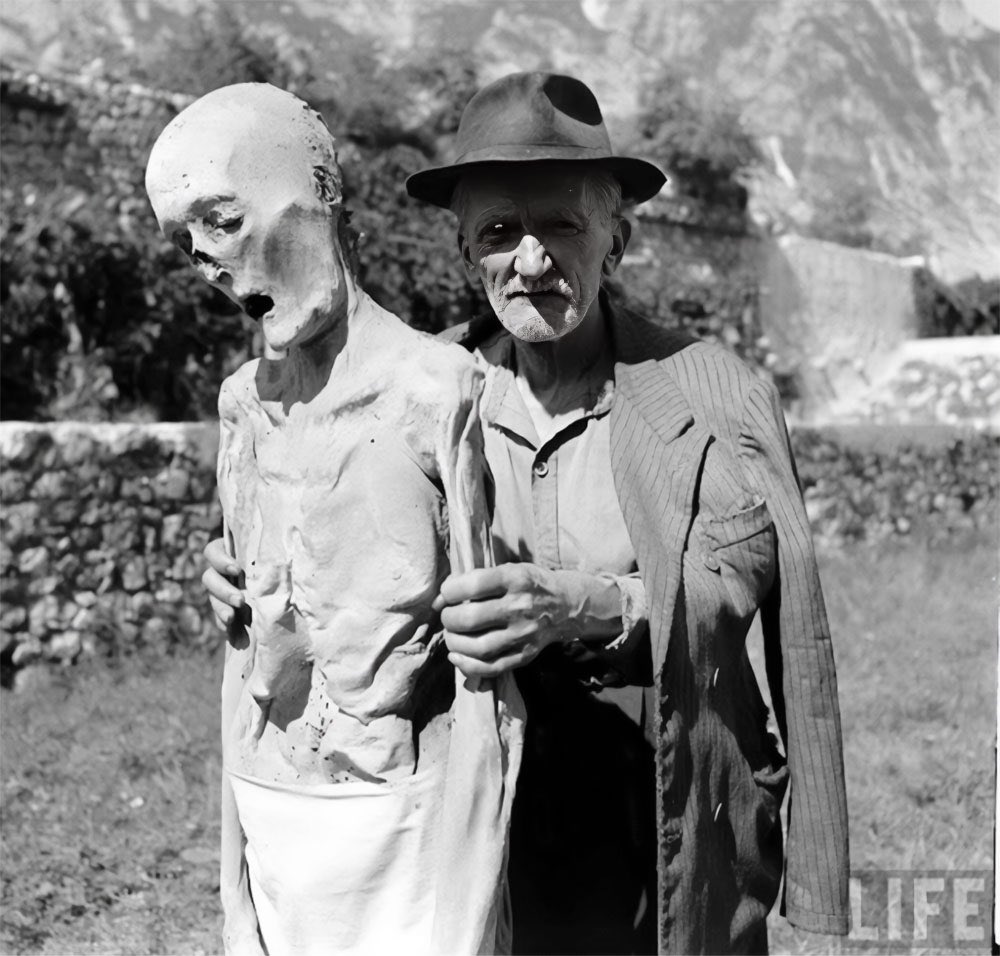
Venzone is a small town in Italy that has a unique history of mummification. In the 14th century, the town was hit by a deadly plague, which killed many of its inhabitants.
To prevent the spread of the disease, the bodies of the deceased were buried in a special soil mixture that was high in calcium, which helped to dry out the corpses and preserve them.
Over time, this process of natural mummification became more common, and by the 16th century, it was a widespread practice in the town.
In 1976, Venzone was struck by a devastating earthquake that destroyed many of its buildings, including the cemetery.
During the reconstruction process, workers discovered the mummified remains of some of the town's ancient residents.
Instead of disposing of these remains, the town decided to preserve them and put them on display in St. Andrew's Church, where they can be visited by tourists.
In the 1720s, a Scottish woman named Margaret Dickson was found trying to abandon the body of her newborn baby near the banks of the River Tweed.
It isn’t known whether she lost the child in the late stages, or whether it died shortly after being born.
Nonetheless, she was arrested charged and taken to Edinburgh to face trial, where she was found guilty and sentenced to death.
In 1724, Dickson was hanged but somehow survived. She was then allowed to go free because under Scots Law, her punishment had been carried out, she could not be executed for a second time for the same crime.
This prompted the wording of the law to be changed to hanged “until dead".
Richard Chase was an American serial killer who killed and mutilated the bodies of his six victims.
He was nicknamed The Vampire of Sacramento because he drank his victims' blood and cannibalized their remains.
Chase later told detectives that If he attempted to enter the home of a woman but found her doors locked, he walked away. He believed that locked doors were a sign that he wasn't welcome, but unlocked doors as an open invitation to come inside.