S.cerevisiae yeast does all the best things - beer, bread, champagne, chocolate, vaccines that cure cancer.... BBC: Young women now have 'close to zero' risk of cervical cancer death after HPV jab https://t.co/b1KfdTrs40
A PhD's success depends more on the fit between the student, the advisor, and the lab than on the specific topic being studied (it barely matters at all).
Similarly, a lab's success depends more on how excited (or miserable) its researchers are than on the precise project they are working on (it could be virtually anything).
This information isn't in papers or in grant proposals, you have to ask the researchers.
I've always told my PhD students that a PhD is a marathon and not a sprint. Now that Sabastian Sawe has run the London Marathon in under 2 hours, I'll need to think of something else to tell them.
Your lectures are engaging—shouldn't your course materials be, too? ⚡️ Don't let a boring textbook kill the momentum of a great class. Upgrade your content here: https://t.co/AP6ovLtBOp
#biology#science#3D#animation#Edtech#HigherEd
Only one chance in this lifetime…
Like watching sunset at the beach from the most foreign seat in the cosmos, I couldn’t resist a cell phone video of Earthset. You can hear the shutter on the Nikon as @Astro_Christina is hammering away on 3-shot brackets and capturing those exceptional Earthset photos through the 400mm lens. @AstroVicGlover was in window 3 watching with @Astro_Jeremy next to him.
I could barely see the Moon through the docking hatch window but the iPhone was the perfect size to catch the view…this is uncropped, uncut with 8x zoom which is quite comparable to the view of the human eye. Enjoy.
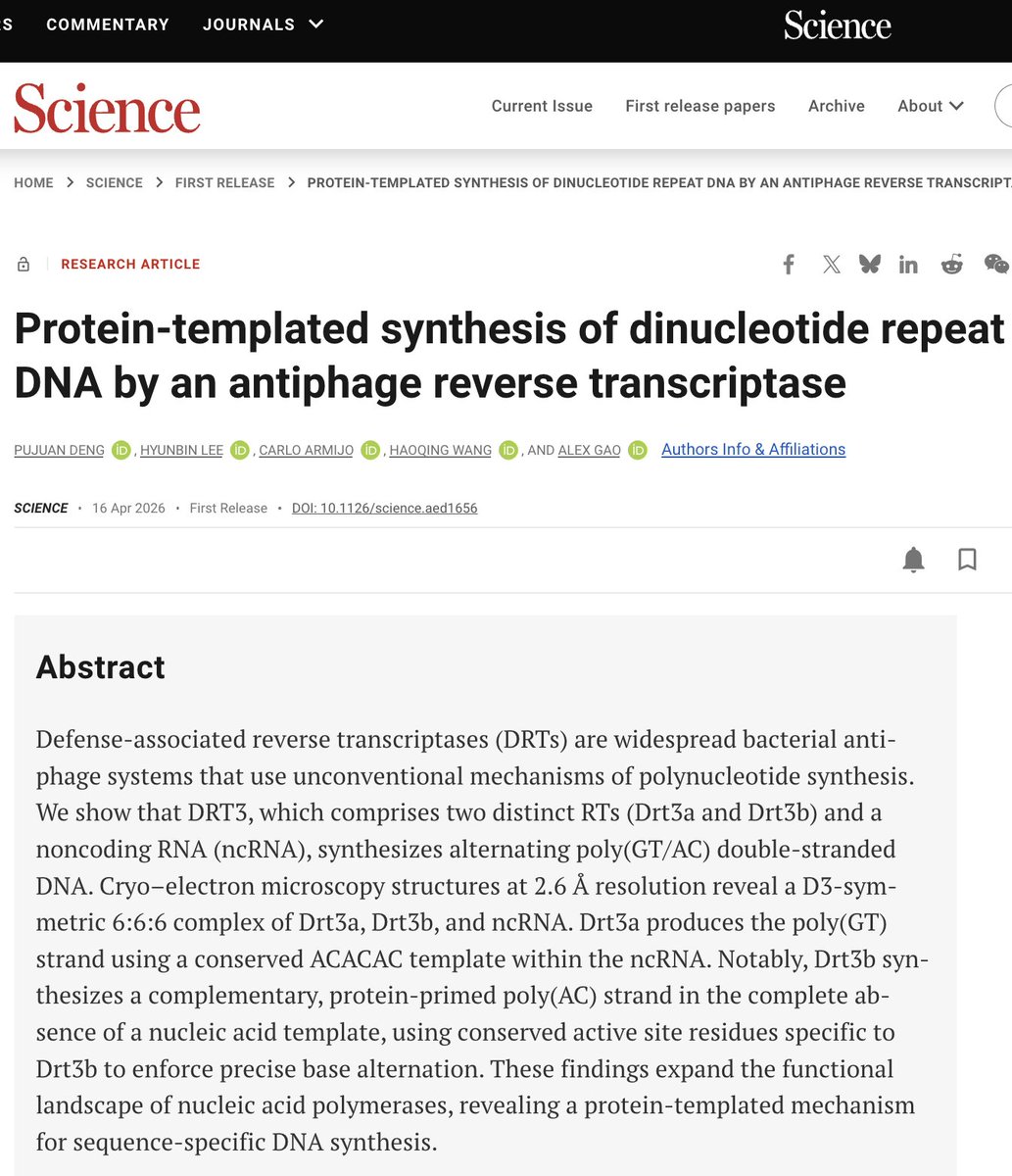
Bacteria are full of diverse molecular tricks. This Science article reports an interesting one that is being misrepresented by news coverage, including the coverage in Science.
The study describes an enzyme complex that synthesizes alternating dinucleotide repeat DNA as part of an immune response. Protein templating DNA is a cool observation, even if the sequence is only a repeating dinucleotide.
The headline-grabbing takeaway is the mechanism of the Drt3b subunit. While its partner, Drt3a, uses a canonical RNA template (reverse transcription), Drt3b synthesizes the complementary strand in the absence of a nucleic acid template. Instead, it uses specific amino acid residues (a glutamate and an arginine) to stabilize and "select" the incoming dNTPs.
It is tempting to view this as a radical shift in our understanding of information transfer, a "protein-templated" genetic sequence. However, we should be cautious with the "paradigm shift" narrative.
Why this isn't "rewriting" the Genetic Code:
Despite claims in the news coverage, this finding does not represent a new form of hereditary information transfer. This is not a protein "reading" itself to create a complex message; rather, it is a highly specialized structural constraint. The protein is essentially a "stuttering" machine, physically keyed to produce a simple, repetitive sequence. The "information" is hard-coded into the protein's fold to perform a single, specific defensive task, rather than acting as a general-purpose template for diverse genetic messages.
The Parallel to tmRNA:
This observation is not entirely unprecedented when we look at how bacteria handle biochemical "dead ends." It reminds me of transfer-messenger RNA (tmRNA). In trans-translation, when a ribosome stalls on a broken mRNA, the tmRNA molecule steps in to provide both the tRNA component and a short mRNA "tag" to rescue the ribosome:
- The "Non-Standard" Template: Much like tmRNA provides an external sequence to fix a stalled process, the DRT3 ncRNA and the Drt3b protein provide "internal" instructions to create DNA where no genomic template exists.
- Specialized Rescue: Both mechanisms are niche "emergency" responses, one for proteostasis (tmRNA) and one for viral defense (DRT3).
In the end, this discovery doesn't replace our understanding of the genetic code; it expands the "toolbox" of how cells can synthesize polynucleotides when the standard rules don't apply. It is a beautiful reminder that in the microbial world, if a chemical shortcut is possible, evolution has likely found it.
After 30+ years of genetic drift with only weak selective pressure, a duplicated gene sequence will begin to look less and less like its original version.
There's a physicist at Stanford named Safi Bahcall who modeled this exact principle and the math is wild.
He calls it "phase transitions in human networks." When you're stationary, your probability of a lucky event is limited to your existing surface area: the people you already know, the places you already go, the ideas you've already been exposed to. Your opportunity window is fixed.
When you move, your collision rate with new nodes in a network increases nonlinearly. Double your movement (new conversations, new cities, new projects) and your probability of a serendipitous encounter doesn't double. It roughly quadruples. Because each new node connects you to their entire network, not just to them.
Richard Wiseman ran a 10-year study at the University of Hertfordshire tracking self-described "lucky" and "unlucky" people. The single biggest differentiator wasn't IQ, education, or family money. Lucky people scored significantly higher on one trait: openness to experience. They talked to strangers more, varied their routines more, and said yes to invitations at nearly twice the rate.
The "unlucky" group followed the same routes, ate at the same restaurants, and talked to the same 5 people. Their networks were closed loops. No new inputs, no new collisions.
Luck isn't random. Luck is surface area. And surface area is a function of movement.
The lobster emoji is doing more work than most people realize. Lobsters grow by shedding their shell when it gets too tight. The growth requires a period of total vulnerability. No protection, no armor, soft body exposed to the ocean.
That's the cost of movement nobody posts about. You have to be uncomfortable first. The new shell only hardens after you've already moved.
I rarely taste my food while cooking, I cook entirely on confidence and vibes so the finished product is always a surprise to me as much as it is to you.
If you eat my food and something is wrong, please know that I am also a victim and we are in this together.
My favourite academia joke of all time. "The moral of this story is: The topic of your dissertation isn't really important; what's important is who your advisor is."
—Harvey Cox, When Jesus Came to Harvard
Wli Agumatsa the highest waterfall in West Africa this is nature in its purest form. If you haven't stood at the base of these falls yet, you haven't truly seen the heart of Volta Region.
#waterfalls#tourism#exploringvolta#gbcheritagemonth
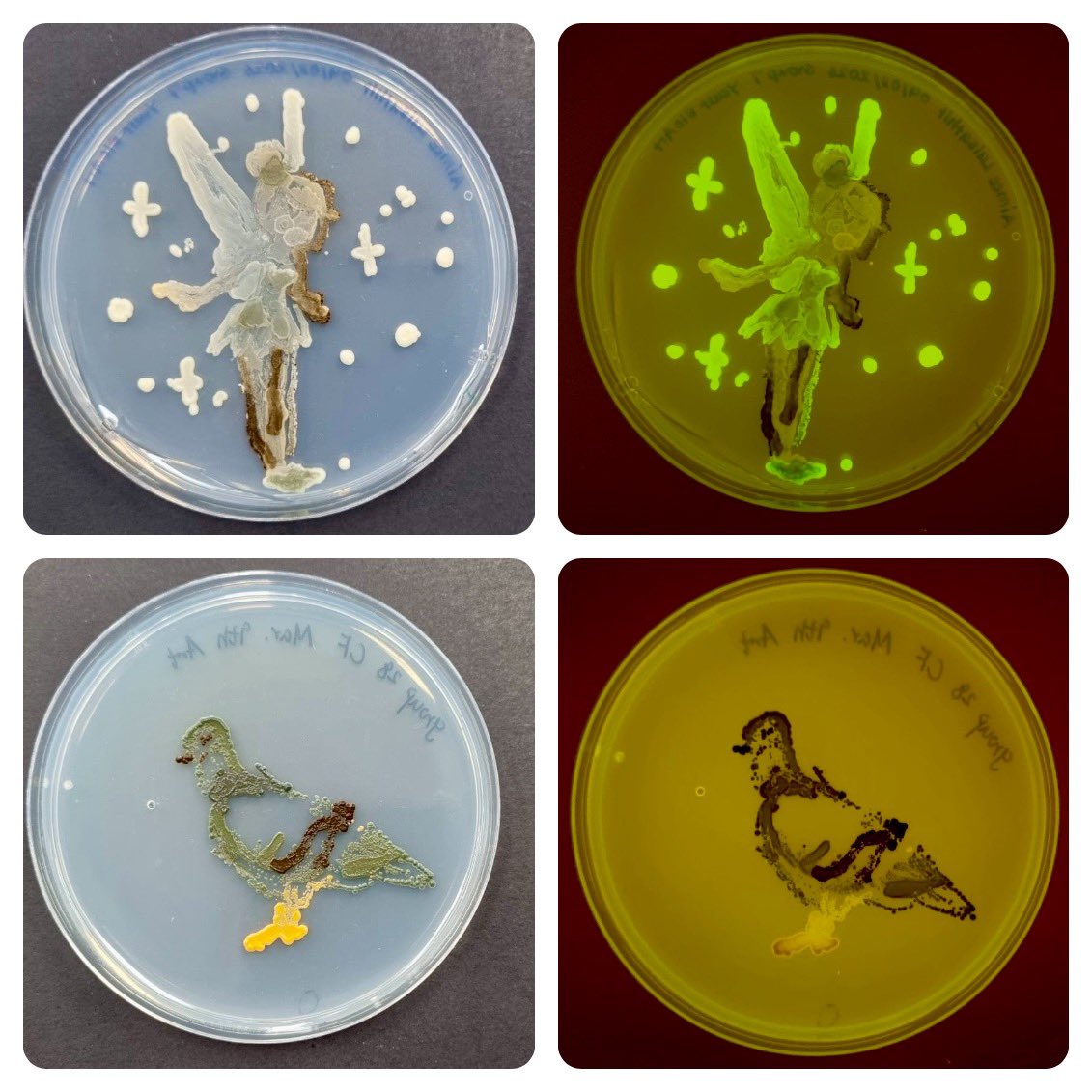
It’s time for the annual vote for best engineered yeast bioart from the @ImperialBioeng undergrad #SynBio students. Help us decide among these beautiful final 4 with your votes. 🗳️ ⬇️