$DELL is earnings , and I decided to take a position ahead of the event.
I went long $DELL at 464.73, and the position is currently up around 3.4%.
What made the setup more interesting for me is that Decibel’s Boost AMP is now live, giving an extra 50% AMPs on $DELL trades through September 2.
I’m mainly watching how price behaves into earnings, whether this momentum holds or the market starts pricing in the news early.
Let’s see how this one plays out.
@DecibelTrade
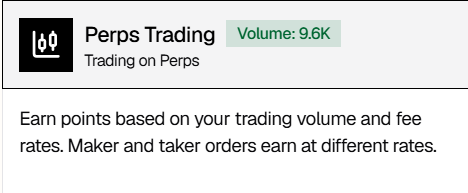
One of the biggest lessons I've learned in trading is that consistency matters more than chasing big wins. Every trade is an opportunity to improve your strategy, manage risk, and stay disciplined. Looking at my 9.6K trading volume on StandX reminds me that long term progress is built one trade at a time, not by trying to hit home runs.
#StandX #Trading #Perps #DeFi
@StandX_Official@Stander_StandX
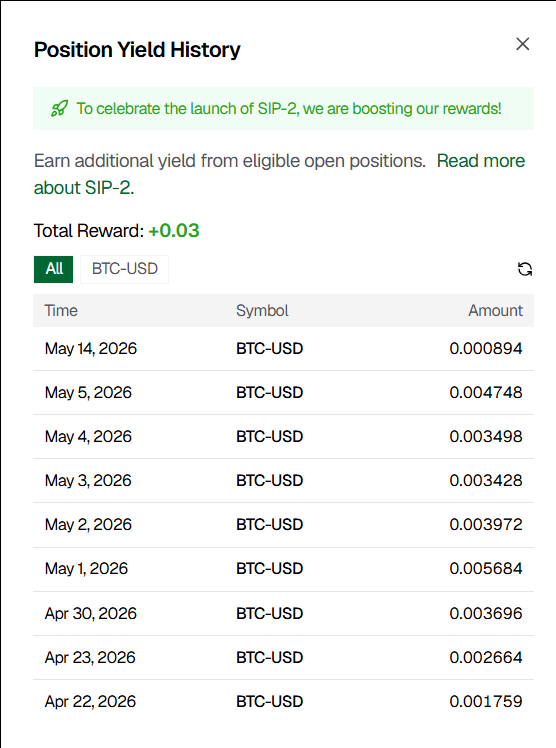
After using the new StandX interface, my favorite feature is definitely the Position Yield History.
I like that every reward is recorded with the trading pair and timestamp, so I can easily track how my eligible positions have contributed over time. Instead of just seeing a single total, I can actually review each Position Yield entry, which makes the reward system feel much more transparent. As someone who enjoys understanding how a protocol works, this is a small detail that really improves the experience.
Overall, the new interface feels clean, responsive, and easy to navigate. Information is organized in a way that doesn't distract from trading, and features like Universal Yield and Position Yield History are only a few clicks away. It makes checking my trading activity and rewards part of my daily routine rather than something I have to search for.
Here's a screenshot from my account showing my Position Yield History and the rewards I've earned while trading BTC-USD on StandX. Looking forward to exploring more features as the protocol continues to evolve.
#StandX #PerpDEX
@StandX_Official
Why I Moved from Another Perps DEX to StandX
I've spent the last few years trading on different perpetual DEXs, and after a while they all started to feel the same. Deposit collateral, open a position, monitor the chart, close the trade, and repeat. There was nothing wrong with that workflow, but it also didn't give me much reason to stay loyal to any particular platform.
What caught my attention about StandX wasn't lower fees or higher leverage. It was the idea of Universal Yield. At first, I assumed it was just another rewards program. But after reading the docs and using the platform myself, I realized it was designed as part of the trading experience rather than an extra incentive layered on top.
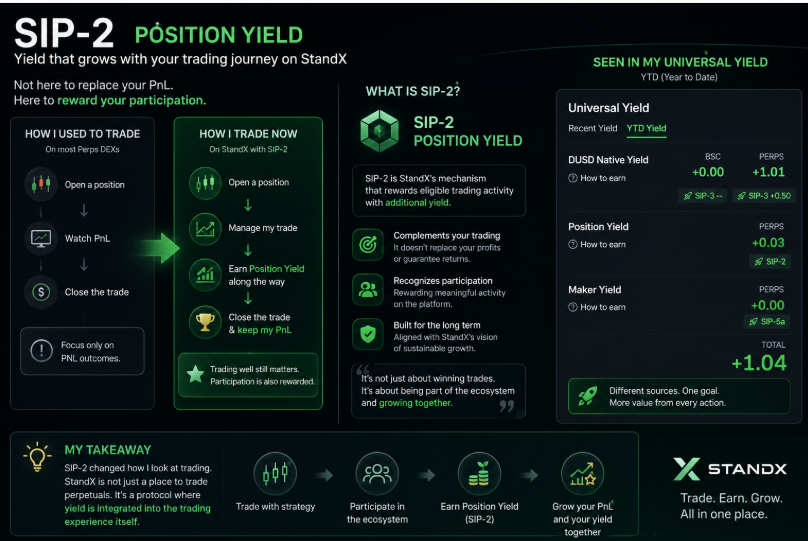
The biggest difference for me was SIP-2 (Position Yield). Instead of looking at trading as something where only PnL matters, StandX introduces another dimension. While I'm still responsible for making good trading decisions, eligible activity can also contribute to Position Yield, alongside DUSD Native Yield and Maker Yield through their own mechanisms. It doesn't replace profits, but it changes the way I think about participating in the protocol.
Another thing I appreciate is the transparency. Every yield source is linked to a specific SIP, so if I want to understand where something comes from, I can read the mechanism behind it instead of treating it like a black box. As someone who likes to understand how DeFi protocols actually work, that makes a huge difference.
I'm not saying StandX guarantees better trading results. Good trades will always come down to strategy, discipline, and risk management. But it has become the first Perps DEX where I find myself checking not only my PnL, but also how my activity is reflected across the different yield mechanisms. That shift is exactly why I decided to move and why I'm still here exploring what the protocol has to offer.
@StandX_Official@Stander_StandX
I didn't really understand SIP-2 until I started using StandX.
At first, I assumed Position Yield was just another reward program added to encourage trading. But after spending more time on the platform, I realized that's not what it is.
On most perpetual DEXs I've used, once I opened a position, the only thing that really mattered was my PnL. If the market moved in my favor, I made money. If it didn't, I took the loss. My collateral simply sat there supporting the trade, and that was the end of the story.
StandX introduced a different perspective. Through SIP-2, trading activity itself becomes part of the protocol's yield design. Position Yield doesn't replace trading profits or guarantee returns. Instead, it's an additional layer that recognizes eligible participation while you're actively using the platform.
The first time I noticed Position Yield in my Universal Yield dashboard, the number wasn't large. But it made me curious enough to read how it actually worked. That's when I realized StandX isn't only focused on helping traders speculate on price movements, it also tries to create value around the trading experience itself.
Looking at my dashboard today, I can clearly see my yield separated into DUSD Native Yield, Position Yield, and Maker Yield. Each one represents a different mechanism, and SIP-2 is the piece that connects yield directly with trading activity rather than treating it as a completely separate product.
The more I explore StandX, the more I feel that each SIP isn't designed to stand alone. They work together as parts of a larger system, and for me, SIP-2 was the feature that changed how I looked at the protocol. Instead of being just another Perps DEX where everything depends on PnL, StandX is building a model where yield is integrated into the trading experience itself.
That's the moment I realized SIP-2 isn't just a feature, it's part of the philosophy behind how StandX is designed.
@StandX_Official@Stander_StandX