@Retlouping Definitely available end range. Tracking the changes within and between session (for better or worse) can help with continuing towards a directional preference.
@DrDunning@MSKPhysioJnl Good point @DrDunning. The important distinction for PTs to consider is whether sleep dysfunction was present before condition vs the condition contributing to sleep dysfunction.
@Retlouping Have to also keep the age of those in the study - the avg. age was around 50 with a SD of ~14 years. So we can't say this for certain for people in their 20s and 30s. There is evidence that the larger the herniation, the more likely the body reabsorbs it.
Atraumatic cuff tears (what most of you have) are not acute traumatic cuff tears...
They occur for different reasons and often require different treatments...
Put on your shoulder doc cap...
Are you screening for sleep dysfunction in people w/ LBP? If not, I encourage you to make it a priority.
Not much out there on how to do it, so we published an open-access article on exactly how to do this in clinical practice as a PT: https://t.co/JC0Xe3XkGu
🔥 🔥 🔥 New research: A 12-month prospective cohort study found that greater insomnia severity was consistently associated with poorer quality of life, higher pain intensity, and greater disability in people with persistent spinal pain.
The findings highlight the importance of addressing sleep as part of integrated pain management.
#Pain #Insomnia #SpinalPain #PainResearch
What prevents people from accessing physiotherapy?
For many individuals from minoritized communities, the barriers extend far beyond the clinic door.
This qualitative study explored why people with musculoskeletal conditions who were referred to outpatient physiotherapy never attended.
Read more here: https://t.co/lWYU4WktGF
#Health services accessibility #Socioeconomic factors #Public health #Musculoskeletal Disorders #Physical therapy
@Retlouping Almost like it is just a description of a person's posture (thinking upper cross-syndrome type thing). I find dysfunction vs. derangement patterns help the most with treatment approach.
@DrSethPT PNE is also viewed like a one-and-done thing, or a sit-down-let-me-educate you type of treatment. Pain science is a communication approach - it is infused within how I engage with people moreso than a "teach me about pain" kinda thing, which is usually how it is done in research
@Retlouping This seems to be consistent in the literature showing that people with an intact annulus tend to show a more clear DP and centralize. I wonder if more inflammation around the DRG/nerve root causing more sensitivity = less tolerance to loading in general = less clear DP, etc.
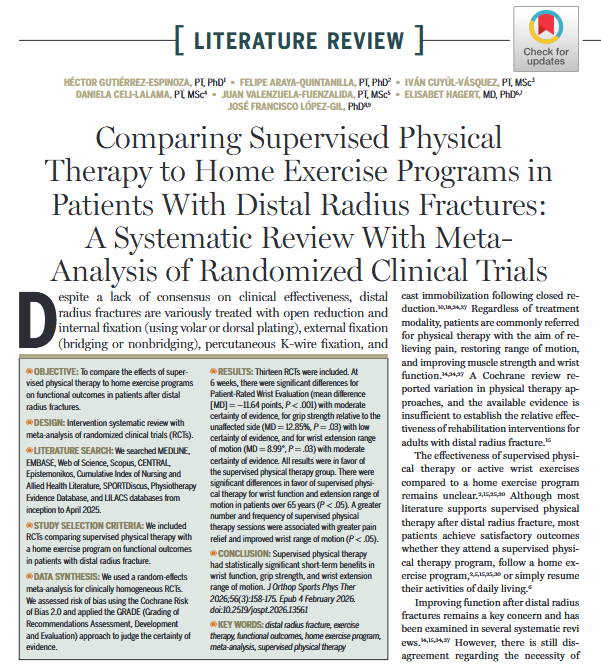
Supervised physio after a distal #radius#fracture delivers real short-term gains 💪
This #MetaAnalysis found that short-term post injury supervised physical therapy was superior to home exercise alone, especially in #OlderAdults#Review ➡️ https://t.co/TLxefKf4hY
#yourJOSPT
@Retlouping Thanks for sharing. Any key observational clues you have found to key you in to a DP (i.e. lordosis/hinging at upper lumbar, etc.)? Curious to see what you think.
@Retlouping@TaiwanOzPhysio I like the Rosedale study - there are some limitations, but def points to modulating extremity pain (esp. proximal) with spine movements
@Retlouping@TaiwanOzPhysio Thanks for sharing. What would be your approach - if neck main nociceptor, would think repeated dorsal glides (maybe with tennis balls at upper t-spine) to target lower neck. Have seen changes clinically w/ that in schneck pain.
Thrilled to share results of a tremendous effort to define competencies and graduation milestones for fellowship training in OMPT. I thank all those involved in these projects.
https://t.co/ZqBaR6DvaX
https://t.co/PubGmTrcj4
https://t.co/pNy4OrDZlv
https://t.co/n07PGdjVqC