Wall Street is taking @HyperliquidX seriously - as an opportunity and a threat
I think there are 3 factors that made it happen:
1. Hyperliquid enables round-the-clock trading of TradFi assets when traditional markets are closed
2. Hyperliquid enables pre-IPO markets with impressive trading volumes and OI
3. Reliable and democratic infrastructure that allows it to happen.
“convenience store” is becoming a department store.
perps. commodities. pre-IPO. outcomes. one venue. 24/7.
that’s the vision: house of all finance. and it’s getting closer
Pre-IPO markets on @HyperliquidX, June 1:
SPCX · $61.6M OI · $205 (↑41% in 4 days)
ANTHROPIC · $8.74M OI · $1,551
QNT · $4.14M OI · $99
OPENAI · $3.46M OI · $1,352
Total: $80.5M open interest.
SpaceX IPO: June 12. 11 days.
CBRS peaked at $58M OI the day it resolved. SPCX is already at $61.6M - and still climbing. Trade it on @Markets_xyz: https://t.co/A6tAIAcEeT
Cerebras @cerebras IPO'd 12 days ago. Traders didn't go home.
They rotated into SpaceX.
I analyzed every pre-IPO perpetual on @HyperliquidX. Five markets, two deployers, $1.12B cumulative volume in 90 days in a category that did not meaningfully exist before March.
What the data shows, market by market:
→ CBRS (Cerebras · @tradexyz): proof of concept. Launched May 1. IPO day did $281M in volume - the single largest pre-IPO day in HIP-3 history. OI still sticky at $37M post-resolution.
→ SPCX (SpaceX · @tradexyz): the new flagship. Day 1 volume $54.5M. OI ramped $25M → $50M in seven days. Doing in 10 days what CBRS took three weeks to build.
→ ANTHROPIC (@ventuals): $7.5M OI · funding +58% annualized. Most-loved Ventuals name. Longs paying the highest premium in the category.
→ SPACEX (@ventuals): $4.5M OI on $72K daily volume. OI/vol = 62×.
→ OPENAI (@ventuals): $3.4M OI.
CBRS → SPCX isn't two trades. It's one trade in two parts. When Cerebras resolved on May 14, capital didn't leave the venue, it redeployed into SpaceX four days later.
@tradexyz captured 61% (~$43K) of Pre-IPO HIP-3 revenue, while @ventuals accounted for 39% (~$28K).
Three months ago, retail couldn't touch SpaceX without a $1M net worth and a broker relationship.
Today: a Hyperliquid account.
now Quantinuum $QNT is next Pre-IPO Perpetual (IPOP) Market on @tradexyz
Hyperliquid testnet has its first HIP-4 market on a real-world event - not a crypto price. It's "Fed rate change in June."
The resolution rules are sharp. It settles "Change" if the Fed moves rates at the June 16-17 meeting, and "No Change" if rates hold or the meeting produces no decision. Moves between meetings don't count.
But here's the gap: the spec says what counts as a rate change - it doesn't say who posts the result on-chain, or whether there's a challenge window.
$BTC and $HYPE markets settle to @HyperliquidX own mark price, so they never needed an external oracle. A Fed decision can't do that. This is the first HIP-4 market where real-world resolution actually has to be solved - and the mechanism or oracle isn't public yet.
The one to watch: https://t.co/AfrUJxm1VJ
cftc just streamlined the rules for prediction market exchanges.
one umbrella letter now replaces 18 separate approvals. new exchanges can join by request.
19 venues on the list, including @kalshi, @polymarket us, cme, bitnomial, @cryptocom, railbird, ex-ledgerx.
the takeaway: lower barrier to entry, consistent rules, and the cftc is signaling formal rulemaking is next.
prediction markets are graduating from experiment to recognised venues.
trade[xyz] q1: $112.87B volume, +857% qoq.
what the headline doesn't show:
commodities = 67.65% of platform throughput
silver + cl = ~50% of total volume ($56.52B combined)
two stress windows:
- silver crash (jan 20 - feb 10, 22 days): $18.89B
- hormuz crisis (feb 24 - mar 18, 23 days): $10.47B
~26% of q1 volume came from 45 stress-event days.
48 consecutive days of OI ATHs is real for @tradexyz. spread convergence to crypto perps is real. the s&p license is real.
but the volume curve has two named catalysts driving the spikes.
the "no-event month" baseline is the q2 question.
kudos and credits to for amazing research: @smartestxyz and @shaundadevens
$HYPE outcome market is up on @HyperliquidX testnet.
Same template as the $BTC one, recurring daily binary, settles to the $HYPE mark price on HL.
First contract: HYPE above 28.18 at May 15, 00:00 UTC.
ticker: hype-above-2818-yes-may-15-0000
$BTC was the canonical first market on mainnet. $HYPE looks like #2.
Ondo just bridged 250+ tokenized US stocks to @HyperliquidX via @felixprotocol and @LayerZero_Core
How I farm~39% APR, delta-neutral, on $GME
Funding rate on the $GME perp is currently +0.0091%/hour on @tradexyz (~78% APR)
Long the Ondo-tokenized $GME spot on HyperEVM, short the perp on Hypercore, capture the spread.
Same wallet. HyperEVM and Hypercore. 24/7.
https://t.co/87lSa0vlCP
https://t.co/g6yBM6CGbx
Hyperliquid stopped being a DEX. It's a 24/7 equity venue now.
HIP-4: Week One Numbers
HIP-4 launched 7 days ago with a single market: a recurring daily $BTC binary.
In its first week it cleared $20.6M in volume across 132,462 transactions.
That's 0.37% of the prediction market category for the same week. It's also the wrong number to fixate on.
Here's why.
@Polymarket runs thousands of markets. @Kalshi runs hundreds. HIP-4 launched with one.
The right comparison isn't HIP-4 vs Polymarket. It's HIP-4's $BTC daily binary vs Polymarket's most active $BTC price markets (5 and 15 mins).
On that basis, $3.3M daily volume on a single binary puts HIP-4 within striking distance of @Polymarket's biggest crypto-price contracts. From day one.
Three patterns from the data:
→ Daily volume held steady at ~$3.3M for six straight days. May 2 → $3.03M. May 7 → $3.19M.
→ Transaction count grew through the week. 17,899 on day one. 28,589 by day six.
→ Avg trade size: $156 on HIP-4 vs $97 on Polymarket. HIP-4 is pulling larger, more sophisticated participants. That tracks with the cross-margin thesis: these are traders sized for perp positions, treating binaries as portfolio tools rather than retail bets.
What week one proves:
The mechanism works. The opening auction clears. The CLOB handles size. Settlement executes cleanly. The oracle layer holds for a $BTC mark price binary.
Phase 1 was about proving canonical markets can carry meaningful volume on the rails. They can.
What week one doesn't prove:
Whether non-canonical markets attract liquidity. Whether the oracle architecture holds for sports, elections, macro releases. Whether multi-outcome support lands and unlocks the categories where Polymarket and Kalshi actually win.
Those are questions for the next 90 days.
Three resolution philosophies. Three trade-offs.
@HyperliquidX HIP-4 chose speed. Authorized oracle, minutes-bounded resolution. Fast.
@Polymarket UMA's optimistic oracle is slower but battle-tested across billions in disputed volume. 2 hours to 2 days.
@Kalshi's in-house committee is fast in the common case. Inscrutable in the edge case.
The honest framing: HIP-4's oracle architecture is the least specified part of the spec.
For $BTC daily binaries, the oracle is HyperCore's mark price.
For sports, elections, macro releases? The infrastructure has not been publicly designed.
That's the bet. Speed first, optionality later.
Three things only HIP-4 does:
→ Cross-margin with perps and spot
A long $BTC perp + a $BTC > $80k by Friday outcome contract sharing the same $USDH collateral. @Polymarket lives on Polygon. @Kalshi lives in a brokerage account.
→ On-chain end-to-end
Polymarket's V2 still matches off-chain. Kalshi has no chain at all. HIP-4 runs every step on @HyperliquidX: order, match, settle, oracle.
→ Permissionless deployment via burn-able stake
1M $HYPE, slashable, burned on slash. Up to 50% builder fee share. Phase 2 turns market creation into a deployable revenue line, not a curated listings function.
The trade-off: zero maker rebate (Polymarket pays makers 20–25%).
Free entry, paid exit. Nobody else does this.
Hyperliquid stopped being a crypto exchange this quarter
Q1 numbers:
→ 40% of HL OI is now HIP-3 → 52% of that is commodities
The biggest perp on HIP-3 markets in terms of volume in Q1 was silver. Revolutionary for @HyperliquidX
Full breakdown ↓
Data: @artemis
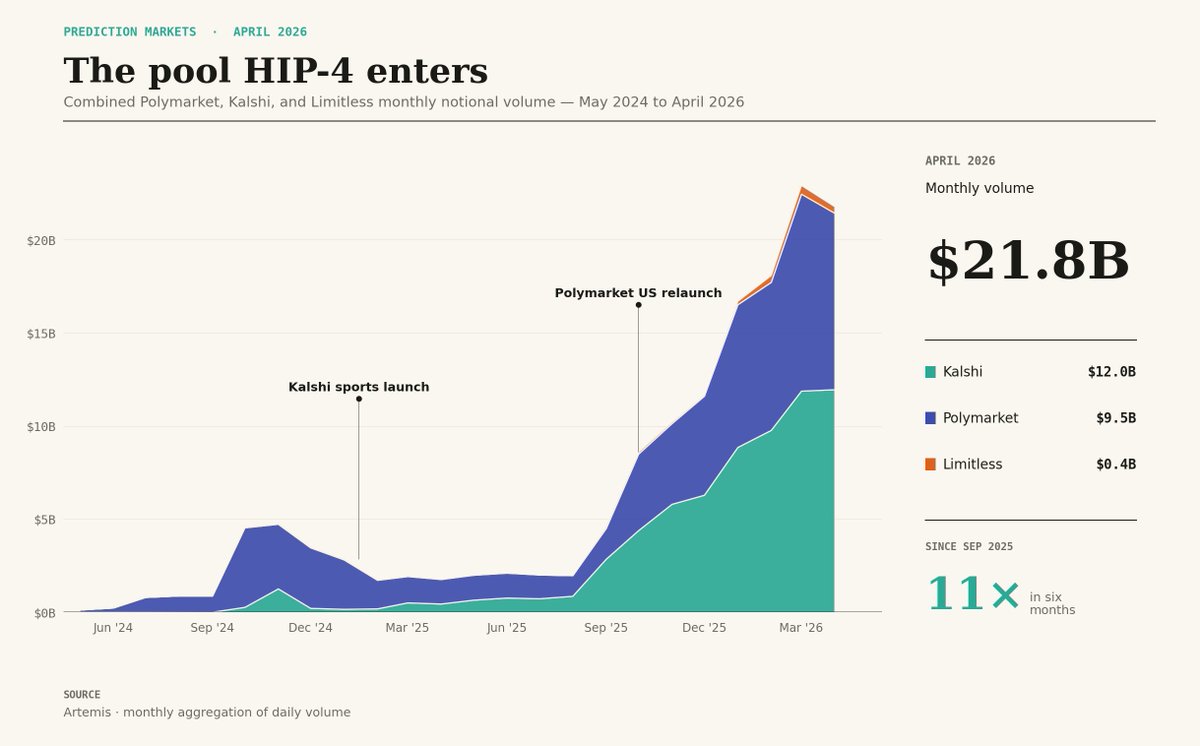
$22B in April.
11× in six months.
While @HyperliquidX was finalizing HIP-4, @Polymarket and @Kalshi quietly turned prediction markets into one of the fastest-growing categories in finance.
Sports drove Kalshi to $12B/month. Geopolitics carried Polymarket to $9.5B. On-chain venues are still underrepresented: @trylimitless cleared $356M.
This is the pool HIP-4 entered on May 2.
The category isn't speculative anymore. It's institutional-scale.
Took @kirbyongeo's HIP-4 ecosystem rundown and compiled it into a single visual map.
30+ services laid out by layer:
foundation rails → live frontends (7) → coming soon (10) → analytics & infra.
Full credit to him + @hypurr_co for the source thread.
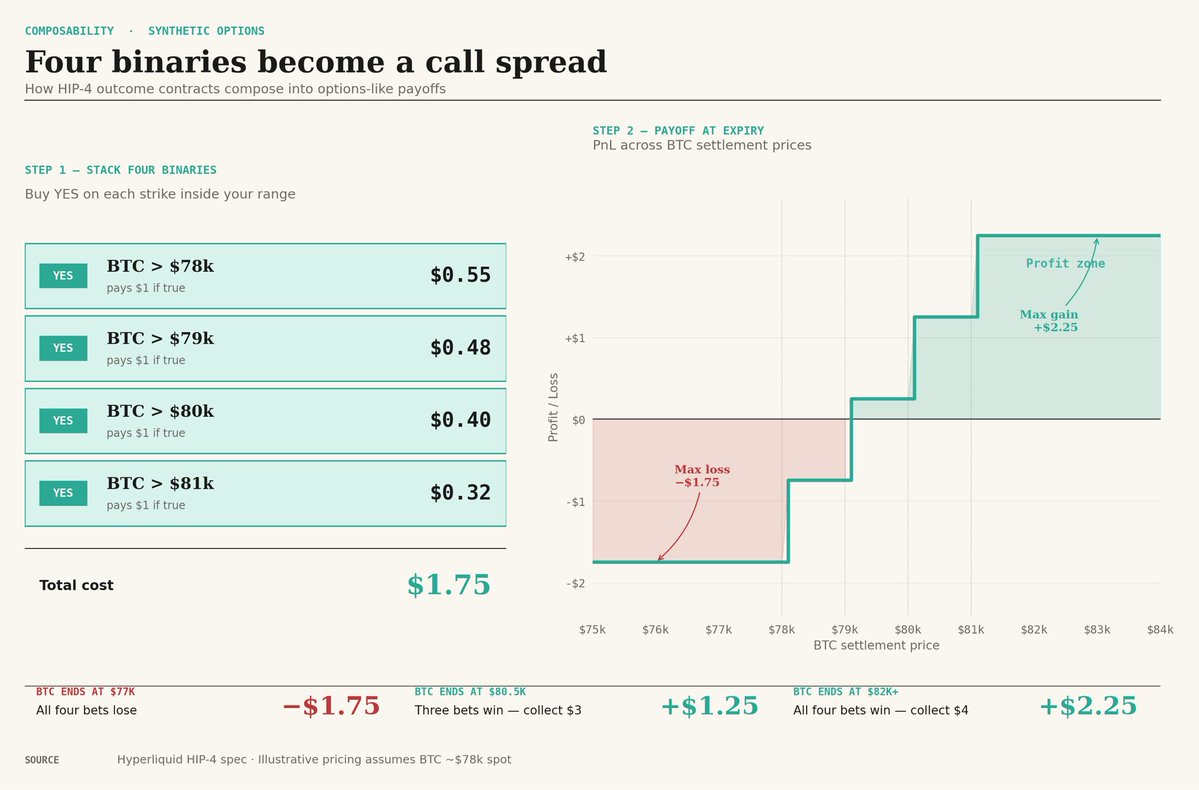
HIP-4 quietly enables synthetic options on @HyperliquidX
Want to bet BTC ends between $78k and $82k by Friday? Buy four cheap “yes/no” bets, one at each strike inside your range.
→ “BTC > $78k?” YES at $0.55
→ “BTC > $79k?” YES at $0.48
→ “BTC > $80k?” YES at $0.40
→ “BTC > $81k?” YES at $0.32
Total cost: $1.75. Each pays $1 if true.
If BTC ends at $80.5k → three bets win → +$1.25 profit
If BTC ends below $78k �� all lose → -$1.75 max loss
If BTC ends above $81k → all win → +$2.25 max gain
Same shape as a call spread. Built from four binaries.
Polymarket can do this in theory. But each bet sits in a separate market with separate collateral, and you can’t cross-margin against a BTC perp.
HIP-4 puts all of it on one engine, one collateral pool, alongside your perp delta.
That’s how a binary book becomes an options surface.


![PDmytriiev's tweet photo. trade[xyz] q1: $112.87B volume, +857% qoq.
what the headline doesn't show:
commodities = 67.65% of platform throughput
silver + cl = ~50% of total volume ($56.52B combined)
two stress windows:
- silver crash (jan 20 - feb 10, 22 days): $18.89B
- hormuz crisis (feb 24 - mar 18, 23 days): $10.47B
~26% of q1 volume came from 45 stress-event days.
48 consecutive days of OI ATHs is real for @tradexyz. spread convergence to crypto perps is real. the s&p license is real.
but the volume curve has two named catalysts driving the spikes.
the "no-event month" baseline is the q2 question.
kudos and credits to for amazing research: @smartestxyz and @shaundadevens](https://pbs.twimg.com/media/HIJ0IzTWwAAUqQi.jpg)