Volta says its edge is “structurally lower cost of capital.”
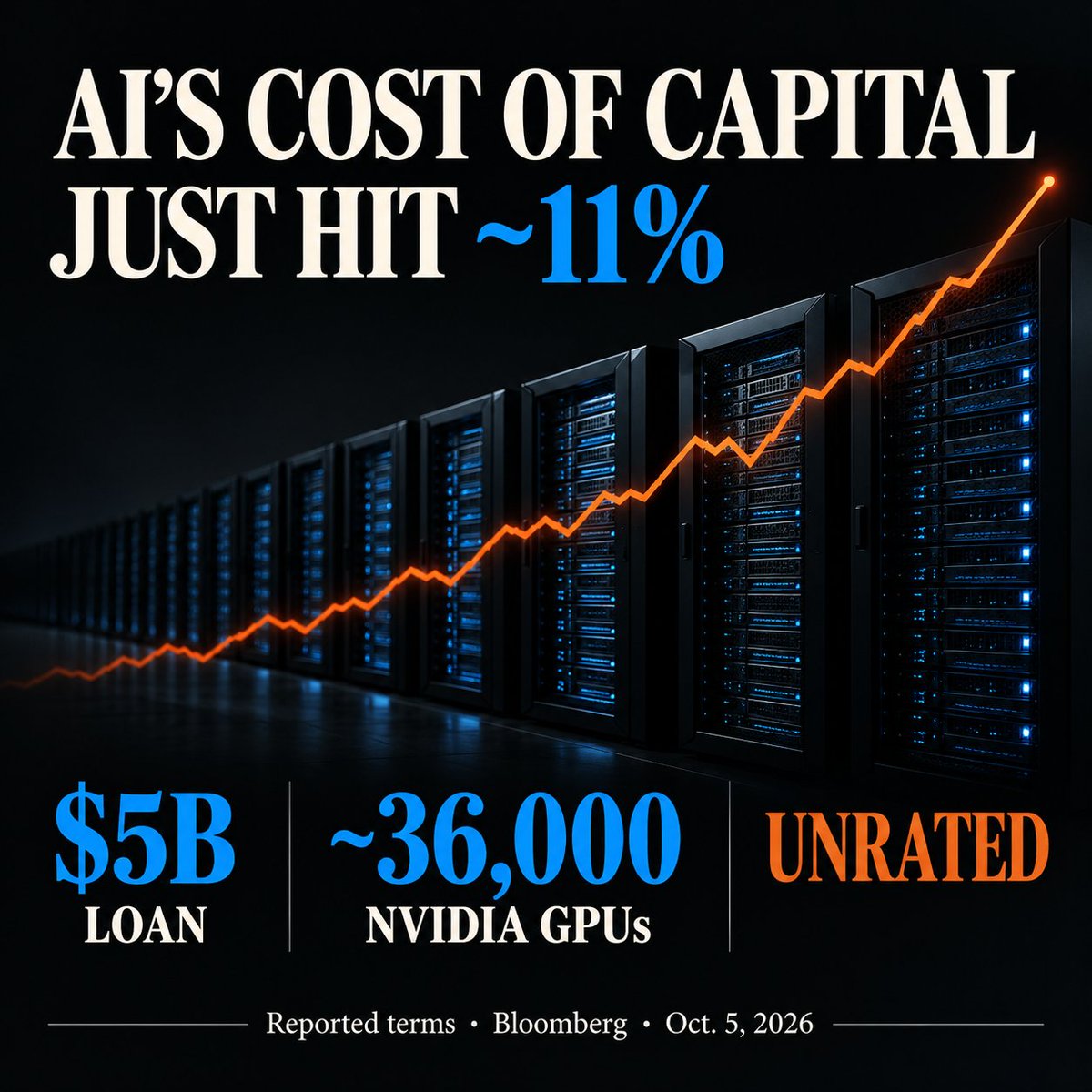
Wall Street’s first hard price is roughly 11%.
JPMorgan is reportedly marketing a $5B unrated loan to fund about 36,000 Nvidia GPUs and secure a Norwegian data-center lease.
That spread is the AI market separating access to chips from access to cheap money.
The GPUs may be identical. The balance sheets aren’t. And compute financed at double-digit yields eventually lands on someone’s bill.
ALERT — Wall Street has begun syndicating AI’s biggest chip-financing package
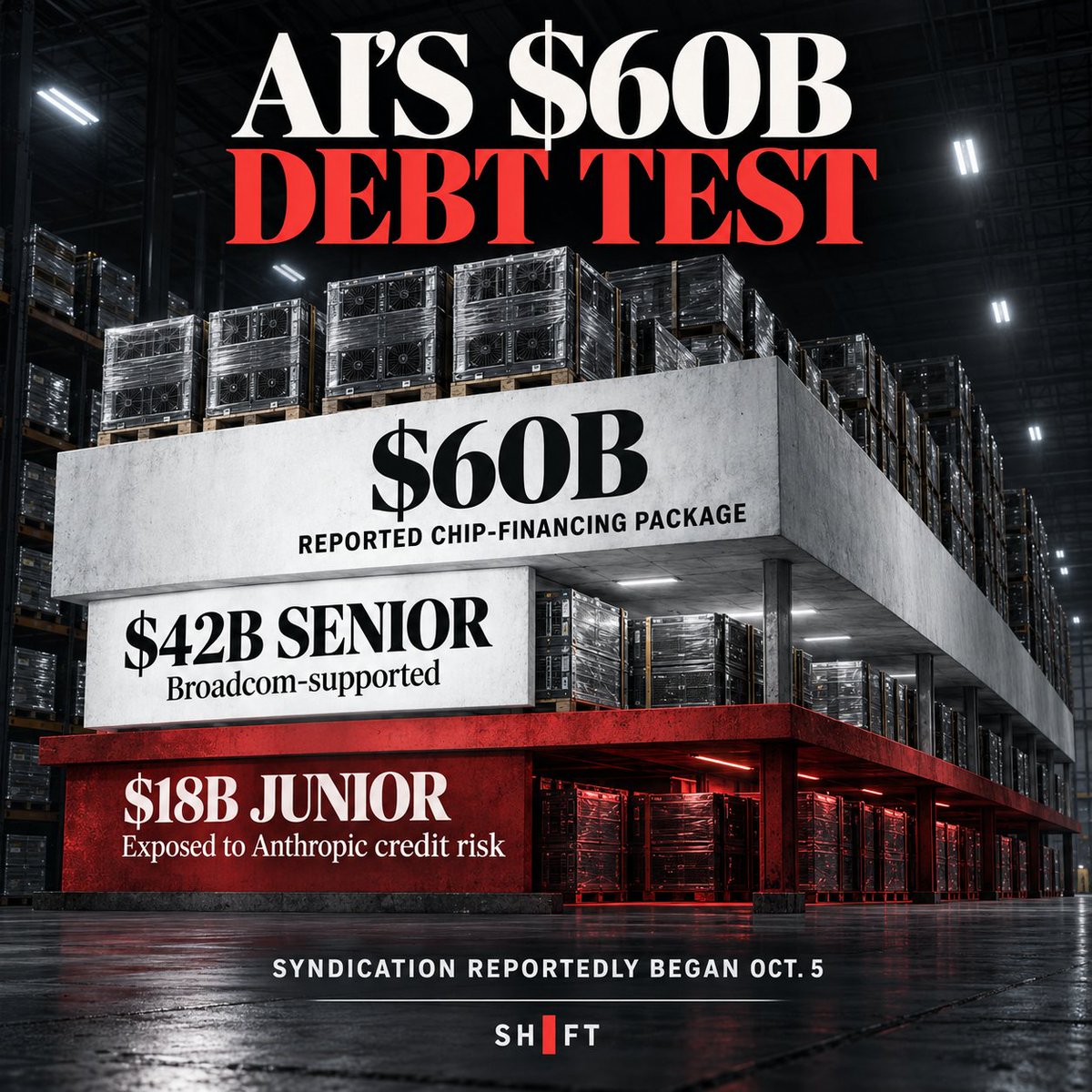
Bank of America, Citigroup and Morgan Stanley have started offering portions of a reported $60 billion debt package designed to finance Anthropic’s lease of Google TPUs, according to the Financial Times. It is described as the largest chip-financing deal yet.
The risk is being split deliberately:
$42 billion senior financing, supported by Broadcom.
$18 billion junior financing, reportedly without Broadcom’s guarantee and therefore exposed more directly to Anthropic.
Blackstone has reportedly committed about $9 billion to that junior layer.
The junior tranche has not launched, and the overall package has not closed. Banks may wait until Anthropic’s planned IPO gives lenders fuller financial disclosure.
Anthropic’s filing already disclosed up to $42 billion of Broadcom financing toward a five-year TPU lease commitment worth $125.2 billion. The new development is that banks have begun testing broader market appetite for the debt.
SHIFT post
Wall Street has started slicing Anthropic’s chips into debt tranches.
$42bn senior—with Broadcom support.
$18bn junior—exposed to Anthropic.
Blackstone is reportedly in for $9bn.
This is no longer venture capital chasing software.
It’s structured finance underwriting whether Claude can pay the rent on its silicon.
Sources: Financial Times · Reuters
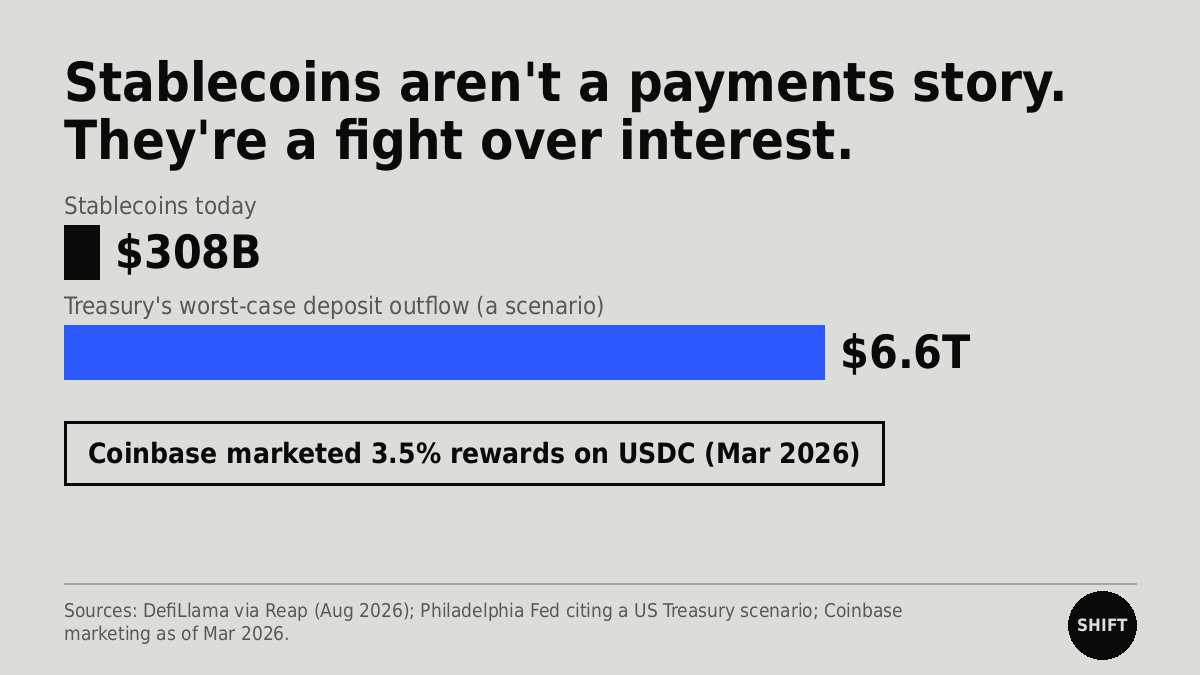
Stablecoins aren't a payments story. They're a fight over who pays you interest.
The market is about $308B, versus trillions in bank deposits. Coinbase was marketing 3.5% USDC rewards in March, and a Treasury report floated up to $6.6T of deposits at risk.
Twist: if issuers hold reserves at banks, deposits mostly change hands rather than vanish.
ALERT — AI’s power shortage may hit the suppliers, not Nvidia
Morgan Stanley estimates U.S. data-center developers face a 32 GW net power shortfall through 2028—34% of projected demand—even after accounting for onsite generation and fuel cells. This is a modelled forecast, not an observed shortage.
The investment consequence is uneven. Morgan Stanley does not expect the constraint to threaten Nvidia or Broadcom’s 2027 forecasts. But if customers cannot energize purchased hardware, deliveries could be postponed or cancelled—leaving memory, optical, analog and power-management suppliers exposed to excess inventory.
SHIFT post
AI has a 32 GW problem.
Morgan Stanley estimates U.S. data centers face a 34% net power shortfall through 2028—even after onsite generation and fuel cells.
Nvidia may be protected. Memory, optics and power-chip suppliers may eat the delayed orders.
The bottleneck is electricity.
Sources: Reuters · Morgan Stanley’s AI-power outlook
ALERT — The AI-infrastructure trade is splitting the landlord from the hardware owner
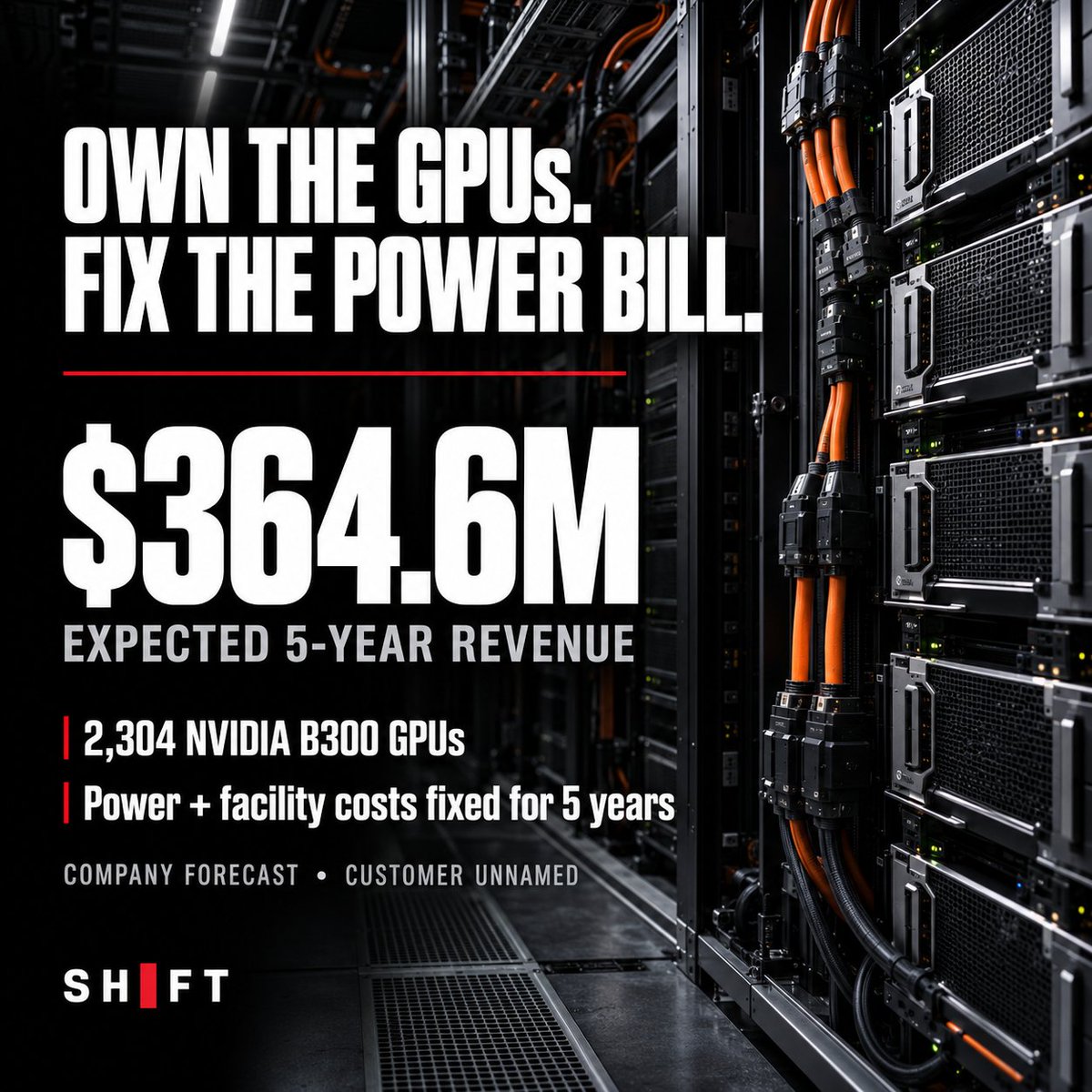
Axe Compute has taken full ownership of a Georgia AI cluster containing 2,304 Nvidia B300 GPUs. It repaid $87.8 million of asset-backed debt without issuing new equity, while extending the customer contract from three to five years. Axe forecasts $364.6 million in revenue through 2031.
The interesting part is who carries which risk. Duos keeps the data centre, power and colocation business—and covers those costs for the five-year term. Axe owns the GPUs and therefore takes the utilization and hardware-obsolescence risk. Duos says the sale also removes roughly $98.1 million in prospective equipment financing, freeing capital for more sites.
The customer remains unnamed, and the $364.6 million figure is management’s forecast—not guaranteed revenue.
SHIFT post
The new AI trade isn’t just buying GPUs. It’s deciding who gets stuck owning them.
Axe Compute now owns 2,304 Nvidia B300s and expects $364.6mn from the five-year customer contract.
Duos keeps the site, power and colocation revenue.
One side owns the infrastructure. The other owns the depreciation clock.
Sources: SEC filing · Axe Compute · Duos
The buybacks aren’t the bailout people think they are.
Treasury isn’t making the debt disappear. It’s mostly swapping older, less-liquid securities for newly issued debt and trying to improve market liquidity.
The interesting signal is elsewhere: even with larger long-end buybacks, investors still want ~5% to lend Washington money for 30 years.
That’s the price worth watching.
Calling this a 2008-style housing crash misses what’s actually broken.
In 2008, people desperately wanted to sell.
Today, millions of owners sitting on 3% mortgages don’t want to sell, while buyers can’t stomach today’s payment at 6%+.
So transactions freeze.
The strange part is having 2008-level demand without 2008-level prices.
That’s not a normal housing market.
> $56M is nice. The stickiness is the more interesting part.
Once a component is qualified for a weapons program, swapping suppliers isn’t like changing a SaaS subscription.
If production scales, Ondas doesn’t need to win the airframe. It needs to stay inside it.
That’s where this order gets interesting.
This is the AI equivalent of asking someone every day if they’re haunted and then treating “maybe” as evidence of ghosts.
If uncertainty about consciousness is part of Claude’s training, Claude expressing that uncertainty tells us something about the training.
Not necessarily about consciousness.
Deutsche Telekom says AI + automation could eliminate roughly €2.5 BILLION in indirect costs by 2030.
This isn’t a hypothetical productivity pitch.
Its AI chatbot handled 2.6 million customer-service calls in just the first half of 2026.
At T-Mobile US, AI agents already handle 40% of customer contacts.
And Telekom is deploying AI across:
Network operations.
Customer service.
Software development.
Administration.
This is where the AI story gets much bigger than ChatGPT.
When a company can attach billions in measurable savings to automation, every CEO starts asking the same question:
How much human work are we still paying for that software can now do?
Source — Oct. 5: Reuters — Deutsche Telekom sees €2.5 billion in savings from AI, automation by 2030
Who exactly is “they”? You’ve bundled migration, interracial relationships and casting decisions into a conspiracy without identifying who coordinates it or offering evidence. People choosing partners aren’t “destroying bloodlines.” Criticise immigration policy with facts; racial purity rhetoric explains nothing.
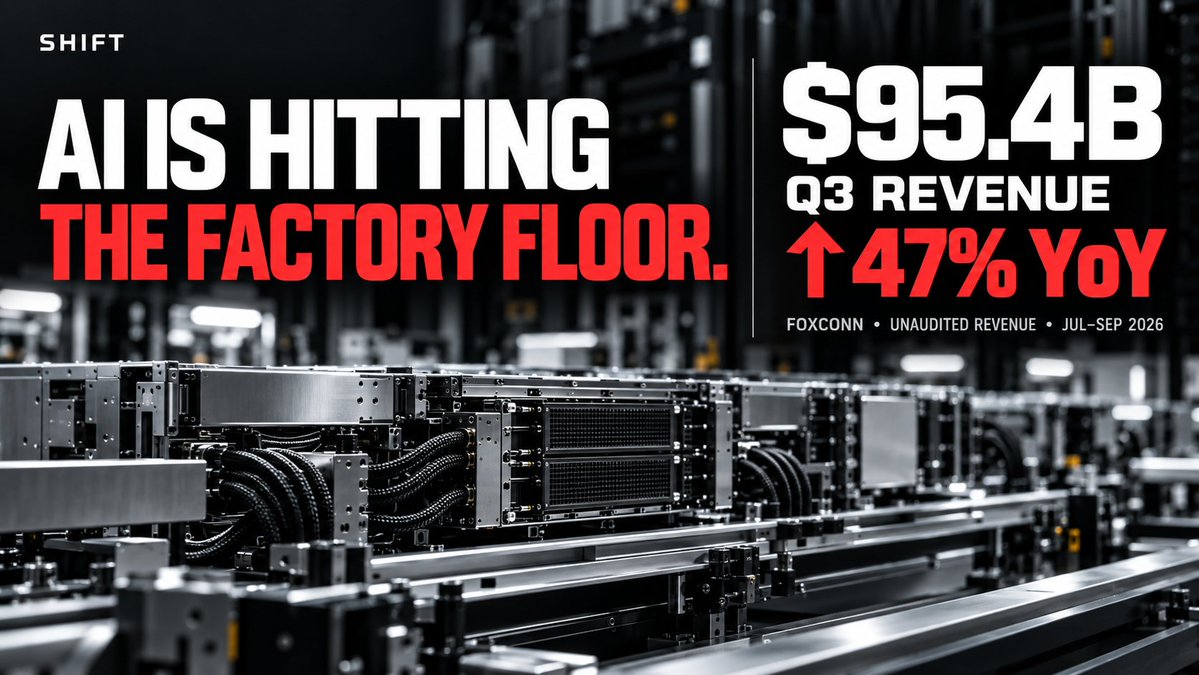
Foxconn just did $95.4bn in quarterly revenue, up 47%. September alone broke NT$1tn.
AI servers helped drive it. So did iPhones.
That matters: the AI boom is no longer sitting inside chip stocks. It is filling factory lines across the electronics supply chain.
Sources: Foxconn investor calendar · Reuters
@jackprandelli Both can be true. Savers don’t need a geopolitical thesis to want out of disappointing investments at home. But “puts a floor under the price” is doing a lot of work here. A big buyer can support gold without guaranteeing where the next sell-off stops.
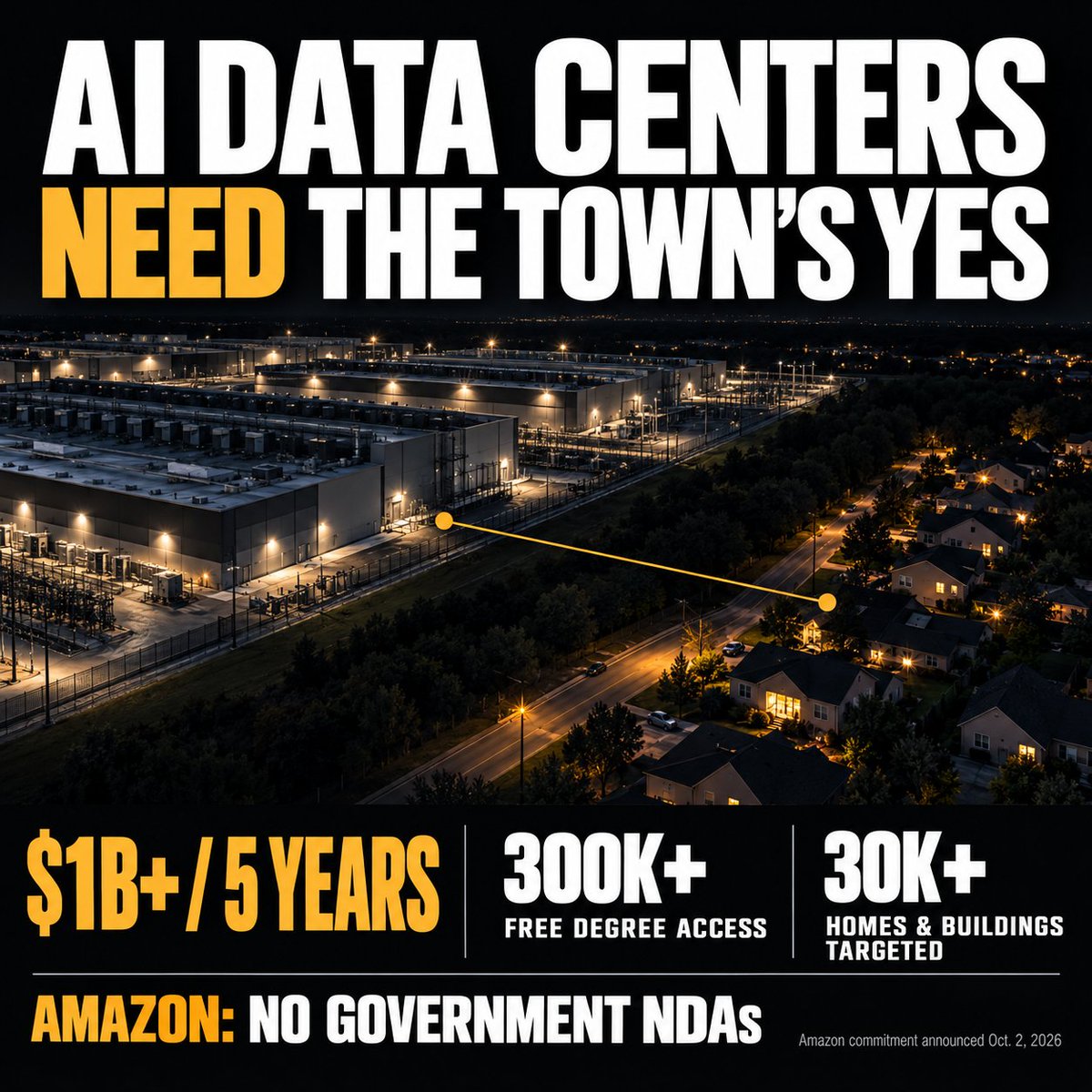
Amazon is offering over $1B to communities around its data centers over the next five years.
Its targets include degree access for 300,000+ people and energy upgrades for 30,000+ homes and buildings. Amazon also says it no longer uses NDAs with government agencies on these projects.
AWS says 100+ U.S. data-center moratoriums are under consideration. You don’t launch a package like this if every town is already on board.
As a European, what gets me is this: people will spend $100,000—or more—on a four-year degree, sometimes for several children, yet balk at paying a little more in taxes for healthcare and education that are accessible to everyone who needs them.
The money gets spent either way. The real question is who pays—and who gets left behind.
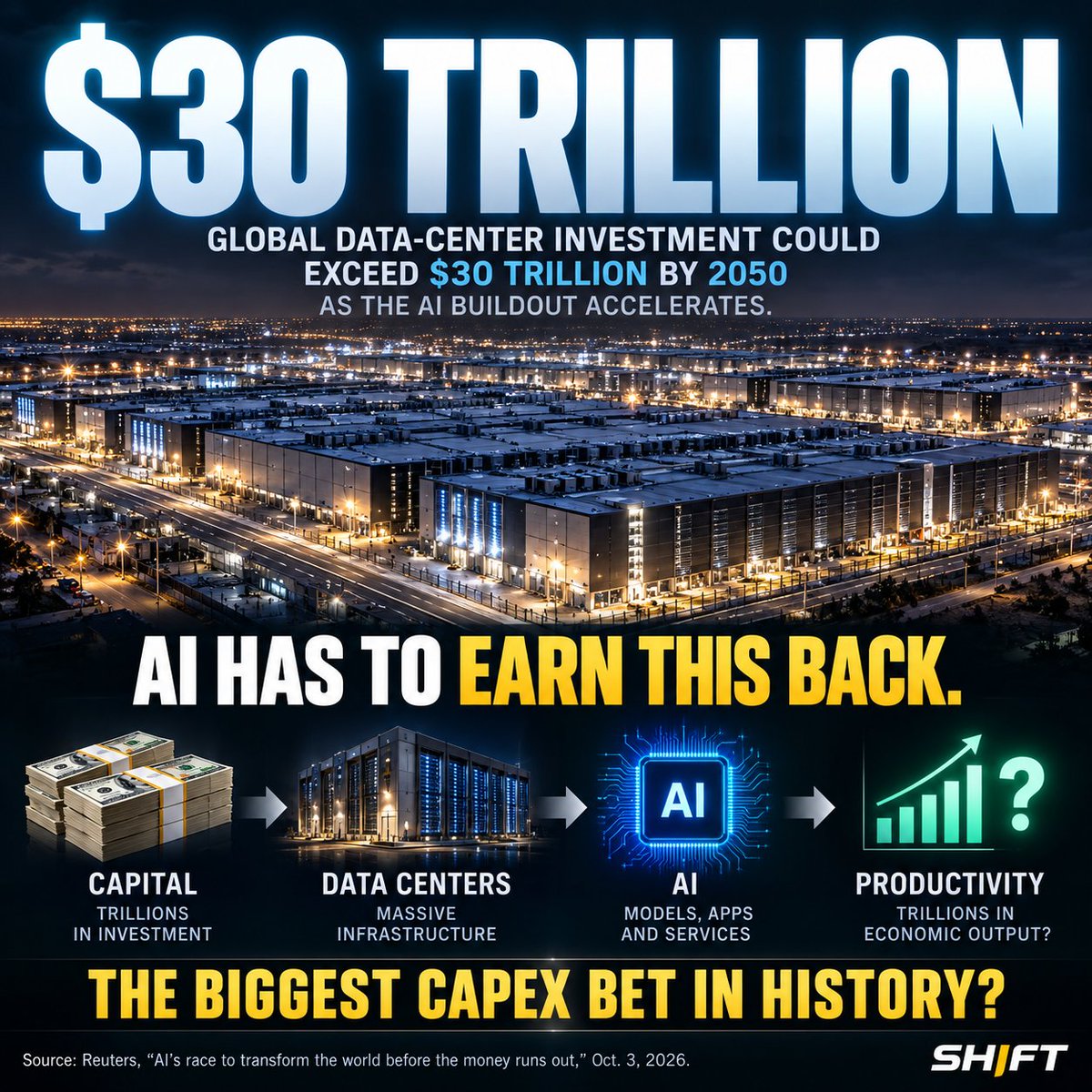
🚨 $30 TRILLION.
That’s how much global data-center investment could exceed by 2050 as the AI buildout accelerates.
Now comes the uncomfortable part:
AI has to earn it back.
Reuters reports U.S. companies may need to generate trillions of dollars in annual AI-related revenue by 2032 to justify the infrastructure being built.
Yet broad productivity gains are still difficult to see.
This is no longer just a technology bet.
It’s one of the largest capital-allocation bets in history.
If AI delivers → enormous productivity upside.
If it doesn’t → someone is holding trillions of dollars of infrastructure built for returns that never arrived.
The AI race is becoming a race between productivity and the cost of capital.
Source: Reuters, Oct. 3, 2026