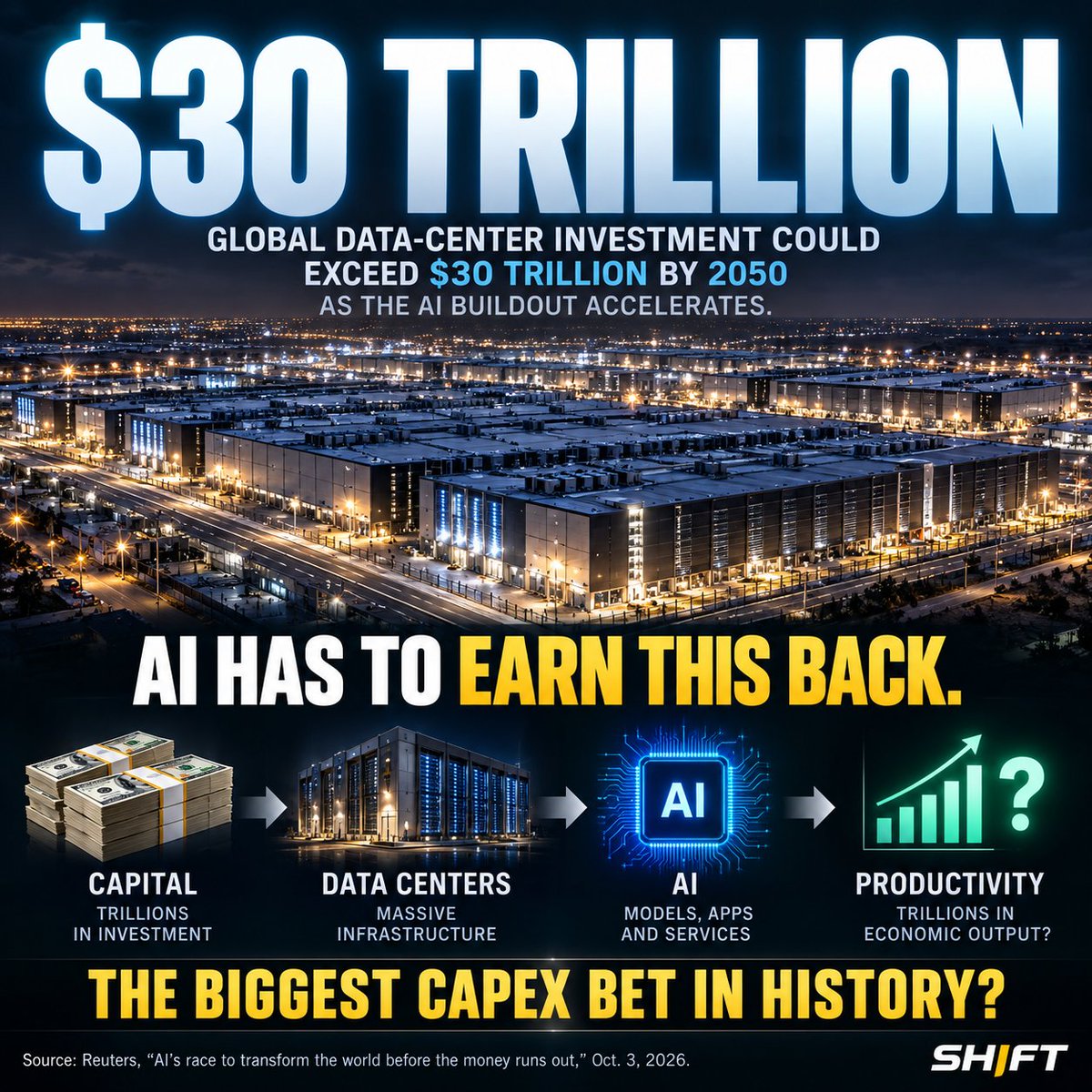
🚨 $30 TRILLION.
That’s how much global data-center investment could exceed by 2050 as the AI buildout accelerates.
Now comes the uncomfortable part:
AI has to earn it back.
Reuters reports U.S. companies may need to generate trillions of dollars in annual AI-related revenue by 2032 to justify the infrastructure being built.
Yet broad productivity gains are still difficult to see.
This is no longer just a technology bet.
It’s one of the largest capital-allocation bets in history.
If AI delivers → enormous productivity upside.
If it doesn’t → someone is holding trillions of dollars of infrastructure built for returns that never arrived.
The AI race is becoming a race between productivity and the cost of capital.
Source: Reuters, Oct. 3, 2026
“Every. Time.” is simply not what the historical data says.
Youth employment is highly cyclical and often gets crushed around recessions. That makes it worth watching.
But there have been plenty of youth-employment reversals without a recession immediately following.
Interesting signal? Yes.
Infallible recession indicator? No.
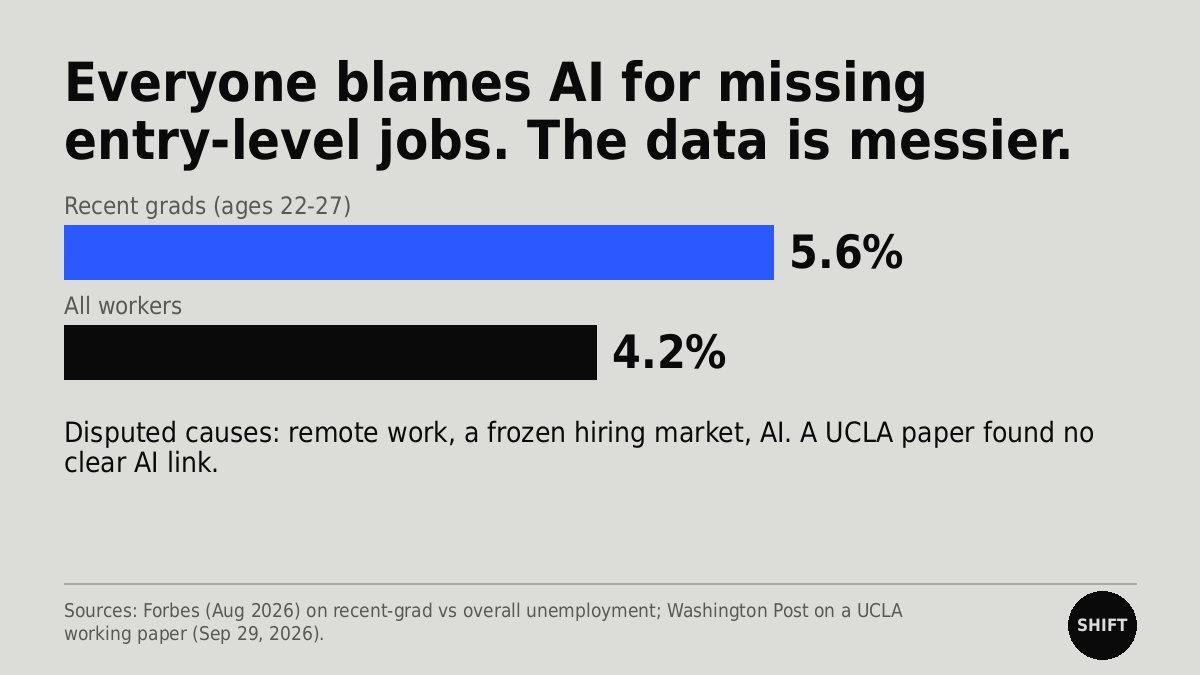
Everyone blames AI for vanishing entry-level jobs. The data is messier.
Recent-grad unemployment is about 5.6%, above the 4.2% overall rate. But a UCLA paper this week found no clear link between AI exposure and grad unemployment, and NY Fed researchers point mainly to remote work.
@ekwufinance $100T sounds terrifying. But it’s not a bill America has to pay tomorrow.
These promises can be rewritten.
Taxes up. Benefits down. More borrowing. More inflation.
There’s no painless option.
That’s the real problem.
I checked this against YouTube/Google’s own documentation and current 2026 benchmark sources. The core strategy is directionally right, but several of the precise numbers and the methodology are presented with far more certainty than the evidence supports.
The biggest problem: CPM ≠ what YouTube pays you
YouTube explicitly distinguishes:
CPM = what advertisers pay per 1,000 ad impressions, before YouTube's revenue share.
RPM = what the creator actually earns per 1,000 video views, after YouTube's share, and it includes views that weren't monetized. �
Google Help +1
For standard long-form Watch Page ads, creators receive 55% of net ad revenue. �
Google Help
So the opening claim—
"$44 per thousand views vs $3 per thousand views"
—is only valid if those numbers are RPM, not CPM. The post repeatedly calls $44 "CPM" while simultaneously using it as creator revenue. That's a significant error.
> 788 MW for one load.
Forget the chatbot demos for a minute. This is what the AI race looks like in the physical world.
Power plants. Substations. Transmission lines. Hundreds of millions in grid upgrades.
The question people should be asking is: who pays the $540 million?
Because if the answer eventually shows up on everyone else’s electricity bill, the public is quietly subsidizing the AI boom.
The scale point is right. The framing is not.
100 million barrels against roughly 14 million barrels a day of European oil use is about a week of consumption, not a stockpile that resets the market. Spread over the four months in the G7 statement, it is about 0.8 million barrels a day.
Two catches.
It is not all diesel. The release is crude plus products, with a "substantial" diesel slice front-loaded into the first 20 days. No country split yet.
And part of the 100 million looks like finishing the March IEA commitment, not a clean extra 100 million on top of the 400 million already pledged after the Iran war.
So yes, if the aim was to refill Europe, they need a bigger dump. What this actually does is put physical barrels into a tight diesel market and head off a US export ban. It does not restart damaged Gulf and Russian refineries.
Stocks bridge a shortage. They do not refine one.
@Artemisfornow The AI boom needs land, power and infrastructure. Fine.
But “we need a data centre” shouldn’t automatically outrank “we’ve kept this for 1,000 years.”
You can build another data centre.
You cannot build another 1,000-year-old castle.
🚨 AI now has a $4.2 TRILLION revenue problem.
The infrastructure buildout is moving faster than the economics underneath it.
Bain estimates AI infrastructure will need $4.2T in additional annual revenue within five years to justify the computing power being built.
Meanwhile, Reuters reports AI investment could exceed $30 TRILLION by 2050.
That’s the real bet:
Build the data centers.
Build the chips.
Build the powe
Then hope AI creates enough economic value to pay for all of it.
The biggest risk to the AI boom may not be that the technology fails.
It’s that the technology works — but the economics don’t catch up fast enough.
Reuters
Source — Oct. 3: Reuters — AI's race to transform the world before the money runs out
🚨 US JOBS JUST COLLAPSED TO 29,000.
NASDAQ HIT A RECORD HIGH ANYWAY.
September payrolls came in at just 29K.
Wall Street expected roughly 90K.
Previous months were revised lower too.
And the Nasdaq?
Record high.
Why?
Weak jobs crushed expectations for another Fed hike.
That tells you exactly what this market is trading now:
Bad news for workers
= good news for rates
= good news for tech.
The economy is slowing.
The market is celebrating.
Source: Reuters, Oct. 2
Reuters
@ZSchneeweiss@jackie_deals Spreads are doing what spreads do. The French-German gap is above 140bp, the widest since 2012. Add record borrowing plans and a reportedly high bar for ECB intervention, and the backstop question stops being theoretical.
@robin_j_brooks The counterpoint: the ECB's job is monetary transmission, not bailouts, and a disorderly sovereign default would hit everyone, German banks and exporters included. The hard part is rules that protect the euro without rewarding fiscal drift.
🚨 The AI boom is starting to look like Wall Street engineering.
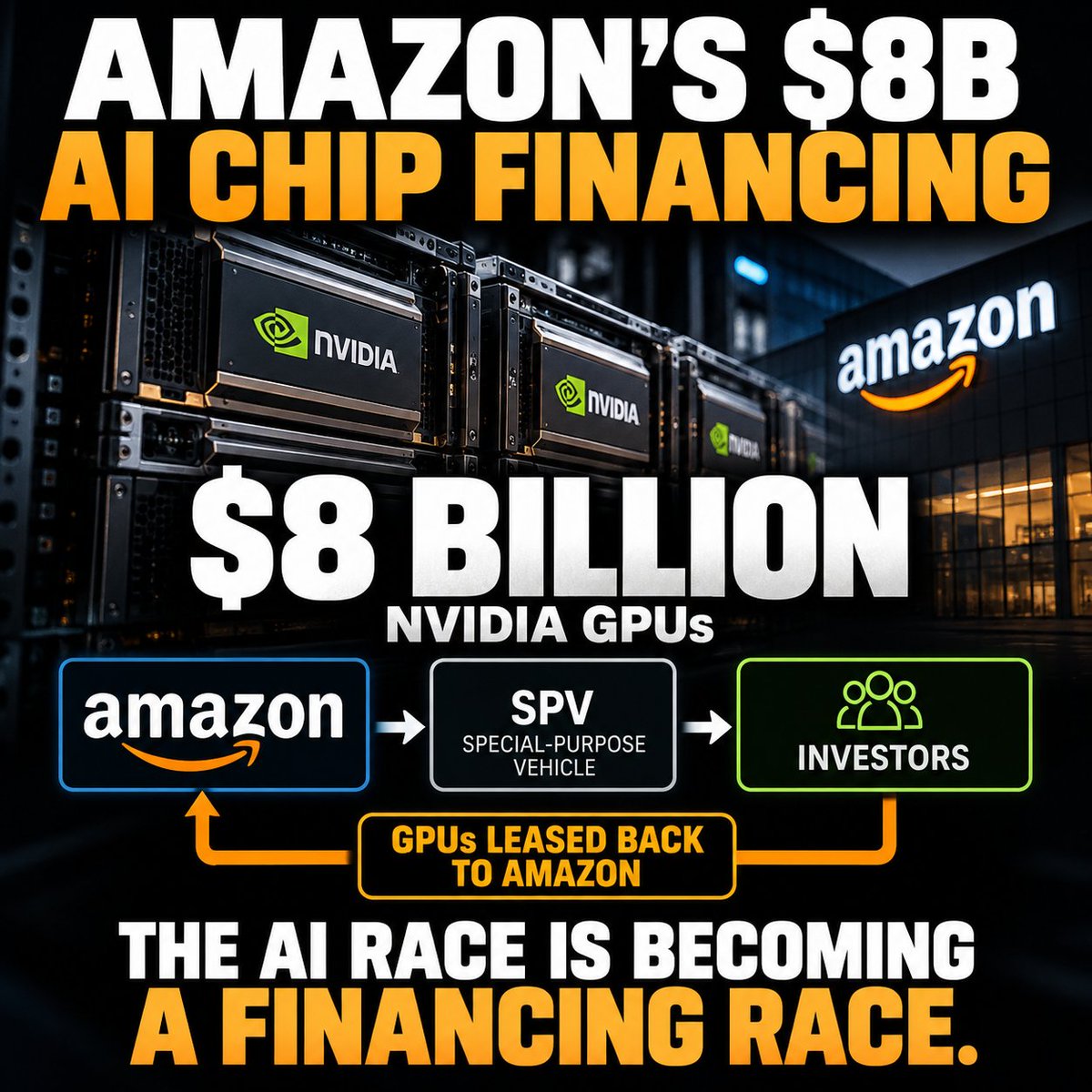
Amazon is reportedly trying to move roughly $8 BILLION of Nvidia AI chips into a special-purpose vehicle.
Investors would own the vehicle.
Amazon would lease the chips back.
Translation:
Buy GPUs → move them off the balance sheet → raise outside debt → keep using the GPUs.
AI infrastructure is becoming so capital-intensive that even a $2+ trillion company is looking for ways to finance the hardware without carrying all of it directly.
The next phase of the AI race isn’t just about who has the best model.
It’s about who can finance the compute.
And Wall Street just entered the server room.
Reuters
Source, Oct. 2: Reuters — Amazon seeks to offload $8 billion of Nvidia chips to investors