Personal view on pre market trading #smallcaps:
Do it mostly in strong cycles. Weak cycles unless you are shorting and really up very early (as many tickers top out well before 8AM) is just not worth it. In weak/cold market number of tickers in PM is low. And PM trading in my view is all about high number of samples because only one ticker out of 3 or 5 might fit a good PM trade. So if you dont have samples because there is only 1 gapper on the day ,and you have low volatility and RR opportunity (often the case in colder cycles) then whats the point of draining that brain battery for extra 2.5 hours in pre market. There isnt much, unless you are shorting really early and have for some reason high conviction on some ticker to be fader.
In strong cycles its when number of gapping tickers increases significantly. Samples increase, opportunities increase and you have both long and short side opps. Mostly long side 7 AM (when many brokers open) play on tickers that are multiday runners or are hot sector plays are the go to. Often not good to be shorting those in PM unless the ticker has made 1000% run. If you do short, dont short frontside but perhaps after ticker has been for 2 hours consolidating with lower highs. Thats when odds are bit better, especially if frontside already has 200% or more gap up.
Some $GDC long here on 7AM
25 trading lessons that took me years to learn:
1. You will gain more confidence from the losses you cut short rather than from your big wins.
2. No matter how good a trade looks, if the environment isn’t favorable it will be hard to make progress.
3. You’ll have great days when you feel like trading is easy and bad days when you wonder if trading is even for you. This is normal, it’s human.
4. Your fear of losing money is ironically causing you to make bad decisions and lose more money.
5. All of my biggest losses came after my biggest wins. Arrogance is a quick way to lose money in the market.
6. One undisciplined trade can undo months of progress.
7. Don't be so critical of your trading mistakes... we all make them. Just learn and move on — quickly.
8. No matter how confident you are when you place a trade, remember that the outcome will always be out of your control.
9. The most important thing in trading is not being right; it's making money.
10. Most trading errors can be minimized by sizing down.
11. Sometimes the best thing to do is nothing at all.
12. The only way to become a good trader is to first be a bad trader.
13. Your trading will improve faster if you focus on one thing at a time.
14. Discipline is more important than intelligence (without it, the market will eventually wipe you out).
15. Nobody knows where the market is going to go next, and you don't need to.
16. An edge in trading is simply having a higher probability of being right than wrong.
17. You need to have a clear head to make the best trading decisions.
18. You don't need to trade every day. In fact, you shouldn't.
19. It's important to study the great traders instead of only studying great strategies.
20. Most traders don't develop the necessary discipline until they have felt the pain. (That's how it worked for me.)
21. The more you understand yourself as a trader, the better your trades will be.
22. If you don't have a trading plan, you're just guessing at what the market will do next and hoping for the best.
23. The less time and energy you spend on things outside of your control, the more successful you will be as a trader.
24. It's important to only trade with money that you can afford to lose.
25. If you can manage your risk, you can recover from any bad day and come back stronger than before.
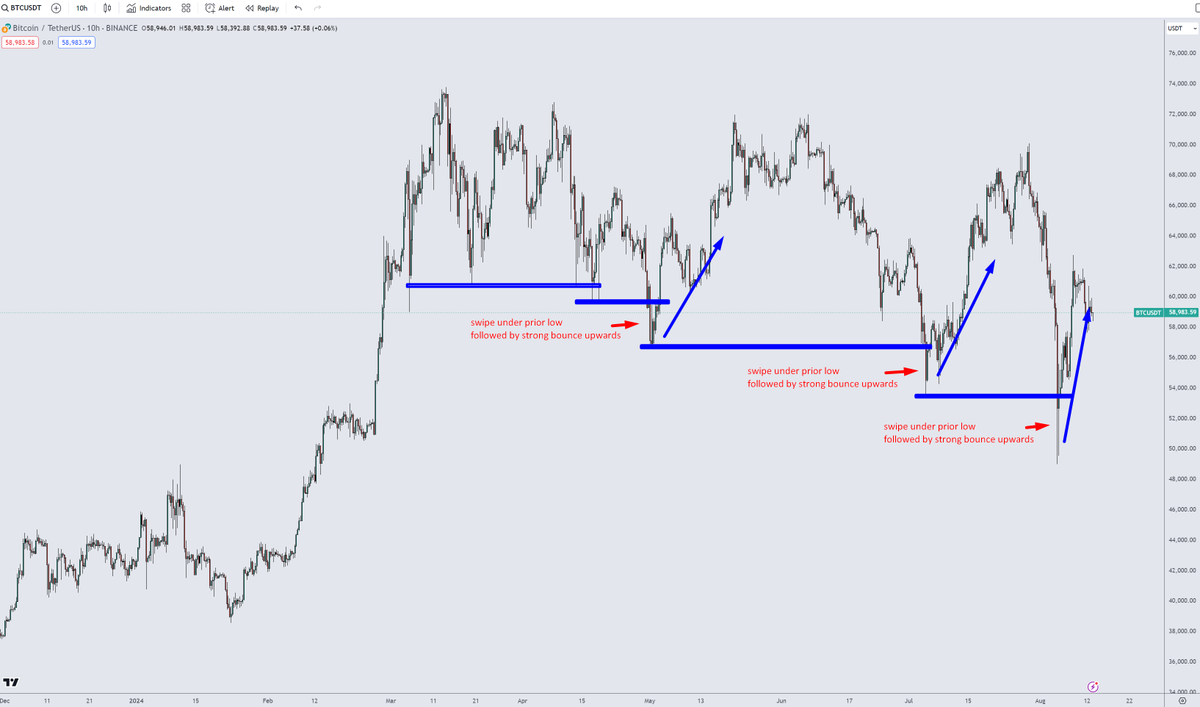
This rule still applies. Best long opportunities with highest RR on #Bitcoin over entire 2024 came after major clearouts under prior macro lows. Last August sample proves it again.
Understanding candle patterns part two:
Morning doji star:
This is a bullish reversal formation that consists of three candles:
First, a large bearish candle indicating strong selling pressure, followed by a small doji candle that I best can describe as indecision or minimal price movement.
Finally, a large bullish candle appears which shows renewed buying interest. This typically appears during a downtrend, signaling a potential shift from bearish to bullish.
The chart below is $AIQ heading into the rest of the week.
No single pattern guarantees success. but wanted to share an example that is gradually unfolding so that everyone can understand it at the same pace.
Usually, I look for confirmation with higher volume and further price follow through after the pattern is fully formed.
How I personally trade this pattern:
Morning stars are most effective in a downtrend, so I first look for a strong bearish trend before the pattern begins to form.
Entry and Stop Loss:
I personally suggest entering a position when the bullish candle of the pattern closes. Place a stop loss order just below the lowest low of the pattern to manage your risk.
Use the Morning Doji Star as a tool in your trading, and always consider the broader market context and other technical indicators.
Like & Retweet the first post if you want me to go over how I personally find great swing opportunities.
If your system has an edge, your funds will grow even with this.
❎❎❎⭕️❎ ❎⭕️❎⭕️❎
⭕️❎❎⭕️❎ ❎⭕️⭕️❎⭕️
However, many people give up easily after seeing the first few results.
❎❎❎⭕️❎❎
Or they quit after the first three losses.
❎❎❎
The system isn't bad, you are.
Trust the statistics from large sample size backtests.
Doubt yourself before doubting the system.
Your perspective is too short-term.
Don't judge by a few results.
A 50% win rate doesn't mean wins and losses will alternate.
In the short term, over about 20 trials, the win rate could be 40% or even 60%.
However, in the long run, with a large sample size, it converges to the true probability.
This is probability, and traders need a long-term perspective and consistency.
Your discipline, consistency, and patience are constantly tested, and without these qualities, no matter how excellent your system is, you won't succeed as a trader.
Traders who can't succeed are not losing by chance; they are losing for a reason.
There are clear reasons why their funds don't grow.
- They base their position size on how much they want to earn or how much they need to recover losses.
- They celebrate wins and get angry over losses, quickly abandoning strategies after a few losing trades and constantly changing their approach.
- They want to use deposited funds immediately without any backtesting or practice and feel uneasy if they are not constantly trading.
- They avoid cutting losses, hoping prices will rebound, and quickly take profits out of fear of losing unrealized gains.
It is impossible to consistently be a profitable trader with these behaviors.
Challenging the impossible won't make you an exception who succeeds.
If you seriously want to succeed as a trader, you absolutely must approach it seriously.
The market will never reward traders who don't deserve to earn.
Let's stop gambling-like behavior.
Learn the correct way to approach and think about trading.
Don't worry, I will teach you how to do it every day here.
Follow my account and stay with me😊
Understanding Institutional buys/sells in the market:
Have you ever set your stop loss just below a support level, only to see the price bounce back immediately? This often suggests that institutional investors were ready to buy the dip and support the current price.
Each level attracts significant attention from institutional traders and are crucial for gauging market sentiment.
Type4 pattern dynamics- thread:
Structure of type4 pattern is as outlined on image. The key to trading this pattern is recognizing that pattern is developing before it actually completes. By the point 2 or 3 trader should have idea what might be happening there.
#smallcaps
Uncommon opinion: sticky notes are a must. In your face ones, physical on your trading desk.
Because a lot of errors in trading take many repeat attempts to get fixed so the reminder needs to be around for while. Many errors in trading are stubbornness related. So sticky notes are good combo for that.
#trading
The worst part about #trading#smallcaps is not just the "hot chicking" of tickers and have no loyalty to any asset (low specialization) but the fact that relationships between traders are "hot chicked" too often because many guys sooner rather than later exit the field. "Dude I trade large caps now". Or "dude I don't trade anymore."
Stable co-working relationships between experienced players within industry is what carries your growth over long run. Everyone has blind spots even when experienced so leaning on other experienced fellas is good to fill those spots.
There is major sinkhole if that is missing because its on you much more. And while this is true to all markets it's much more obvious in smallcaps due to smaller pool of traders creating bigger deficit of seasoned individuals. Out of everything one can name bad about SC trading I dislike this part the most because it makes it far less enjoyable over long run as well.
It's also not talked about much at all. It reminds about what was highlighted in "Masters of air" series this year that returned seasoned crew members from B17s didn't spend much time talking about fallen crews in battle. Because the turnover was so high that if you did it would become demoralizing fast for newcomers.
Consistency is a Skill: Consistency is Being a Trader
Consistency is not a mental concept but an undeniable skill.
Trading consistency is more than just following rules; it encompasses your entire understanding of trading.
I was originally a disciplined person before I started trading, but I couldn't stick to trading rules.
This involves instinctive reactions, and if you have incorrect thought processes or understanding of trading, it triggers an instinctive rejection that becomes impossible to resist.
Even if you can resist once, trading is a very long process with endless repetitions.
If resisting once is so difficult, continuing on that long journey is extremely challenging.
Truly excellent traders don't struggle with consistency.
This is because their fundamental perception of trading, their view of winning and losing, what they should do and their responsibilities, have been completely replaced by a deep understanding of trading.
Creating an excellent system as a trader is the first hurdle.
Many people can clear this problem with effort.
The issue is whether you can pass the "consistency test" afterward.
This test examines whether you have the appropriate mindset, proper preparation, and qualities as a trader by seeing "whether various doubts and mistrust are generated in you."
This challenge relates to how many incorrect beliefs you still have, how well you understand probabilistic thinking, how well you understand what you're doing, how much you can trust statistics, whether you're testing with a reliable sample size, and how well you've eliminated bad habits.
If you hold incorrect beliefs that place value on immediate wins and losses, lack probabilistic thinking, have lingering doubts about your edge due to insufficient system testing, or maintain habits that contradict probabilistic thinking (such as checking charts unnecessarily or constantly thinking about monetary amounts), you will always experience anxiety and doubt about short-term results. Even with a system that has an edge, you won't be able to maintain consistency and extract that edge.
This is precisely the challenge for us traders who trade with probabilistic thinking.
This is a challenge I repeatedly mention.
These are quite specific tasks.
If you're interpreting what I'm saying as just mental talk or mindset talk, you might be missing the core point.
I'm talking about the most painful battles in the trading journey.
Most of my talk is about conquering the most difficult problems in my own trading journey.
Instead of dismissing this as mere mental or psychological talk, please try to seriously tackle these tasks.
Think carefully about how far you've come and what you need to do.
If you're truly a trader struggling with the final hurdle of the "consistency test," you should understand well what I'm saying.
Furthermore, I've written many times about specific solutions for each task, so please read them.
There are abundant detailed articles on understanding the trader's job, the scope of its responsibilities, understanding probabilistic thinking, understanding how probability works, why a reliable sample size is necessary, and so on.
This deep understanding creates consistency.
I hope this helps someone out there.
Misunderstanding of 'Dealing with' and 'Adapting to' the Market
Many people misunderstand the meaning of 'dealing with' or 'adapting to' the market.
It doesn't mean constantly changing strategies or systems to match market movements.
Many traders can't consistently use the same system for even a few months, abandoning or quickly tweaking their system when they can't endure consecutive losses or drawdowns.
They claim the market has changed or their system has stopped working in just a few months (or even shorter periods).
They think they need to deal with changing markets.
This perspective is too short-term.
Correctly dealing with market movements means covering all types of market movements through a large sample size.
Probabilities don't stabilize with small sample sizes.
If you've only tested 100 times, you're still strongly influenced by randomness, and there's still variability you're unaware of.
If you've only tested 100 times, you might misinterpret completely different results in the next 100 trades as 'the market has changed' or 'the system no longer works'.
This is simply the appearance of performance you weren't aware of yet.
However, if you increase the sample size to 10,000 trades by backtesting 1000 samples over 10 years across 10 currency pairs, the probability stabilizes and doesn't fluctuate much.
This is the 'law of large numbers', the convergence of probability, and it allows you to grasp accurate performance through a large sample size.
Of course, this includes both trending and trendless markets, and systems with an edge are designed to maintain profits with rules to avoid unfavorable market conditions as much as possible, and appropriate profit-taking and stop-loss rules.
Therefore, dealing with the market means dealing with it through a large sample size.
I use a trend-following strategy, but my system has been extensively tested over a long period and is designed to avoid participating in situations where trends don't occur as much as possible, and even if it does participate, it's designed to maintain profits with appropriate stop-losses.
Trends don't continue forever, and the market naturally changes in short periods.
However, this is already incorporated into the strategy, and from my perspective, nothing has changed.
Many traders who can't maintain consistency by frequently changing their systems should trade with the same system for several years before saying 'the market has changed', and they should prepare thoroughly enough to do so.
Excellent traders who can maintain consistency over several years don't easily say 'the market has changed' based on results from just a few months or weeks because they have conducted thorough tests with large sample sizes beforehand.
They don't look at such short periods.
It would take thousands or tens of thousands of trade samples to overturn their probabilistic performance, so they don't feel anything from just a few consecutive losses and can continue the same rule-based trades effortlessly even during losing streaks.
Consecutive losses and drawdowns are unavoidable.
Understand that they're all part of the system.
Build enough trust through thorough preparation to accept this.
You're trying to use the laws of probability, which requires a large sample size.
Consistency is required.
Consistency includes all understanding as a trader.
Consistency is being a trader.