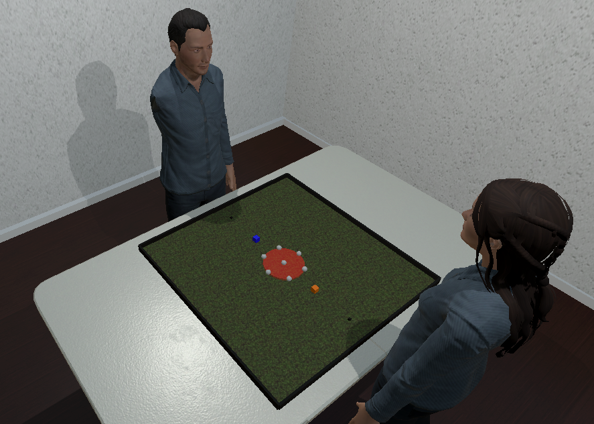
Today at #CogSci2023, I'll be presenting my #SocialVR work investigating the interactive behaviors that scaffold collaborative solution insight, using our social 'shepherding' game, and quantified using multidimensional recurrence analyses https://t.co/Vy4cIGx7b8
We're thrilled to release & open-source Hunyuan3D World Model 1.0! This model enables you to generate immersive, explorable, and interactive 3D worlds from just a sentence or an image.
It's the industry's first open-source 3D world generation model, compatible with CG pipelines for full editability & simulation. Set to transform game development, VR, digital content creation and so on. Get started now👇🏻
Project Page:https://t.co/bbFzdTXUdU
Try it now:https://t.co/swscD5KGu2
Github:https://t.co/vKq8ykY4Hu
Hugging Face:https://t.co/StC2E9kOmE
We deployed 100 deep RL cruise controllers into rush-hour highway traffic to smooth traffic flow and reduce everyone’s energy consumption. Our AVs were decentralized and used standard radar, making our controllers deployable on most cars
1/n
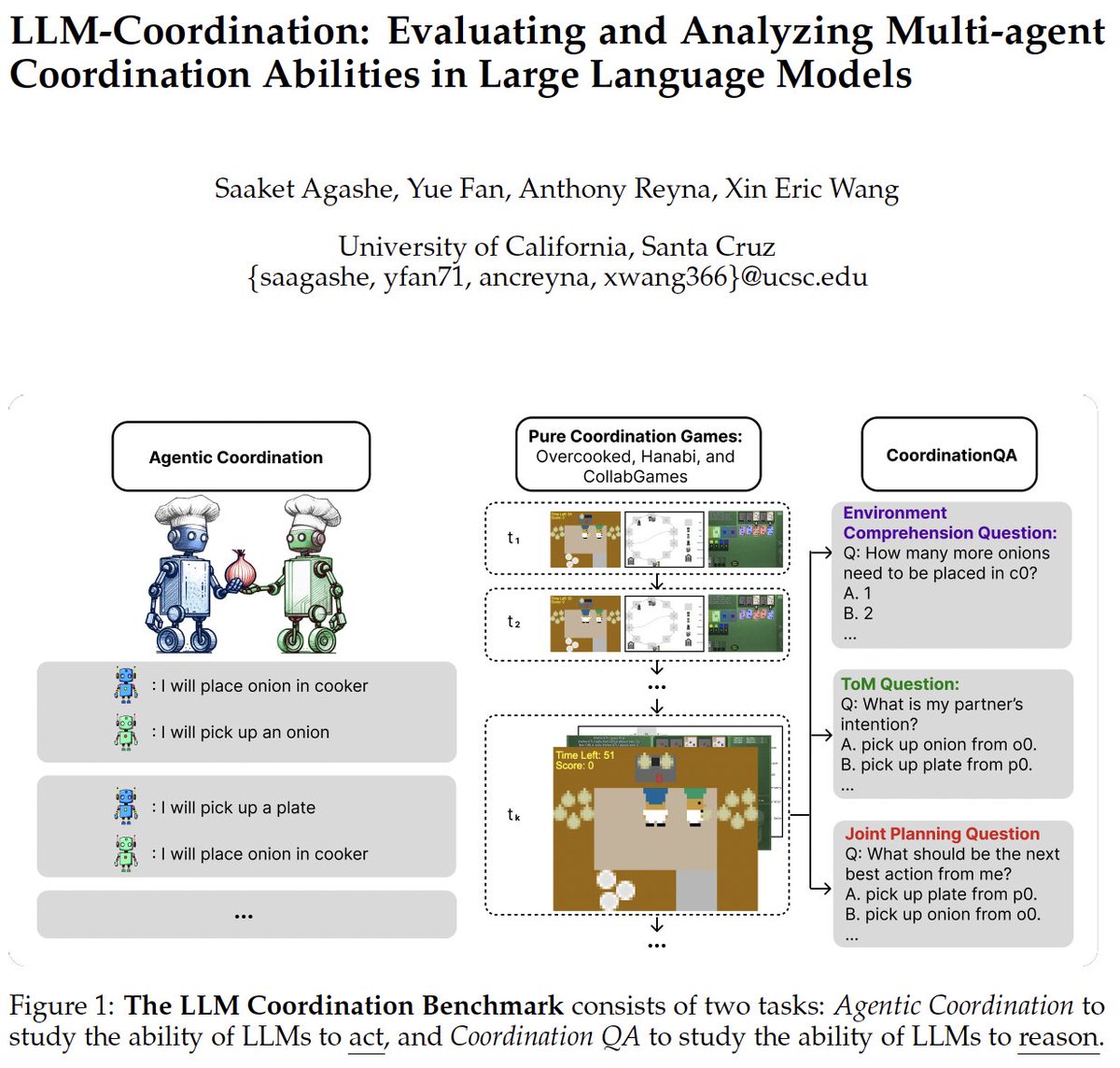
🔮Demystifying Coordination in #LLMs: We are excited to announce LLM-Coordination, a new benchmark for the evaluation and analysis of #LLMs in Multi-agent coordination tasks.
Our benchmark studies two task settings:
1. 🤖 Agentic Coordination, where LLMs act as proactive participants for cooperation in 4 pure coordination games;
2. ❓Coordination Question Answering (CoordQA), where LLMs are prompted to answer questions from coordination games for evaluation of three key reasoning abilities: Environment Comprehension, #ToM Reasoning, and Joint Planning.
Interestingly, we find that LLM agents excel at coordination games where the primary challenge is common-sense reasoning about the environment 🌎 and following the rules of the game.
However, they struggle at games requiring an advanced Theory Of Mind🤔 #ToM, which is the ability to reason about the beliefs and intentions of their partners!
Keep Reading 🧵 for the details and discoveries!
Website: https://t.co/to2jxWyB12
📜paper: https://t.co/VQrJrdICCu
🔗data & code: https://t.co/Rql4lChLsO
Wrenching news: Dan Dennett has died.
He's been a great friend and incredible inspiration for me throughout my career. I will miss him enormously.
https://t.co/zNN91XDEow
It’s amazing how many empirical features of interactions and collective response can emerge from a simple imperative: to minimize surprise. Out today in PNAS @PNASNews - with @conorheins@richardpmann Karl Friston and colleagues! @CBehav@maxplanckpress https://t.co/gZcyDuG285
@DrTomFroese Great talk today at Macquarie! I was sitting quietly in the audience, but if you are still around Sydney our social interaction research group at MQ and @ManuelVarlet at WSU may benefit from a discussion of this paper
Excited by our new perspective piece! 😊
Why is it that not all social engagement consistently increases inter-brain synchrony? Irruption theory predicts that more subjective involvement increases interference. Next step: experimentally test this idea! https://t.co/zNp8UULYNJ
I am really excited to reveal what @GoogleDeepMind's Open Endedness Team has been up to 🚀. We introduce Genie 🧞, a foundation world model trained exclusively from Internet videos that can generate an endless variety of action-controllable 2D worlds given image prompts.
Foundation models are well-established in vision and language, but time series forecasting has lagged behind - it still relies on dataset-specific models.
Meet Lag-Llama: the first open-source foundation model for time series forecasting!
New paper from @ThaliaWheatley, me, @StolkArjen & @lukejchang at Perspectives on Psychological Science!
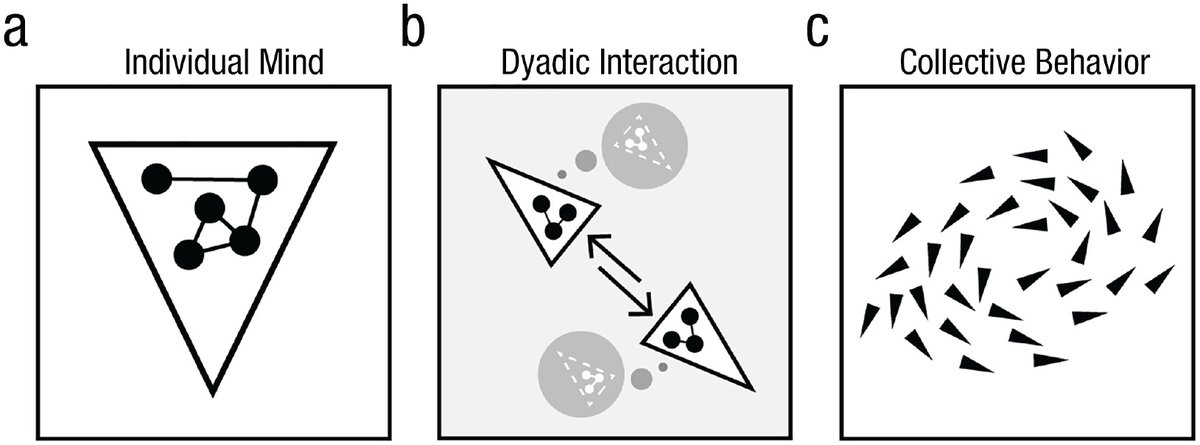
"The Emerging Science of Interacting Minds"
Read about why we think that this is a particularly auspicious moment for interaction science!
Link: https://t.co/f6EAQgpyLM
Together with the Ego4D consortium, today we're releasing Ego-Exo4D, the largest ever public dataset of its kind to support research on video learning & multimodal perception — including 1,400+ hours of videos of skilled human activities.
Download ➡️ https://t.co/sYbzAMyeeg
Autocurricula can produce more general agents...but can be expensive to run 💸.
Today, we're releasing minimax, a JAX library for RL autocurricula with 120x faster baselines. Runs that took 1 week now take < 3 hours.
Paper: https://t.co/xaR99lNOti
https://t.co/wUmsmvOT5F
📢Just published! Our new paper looks at some of the processes people use to hear and be heard when (mis)communicating in noise 🗣️🔊Spoiler: adapt and coordinate! #CommunicationDifficulty#CommunicationBreakdowns
https://t.co/pQ8l2Al92O
Announcing Habitat 3.0, simulating humanoid avatars and robots collaborating!
- Humanoid sim: diverse skinned avatars
- Human-in-the-loop control: mouse/keyboard or VR
- Tasks: social navigation and rearrangement
Over 1,000 steps per second on 1 GPU for large-scale learning!
Interested in #OpenScience, machine learning, motion tracking, and/or (social) signal processing? https://t.co/a4e20U5Cps has officially launched! 🚀
This is a community-driven platform for learning and sharing methods, with everything open-source (using R and Python).