Why is RL training with policy-gradient methods often unstable—especially near the optimum?
Our new work studies this through the noise-to-signal ratio (NSR) of the REINFORCE gradient estimator (defined as the estimator variance (noise) normalized by the squared norm of the true gradient (signal)).
We show that the NSR is highly non-uniform and often increases as training progresses, which can trigger instability or even policy collapse.
Paper link: https://t.co/qusv7YHPld
Long thread👇
New paper: Compose by Focus — we make robot visuomotor skills robustly composable by focusing perception on the task-relevant parts of a scene using 3D scene graphs, then learning a single policy over those structured inputs.
Motivation: planners (VLM/TAMP) can break a long task into sub-goals, but visuomotor policies often crumble in cluttered, novel scenes. The issue isn’t the planner — but the policy's brittle visual processing under distribution shift. We argue skills must be focused, attending only to relevant objects and relations.
Method in a nutshell: for each sub-goal, we build a dynamic sub-scene graph—Grounded SAM segments relevant objects, a VLM infers relations; a GNN encodes the graph; CLIP encodes the skill text; a diffusion policy is conditioned on both language + graph features; a VLM planner sequences sub-goals.
Why it matters: focusing on relevant objects/relations mitigates distribution shift, enabling reliable multi-skill composition in visually complex scenes. Scene graphs also form a natural interface between high-level planning and low-level control, easing long-horizon execution and reducing data demands.
Project & paper:
https://t.co/OFzNxXu94b
Sharing a project that’s kept me excited for months:
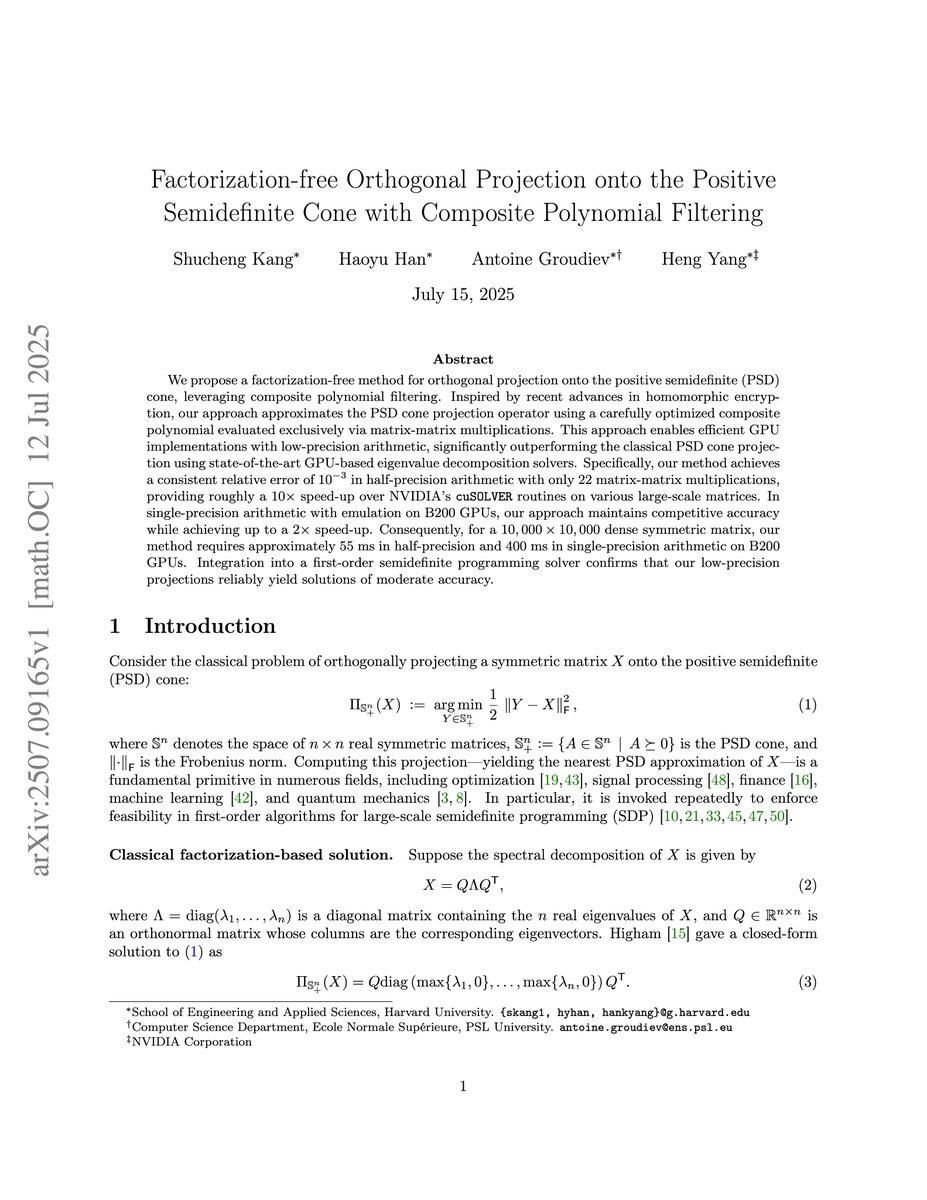
Five years ago, I tried projecting a 10000×10000 symmetric matrix onto the positive semidefinite cone using MATLAB’s eig on my MacBook—gave up out of sheer impatience.
Today, we released a CUDA-based factorization-free method that projects a 10000×10000 matrix in 55 ms (FP16) and 400 ms (FP32) on NVIDIA B200 GPUs.
The trick? Approximating the ReLU-induced spectral operator with composite low-degree polynomials, evaluated via pure matrix-matrix multiplies—perfect for GPUs.
Proud of the students who made this possible: @ShuchengK@Hyhan0118 and Antoine.
Paper: https://t.co/PUS2bS1DVC
Wow "Building Rome with Convex Optimization" is a #RSS2025 Outstanding Systems Paper Award Finalist — congratulations to @Hyhan0118!
Also excited to see XM tackled a massive bundle adjustment problem involving 20,000 images, shared by a GitHub issue — an SDP of size 60,000 × 60,000!
(Note: only showing camera poses, 3D structure omitted to preserve data privacy.)
"Building Rome with Convex Optimization" has been accepted to #RSS2025!
Try XM, our new structure from motion pipeline powered by GPU-accelerated convex semidefinite optimization:
https://t.co/ygjltwNzH4
XM solves large-scale (nonconvex) global bundle adjustment problem via learned depth and a tight convex semidefinite relaxation.
By implementing the Burer-Monteiro low-rank factorization algorithm in CUDA, XM can solve bundle adjustment problems with more than 10,000 images/views.
Technical details in the paper: https://t.co/BuF6y7bqZ3
Kudos to @Hyhan0118
Had fun presenting @ShuchengK's recent work, “Local Linear Convergence of ADMM for Solving SDPs under Strict Complementarity,” at the Numerical Analysis Seminar hosted by the Department of Mathematics at the University of Maryland.
In this work, we uncover and prove an interesting property of ADMM when applied to semidefinite programs (SDPs). Although ADMM can exhibit slow (sublinear) convergence initially, we show that, once the iterates enter a neighborhood around the converged optimal solution—under the assumption of strict complementarity—they begin to converge at a local linear rate.
The analysis builds on a dynamical systems perspective: by linearizing the ADMM iteration around its fixed point and using a sharpened error bound for projections onto the positive semidefinite cone, we establish linear convergence of the sequence. Notably, this result holds even in the absence of nondegeneracy, relying solely on strict complementarity.
Slides: https://t.co/o6ne7Imprj
Paper: https://t.co/tdI3sozwPI
Kang, Jiang, Yang: Local Linear Convergence of the Alternating Direction Method o... https://t.co/wHvGl0Xcve https://t.co/lL7nJv1dLL https://t.co/oGqz5I1qgC
In Contact-Rich motion planning, the so-called "Contact-Implicit" formulation stands out as it embeds discrete and combinatorial contact sequencing using implicit "complementarity constraints" in a continuous optimization problem.
The contact-implicit formulation looks "continuous" but fails common constraint qualifications that are crucial for the convergence of primal-dual local solvers such as Sequential Quadratic Programming (SNOPT) or Interior Point Method (IPOPT). The practical consequence is that intricate initializations are required for the solvers to find good solutions.
We designed a simple algorithm called CRISP, which builds upon Sequential Convex Optimization, or "Primal-Only" SQP if you wish, and show that CRISP is surprisingly robust -- it computes entirely new contact-rich motion plans starting from naive or even all-zero initializations, and it beats SNOPT and IPOPT.
What surprises me even more is that, CRISP succeeds almost 100% on real-world push-T.
Perhaps model-based contact-rich motion planning is not as pessimistic as it looks like.
CRISP is open-sourced, try it and let us know!
https://t.co/OZOU8KF48l
Diffusion has shown great promise for generating robot **actions**, can it act as a **world model** to generate the future conditioned on actions?
In our work led by @hanqi359246@hcy1n and in collaboration with @du_yilun, we show a **controllable** action-conditioned video diffusion model can produce photorealistic and (near) physics-accurate future predictions.
This ability strengthens the policy via:
- ranking different action proposals and selecting the best, or
- **visual** trajectory optimization by optimizing the action proposals using gradient ascent.
Learn more about Generative Predictive Control (GPC) at:
https://t.co/0BeujMLhVW
How robust can model predictive control be if we can solve each trajectory optimization to global optimality?
On the contact-rich push-T problem, we show that model-based global optimization is so robust that it never fails, even if the model is not even correct!
We achieve global optimality via sparse Moment and SOS relaxations. -- Yes, we managed to solve SDPs online on a robot.
Amazing work by @ShuchengK and Guorui Liu.
Robots in our group are finally moving!
Excited to share the first #RobotLearning project from my group led by Han Qi and @hcy1n:
Control-oriented Clustering of Visual Latent Representation
In classical robotics, "perception" and "control" are separated with an explicit state representation.
In end-to-end vision-based control, what's going on in the visual latent representation space?
- Focusing on the planar pushing task, we found an elegant geometric structure in the visual latent space: visual features are clustered according to "control-oriented" goals. Moreover, such clustering has a rigid structure known as "neural collapse" (NC, first found in the image classification literature).
- How does this understanding help? We show that pretraining the vision encoder with control-oriented clustering significantly increases test-time performance in the low-data regime (e.g., 50 or 100 demos). For example, with 100 demos, baseline succeeds 5 out of 10, but NC-pretrained policy succeeds 8 out of 10.
Check out more about the project:
https://t.co/b9UeCSoPmf
⭐New Paper Alert ⭐
How can your #RL agent quickly adapt to new distribution shifts ? And without ANY tuning?🤔
We suggest you get on the Fast TRAC🏎️💨, our new Parameter-free Optimizer that surprisingly works. Why?
Website:https://t.co/xiLDcXv4B7
1/🧵
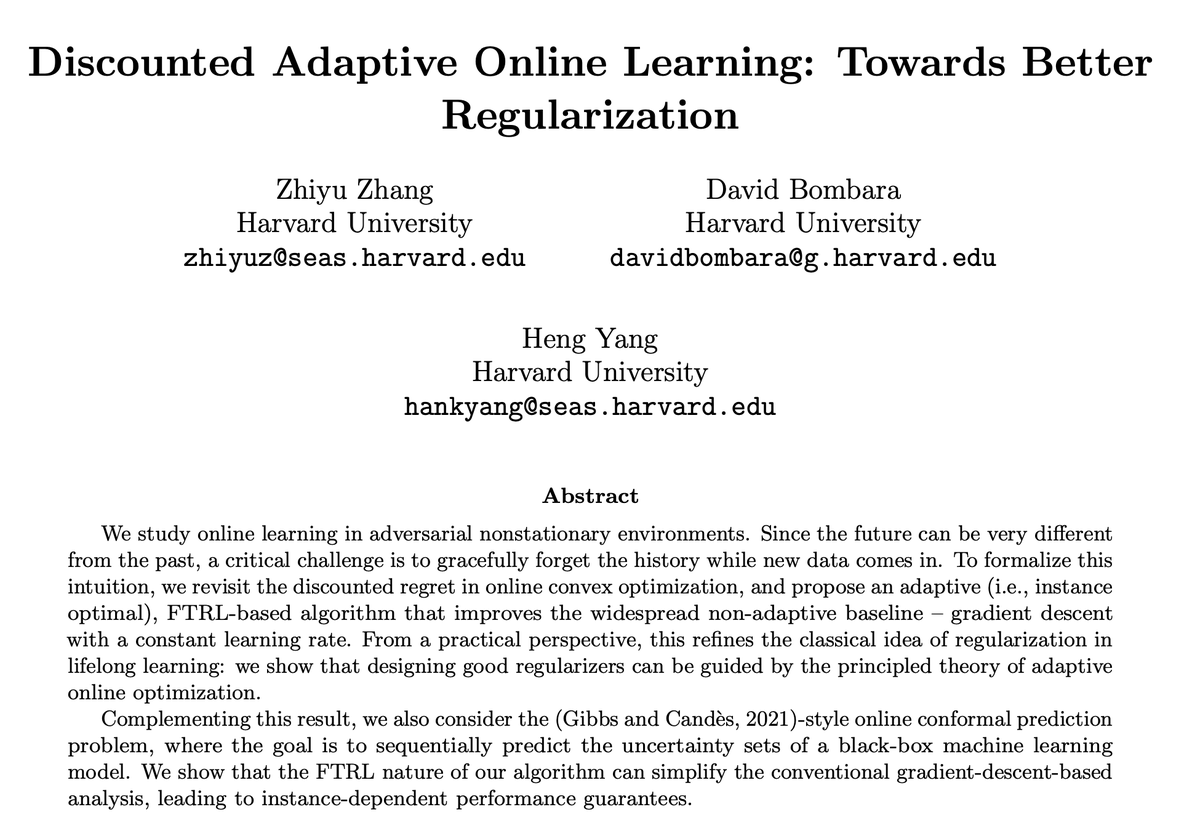
A short thread about our ICML paper, joint work with David Bombara and Heng Yang (@hankyang94).
tldr: Follow the Regularized Leader (FTRL), as a well-known gradient descent replacement in online learning, is particularly useful for lifelong learning and conformal prediction.