Building a Stronger Network Through Enterprise Nodes
Technology can be copied, but a trusted network of verified people and reputable businesses is much harder to reproduce.
InterLink aims to bring both together through Human Nodes and Enterprise Nodes, creating a potential network effect that connects blockchain with real-world business activities.
My Code: 245709
𝐃𝐄𝐂𝐄𝐍𝐓𝐑𝐀𝐋𝐈𝐙𝐀𝐓𝐈𝐎𝐍 𝐁𝐄𝐘𝐎𝐍𝐃 𝐓𝐎𝐊𝐄𝐍𝐒: 𝐖𝐇𝐘 𝐕𝐄𝐑𝐈𝐅𝐈𝐄𝐃 𝐍𝐎𝐃𝐄𝐒 𝐂𝐎𝐔𝐋𝐃 𝐒𝐓𝐑𝐄𝐍𝐆𝐓𝐇𝐄𝐍 𝐈𝐍𝐓𝐄𝐑𝐋𝐈𝐍𝐊 𝐆𝐎𝐕𝐄𝐑𝐍𝐀𝐍𝐂𝐄
Decentralization is one of the most important principles in blockchain technology. It aims to distribute participation and decision-making rather than concentrating influence in the hands of a small number of powerful entities.
However, achieving meaningful decentralization requires more than distributing digital tokens among different wallets.
It also requires a governance structure that encourages genuine participation.
InterLink's proposed $ITLG Staking Vault introduces an interesting approach by connecting governance with verified Human Nodes and Enterprise Nodes.
Human Nodes represent individuals who complete ITLG KYC, while Enterprise Nodes represent legally registered businesses that complete KYB verification.
Both categories are designed to participate in the shared staking ecosystem.
One particularly interesting element is the proposed one-node-one-vote governance principle.
In conventional token-weighted governance, participants holding larger token balances may have greater voting influence. InterLink's proposed approach aims to connect voting power to verified node participation instead.
This could introduce a different way of thinking about decentralized decision-making.
Rather than measuring influence exclusively through financial ownership, the model emphasizes verified participation and representation.
However, effective decentralization also requires protection against duplicate identities, transparent voting procedures, and safeguards against concentrated institutional influence.
The success of this approach will depend on how these mechanisms are implemented.
Ultimately, governance should allow legitimate participants to contribute to important decisions while maintaining fairness and accountability.
A decentralized economy becomes more meaningful when its participants have a genuine opportunity to shape its future.
#InterLink #ITLG #ITL
𝐃𝐄���𝐄𝐍𝐓𝐑𝐀𝐋𝐈𝐙𝐀𝐓𝐈𝐎𝐍 𝐁𝐄𝐘𝐎𝐍𝐃 𝐓𝐎𝐊𝐄𝐍𝐒: 𝐖𝐇𝐘 𝐕𝐄𝐑𝐈𝐅𝐈𝐄𝐃 𝐍𝐎𝐃𝐄𝐒 𝐂𝐎𝐔𝐋𝐃 𝐒𝐓𝐑𝐄𝐍𝐆𝐓𝐇𝐄𝐍 𝐈𝐍𝐓𝐄𝐑𝐋𝐈𝐍𝐊 𝐆𝐎𝐕𝐄𝐑𝐍𝐀𝐍𝐂𝐄
Decentralization is one of the most important principles in blockchain technology. It aims to distribute participation and decision-making rather than concentrating influence in the hands of a small number of powerful entities.
However, achieving meaningful decentralization requires more than distributing digital tokens among different wallets.
It also requires a governance structure that encourages genuine participation.
InterLink's proposed $ITLG Staking Vault introduces an interesting approach by connecting governance with verified Human Nodes and Enterprise Nodes.
Human Nodes represent individuals who complete ITLG KYC, while Enterprise Nodes represent legally registered businesses that complete KYB verification.
Both categories are designed to participate in the shared staking ecosystem.
One particularly interesting element is the proposed one-node-one-vote governance principle.
In conventional token-weighted governance, participants holding larger token balances may have greater voting influence. InterLink's proposed approach aims to connect voting power to verified node participation instead.
This could introduce a different way of thinking about decentralized decision-making.
Rather than measuring influence exclusively through financial ownership, the model emphasizes verified participation and representation.
However, effective decentralization also requires protection against duplicate identities, transparent voting procedures, and safeguards against concentrated institutional influence.
The success of this approach will depend on how these mechanisms are implemented.
Ultimately, governance should allow legitimate participants to contribute to important decisions while maintaining fairness and accountability.
A decentralized economy becomes more meaningful when its participants have a genuine opportunity to shape its future.
#InterLink #ITLG #ITL
𝐓𝐇𝐄 𝐑𝐎𝐋𝐄 𝐎𝐅 𝐑𝐄𝐀𝐋 𝐄𝐂𝐎𝐍𝐎𝐌𝐈𝐂 𝐀𝐂𝐓𝐈𝐕𝐈𝐓𝐘 𝐈𝐍 𝐁𝐔𝐈𝐋𝐃𝐈𝐍𝐆 𝐀 𝐒𝐔𝐒𝐓𝐀𝐈𝐍𝐀𝐁𝐋𝐄 $𝐈𝐓𝐋𝐆 𝐑𝐄𝐖𝐀𝐑𝐃 𝐒𝐘𝐒𝐓𝐄𝐌
A sustainable blockchain economy needs more than token distribution. It needs useful services, genuine transactions, and economic activities that create value within the ecosystem.
This is an important consideration when examining InterLink's proposed $ITLG Staking Vault.
The proposed reward framework identifies two potential sources: existing token allocation and ecosystem fees generated through InterLink dApps and ITLX.
This introduces an interesting connection between staking and the broader economic development of the network.
Imagine an ecosystem where users can access digital applications, make payments, interact with services, and participate in different economic activities.
As these applications develop, they may generate transaction activity and applicable fees.
Under the proposed model, a portion of eligible ecosystem fees could contribute to staking rewards.
This creates an opportunity for staking to become connected to the actual use of blockchain services.
However, there is an important distinction between transaction activity and sustainable economic value.
High transaction numbers alone do not necessarily demonstrate genuine adoption.
A strong ecosystem also needs useful products, real customers, reliable infrastructure, reasonable fees, and transparent financial management.
Dynamic rewards should reflect the actual reward mechanism rather than unrealistic expectations.
The long-term objective should be to create an economic environment where applications generate utility and utility supports continued ecosystem participation.
A sustainable token economy is built through useful services and genuine economic activity, not simply through the circulation of tokens.
#InterLink #ITLG #ITL
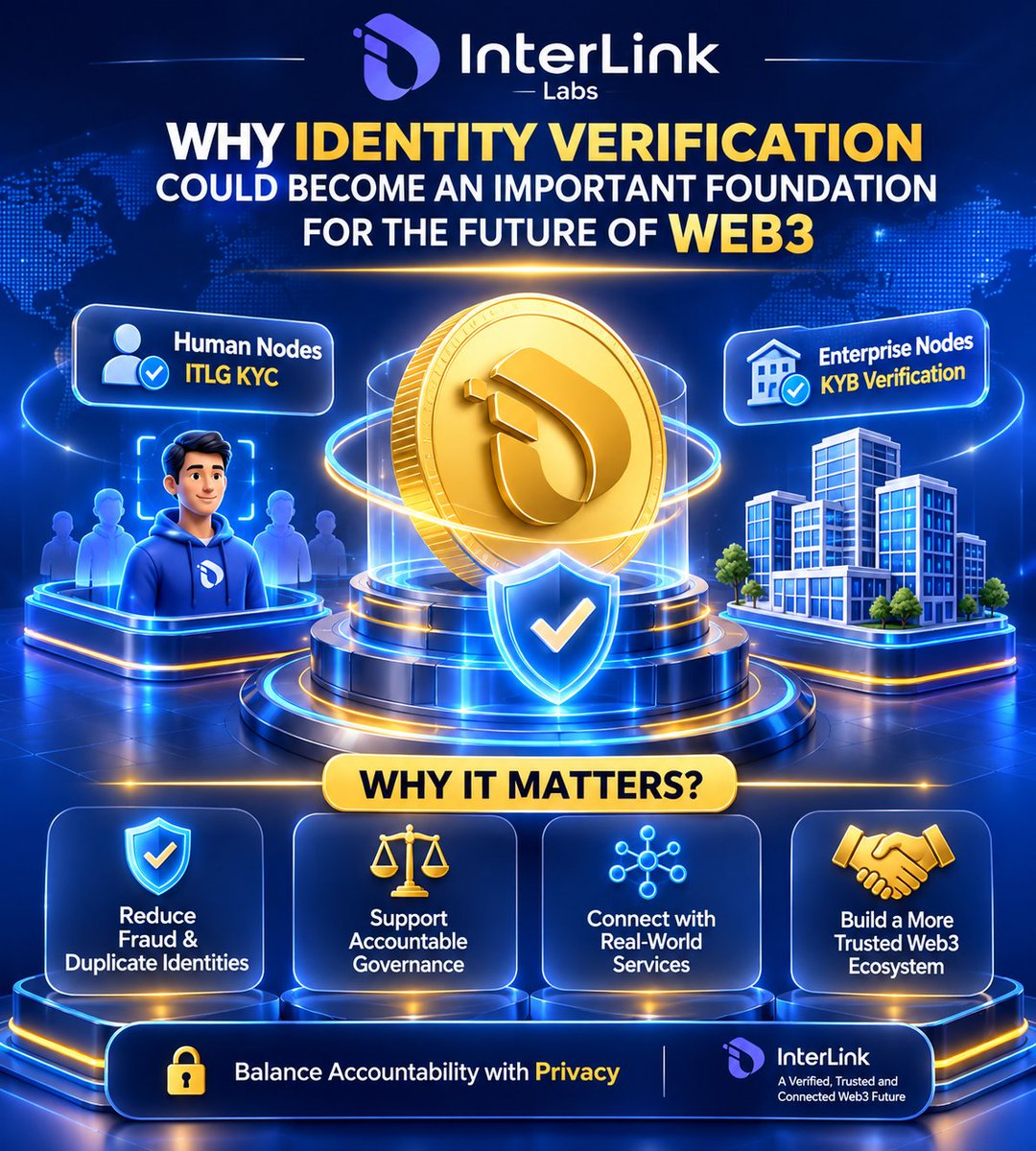
𝐖𝐇𝐘 𝐈𝐃𝐄𝐍𝐓𝐈𝐓𝐘 𝐕𝐄𝐑𝐈𝐅𝐈𝐂𝐀𝐓𝐈𝐎𝐍 𝐂𝐎𝐔𝐋𝐃 𝐁𝐄𝐂𝐎𝐌𝐄 𝐀𝐍 𝐈𝐌𝐏𝐎𝐑𝐓𝐀𝐍𝐓 𝐅𝐎𝐔𝐍𝐃𝐀𝐓𝐈𝐎𝐍 𝐅𝐎𝐑 𝐓𝐇𝐄 𝐅𝐔𝐓𝐔𝐑𝐄 𝐎𝐅 𝐖𝐄𝐁𝟑
Blockchain technology provides a powerful way to transfer digital assets and interact with decentralized applications.
However, one challenge remains: blockchain addresses do not automatically reveal whether they represent real individuals, businesses, or automated accounts.
This is where identity verification can introduce additional accountability.
InterLink's proposed Human Node and Enterprise Node framework places identity verification at the center of its staking economy.
𝐇𝐔𝐌𝐀𝐍 𝐍𝐎𝐃𝐄𝐒 𝐀𝐍𝐃 𝐈𝐓𝐋𝐆 𝐊𝐘𝐂
For individual participants, ITLG KYC is designed to establish that a Human Node represents a verified person.
𝐄𝐍𝐓𝐄𝐑𝐏𝐑𝐈𝐒𝐄 𝐍𝐎𝐃𝐄𝐒 𝐀𝐍𝐃 𝐊𝐘𝐁 𝐕𝐄𝐑𝐈𝐅𝐈𝐂𝐀𝐓𝐈𝐎𝐍
For businesses, KYB verification is intended to establish the legal identity of an Enterprise Node.
These two verification processes serve different purposes, but they support a common objective: connecting digital participation with identifiable participants.
𝐖𝐇𝐘 𝐂𝐎𝐔𝐋𝐃 𝐈𝐃𝐄𝐍𝐓𝐈𝐓𝐘 𝐕𝐄𝐑𝐈𝐅𝐈𝐂𝐀𝐓𝐈𝐎𝐍 𝐌𝐀𝐓𝐓𝐄𝐑?
First, verification could help reduce duplicate identities and certain forms of fraudulent participation.
Second, it could provide a clearer foundation for node eligibility.
Third, it could support more accountable governance and institutional integration.
Fourth, it could make it easier to connect blockchain participation with real-world services.
𝐓𝐇𝐄 𝐈𝐌𝐏𝐎𝐑𝐓𝐀𝐍𝐂𝐄 𝐎𝐅 𝐏𝐑𝐈𝐕𝐀𝐂𝐘 𝐀𝐍𝐃 𝐒𝐄𝐂𝐔𝐑𝐈𝐓𝐘
However, identity verification must be implemented responsibly.
Privacy protection, secure data storage, appropriate access controls, and regulatory compliance are essential.
A verified identity should not mean that sensitive personal information becomes publicly accessible.
The challenge is to balance accountability with privacy.
𝐓𝐇𝐄 𝐅𝐔𝐓𝐔𝐑𝐄 𝐎𝐅 𝐕𝐄𝐑𝐈𝐅𝐈𝐄𝐃 𝐖𝐄𝐁𝟑 𝐏𝐀𝐑𝐓𝐈𝐂𝐈𝐏𝐀𝐓𝐈𝐎𝐍
InterLink's proposed model explores how verified individuals and businesses could participate within one shared blockchain economy.
The future of Web3 may require a stronger connection between digital identities, responsible participation, and decentralized infrastructure.
#InterLink #ITLG #ITL
𝐍𝐎𝐃𝐄 𝐑𝐄𝐒𝐏𝐎𝐍𝐒𝐈𝐁𝐈𝐋𝐈𝐓𝐘: 𝐖𝐇𝐘 𝐏𝐀𝐑𝐓𝐈𝐂𝐈𝐏𝐀𝐓𝐈𝐎𝐍 𝐈𝐍 𝐈𝐍𝐓𝐄𝐑𝐋𝐈𝐍𝐊 𝐂𝐎𝐔𝐋𝐃 𝐌𝐄𝐀𝐍 𝐌𝐎𝐑𝐄 𝐓𝐇𝐀𝐍 𝐇𝐎𝐋𝐃𝐈𝐍𝐆 $𝐈𝐓𝐋𝐆
Owning a digital asset and actively contributing to a blockchain ecosystem are two different things.
A wallet may contain tokens without interacting with applications, participating in governance, or contributing to the network's development.
𝐈𝐧𝐭𝐞𝐫𝐋𝐢𝐧𝐤'𝐬 𝐩𝐫𝐨𝐩𝐨𝐬𝐞𝐝 𝐧𝐨𝐝𝐞 𝐟𝐫𝐚𝐦𝐞𝐰𝐨𝐫𝐤 introduces a broader understanding of participation.
Through Human Nodes and Enterprise Nodes, the ecosystem aims to connect verified identity, staking, and ongoing responsibility.
𝐇𝐮𝐦𝐚𝐧 𝐍𝐨𝐝𝐞𝐬 are designed for individual Linkers who complete ITLG KYC.
𝐄𝐧𝐭𝐞𝐫𝐩𝐫𝐢𝐬𝐞 𝐍𝐨𝐝𝐞𝐬 represent legally registered businesses that complete KYB verification.
Both categories are expected to stake transferable $ITLG through the proposed Staking Vault.
However, participation involves more than depositing tokens.
𝐇𝐮𝐦𝐚𝐧 𝐍𝐨𝐝𝐞𝐬: 𝐓𝐡𝐞 𝐈𝐦𝐩𝐨𝐫𝐭𝐚𝐧𝐜𝐞 𝐨𝐟 𝐀𝐜𝐭𝐢𝐯𝐞 𝐏𝐚𝐫𝐭𝐢𝐜𝐢𝐩𝐚𝐭𝐢𝐨𝐧
Human Nodes are also subject to proposed activity requirements. After 30 days of inactivity, a node enters sleep mode and stops earning rewards. After 90 days, its stake is proposed to be removed from the Vault, with a 180-day waiting period before staking again.
𝐄𝐧𝐭𝐞𝐫𝐩𝐫𝐢𝐬𝐞 𝐍𝐨𝐝𝐞𝐬: 𝐈𝐧𝐬𝐭𝐢𝐭𝐮𝐭𝐢𝐨𝐧𝐚𝐥 𝐂𝐨𝐦𝐦𝐢𝐭𝐦𝐞𝐧𝐭
Enterprise Nodes, meanwhile, are designed around institutional verification and locking commitments.
These different requirements reflect the responsibilities associated with each participant category.
𝐖𝐡𝐲 𝐈𝐬 𝐓𝐡𝐢𝐬 𝐈𝐦𝐩𝐨𝐫𝐭𝐚𝐧𝐭?
Because a successful blockchain economy needs participants who understand the system, follow its rules, protect their accounts, and contribute meaningfully.
The exact activity verification process and some staking parameters remain subject to final clarification.
Nevertheless, the underlying philosophy is clear: the proposed model emphasizes active participation rather than passive token ownership alone.
𝐀 𝐧𝐨𝐝𝐞 𝐬𝐡𝐨𝐮𝐥𝐝 𝐫𝐞𝐩𝐫𝐞𝐬𝐞𝐧𝐭 𝐫𝐞𝐬𝐩𝐨𝐧𝐬𝐢𝐛𝐢𝐥𝐢𝐭𝐲, 𝐜𝐨𝐦𝐦𝐢𝐭𝐦𝐞𝐧𝐭, 𝐚𝐧𝐝 𝐩𝐚𝐫𝐭𝐢𝐜𝐢𝐩𝐚𝐭𝐢𝐨𝐧���𝐧𝐨𝐭 𝐦𝐞𝐫𝐞𝐥𝐲 𝐚 𝐰𝐚𝐥𝐥𝐞𝐭 𝐜𝐨𝐧𝐭𝐚𝐢𝐧𝐢𝐧𝐠 𝐝𝐢𝐠𝐢𝐭𝐚𝐥 𝐚𝐬𝐬𝐞𝐭𝐬.
#InterLink #ITLG #ITL
𝐍𝐎𝐃𝐄 𝐑𝐄𝐒𝐏𝐎𝐍𝐒𝐈𝐁𝐈𝐋𝐈𝐓𝐘: 𝐖𝐇𝐘 𝐏𝐀𝐑𝐓𝐈𝐂𝐈𝐏𝐀𝐓𝐈𝐎𝐍 𝐈𝐍 𝐈𝐍𝐓𝐄𝐑𝐋𝐈𝐍𝐊 𝐂𝐎𝐔𝐋𝐃 𝐌𝐄𝐀𝐍 𝐌𝐎𝐑𝐄 𝐓𝐇𝐀𝐍 𝐇𝐎𝐋𝐃𝐈𝐍𝐆 $𝐈𝐓𝐋𝐆
Owning a digital asset and actively contributing to a blockchain ecosystem are two different things.
A wallet may contain tokens without interacting with applications, participating in governance, or contributing to the network's development.
𝐈𝐧𝐭𝐞𝐫𝐋𝐢𝐧𝐤'𝐬 𝐩𝐫𝐨𝐩𝐨𝐬𝐞𝐝 𝐧𝐨𝐝𝐞 𝐟𝐫𝐚𝐦𝐞𝐰𝐨𝐫𝐤 introduces a broader understanding of participation.
Through Human Nodes and Enterprise Nodes, the ecosystem aims to connect verified identity, staking, and ongoing responsibility.
𝐇𝐮𝐦𝐚𝐧 𝐍𝐨𝐝𝐞𝐬 are designed for individual Linkers who complete ITLG KYC.
𝐄𝐧𝐭𝐞𝐫𝐩𝐫𝐢𝐬𝐞 𝐍𝐨𝐝𝐞𝐬 represent legally registered businesses that complete KYB verification.
Both categories are expected to stake transferable $ITLG through the proposed Staking Vault.
However, participation involves more than depositing tokens.
𝐇𝐮𝐦𝐚𝐧 𝐍𝐨𝐝𝐞𝐬: 𝐓𝐡𝐞 𝐈𝐦𝐩𝐨𝐫𝐭𝐚𝐧𝐜𝐞 𝐨𝐟 𝐀𝐜𝐭𝐢𝐯𝐞 𝐏𝐚𝐫𝐭𝐢𝐜𝐢𝐩𝐚𝐭𝐢𝐨𝐧
Human Nodes are also subject to proposed activity requirements. After 30 days of inactivity, a node enters sleep mode and stops earning rewards. After 90 days, its stake is proposed to be removed from the Vault, with a 180-day waiting period before staking again.
𝐄𝐧𝐭𝐞𝐫𝐩𝐫𝐢𝐬𝐞 𝐍𝐨𝐝𝐞𝐬: 𝐈𝐧𝐬𝐭𝐢𝐭𝐮𝐭𝐢𝐨𝐧𝐚𝐥 𝐂𝐨𝐦𝐦𝐢𝐭𝐦𝐞𝐧𝐭
Enterprise Nodes, meanwhile, are designed around institutional verification and locking commitments.
These different requirements reflect the responsibilities associated with each participant category.
𝐖𝐡𝐲 𝐈𝐬 𝐓𝐡𝐢𝐬 𝐈𝐦𝐩𝐨𝐫𝐭𝐚𝐧𝐭?
Because a successful blockchain economy needs participants who understand the system, follow its rules, protect their accounts, and contribute meaningfully.
The exact activity verification process and some staking parameters remain subject to final clarification.
Nevertheless, the underlying philosophy is clear: the proposed model emphasizes active participation rather than passive token ownership alone.
𝐀 𝐧𝐨𝐝𝐞 𝐬𝐡𝐨𝐮𝐥𝐝 𝐫𝐞𝐩𝐫𝐞𝐬𝐞𝐧𝐭 𝐫𝐞𝐬𝐩𝐨𝐧𝐬𝐢𝐛𝐢𝐥𝐢𝐭𝐲, 𝐜𝐨𝐦𝐦𝐢𝐭𝐦𝐞𝐧𝐭, 𝐚𝐧𝐝 𝐩𝐚𝐫𝐭𝐢𝐜𝐢𝐩𝐚𝐭𝐢𝐨𝐧—𝐧𝐨𝐭 𝐦𝐞𝐫𝐞𝐥𝐲 𝐚 𝐰𝐚𝐥𝐥𝐞𝐭 𝐜𝐨𝐧𝐭𝐚𝐢𝐧𝐢𝐧𝐠 𝐝𝐢𝐠𝐢𝐭𝐚𝐥 𝐚𝐬𝐬𝐞𝐭𝐬.
#InterLink #ITLG #ITL
WHY TRANSFERABLE $ITLG MATTERS IN THE STAKING VAULT ECONOMY
Digital assets become more meaningful when they have a clear role within an ecosystem.
A token should not simply exist as a balance displayed inside an application. Its purpose, utility, transferability, and relationship with other ecosystem activities all contribute to its economic importance.
This is one reason transferable $ITLG plays an important role in InterLink's proposed Staking Vault.
Under the proposed framework, both Human Nodes and Enterprise Nodes stake transferable $ITLG.
For individual participants, this means verified Linkers can use eligible transferable tokens through their verified wallets to participate in the staking economy.
For institutions, verified companies can register business wallets and commit transferable $ITLG under their legal identities.
The distinction between transferable $ITLG and non-transferable vITLG is also important.
Transferable $ITLG is intended to function as a digital asset within the wider ecosystem, while vITLG represents a non-transferable token form associated with a potential future pathway toward receiving $ITL under the applicable mechanism.
Human Nodes may have the option to upgrade staked $ITLG into vITLG, subject to the final rules.
Why does this matter?
Because it introduces different participation possibilities within the same ecosystem.
Participants can explore staking through transferable assets while also considering the potential long-term role of non-transferable vITLG.
However, users should carefully understand the conditions, conversion rules, and risks before making decisions involving their tokens.
A sustainable token economy requires clearly defined utility rather than relying on speculation.
Understanding the role of each digital asset is essential to understanding the future of the InterLink economy.
#InterLink #ITLG #ITL
ITLG Staking Vaults
InterLink is developing $ITLG Staking Vaults for individuals and institutions.
Rewards will come from ecosystem fees, while Verified status remains a separate randomized opportunity, not a guarantee.
Code: 245709
𝐖𝐇𝐘 𝐋𝐎𝐍𝐆-𝐓𝐄𝐑𝐌 𝐏𝐀𝐑𝐓𝐈𝐂𝐈𝐏𝐀𝐓𝐈𝐎𝐍 𝐌𝐀𝐓𝐓𝐄𝐑𝐒 𝐌𝐎𝐑𝐄 𝐓𝐇𝐀𝐍 𝐏𝐀𝐒𝐒𝐈𝐕𝐄 𝐒𝐓𝐀𝐊𝐈𝐍𝐆
Staking is often viewed as a way to lock digital assets and receive rewards over time.
But what happens when participants deposit their tokens and disappear without contributing to the network?
This is an important question for blockchain ecosystems that want to encourage genuine participation.
InterLink's proposed Human Node mechanism introduces activity requirements designed to encourage participants to remain connected to the ecosystem.
Under the proposed framework, Human Nodes are expected to maintain ongoing activity to remain eligible for staking rewards.
𝐓𝐇𝐄 𝐓𝐇𝐑𝐄𝐄 𝐈𝐍𝐀𝐂𝐓𝐈𝐕𝐈𝐓𝐘 𝐒𝐓𝐀𝐆𝐄𝐒
𝟑𝟎 𝐃𝐀𝐘𝐒 — 𝐒𝐋𝐄𝐄𝐏 𝐌𝐎𝐃𝐄
If a Human Node remains inactive for 30 days, it is designed to enter sleep mode and stop earning rewards.
𝟗𝟎 𝐃𝐀𝐘𝐒 — 𝐕𝐀𝐔𝐋𝐓 𝐑𝐄𝐌𝐎𝐕𝐀𝐋
After 90 days of inactivity, the proposed mechanism removes the participant's stake from the Vault.
𝟏𝟖𝟎 𝐃𝐀𝐘𝐒 — 𝐖𝐀𝐈𝐓𝐈𝐍𝐆 𝐏𝐄𝐑𝐈𝐎𝐃
Following removal, a 180-day waiting period is proposed before the participant can stake again.
𝐖𝐇𝐘 𝐃𝐎𝐄𝐒 𝐋𝐎𝐍𝐆-𝐓𝐄𝐑𝐌 𝐏𝐀𝐑𝐓𝐈𝐂𝐈𝐏𝐀𝐓𝐈𝐎𝐍 𝐌𝐀𝐓𝐓𝐄𝐑?
These conditions demonstrate that the proposed model is not designed around passive token ownership alone.
Instead, it emphasizes continued participation and engagement.
This could help encourage users to remain involved in dApps, digital payments, ecosystem activities, and governance.
𝐓𝐑𝐀𝐍𝐒𝐏𝐀𝐑𝐄𝐍𝐂𝐘 𝐀𝐍𝐃 𝐅𝐀𝐈𝐑𝐍𝐄𝐒𝐒
However, the exact activity verification process and certain staking parameters are still being finalized. Participants should follow official announcements for the definitive rules.
It is also important to understand that activity requirements should be transparent, measurable, and fair to users.
𝐁𝐔𝐈𝐋𝐃𝐈𝐍𝐆 𝐀 𝐒𝐔𝐒𝐓𝐀𝐈𝐍𝐀𝐁𝐋𝐄 𝐁𝐋𝐎𝐂𝐊𝐂𝐇𝐀𝐈𝐍 𝐄𝐂𝐎𝐍𝐎𝐌𝐘
A healthy blockchain economy needs participants who contribute over time, not simply wallets that remain inactive.
Long-term ecosystem growth requires more than staking capital. It requires consistent participation and meaningful activity.
#InterLink #ITLG #ITL
𝐖𝐇𝐘 𝐋𝐎𝐍𝐆-𝐓𝐄𝐑𝐌 𝐏𝐀𝐑𝐓𝐈𝐂𝐈𝐏𝐀𝐓𝐈𝐎𝐍 𝐌𝐀𝐓𝐓𝐄𝐑𝐒 𝐌𝐎𝐑𝐄 𝐓𝐇𝐀𝐍 𝐏𝐀𝐒𝐒𝐈𝐕𝐄 𝐒𝐓𝐀𝐊����𝐍𝐆
Staking is often viewed as a way to lock digital assets and receive rewards over time.
But what happens when participants deposit their tokens and disappear without contributing to the network?
This is an important question for blockchain ecosystems that want to encourage genuine participation.
InterLink's proposed Human Node mechanism introduces activity requirements designed to encourage participants to remain connected to the ecosystem.
Under the proposed framework, Human Nodes are expected to maintain ongoing activity to remain eligible for staking rewards.
𝐓𝐇𝐄 𝐓𝐇𝐑𝐄𝐄 𝐈𝐍𝐀𝐂𝐓𝐈𝐕𝐈𝐓𝐘 𝐒𝐓𝐀𝐆𝐄𝐒
𝟑𝟎 𝐃𝐀𝐘𝐒 — 𝐒𝐋𝐄𝐄𝐏 𝐌𝐎𝐃𝐄
If a Human Node remains inactive for 30 days, it is designed to enter sleep mode and stop earning rewards.
𝟗𝟎 𝐃𝐀𝐘𝐒 — 𝐕𝐀𝐔𝐋𝐓 𝐑𝐄𝐌𝐎𝐕𝐀𝐋
After 90 days of inactivity, the proposed mechanism removes the participant's stake from the Vault.
𝟏𝟖𝟎 𝐃𝐀𝐘𝐒 — 𝐖𝐀𝐈𝐓𝐈𝐍𝐆 𝐏𝐄𝐑𝐈𝐎𝐃
Following removal, a 180-day waiting period is proposed before the participant can stake again.
𝐖𝐇𝐘 𝐃𝐎𝐄𝐒 𝐋𝐎𝐍𝐆-𝐓𝐄𝐑𝐌 𝐏𝐀𝐑𝐓𝐈𝐂𝐈𝐏𝐀𝐓𝐈𝐎𝐍 𝐌𝐀𝐓𝐓𝐄𝐑?
These conditions demonstrate that the proposed model is not designed around passive token ownership alone.
Instead, it emphasizes continued participation and engagement.
This could help encourage users to remain involved in dApps, digital payments, ecosystem activities, and governance.
𝐓𝐑𝐀𝐍𝐒𝐏𝐀𝐑𝐄𝐍𝐂𝐘 𝐀𝐍𝐃 𝐅𝐀𝐈𝐑𝐍𝐄𝐒𝐒
However, the exact activity verification process and certain staking parameters are still being finalized. Participants should follow official announcements for the definitive rules.
It is also important to understand that activity requirements should be transparent, measurable, and fair to users.
𝐁𝐔𝐈𝐋𝐃𝐈𝐍𝐆 𝐀 𝐒𝐔𝐒𝐓𝐀𝐈𝐍𝐀𝐁𝐋𝐄 𝐁𝐋𝐎𝐂𝐊𝐂𝐇𝐀𝐈𝐍 𝐄𝐂𝐎𝐍𝐎𝐌𝐘
A healthy blockchain economy needs participants who contribute over time, not simply wallets that remain inactive.
Long-term ecosystem growth requires more than staking capital. It requires consistent participation and meaningful activity.
#InterLink #ITLG #ITL
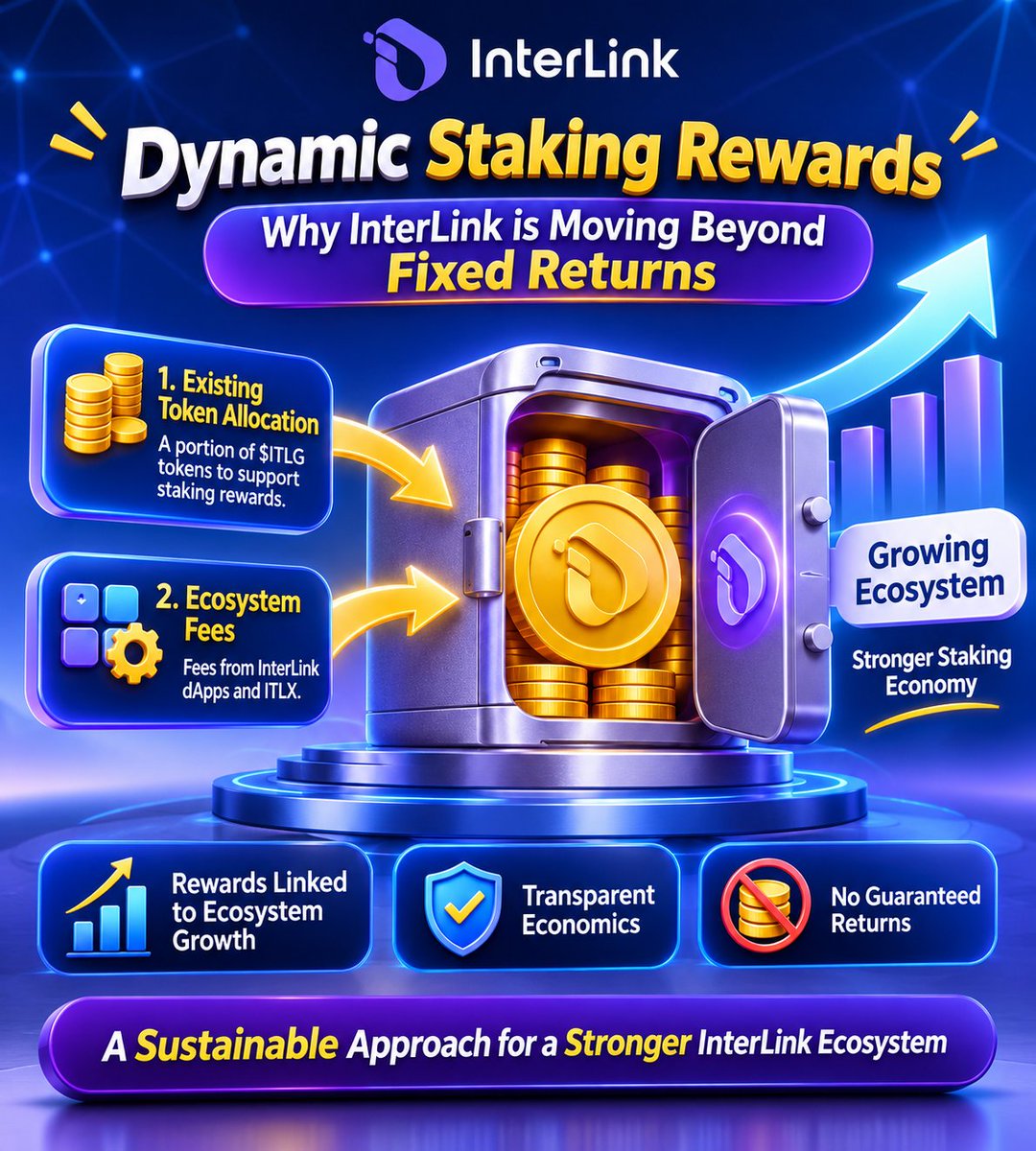
𝐃𝐘𝐍𝐀𝐌𝐈𝐂 𝐒𝐓𝐀𝐊𝐈𝐍𝐆 𝐑𝐄𝐖𝐀𝐑𝐃𝐒: 𝐖𝐇𝐘 𝐈𝐍𝐓𝐄𝐑𝐋𝐈𝐍𝐊 𝐈𝐒 𝐌𝐎𝐕𝐈𝐍𝐆 𝐁𝐄𝐘𝐎𝐍𝐃 𝐅𝐈𝐗𝐄𝐃 𝐑𝐄𝐓𝐔𝐑𝐍𝐒
When people hear about cryptocurrency staking, one of the first questions they usually ask is: How much can I earn?
Many staking platforms advertise fixed or predictable reward rates. However, these systems can create unrealistic expectations when network conditions, token economics, or available rewards change.
InterLink's proposed $ITLG Staking Vault introduces a different approach through 𝐝𝐲𝐧𝐚𝐦𝐢𝐜 𝐬𝐭𝐚𝐤𝐢𝐧𝐠 𝐫𝐞𝐰𝐚𝐫𝐝𝐬.
Instead of promising a permanent fixed return, the proposed system is designed to distribute rewards according to the ecosystem's reward mechanism.
There are two important reward sources identified in this vision.
𝟏. 𝐄𝐗𝐈𝐒𝐓𝐈𝐍𝐆 𝐓𝐎𝐊𝐄𝐍 𝐀𝐋𝐋𝐎𝐂𝐀𝐓𝐈𝐎𝐍
A portion of the existing $ITLG token allocation is proposed to support staking rewards.
This means rewards are connected to an established token distribution framework rather than requiring unlimited new token creation.
𝟐. 𝐄𝐂𝐎𝐒𝐘𝐒𝐓𝐄𝐌 𝐅𝐄𝐄𝐒
Fees generated through InterLink dApps and ITLX are also identified as potential sources for staking rewards.
As the ecosystem develops, the economic activities of its applications could contribute to the broader reward structure.
𝐇𝐎𝐖 𝐃𝐎𝐄𝐒 𝐄𝐂𝐎𝐒𝐘𝐒𝐓𝐄𝐌 𝐆𝐑𝐎𝐖𝐓𝐇 𝐂𝐎𝐍𝐍𝐄𝐂𝐓 𝐓𝐎 𝐒𝐓𝐀𝐊𝐈𝐍𝐆?
This creates an interesting connection between ecosystem adoption and staking economics.
For example, if more useful applications attract genuine users and generate sustainable activity, the associated ecosystem fees could become increasingly relevant to the reward mechanism.
However, higher adoption does not automatically guarantee higher individual rewards.
The final distribution will depend on the actual reward formula, available allocation, eligible stakes, ecosystem revenue, and other published parameters.
��𝐑𝐎𝐏𝐎𝐒𝐄𝐃 𝐑𝐄𝐖𝐀𝐑𝐃𝐒 𝐕𝐒. 𝐆𝐔𝐀𝐑𝐀𝐍𝐓𝐄𝐄𝐃 𝐑𝐄𝐓𝐔𝐑𝐍𝐒
This is why participants should understand the difference between a proposed reward model and a guaranteed financial return.
𝐓𝐇𝐄 𝐁𝐈𝐆𝐆𝐄𝐑 𝐏𝐈𝐂𝐓𝐔𝐑𝐄
The objective is to connect staking incentives with the development of the ecosystem.
Sustainable staking should be supported by transparent economics, not unrealistic promises of guaranteed profits.
#InterLink #ITLG #ITL
𝐖𝐇𝐘 𝐎𝐍𝐄 𝐍𝐎𝐃𝐄, 𝐎𝐍𝐄 𝐕𝐎𝐓𝐄 𝐂𝐎𝐔𝐋𝐃 𝐂𝐇𝐀𝐍𝐆𝐄 𝐓𝐇𝐄 𝐖𝐀𝐘 𝐁𝐋𝐎𝐂𝐊𝐂𝐇𝐀𝐈𝐍 𝐆����𝐕𝐄𝐑𝐍𝐀𝐍𝐂𝐄 𝐖𝐎𝐑𝐊𝐒
Decentralized governance is one of the most important ideas in blockchain technology.
It gives participants an opportunity to influence decisions about the development, direction, and future priorities of a network.
However, traditional token-weighted governance has an important challenge: participants holding larger amounts of tokens can often exercise greater voting influence.
This raises an important question.
𝐒𝐡𝐨𝐮𝐥𝐝 𝐠𝐨𝐯𝐞𝐫𝐧𝐚𝐧𝐜𝐞 𝐩𝐨𝐰𝐞𝐫 𝐝𝐞𝐩𝐞𝐧𝐝 𝐞𝐧𝐭𝐢𝐫𝐞𝐥𝐲 𝐨𝐧 𝐟𝐢𝐧𝐚𝐧𝐜𝐢𝐚𝐥 𝐨𝐰𝐧𝐞𝐫𝐬𝐡𝐢𝐩, 𝐨𝐫 𝐬𝐡𝐨𝐮𝐥𝐝 𝐯𝐞𝐫𝐢𝐟𝐢𝐞𝐝 𝐩𝐚𝐫𝐭𝐢𝐜𝐢𝐩𝐚𝐭𝐢𝐨𝐧 𝐚𝐥𝐬𝐨 𝐦𝐚𝐭𝐭𝐞𝐫?
InterLink's proposed $ITLG Staking Vault introduces an alternative governance vision based on 𝐎𝐧𝐞 𝐍𝐨𝐝𝐞, 𝐎𝐧𝐞 ���𝐨𝐭𝐞.
Under this proposed principle, voting influence would be connected to verified node participation rather than being determined entirely by the number of tokens held.
This is particularly interesting because the ecosystem is designed around two types of nodes.
𝟏. 𝐇𝐔𝐌𝐀𝐍 𝐍𝐎𝐃𝐄𝐒 — 𝐕𝐄𝐑𝐈𝐅𝐈𝐄𝐃 𝐈𝐍𝐃𝐈𝐕𝐈𝐃𝐔𝐀𝐋𝐒
Human Nodes represent verified individuals who complete KYC.
𝟐. 𝐄𝐍𝐓𝐄𝐑𝐏𝐑𝐈𝐒𝐄 𝐍𝐎𝐃𝐄𝐒 — 𝐕𝐄𝐑𝐈𝐅𝐈𝐄𝐃 𝐁𝐔𝐒𝐈𝐍𝐄𝐒𝐒𝐄𝐒
Enterprise Nodes represent legally verified businesses that complete KYB.
Both categories are intended to participate in the shared staking economy and contribute to the broader ecosystem.
The proposed governance framework could allow eligible nodes to participate in decisions concerning ecosystem development, reward distribution, and business integrations.
𝐖𝐇𝐘 𝐂𝐎𝐔𝐋𝐃 𝐓𝐇𝐈𝐒 𝐌𝐀𝐓𝐓𝐄𝐑?
It could help reduce the concentration of voting influence among a small number of large token holders.
It could also encourage participants to become active members of the ecosystem rather than simply holding digital assets.
Nevertheless, one-node-one-vote governance requires strong protections. The network must ensure that one real participant cannot create multiple eligible voting identities and that institutional participation follows clearly defined rules.
𝐆𝐎𝐕𝐄𝐑𝐍𝐀𝐍𝐂𝐄 𝐈𝐒 𝐌𝐎𝐑𝐄 𝐓𝐇𝐀𝐍 𝐕𝐎𝐓𝐈𝐍𝐆.
It is about ensuring that decisions are transparent, representative, and accountable.
The real strength of decentralization comes from meaningful participation, not simply the distribution of tokens.
#InterLink #ITLG #ITL
𝐖𝐇𝐘 𝐎𝐍𝐄 𝐍𝐎𝐃𝐄, 𝐎𝐍𝐄 𝐕𝐎𝐓𝐄 𝐂𝐎𝐔𝐋𝐃 𝐂𝐇𝐀𝐍𝐆𝐄 𝐓𝐇𝐄 𝐖𝐀𝐘 𝐁𝐋𝐎𝐂𝐊𝐂𝐇𝐀𝐈𝐍 𝐆𝐎𝐕𝐄𝐑𝐍𝐀𝐍𝐂𝐄 𝐖𝐎𝐑𝐊𝐒
Decentralized governance is one of the most important ideas in blockchain technology.
It gives participants an opportunity to influence decisions about the development, direction, and future priorities of a network.
However, traditional token-weighted governance has an important challenge: participants holding larger amounts of tokens can often exercise greater voting influence.
This raises an important question.
𝐒𝐡𝐨𝐮𝐥𝐝 𝐠𝐨𝐯𝐞𝐫𝐧𝐚𝐧𝐜𝐞 𝐩𝐨𝐰𝐞𝐫 𝐝𝐞𝐩𝐞𝐧𝐝 𝐞𝐧𝐭𝐢𝐫𝐞𝐥𝐲 𝐨𝐧 𝐟𝐢𝐧𝐚𝐧𝐜𝐢𝐚𝐥 𝐨𝐰𝐧𝐞𝐫𝐬𝐡𝐢𝐩, 𝐨𝐫 𝐬𝐡𝐨𝐮𝐥𝐝 𝐯𝐞𝐫𝐢𝐟𝐢𝐞𝐝 𝐩𝐚𝐫𝐭𝐢𝐜𝐢𝐩𝐚𝐭𝐢𝐨𝐧 𝐚𝐥𝐬𝐨 𝐦𝐚𝐭𝐭𝐞𝐫?
InterLink's proposed $ITLG Staking Vault introduces an alternative governance vision based on 𝐎𝐧𝐞 𝐍𝐨𝐝𝐞, 𝐎𝐧𝐞 𝐕𝐨𝐭𝐞.
Under this proposed principle, voting influence would be connected to verified node participation rather than being determined entirely by the number of tokens held.
This is particularly interesting because the ecosystem is designed around two types of nodes.
𝟏. 𝐇𝐔𝐌𝐀𝐍 𝐍𝐎𝐃𝐄𝐒 — 𝐕𝐄𝐑𝐈𝐅𝐈𝐄𝐃 𝐈𝐍𝐃𝐈𝐕𝐈𝐃𝐔𝐀𝐋𝐒
Human Nodes represent verified individuals who complete KYC.
𝟐. 𝐄𝐍𝐓𝐄𝐑𝐏𝐑𝐈𝐒𝐄 𝐍𝐎𝐃𝐄𝐒 — 𝐕𝐄𝐑𝐈𝐅𝐈𝐄𝐃 𝐁𝐔𝐒𝐈𝐍𝐄𝐒𝐒𝐄𝐒
Enterprise Nodes represent legally verified businesses that complete KYB.
Both categories are intended to participate in the shared staking economy and contribute to the broader ecosystem.
The proposed governance framework could allow eligible nodes to participate in decisions concerning ecosystem development, reward distribution, and business integrations.
𝐖𝐇𝐘 𝐂𝐎𝐔𝐋𝐃 𝐓𝐇𝐈𝐒 𝐌𝐀𝐓𝐓𝐄𝐑?
It could help reduce the concentration of voting influence among a small number of large token holders.
It could also encourage participants to become active members of the ecosystem rather than simply holding digital assets.
Nevertheless, one-node-one-vote governance requires strong protections. The network must ensure that one real participant cannot create multiple eligible voting identities and that institutional participation follows clearly defined rules.
𝐆𝐎𝐕𝐄𝐑𝐍𝐀𝐍𝐂𝐄 𝐈𝐒 𝐌𝐎𝐑𝐄 𝐓𝐇𝐀𝐍 𝐕𝐎𝐓𝐈𝐍𝐆.
It is about ensuring that decisions are transparent, representative, and accountable.
The real strength of decentralization comes from meaningful participation, not simply the distribution of tokens.
#InterLink #ITLG #ITL