One thing I found interesting in this paper on EVT is the focus on extreme Expected Shortfall rather than just VaR.
In normal markets VaR may be enough. But when markets actually break the tail is what matters.The paper finding on lower tail ES and threshold robustness makes..
Very valuable!
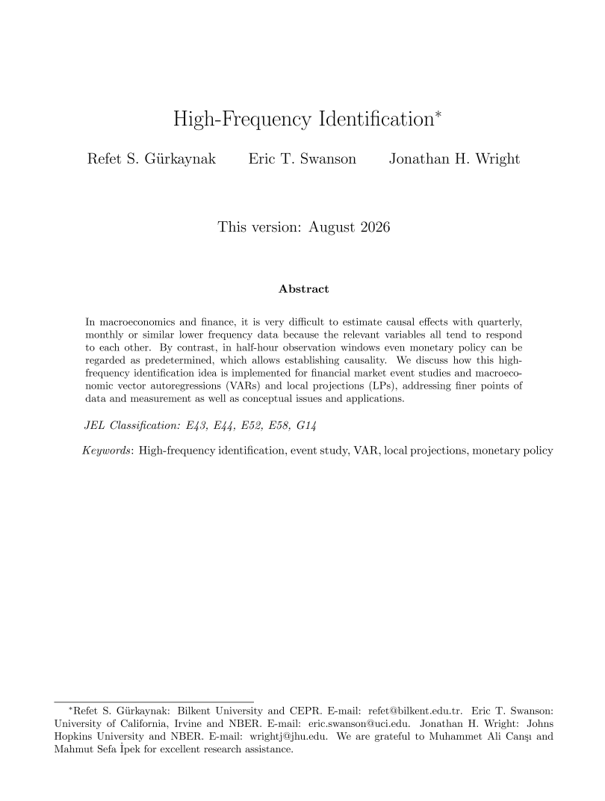
"High-Frequency Identification" by Refet S. Gürkaynak, Eric T. Swanson, and Jonathan H. Wright.
"In macroeconomics and finance, it is very difficult to estimate causal effects with quarterly, monthly or similar lower frequency data because the relevant variables all tend to respond to each other. By contrast, in half-hour observation windows even monetary policy can be regarded as predetermined, which allows establishing causality. We discuss how this high-frequency identification idea is implemented for financial market event studies and macroeconomic vector autoregressions (VARs) and local projections (LPs), addressing finer points of data and measurement as well as conceptual issues and applications."
https://t.co/4dO3m3hdoE
Highly relevant!
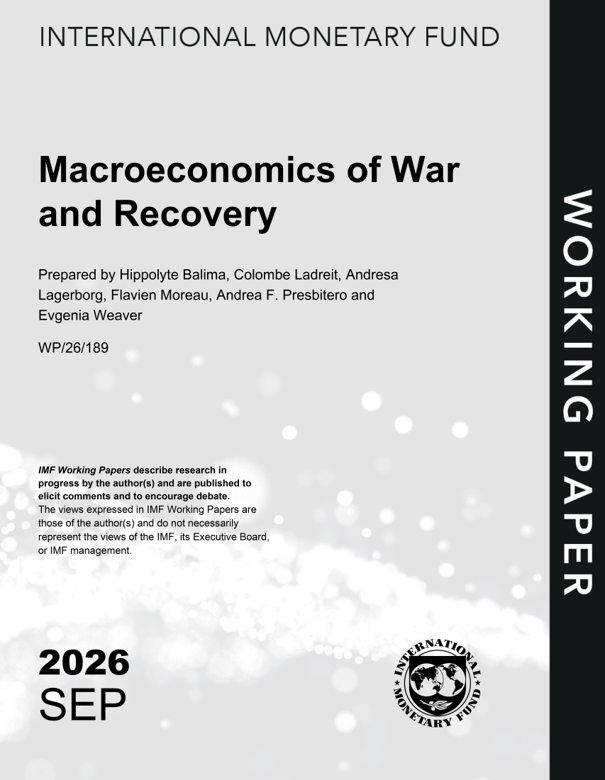
"Macroeconomics of War and Recovery" by Hippolyte W. Balima, Colombe Ladreit, Andresa Helena Lagerborg, Flavien Moreau, Andrea F Presbitero, and Evgenia Weaver.
"This paper studies the macroeconomic dynamics of conflicts and post-conflict recovery using a newly assembled global dataset covering 194 countries, including 170 conflict onsets and 158 conflict terminations, over the period 1946–2024. Using a local-projection difference-in-differences framework complemented by geocoded firm-level evidence, we trace the evolution of macroeconomic aggregates around conflict onset and termination. We make four contributions. First, output losses from conflicts typically exceed those associated with banking, currency, and sovereign debt crises, as well as severe natural disasters. Second, external-sector dynamics constitute a central mechanism through which wars amplify macroeconomic challenges, despite policymakers’ efforts to contain the war shock. Third, post-conflict recoveries are slow and uneven and depend critically on the durability of peace: conflict resumption stalls recovery prospects, while sustained peace produces only gradual recoveries relative to wartime losses. These recoveries are typically labor-led, while capital accumulation and productivity remain subdued. Fourth, firm-level evidence confirms this labor-led recovery and points to persistent financial constraints that hinder capital rebuilding during the postconflict period."
https://t.co/PMF3djcx5c
A new study (ICMR-NICPR & TISS) finds ~10.6% of Indian households (~20.5 million) could move up an economic class by quitting tobacco.
Poor households spend up to 6.4% of income on it. Tobacco causes ~1.35M deaths/year; cessation could cut poverty and improve health.