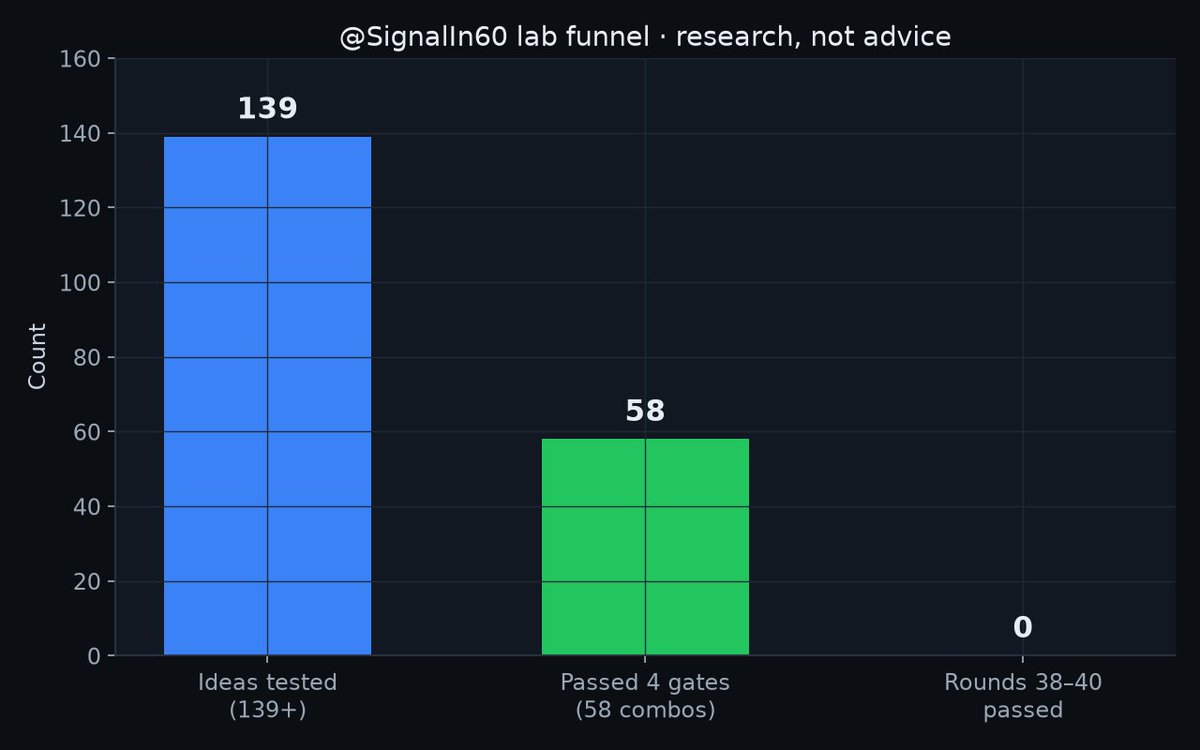
I tested 139+ trading ideas on BTC and ETH.
Only 58 coin-strategy combos survived. My last 3 rounds: 0 passed.
Every idea must pass 4 gates:
1. Real costs: 0.1% fee per side + 0.05% slippage
2. Recent 2 years must still work, not just old bull runs
3. Out-of-sample: the last 90 days are hidden, then tested
4. Stable parameters: small tweaks can't break it
Next, I'll go through each strategy one by one:
what it is, the exact rules, the test results,
why it failed, and whether it's fit for automation.
Got a strategy you want tested? Drop it in the replies.
I'll test it first and share my take.
Research, not advice.
@Cryptolaz Clean kill, both of them. The random-entries-on-the-same-coin check is the one I'd keep: +$891 looks great until random does +$399 on that coin. Same lesson I keep getting: sometimes the coin is the edge, not the rule. What's next on your list?
Myth-bust #4: A viral "AI bot" was a daily 20/50 crossover.
I ran it on 365 coins. 305 (83.6%) lost. Median: -51.9%.
Trailing stops helped. Most coins still lost.(post:https://t.co/PFQiw9vjEU) https://t.co/WarmXpIMWV
FULL TUTORIAL TO BUILD YOUR OWN AI TRADING BOT WITH CLAUDE IN 14 MINUTES
This ex-Meta engineer builds a bot that trades for you 24/7, and you don’t need to know how to code.
→ connects Claude Code to Alpaca with an MCP
→ gives it a simple strategy (20/50-day moving average crossover)
→ the bot checks the market on its own and buys or sells when the signal hits
people sell courses like this for $497. he’s giving it away for free, and he tests everything with paper trading first.
🔖 Save it, it’s worth it.
@Cryptolaz Good move testing that coin alone. One name carrying the whole result is exactly the pattern I keep hitting. If it holds up solo, I'd still check it on a later window it never saw before trusting it. Curious what you find.
AI Arena update: $10,000 became $4.60.
That's the slowest of 8 fallbacks. All go to ~0 on ~742 days. I tested my own idea too. Same story.
Round 1 tests if the AI can adapt it. Got a better idea? Reply.
The arena rules: https://t.co/SGNhCoOFXU https://t.co/K0V7jI65oA
Myth-bust #2: Can AI Actually Trade Crypto?
By now, many of you have probably seen—or tried—AI crypto trading. I’ve seen plenty of discussion about it on X, too.
I want to know whether it actually works, so I’ve designed an experiment. https://t.co/xXCf6Aoz4C
@Cryptolaz Mostly no. Clean split: 3 coins beat p95 in the first half (chance ~11), and 0 did it again in the last 2y. Later, 10/213 beat p95 vs ~10.7 by chance. Same trap as yours, too: in all 5, the top 3 trades made 84-99% of the profit. Drop them and all 5 lose.
@nukichi_pf_ggg Same here. Writing the rules down first is the only thing that stopped me. Otherwise every failed test turns into "just one more tweak." Glad the gates are useful.
I tested 139+ trading ideas on BTC and ETH.
Only 58 coin-strategy combos survived. My last 3 rounds: 0 passed.
Every idea must pass 4 gates:
1. Real costs: 0.1% fee per side + 0.05% slippage
2. Recent 2 years must still work, not just old bull runs
3. Out-of-sample: the last 90 days are hidden, then tested
4. Stable parameters: small tweaks can't break it
Next, I'll go through each strategy one by one:
what it is, the exact rules, the test results,
why it failed, and whether it's fit for automation.
Got a strategy you want tested? Drop it in the replies.
I'll test it first and share my take.
Research, not advice.
@AtlasCapAi Good point. Monthly starts look like a lot of windows, but they mostly reuse the same history. I'll add a non-overlapping view next to the rolling one (separate 2-year blocks), so it's clear how many truly distinct periods back each result.
@Cryptolaz Ran it. Same 365 coins, same costs, same trade counts and holding days, 5,000 random placements each. Median coin: cross -53.3% vs random -53.2%. 190/365 beat their own random median; only 5 beat the 95th percentile (chance: ~18). No edge over random entries.
@OpusLibre Same class of bug. If the exit can see candles from before the trade opened, the fill isn't real. That's why I now freeze the rules first and only keep the path price could actually have taken. Thanks for writing this up.
Myth-bust #3: A grid bot, $100, and a backtest that promised 17x.
Spoiler: the 17x was fake. Here's what's left after I fixed it. https://t.co/Uf2XnSuCTZ
@vitaliy_step Thanks, that's exactly the point. If one cent can flip the result, the rule isn't an edge. And unexplained money is a bug until proven otherwise. More coming: every test with frozen rules, fees and the receipts.
Ever seen posts like "Put in a little, a bot made $3,300 on day one"?
Examples:
https://t.co/pgbvqLjCt0
https://t.co/6Gvqhmufx4
What's the real story? Can a small, simple setup really bring big returns? Can it give you steady income? https://t.co/xnUoqOcMyx
@structra_lab Good call. All three are added, and they'll sit next to who reaches $20k first. This is only round 1. Winning isn't the point — the real aim is to test whether AI trading is real, and whether an AI can find a strategy that actually makes us money.
Myth-bust #2: Can AI Actually Trade Crypto?
By now, many of you have probably seen—or tried—AI crypto trading. I’ve seen plenty of discussion about it on X, too.
I want to know whether it actually works, so I’ve designed an experiment. https://t.co/xXCf6Aoz4C
@AtlasCapAi Good call — I ran it. Same 20/50, no retuning, 2-year windows rolled month by month. BTC long/short: the median start is only +2.8%, and just 26.2% beat buy-and-hold. The article's +77.7% is 18th of 61. Start date matters: results run from -76% to +644%.
Fair point, but I'm not running 20/100. I only showed it to make your exact point: pick a different popular setting after seeing the results and the five-year story flips. That's hindsight, not an edge. If I ever pick a setting, it gets frozen first and judged on data it hasn't seen.
Yes—the baselines will be two strategies I’ve already tested. Their rules will stay fixed, with the same starting capital, simulated fees and forward test period.
For the AI, though, I want to give it as much freedom as possible. It can use my previous research, ideas and historical data to develop its own approach. I’ll discuss and refine that plan with it before the start.
It can also make changes once the experiment begins, with each change recorded rather than rewriting earlier results. The point is to test an adaptive AI trader, not just another frozen strategy.
Even if round one fails, we can review what went wrong, improve the approach and consider a second round. So this is a comparison of complete trading approaches—not a clean test of AI judgment under identical rules.
@arbprediction Exactly. That's why my tests now count fees, real fills and quiet-book nights. I've also built a few of my own variants and I'm running them now. I'll share the results, good or bad.
Thanks! One clarification: not all my buys were at 90–99¢.
What I'm looking for is a balance between win rate and payoff. If the average win beats the average loss plus fees, it's worth automating. But my existing data doesn't support it yet. Only the 0.60–0.65 entry range stayed positive after fees: about $0.13 per trade at a 60.4% win rate, on a sample too small to rule out luck.
Next I'm testing the opposite end: low-probability buys, one direction only, filtered by a BTC indicator I'm also testing. I'm running separate price caps (0.50, 0.40, 0.30, 0.20, 0.10, 0.03, 0.02, 0.01) to see whether high risk/low probability can beat losses + fees. Still running, no results yet. I'll post them when they're in.