🚨 Signal delivers the tech news worth knowing — fast.
Apple. iPhone. iOS. Mac. AI. Privacy. Product launches. Major updates.
Breaking news when it matters. Useful features you’ll actually use. Clear context without the noise.
⚡ Fast
📱 Practical
🧠 Easy to understand
🔔 Worth turning notifications on for
Follow Signal to stay ahead of what’s next.
AI agents are quickly moving from “help me decide” to “just handle it for me.”
Shopify. PayPal. Expedia. Instacart.
That means checkout, payments, hotels and groceries could increasingly happen inside one AI workflow.
The big question now: how much control should the agent have before it needs your approval?
icymi: 4 new connectors announced in the last 24 hours, all coming soon.
• @Shopify for one-tap checkout across the Internet
• @PayPal for payments your agent handles globally
• @Expedia to book that dream hotel
• @Instacart for groceries at your door
what do you want to see next? 👀
Meta Connect is tonight at 7 PM ET. 👀
The thing I’m watching most: camera-free AI glasses.
If Meta can keep the useful parts of smart glasses — AI, audio, voice assistance — while removing one of the biggest privacy concerns, that could make wearables much easier for everyday people to adopt.
I’ll be watching the keynote and posting the important stuff here.
$META Connect 2026 keynote is today at 7 PM ET, with Mark Zuckerberg presenting.
What to watch for:
• Next-gen glasses, incl. possible camera-free models
• Project Phoenix mixed-reality headset
• New Muse AI updates + deeper wearable integration
• HorizonOS / avatar updates
• More details on Meta’s broader AI strategy
@theron_chase Most AirTag owners bought a key finder. The network is bigger than that. If you only use Find My, you’re skipping the parts Apple built so the same hardware isn’t a tracking nightmare.
@WallStreetApes On device summaries can be useful. The design problem is social if the watch decides a conversation started, the other person didn’t opt in. That’s the part Apple has to make visible, not the model card.
@Google@Android Googlebook’s pitch is phone + laptop as one session. That’s useful if Gemini actually carries context across both. If it’s just a pretty Chromebook with a new name, users will notice in a week.
@SokoAnalyst The price war is real. The footnote is cache and routing. If your prompts don’t hit cache, “40% cheaper” on the slide won’t match the invoice.
@wallstengine Muse beating ChatGPT’s early mobile curve is Meta’s install base doing work. Retention after the grocery/PayPal integrations ship is the real test.
@gurgavin A screenless Apple band is obvious. The only question that matters is it a Watch accessory or a Whoop killer with no subscription? If it’s the first, Whoop sleeps fine.
@Mr_Salio Treat Aeon as unconfirmed. If a profile + DMs + groups layer ships, the product isn’t “smarter GPT.” It’s OpenAI trying to own the session, not just the model.
@XiaomiMiMo Another model claiming Claude level scores is noise. Shipping weights and the training setup is the part that actually moves builders. That’s what to watch, not the index number.
@AndrewYNg Ng is right that doom headlines moved faster than the tech. The part users should care about is simpler: agents that can act will keep finding holes in boring software. That’s an ops problem, not a pause AI problem
@thsottiaux Price cut is real. “You know it when you try it” is marketing until someone posts the same brief on Astra vs Sol vs Opus 5.5. That’s the test that matters for normal users.
@OpenAI Sol and Luna aren’t the “next GPT.” They’re OpenAI making the mid tier cheap enough that teams stop rationing API calls. If your workflow was Astra or nothing, that’s the actual change.
Andrew Ng’s take: AI risk headlines are getting louder, but the technology itself hasn’t suddenly taken some dramatic turn.
His bigger concern is cybersecurity — especially agents testing vulnerabilities at scale.
Capability ≠ loss of control. 📡
The loudest voices stoking fears about AI dangers have made tremendous headway in the past two weeks. AI technology has not taken some unexpected, dangerous turn, but the hype around it — propelled by what appears to be a well orchestrated PR campaign — has drummed up considerable fear. I worry that it represents a setback for our field.
I have written frequently that fears of AI are overhyped. AI’s capabilities can be uncannily human-like and unpredictable, and it’s rational to worry when people who are directly involved express concerns. But I see the problems as a sign of the engineering work that ahead, rather than insurmountable barriers or the sky falling. AI technology continues to advance — which is a good thing! — but technical advances, poorly understood by the public, give those who seek to generate hype repeated opportunities to do so.
First, I don’t see any step up in the risk of human extinction from AI compared to a few months ago. The theories about this remain the same fantastical, science fiction scenarios as a few months ago. The biggest change in AI risk is its cybersecurity capabilities — a topic which we should take seriously — but this, too, will not lead to the end of the world.
The most notable recent event leading to increased fear was when an OpenAI team deployed an agent swarm that hacked into Hugging Face. Much of the popular press contained significant hype. For example, some publications reported that a swarm of 1,200 agents carried out the attack. While this was technically accurate, as I write this, I have about 1,300 processes running on my laptop. Yes, the ability to get large swarms of agents to work in parallel on a task is a significant technical advance, And, in computing, many processes run at the same time. So this shouldn’t be seen as some magical capability.
Additionally, OpenAI’s buggy sandboxing and monitoring processes were key to enabling this incident. Fixing these bugs and putting in place improved monitoring would be appropriate fixes, not pausing AI. There are many well known ways to attack software systems. The main advantage of AI agents is that they are relentless. They will tirelessly try many tactics — and have the patience to chain vulnerabilities together — that previously would have taken an infeasible amount of human effort. But in the long term, I believe the advantage will lie with defenders (because they have more information with which to identify bugs, which they can fix), but the cyber-threat landscape has changed significantly. There are still bottlenecks to identifying and exploiting a vulnerability. AI agents still have to try a lot of things to see what works, and taking these actions takes time and might be detected by defenders. This is why, even though it is now easy to obtain versions of leading open weight models that have had their guardrails removed or weakened, so they will not refuse to try to execute cyber attacks, the world has not ended.
I am also concerned about the anthropomorphization of AI in a lot of reporting, where LLMs and agents are unnecessarily treated as if they were people. If I wield a hammer, miss a nail, and accidentally dent the wall, it’s not the fault of the hammer. The problem lies in how I used the hammer. Similarly, if I prompt an agent and it hacks into someone else’s system, the responsibility lies with me, not the agent.
Of course, we want to build systems that are as safe and predictable as possible. (For example, an unsafe hammer would be one whose head randomly flies off under normal use.) Today’s agentic systems are not predictable, but I see no reason why, by applying sound engineering practices, we won’t be able to make them extremely safe to use. One new element in the forecasts of AI-enabled doom is AI companies disclaiming responsibility for their own products. “I didn’t do it; my out-of-control agent did!” There’s a balance to be struck between the responsibility of the tool maker and the tool user, but when something goes wrong, let’s hold the people building and/or using the hammer responsible, rather than the hammer. (By the way, if you’re worried about AI bioweapon risk, David Bellamy has a great post on why this, too, is overhyped. Briefly, the bottleneck in building a bioweapon is not intelligence, but lab work and manufacturing.)
Pausing AI progress will create much more harm than benefit. First, our adversaries will certainly not slow down. Second, engineering requires discovering problems empirically so we can fix them. If we pause AI by a decade, we will also delay finding and implementing safety engineering fixes by about the same duration.
Of course, the incentive to stoke fears — for regulatory capture, to garner attention, or to make one’s technology seem more powerful — remains the same as before. Disclaiming responsibility is a new one. Taking a hard technical look at the actual risks however, I see little factual basis for the degree of fear that’s been stoked up. We still have hard research and engineering work ahead to improve AI safety, but the beneficial applications continue to vastly outweigh the risks, and we should keep building.
[Original text (with links): https://t.co/jni2tWazAH ]
🚨 New details on Apple’s unreleased iPhone anti-snatching feature.
iOS 27.2 beta 2 reportedly reveals an “AutoLock” system that could detect when an iPhone is grabbed and carried away, then lock it automatically.
Still unreleased — but Apple appears to be getting more serious about stopping theft in the moment.
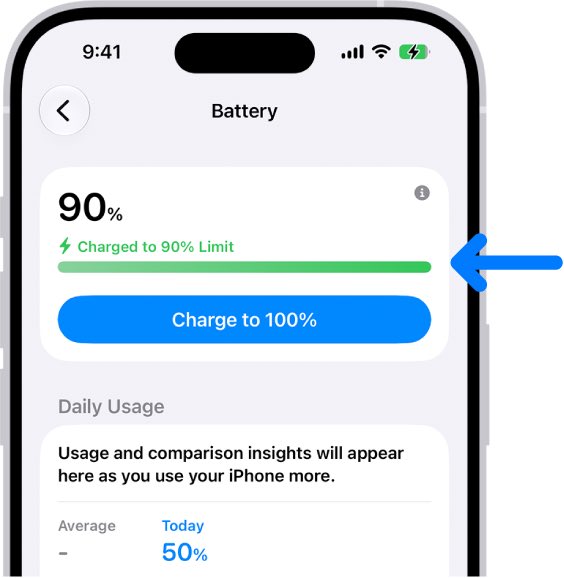
🔋 Save this one — a simple iPhone battery habit 👇
If you keep your iPhone for several years, you don’t necessarily need to charge it to 100% every night.
On supported iPhones, Apple lets you set a charging limit below 100%.
Go to:
Settings → Battery → Charging
A lower limit can reduce the amount of time your battery spends sitting fully charged.
Small setting. Potentially useful over years of ownership.
🚨 Apple is reportedly preparing an entirely new operating system for its upcoming smart home hub.
Think:
• iPhone-style app grid
• Widgets + customizable clock faces
• Face recognition for personalized info
• FaceTime
• Home controls + security monitoring
• Siri AI at the center
• Multiple user profiles
The rumored name: homeOS.
Apple could unveil the device as soon as October.
This could be Apple’s biggest push into the smart home yet. https://t.co/LvZ2eKvdhx
🚨 @bot is rolling out to Tesla vehicles today. 🤖🚗
This goes way beyond asking Grok questions in the car.
Grok Bot is xAI’s agentic AI system built to actually complete multi-step tasks for you — things like working across email, calendars, files, chats and online services instead of just giving you an answer.
In @Tesla , that means you can start handing off real tasks by voice while you drive, turning the car into more of a hands-free AI assistant than a traditional infotainment system.
That’s the bigger shift here: Grok isn’t just coming to Tesla. Grok Bot is bringing AI agents into the car! 👀 https://t.co/sS7ofiGpp8
@TTTTripleTTT Yep, exactly. Screen Time can help set the boundary, but it doesn’t replace the boundary. If another screen is sitting right there, kids will find it 😂
🚨📱 Parents with kids on iPhone: check this after updating to iOS 27.
Apple added Ask to Browse — so you can require your child to get approval before visiting a new website in Safari.
🛡️ Communication Safety was also expanded to detect and block violent/gory content, along with nudity, in shared photos and videos — including FaceTime.
⏱️ Screen Time also got a redesign with quicker controls.
Definitely worth going back through your kids’ settings after the update.
https://t.co/3RsA5yhYGN
@bestaiprice Exactly. The real advantage isn’t just having a smarter model it’s knowing when you actually need to pay for the smarter model. Routing could end up being one of the biggest AI cost advantages.
🚨 OpenAI just launched GPT-6 Sol and GPT-6 Luna.
The big story isn’t just better AI — it’s cheaper AI.
• 50% lower API pricing vs. GPT-5.6 promotional rates
• GPT-6 Sol makes ~50% fewer mistakes than its predecessor, according to OpenAI
• Improved coding, computer use and professional work
• Rolling out today in ChatGPT Work, Codex and the API
The AI race is quickly becoming a performance-per-dollar battle. https://t.co/356XOlkbuk