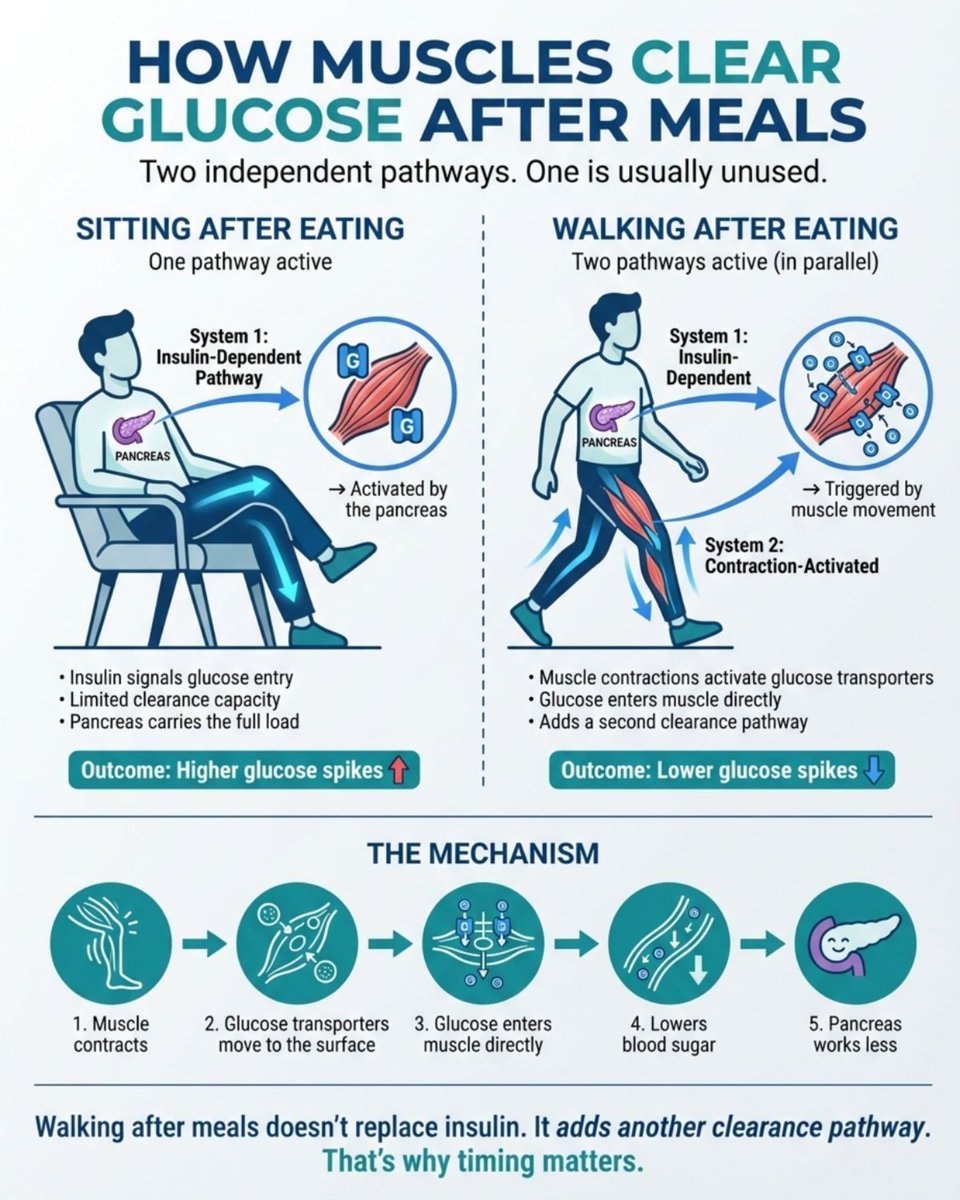
Your muscles clear glucose in two different ways after a meal.
Most people only use one.
When you sit after eating, glucose disposal depends almost entirely on insulin signaling from the pancreas. That pathway works, but it has limited capacity, which is why post-meal glucose spikes are higher and longer.
When you move after eating, even lightly, a second pathway turns on in parallel.
Muscle contraction independently activates glucose transporters (GLUT4), allowing glucose to enter muscle without waiting for insulin. The result is faster clearance, lower peaks, and less strain on the pancreas.
What’s happening under the hood:
• Muscle contraction triggers GLUT4 translocation
• Glucose enters muscle directly
• Blood glucose falls more quickly
• Insulin demand is reduced, not replaced
This isn’t about burning calories or “earning” food. It’s about using the physiology you already have. Walking after meals doesn’t override insulin. It adds another clearance pathway.
That’s why timing matters.
I am extremely thankful to my students, collaborators, and the reviewers and editors for their valuable feedback that improved our manuscript.
https://t.co/mpVzo6nKgw
Artificial Intelligence-Large Language Models (AI-LLMs) for Reliable and Accurate Cardiotocography (CTG) Interpretation in Obstetric Practice https://t.co/CKtz5AyAz2
New work reveals the impact of anxiety & depression on PhD students.
"Anxiety and depression can have a substantially detrimental impact on graduate students’ experiences [..] and likely also contribute to increased time to degree and student attrition."
https://t.co/iNitLTuagj
The Chatbot's performance was as good as those of the very experienced human doctors. "Artificial Intelligence-Large Language Models (AI-LLMs) for Reliable and Accurate Cardiotocography (CTG) Interpretation in Obstetric Practice" https://t.co/OmsVZanyug
Here's the latest 🗞 from [ Nature Communications ]: " Human papillomavirus-encoded circular RNA circE7 promotes immune evasion in head and neck squamous cell carcinoma" https://t.co/1lkYq3OoG9
Meet the SON of splicing! 👲 ✂️
Scientists identified SON as a novel RNA splicing factor that plays a critical role in regulating ErbB2/3 expression. #BreastCancerResearch@BrJCancer | https://t.co/bYBRvM64Js
This work identified SON as a novel RNA splicing factor that plays a critical role in regulating ErbB2/3 expression, suggesting SON is an ideal therapeutic target in ErbB2-positive breast cancers. https://t.co/cLZIh3RgUX





![ItaiYanai's tweet photo. New work reveals the impact of anxiety & depression on PhD students.
"Anxiety and depression can have a substantially detrimental impact on graduate students’ experiences [..] and likely also contribute to increased time to degree and student attrition."
https://t.co/iNitLTuagj https://t.co/kej4BRT7dt](https://pbs.twimg.com/media/GdXPlFtXAAA9FBP.jpg)





