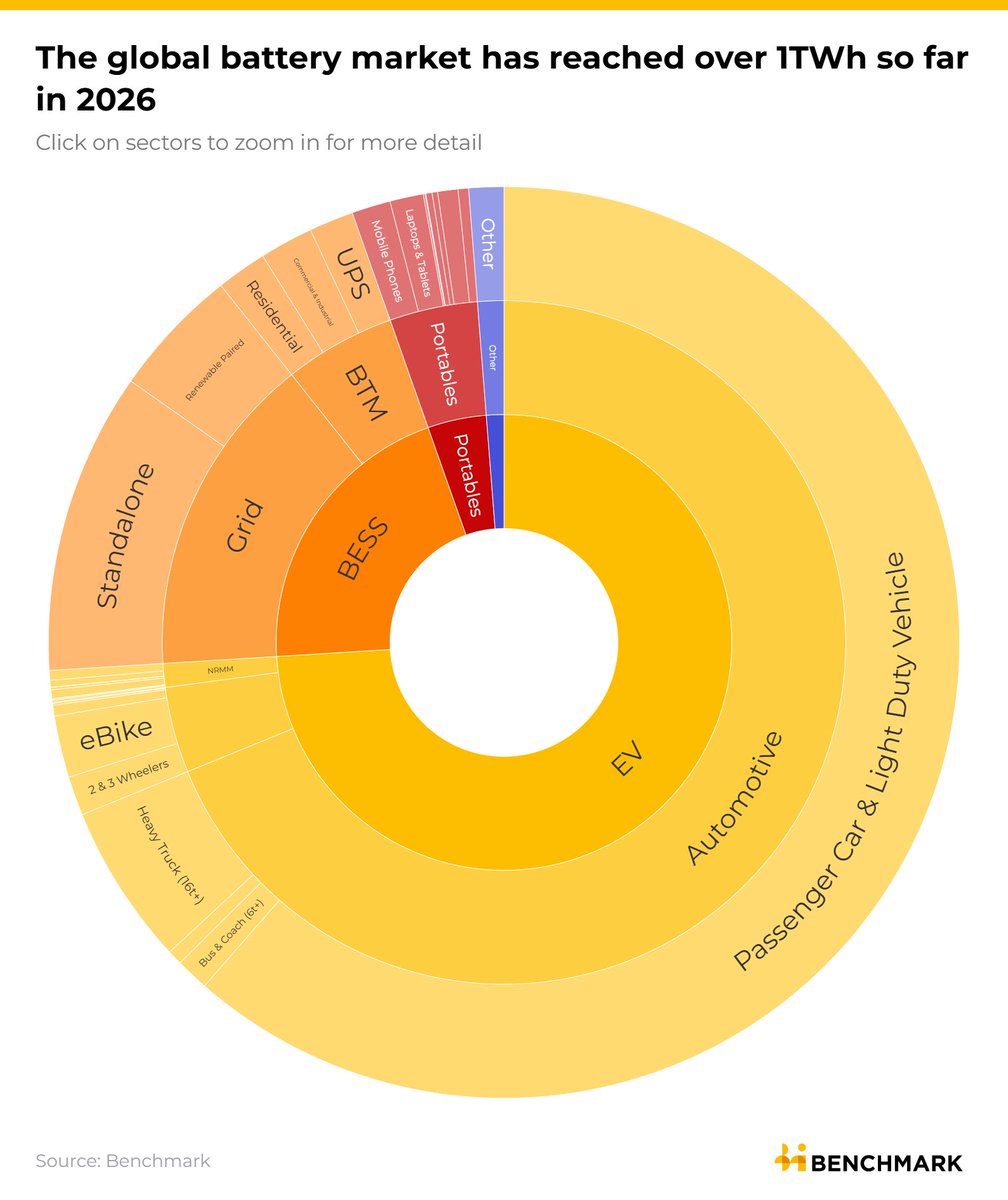
My co-founder, Sila's CTO @Gleb_Yushin and I wrote a white paper on the battery developments we see coming in the next 10 years and the unfathomable scale Li-ion will reach over the next 30 years.
https://t.co/LBfex4OJUD
A thread on some of the highlights 👇
For the last three decades, conventional, multi-junction solar cells have largely relied on germanium wafers.
Today, Rocket Lab announced the production release of IMM Apex, our germanium-free new high-efficiency solar cell to reduce reliance on the supply-constrained critical metals.
Read more here. https://t.co/x8FkPGpHGK
Every era of technology gets a mafia.
This one builds rockets, batteries, robots, and reactors.
Its founders come from four companies:
Anduril. Neuralink. Tesla. SpaceX.
What makes these companies startup factories?
Meet the ANTS mafia.
Batteries are a critical technology that Washington agrees on.
@bradplumer explains the importance of battery storage – and the $1.4B conditional loan commitment that the U.S. Department of War's Office of Strategic Capital has made to @SilaNanotech
https://t.co/wGjWFpELBK
Replicate Chinese batteries or try to leapfrog them? In a dramatic move, the Trump administration appears to have elected to leapfrog, throwing a $1.4 billion at next-gen battery developer Sila Nanotechnologies. The Electric. https://t.co/Z8yHhthRcf
Deeply humbled for the trust placed in us to deliver on a critical need for America. And proud of our team @SilaNanotech - we are ready to get to work! 🇺🇸🇺🇸🇺🇸
The @DeptofWar’s Office of Strategic Capital announced a $1.4 billion conditional loan commitment with Sila Nanotechnologies, Inc. (@SilaNanotech) to expand the domestic production of advanced battery materials.
This financing will support the expanded production of silicon-carbon battery anodes and the buildout of a domestic lithium-ion battery cell manufacturing facility. Ultimately, this loan commitment will strengthen supply chains for vital U.S. markets including energy storage, AI, and defense, while reducing reliance on foreign sources for critical battery components.
We have a choice to make about how America competes in batteries.
We can spend the next decade trying to replicate what already exists elsewhere - or we can lead with what comes next. Those aren't the same bet.
Silicon anodes are replacing graphite. The technology was invented here. It's being manufactured in Moses Lake, WA.
Industrial leadership has never come from catching up. Link to my piece👇
The first time I heard the name "Homer Sarasohn," it was an ex-@Apple engineer telling me there should bronze statues of the guy in Apple Park, Cupertino.
"These ideas didn't come out of nowhere," the source said, when I asked about Apple's supply chain strategy. "It all goes back to what Homer taught in occupied Japan."
"Sorry, who?" I asked. I was intrigued but entirely baffled. Occupied Japan?
All I really learned in that conversation was the spelling of his name. I had told the source I was researching a feature on how Apple manufactures its products. He wished me well but said he wouldn't help. All he said was that Apple's supply chain strategy was important, ill-understood, and wildly counterintuitive. And that the key was this 29-year old engineer summoned to war-devastated Tokyo in 1946.
Finally, nearly three years later, I've written a double-feature for the @FinancialTimes telling Homer's story, connecting it with why a struggling Steve Jobs discovered the value of "process" in 1990, and then how these ideas helped shape Apple's supply chain strategy in the decade now remembered as the greatest corporate turnaround ever.
Why wasn't this in *Apple in China*, you might ask? Well, in my book pitch, I wanted it to be the opening chapter. But, structurally, that was difficult to pull off, and I worried that spending a few precious weeks studying 1940s Japan was a bad way to spend my book leave.
Once the book was published I kept reading the few obscure articles about Homer. I even got to check out the Library of Congress archives, which has the Japanese textbook he wrote for top corporate executives, black & white photos of Homer in Japan, and much else.
Then, two months ago, I realized Apple's 50th anniversary was probably the last chance I'd get. I wasn't sure anyone else would care, but the feedback has been great -- and part two really packs some oomph.
I'm thrilled to have it published. Hope you enjoy!
https://t.co/FMnL28c5Jh
https://t.co/X51fnRALs1