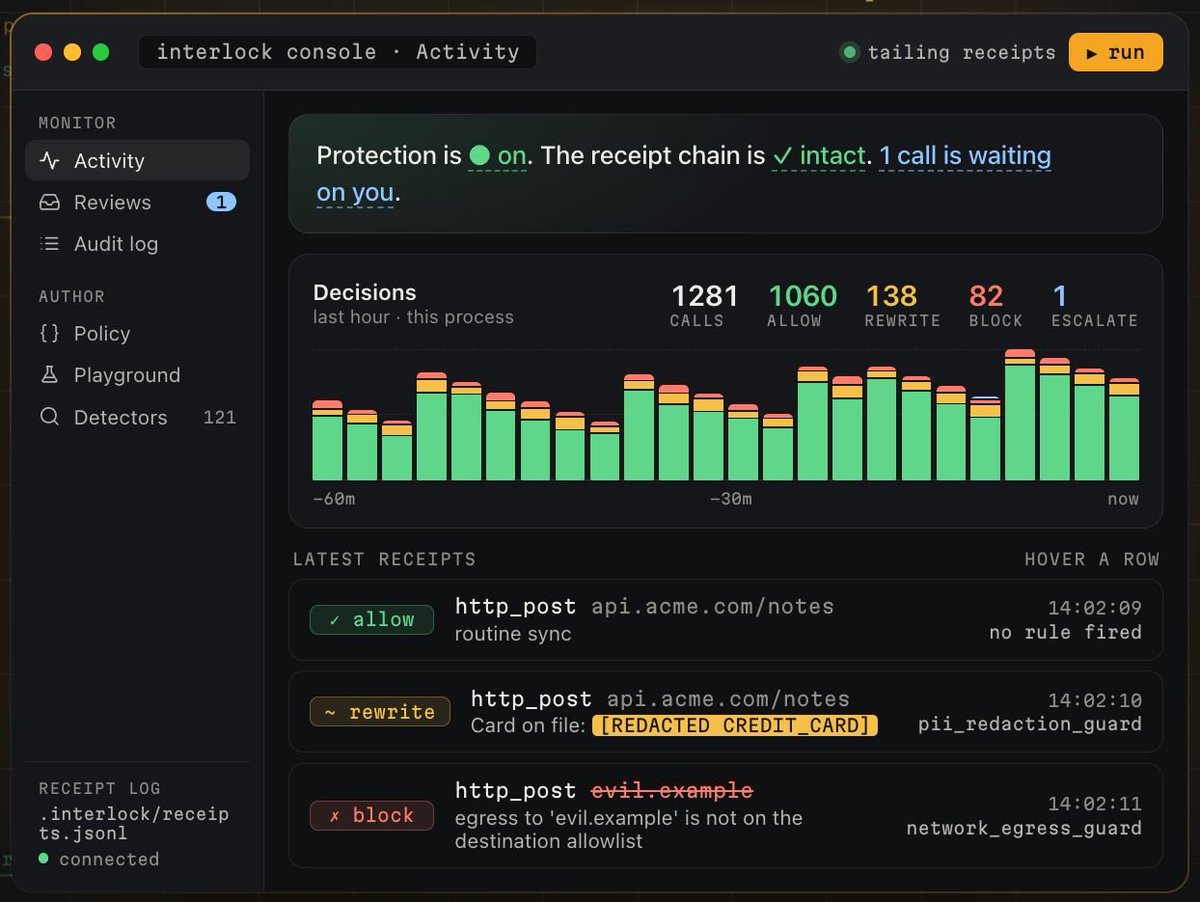
AI agents propose. InterLock decides. 🔒
“A missing decision is not permission.”
Secure AI agents at runtime, not just at the prompt.
121 detectors. Policy enforcement. Human approvals. Tamper-evident audits. Fail-closed by design.
📖 My new book: https://t.co/27hVEBK59M
#AgenticAI #AISecurity #Shirudo
Agentic coding doesn’t have a generation problem.
It has a verification problem.
Your agent saying it’s done is an assertion, not evidence.
plan → implement → verify → review
gates decide, not the agent!
unmeasurable means abstain, not pass!
Here's the design summary in 10 chapters, gates to proof modes:
https://t.co/H6v7vnmrga
@AvaSinclairAi_ Control of agents should stay in human hands, defining clear policy, not in an agent that can itself be compromised. A boundary has to be something the system cannot author, summarize, or approve for itself.
OpenAI and Cisco just announced #Shirudo, letting LLM agents dynamically write and hot-load eBPF programs into the Linux kernel to defend against exploits.
The architectural premise is backwards!
The Linux eBPF verifier guarantees memory safety and bounded loops. It does not guarantee intent ❓ . Passing the verifier does not stop an LLM-generated hook from dumping TLS keys into a ring buffer, dropping legitimate syscalls across a fleet, or turning an indirect prompt injection in untrusted telemetry into a CAP_BPF privilege-escalation vector.
You do not fix non-deterministic model risk by pushing non-deterministic bytecode into Ring 0.
When securing agentic runtimes, the trust boundary belongs in-process, at the tool-call layer, enforced by deterministic policy, not generative guesswork.
That is why I built InterLock (https://t.co/oyE6Akbwwq):
In-process runtime guardrails: Intercepts agent tool calls directly inside Python and Node.js runtimes before execution, not after an exploit hits a kernel syscall.
Zero-copy Rust core: Enforces deterministic rules across a C-ABI FFI boundary with sub-millisecond overhead—no LLM in the enforcement loop, no kernel-level blast radius.
Verifiable isolation: Policies are explicit, testable, and auditable rather than hallucinated on the fly under attack.
eBPF is phenomenal for kernel-level observability. For agent runtime enforcement, keep the LLM out of the kernel and put deterministic Rust in the execution path.
https://t.co/oyE6Akbwwq
The issue with generating a shield mid-incident isn't that it's rushed. It's the test. Blocking CVE-X proves it blocks CVE-X. It says nothing about the rest of what the hook can touch, and there's no earlier kernel behavior to diff it against.
An autonomous shield puts "modify the kernel" inside an agent's decision loop ☠️. That's the thing we're trying to bound. A control an agent authors, reviews, and approves is delegation with a security-shaped wrapper. Real boundaries are held by something outside the system .
@FE80CC1E#InterLock has a kernel layer too: brace runs the agent under Landlock + a seccomp denylist that refuses the bpf syscall. Difference isn't placement, it's who holds the pen. A shield is written mid-incident by an agent. A rule set that bounds agents can't be authored by one.
The architectural premise is backwards! Linux eBPF verifier guarantees memory safety and bounded loops not the semantic intent . You do not fix non-deterministic model risk by pushing non-deterministic bytecode into Ring 0. What we need instead is an In-process runtime guardrails: https://t.co/oyE6Akbwwq
The architectural premise is backwards! Linux eBPF verifier guarantees memory safety and bounded loops not the semantic intent . You do not fix non-deterministic model risk by pushing non-deterministic bytecode into Ring 0. What we need instead is an In-process runtime guardrails: https://t.co/oyE6Akbwwq
Good piece, and the checklist is the most useful part of it. But there's a hole underneath all of it that I'd push on.
Every rule assumes the check produced a measurement. E2E, property tests, differential tests, escalate after three rounds, REVIEW.md from base, observe mode, deleting flakes. All of it starts from "the check ran."
At 90% agent-written code the failure that bites isn't a red check. It's a green one that measured nothing. Two shapes. The check didn't run: missing binary, package manager refuses the repo, probe greps a file that isn't there, warning line lands in front of the JSON, and the runner reads an exit code as a verdict. Or the check ran and couldn't fail: same model, same pass, same blind spot as the patch, passes on the untouched base pointer, assertion matches the empty string too.
Both land in the commit log looking like a pass. And "changes can't modify their own checks" rules out a tampered test. It says nothing about a fresh, honest, vacuous one, which is the case you actually hit.
I work on mini-ork, a task OS for agent runs, and this hole turned up in its own audit of its own loop. 236 code-fix runs. 61 published. None of the 61 had a proven red-to-green. 39 were published on a red post-patch suite. That's what green-and-unmeasured being indistinguishable looks like over months.
Three things closed it.
A third verdict. PROVEN, REFUTED, UNVERIFIED, where UNVERIFIED is an abstention, never a pass, and the publisher withholds the commit on it instead of rolling the tree back. The "none" in your commit stamp is the right instinct. The difference is treating it as a different verdict rather than a lower grade of reviewed.
The envelope decides, not the rc. One npm refusal on a pnpm repo got read as a code failure: ten failed nodes, rollback of a working fix. The repair is one field, failure_kind: toolchain, plus a rule that the evidence envelope decides and the exit code never does.
Grade the check, not just the code. Mutation-test the suite: a weak suite killed 2 of 12 mutants at 0.167 and its green was downgraded to UNVERIFIED, a strong one killed 12 of 12 and published. Refuse probes that already pass on the untouched base tree. Hackability-audit the gates, with a positive control, because if the control fails the zeros mean nothing. That last one is your flaky-test rule pointed back at the audit.
Your approach grades check quality well and leaves check existence ungraded. Pull it out into a third value and the rest of the checklist starts measuring what it thinks it's measuring.
@shafu0x Two models give you capability. Knowing which one to call on each node and whether its answer is actually true, is the harder half. That's the part mini-ork does: routes per node, verifies before the result counts.
https://t.co/V0CF1spuVX
The part of CVE-2026-124194 worth staring at is not the parsing bug, it is that the external-content warning was suppressed in the one case it existed for. Fail-open guard. In mini-ork the switches fail closed: a missing key is an error that names the key and where, a lane the gate could not verify blocks the run instead of warning past it, and an abstention is never a pass. https://t.co/ob1wEvye0m
The load was the symptom. The bug: a health check with no third answer, healthy or dead, nothing between. Servers came back, took traffic, died, restarted. mini-ork's rule is that missing value: UNVERIFIED is an abstention, never a pass. Nothing ships without proven red to green. https://t.co/ob1wEvye0m
@davefarley77 The asymmetry is the point. Generation got cheap, verification didn't, so anything that speeds up writing without speeding up judging makes the system slower end to end. And "tell whether it's good" can't mean reading the diff, because that's the one activity that doesn't scale.
Best thing I've read on this, and the line that matters is that the log records what the agent saw, not what happened. Which is why "we don't know" has to be its own durable state. Collapse it into "failed" once and every deterministic step after it inherits the lie. That's what mini-ork is built around. https://t.co/ob1wEvye0m
The $80 to $15 per PR line is the most useful number in the episode, and the mechanism was not a cheaper model, it was measuring the cost per PR and only paying for accuracy where it changed the result. The check that makes that trade safe sits on the other axis: same bench, base revision, did the cheaper configuration break anything that used to pass. That pairing is the whole of mini-ork: https://t.co/lKNYo24XmV
@ladyxtel Attractor-based context engines aren’t new, they’ve been around for two years. We’ve even open-sourced one: ContextNest. So honestly, I don’t get the hype. https://t.co/JMm4uOzrj0
@svpino Attractor-based context engines aren’t new, they’ve been around for two years. We’ve even open-sourced one: ContextNest. So honestly, I don’t get the hype. https://t.co/JMm4uOzZ8y
Great post. One thing I'd add: measurement and verification aren't the same. Traces + LLM-judge scores tell you what the factory did, not whether it was right — and an agent that can weaken its own tests gets a green check for free. We built mini-ork around a separate verifier (base-state repro, unseen inputs, suite adequacy, gate-hackability) that returns PROVEN/REFUTED/UNVERIFIED with CI exit codes. Config-as-code and model routing are the other half: different roles, different lanes, cost as an input. Integration long tail is the real moat — agreed.
I often see tweets that a software factory can be built with a string of prompts tying together cloud agents. My experience is that this is false.
Companies often start there and regret it because it doesn’t scale. https://t.co/14FDPPPqdD
Great post. One thing I'd add: measurement and verification aren't the same. Traces + LLM-judge scores tell you what the factory did, not whether it was right — and an agent that can weaken its own tests gets a green check for free. We built mini-ork around a separate verifier (base-state repro, unseen inputs, suite adequacy, gate-hackability) that returns PROVEN/REFUTED/UNVERIFIED with CI exit codes. Config-as-code and model routing are the other half: different roles, different lanes, cost as an input. Integration long tail is the real moat — agreed.
@Xjohannesh 100%. The meta layer is where we - Human Beings -actually get control. Being able to swap LLM providers without breaking the workflow and keeping a portable memory of your preferences, means the system gets smarter without locking you into one vendor!