If anyone has friends on the editorial teams of the @WSJ, @FinancialTimes, @barronsonline, @CNBC, @Bloomberg, or @FoxBusiness, please have them reach out to exclusively feature this timely OpEd I just penned regarding the @federalreserve after their policy mistake today. Enjoy!
---
The Honorable Jerome Powell
Chair, Board of Governors of the Federal Reserve System
20th Street and Constitution Avenue NW
Washington, DC 20551
Dear Chair Powell:
Why did you cut 100bps last fall but claim to see little reason to cut 25bps today? It can be argued that your political posturing will all but guarantee the Fed’s independence is at least marginally eroded by the upcoming series of appointees to the board — including your replacement.
The increasingly likely erosion of Fed independence may prove to be more significant than “marginally,” and here’s why:
It is reasonable to question your data dependency because the labor market is worse now than it was then. Private Sector Labor Income grew 4.7% on a three-month annualized basis in Aug-24 — the last report you had on hand before your jumbo-sized 50bps cut last September. FWIW, 4.7% is comfortably above the pre-COVID trend of 4.3%. Fast forward to today, Private Sector Labor Income grew just 1.4% on a three-month annualized basis in June – the lowest rate since Jun-20. The -370bps MoM deceleration marked the slowest rate of change since May-22.
It is also reasonable to question your data dependency because inflation is lower now than it was then. The Super Core PCE Deflator — the inflation metric over which you purported to have the most control as monetary policymakers — was reported at 2.2% on a three-month annualized basis, 2.8% on a six-month annualized basis, and 3.2% on a YoY basis in Jul-24 (mean = 2.7%) — the last report you had on hand before your jumbo-sized 50bps cut last September. The Super Core PCE Deflator is currently mired in a downtrend at 1.1% on a three-month annualized basis, 3.1% on a six-month annualized basis, and 3.1% on a YoY basis as of May-25 (mean = 2.4%).
To be clear, we are not even advocating for cutting the policy rate. We do not believe the economy requires rate cuts for the business cycle expansion to persist over a multi-year time horizon and have remained the most bullish non-permabull on global Wall Street since May 3 (Google search or ChatGPT query “Paradigm C” for details).
What we are advocating is that you drop the “Mr. Tough Guy” act on inflation.
You had no problem being the most dovish Fed chair since the advent of using the policy rate as the primary tool for conducting monetary policy. Arthur Burns’ trough spread of -720bps below what would have been the baseline Taylor Rule estimate at the time looks hawkish compared to your trough spread of -1,040bps in Feb-22 — when you were still performing quantitative easing into a 40-year high in inflation.
You had no problem growing the Fed’s balance sheet to a peak of 36% of GDP in Nov-21 — a year in which the federal budget deficit clocked 10% of GDP, after a whopping 15% in 2020. These figures compare to just 5% in 2019, 4% in 2018, and 3% in 2017. The current Fed balance sheet/GDP ratio of 22% is still well north of the long-run mean of 16% for this time series — data which features your ultra-dovish focus on “maximum and inclusive employment” and green-energy-supportive monetary policy.
We do empathize with why you’re acting tough on inflation. Respectfully, sir, you are 72 years old and like most people in their 70s, you may be succumbing to the understandably human desire to build and preserve your legacy.
Additionally, the Trump administration’s tariff policy shock is significantly larger than anyone expected. Per the Budget Lab at my alma mater Yale, the overall average effective tariff rate of 18.4% is the highest rate since 1933. At some point this will feel like inflation as affected goods finally pass through the system.
But the preponderance of credible academic literature concludes tariffs aren’t inflationary. The PhD economists at your own institution agree — or at least they did agree prior to President Trump’s second ascent into the Oval Office, but that’s neither here nor there.
What is relevant here is the slowdown in Real Services PCE, which grew a paltry 1.1% on a QoQ SAAR basis in Q2 — just one-third of the 3.0% rate recorded in 2024. Real GDP ex-Government & Net Exports contracted at a -3.2% QoQ SAAR pace in Q2, the lowest rate since the COVID lockdowns of 2Q20.
There was a sound economic case to be made for lower policy rates today — we wouldn’t have had two Fed governors dissent for the first time in 32 years otherwise.
Specifically, the labor market is likely to weaken further on a lag to the near contraction in capex observed in the Q2 GDP data (0.4% QoQ SAAR vs. a pre-COVID trend of 3.5%), slowdown in corporate profits growth (S&P 500 constituents 6.4% YoY Q2-to-date vs. 13.6% in Q1 and 11.3% in 2024), and persistently elevated policy uncertainty (e.g., highest ever yearly average for the Baker, Bloom, and Davis Economic Policy Uncertainty Index — a time series that includes data from both COVID and the GFC).
There is an equally unsound economic case to be made for keeping policy rates cyclically and structurally elevated today: the risk of “unanchoring” inflation expectations.
Putting aside the fact that we do not believe the mere ‘unanchoring’ of inflation expectations can cause persistent above-trend inflation in the absence of persistent above-trend credit growth in either the private or public sectors, Chair Powell, you and your colleagues are the primary reason this risk exists. You let the inflation genie out of the bottle by running historically expansionary monetary policy amid an obvious and historic expansion of fiscal policy.
This is why we strongly believe the administration is right to pursue regime change at the Fed. Whether or not they get it right is irrelevant at this juncture. Time will tell on that front.
Lastly, please do not interpret this as a personal attack on you or the institution. Rather, this is a data-driven perspective on how you and your colleagues at the institution have failed the American public and continue to fail the American public. Heaven forbid the FOMC be held accountable for the dramatic outcomes it contributes to in our K-shaped economy and asset markets.
Anyone reading this would be a fool to not agree that better monetary policy can potentially help engineer better outcomes for the consumers and businesses trapped on the bottom part of the “K”.
There are obviously no guarantees that the pending regime change at the Fed will accomplish this goal — or in life in general, save for the fact that two wrongs don’t make a right in Fed policy mistake terms.
Thank you for reviewing, and thank you for your service to the American public. Regardless of whether you and I see eye to eye on your still-developing track record, I recognize how hard your job is and appreciate your efforts nonetheless.
Thank you and God bless,
Darius Dale, Founder and CEO of @42Macro
When BTC has momentum, this is my most profitable setup consistently over the years
Study the Dalai
I have three full videos on the topic in @TheParagonGrp
All of these are public going back over a year:
> Sold top on ETFs going live
> Bought bottom off weekly trend a few weeks later despite Grayscale FUD
> Sold top off of H4 trend losses on majors in March '24
> Bought bottom off of alt/btc HLs in April '24 despite war FUD
> Sold top in June on my alt bags (pepe, ondo, sol) on H4 trend loss
> All in between Sept and Oct '24 despite FUD
> Didn't "derisk" shit during election
> Sold daily trend losses in Dec
> Called for extended fruitless market early Jan
> Called for front run of consensus '24 range high level
> Nailed both mega swing long setups off of the bottom
- 80 - 92k in early March
- 78 - 94k throughout April
> Called for relative strength over SPX before it formed
> Didn't macro larp once the entire way
> Still betting on ranging longer on BTC
Honestly, people don't put enough respect on @TraderMagus's name.
There's no one that has taught me more nuance, psychology and edge than this man.
He's a walking market encyclopedia that has simplified his discretionary market approaches so that even a monkey like me can understand them.
Although I have the privilege to work alongside him, I still learn something new almost every week.
To celebrate our three year anniversary and say thank you to everyone we are offering discounted rates to run from now until the end of November 2024
Let us know if you have any questions
Thank you from Mag, Charlie, Doc & Leer
@TraderMagus Gm mag, always great to hear your analysis!
Will be back in the paragon soon, still a little bit of irl stuff to figure out. Have a good one
Almost Time to Breakout - Outlook July 29th
-Summer time chop coming to an end very soon
-Starting to reposition for trend continuation
-Lock in or get left behind
https://t.co/4dwXta52Dy
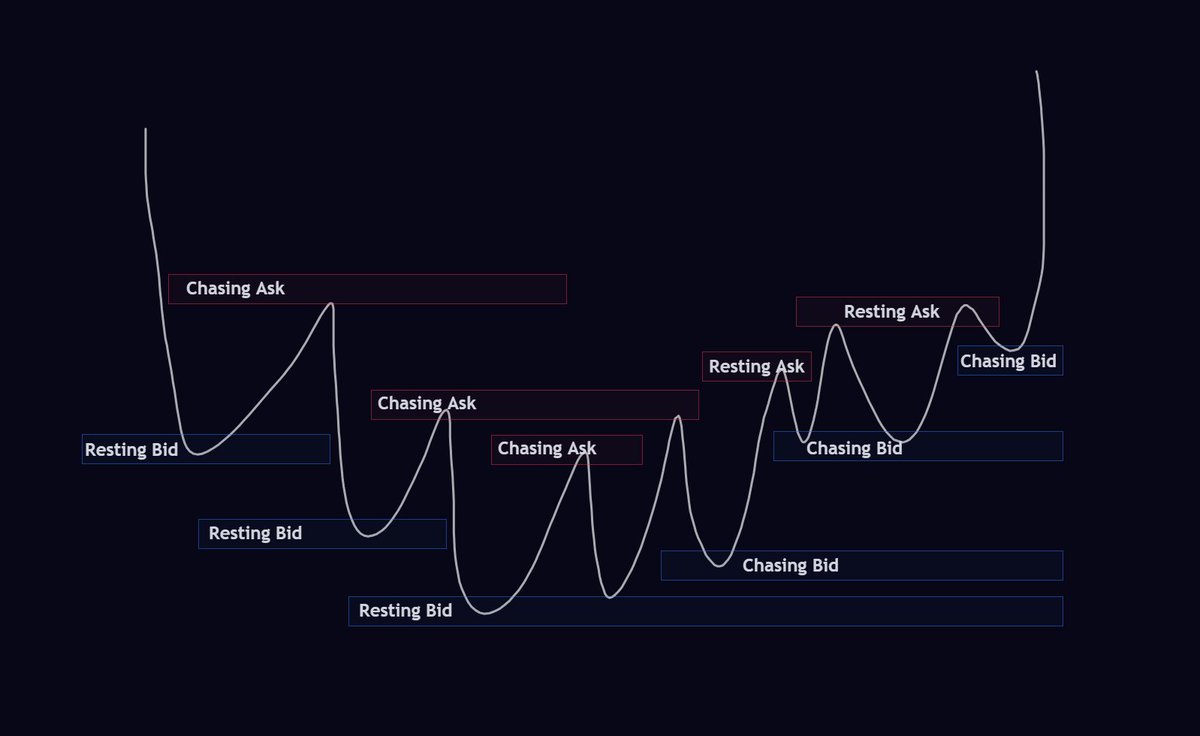
Momentum Loss Pattern
(Three drives/Multiple drives)
The pattern we see that causes directional shift in price
Commonly referred to as "Three Drives" but can be any number of moves. The number required for price to turn around is dynamic, not scripted
Never buy on the first drive down unless upside momentum is extremely high
Wait for downside momentum to be lost, then buy
Anatomy
Impulse move from takers sparks momentum
The majority of the time from an Open Interest wipe, causing toxic flow
Momentum sustains until takers exhaust into liquidity
Passive side soaks & takers give up
Why does this occur?
1. Spreads get blown out from toxic flows
- Orderbooks thin out because liquidity providers don't fight momentum. Makers will thin out liquidity to avoid getting run over & replenish the book depth once momentum fades. This makes it easier for price to move
2. Limit chasers - Informed traders & more directional liquidity providers will chase with limit orders as price moves. This supports & sustains the momentum
3. Faders - There's always someone trying to bet against & top tick a move. Once the trade goes against them they close out with market orders assisting momentum. More often than not these are the midwitt traders
4. Momentum algos - Once momentum begins, algos will pick up on this and join in. This often occurs in the form of twaps
5. Momentum apes - Informed discretionary traders that understand momentum, don't fight the flow but rather go with it. They use a combination of market orders/limit chase to execute & go with the flow
All of this logic applies to both top & bottom formations
I am not covering every detail to simplify somewhat & keep a bit of the spice for myself
Study multiple drives
We are proud to partner with @cryptoslamio, the leading NFT data analytics platform backed by @animocabrands, as they release their first NFT collection.
Citizens - visit the discord to learn details about this generous opportunity!