Simeon Vale is a former military chaplain and global missionary whose work examines the convergence of emerging technology, spiritual deception, and prophecy.
What if the mark of the Beast is not handed to you, but built beneath you?
Not a chip. Not a tattoo. A system. A platform. An invisible net that decides what you can see, buy, sell, or say.
That system already has a name: Palantir.
It is not future tense. It is here. It is already wiring together governments, militaries, police, and corporations. Gotham for intelligence. Foundry for integration. Apollo for deployment. AIP for AI that not only observes but commands.
Engineers know the language. Entity resolution. Graphs that connect you to everyone you know. Policy that follows the data. Copilots that push commands back into live operations. This is not passive analysis. It is active governance.
Where is it running now? In defense targeting. Immigration pipelines. National health systems. Once enough rails are laid, the switch is ready. Whoever holds it will decide who belongs and who is excluded. Who moves and who is frozen. Who may speak and who is silenced.
Revelation 13 foresaw this pattern: “so that no one can buy or sell unless he has the mark.” Identity tied to eligibility. Eligibility tied to compliance. Freedom gated by obedience.
Palantir is not the Antichrist. But it is the architecture of obedience. The throne is being built in code, dashboards, and contracts. And when power flows upward into such a system, it rarely flows back down.
Bookmark this. Reread it. Ask yourself who you are trusting with the rails of your life. Because one day soon, the question may not be what you believe...but what the system believes about you.
Every crown is borrowed—until it is laid at the feet of the Lamb.
What happens when the systems you depend on are controlled by people who do not share your values?
Not in some dramatic, movie-version of tyranny, but in the ordinary version that comes through policy, automation, and bureaucracy.
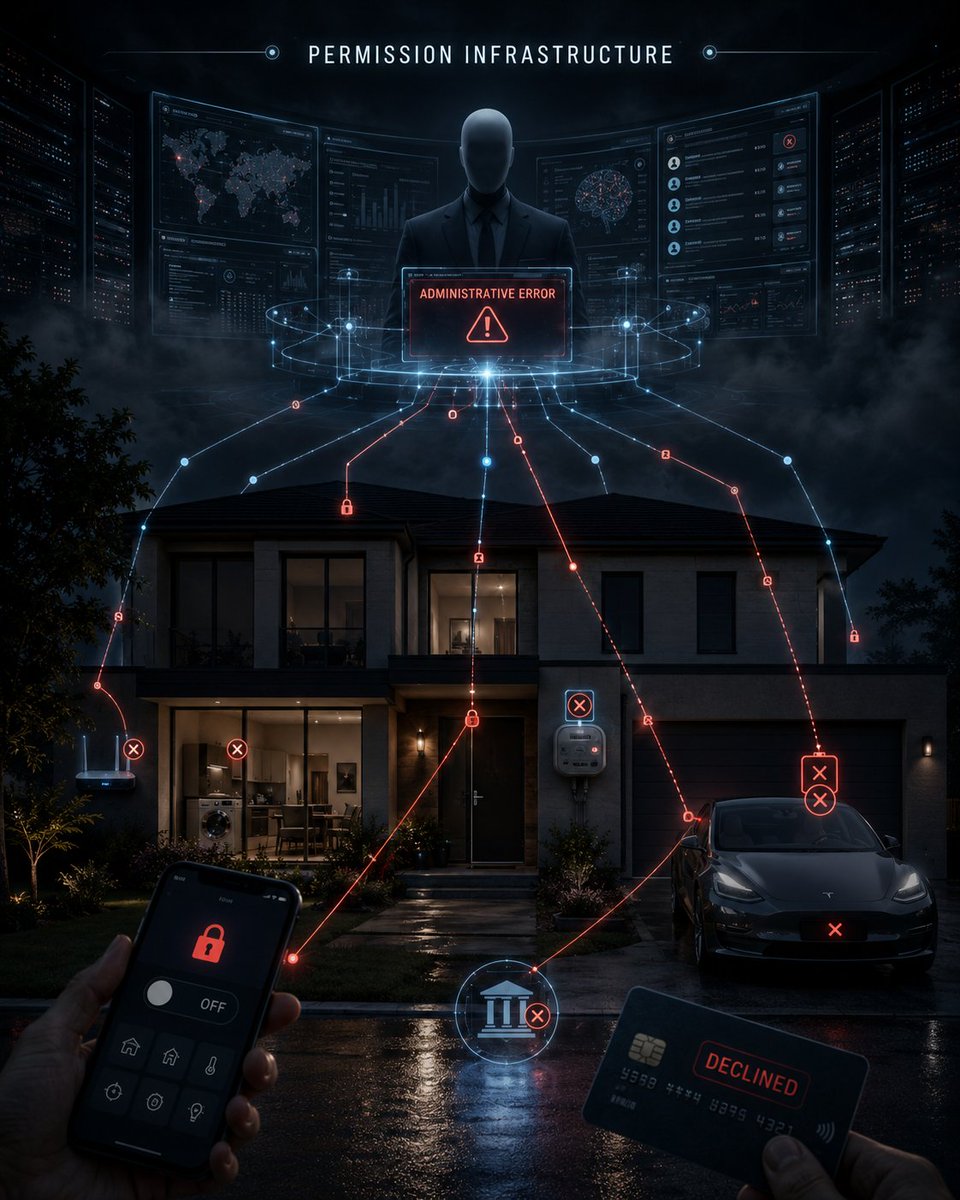
Your power gets limited because an algorithm flagged your usage. Your car will not start because your account status changed. Your payment will not process because a risk system labeled you. Your insurance rate jumps because your behavior profile changed. Your post disappears because an automated moderation tool classified it as harmful.
Then, when you try to fix it, no one can tell you who made the decision. It was not censorship, they say. It was a policy violation. It was not punishment. It was a safety protocol. It was not tyranny. It was an administrative error.
This is why embedded AI matters. It is being built into the physical systems we depend on: homes, cars, appliances, smart meters, routers, phones, medical devices, cameras, EV chargers, payment systems, and energy systems.
The danger is not a smart device by itself. The danger is the stack behind it. Sensors detect what is happening, local AI classifies the pattern, firmware enforces the rule, networks report the activity, cloud systems coordinate across devices, and central authorities can update the rules.
That turns ordinary life into a managed environment.
A device does not need to be malicious to become a control node. It only needs to sense, connect, receive updates, control a physical function, and allow someone other than the user to override it. At that point, ownership changes. You no longer simply own a device. You own hardware governed by someone else’s software.
This does not mean every smart device is evil or every use is malicious. Many uses will be convenient, efficient, and genuinely helpful. But once essential systems can be centrally updated, restricted, or shut off, the question changes.
Who controls the rules? Who can change them? Who can appeal? Who can opt out? Who owns the override?
Because if your power, car, bank account, speech, work access, or home systems can be restricted by invisible processes you cannot meaningfully challenge, then we are not just building better tools. We are building permission infrastructure.
And conditional freedom is not freedom.
Before asking “why,” it is worth asking what is being framed, and to what end.
So...what you seem to be doing, Gerald, is reducing a complex position on Taiwan to “it sounds like Xi” sidesteps the actual argument and invites suspicion in place of substance. That approach does more to discredit than to understand, and it is a concerning direction for Louder with Crowder. I hope you will reconsider that trajectory.
There is a real debate happening about how America balances power, risk, and responsibility abroad. Questioning long-standing assumptions does not make someone aligned with Beijing. It may simply mean they are refusing to repeat familiar lines without examination.
If we are serious about truth, we should test the argument itself rather than assign motives, and be careful not to turn disagreement into accusation.
Every crown is borrowed, until it is laid at the feet of the Lamb
A graph like this should give us pause, but not for the reason you’re suggesting. Search trends do not equal belief; they often reflect confusion, reaction, or people trying to understand why a question like this is even appearing in the first place.
The deeper issue is the erosion of trust. Many people feel they are being shaped and managed rather than told the truth, and when that perception takes hold, even settled moral lines begin to be questioned.
You can see this tension in how the West is processing Israel. There is a growing gap between official narrativesand what people believe they are witnessing in real time, and when that gap is dismissed instead of addressed, it does not lead to clarity. It breeds suspicion, and in some cases, it pushes people toward deeply wrong conclusions.
Antisemitism is evil, without qualification. But outrage without honesty will not correct this trajectory, and reducing a complex moment to simple hatred risks sounding more like posturing than serious analysis.
If we care about truth, we have to confront both the hatred itself and the conditions that are allowing distrust to grow...
Every crown is borrowed, until it is laid at the feet of the Lamb.
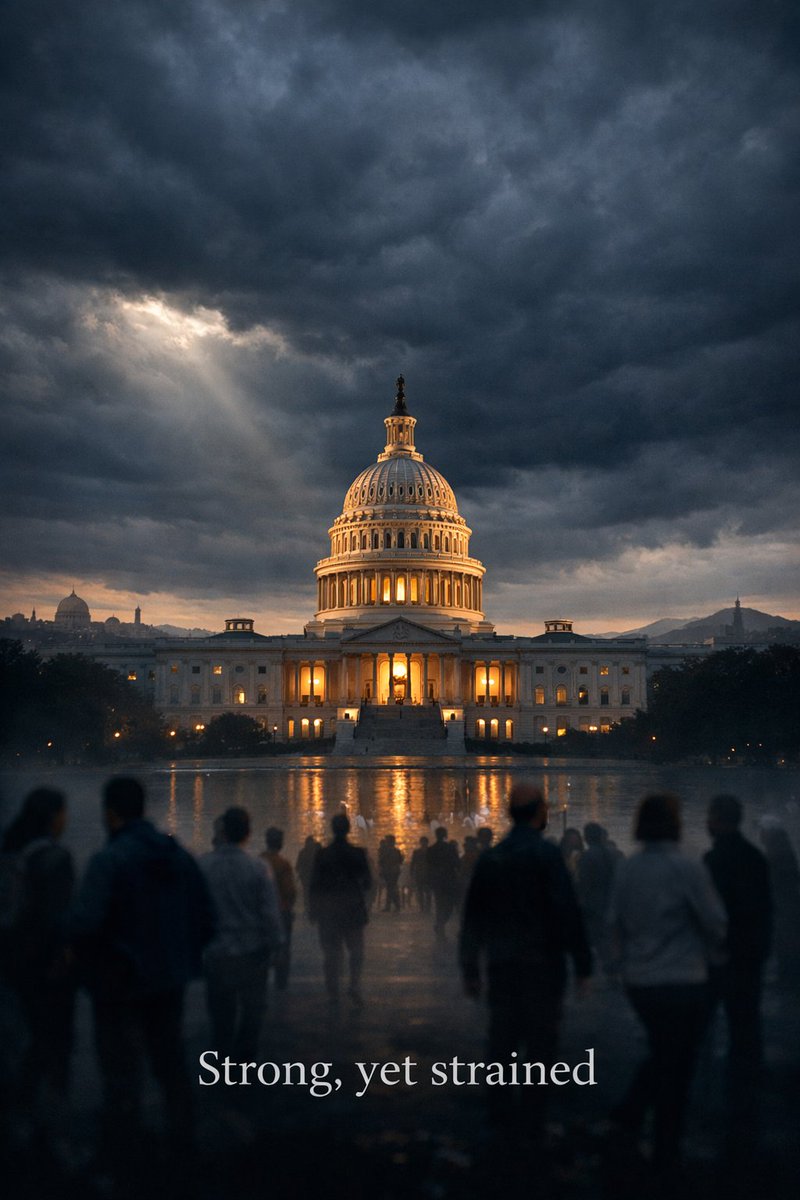
America remains the most powerful nation in the world, yet there is a growing sense that our strength is not carrying the same clarity or steadiness it once did. Our military reach is unmatched, our economic weight still substantial, and our global influence undeniable. And yet, the question is no longer whether we can act, but whether we can do so with unity, purpose, and a clear understanding of why.
The unfolding situation involving Israel and Iran brings this into sharper focus. For generations, the American relationship with Israel has been rooted in shared interests, shared values, and, for many, a shared biblical heritage. That foundation has not disappeared, but it is now being tested in a new way. Increasingly, Americans are wrestling with how to faithfully balance that relationship with the responsibility to act in the best interest of our own nation. This is not merely a political question. It is a question of stewardship.
At the same time, the conflict itself is revealing the limits of power when it is not joined to a clearly defined end. The United States retains the ability to strike, deter, and shape events on the battlefield. Yet the ability to bring a conflict to a stable and lasting resolution is proving more elusive. Allies are more cautious. Some are reluctant to follow. Others are calculating their own position more independently than in years past. Meanwhile, rival powers are watching closely, seeking not necessarily to confront us directly, but to benefit from any uncertainty or division.
In this sense, America remains central to the global order, but no longer unquestioned in its leadership.
What may be more significant, however, is what is happening within our own borders. The divisions we face today are not confined to party lines. They run deeper, cutting across institutions, communities, and even within movements that once spoke with a more unified voice. Questions about foreign intervention, national priorities, and the cost of prolonged conflict are now being raised from multiple directions. This signals not just disagreement, but a deeper struggle over identity and purpose.
History and Scripture both remind us that a nation’s strength is not measured by power alone. It is also measured by its internal cohesion, its moral clarity, and its willingness to pursue justice with humility. A house divided against itself does not immediately fall, but it becomes vulnerable in ways that are not always visible at first. When a people begin to lose a shared sense of direction, even great strength can become difficult to wield effectively.
This is why moments like the present require more than strategy. They require discernment. They require leaders and citizens alike to ask not only what is possible, but what is right, and what is sustainable over time. Proverbs teaches that without vision, people cast off restraint. That truth applies not only to individuals, but to nations as well. Without a clear and righteous sense of purpose, decisions become reactive, and reaction rarely produces lasting stability.
If the current conflict remains limited and defined, it is likely that the nation can carry it without significant internal strain. If it expands, becomes prolonged, or begins to touch the daily lives of Americans through economic or social pressure, the cost will grow, and it will do so quickly. Foreign policy does not remain foreign for long when its effects are felt at home.
And so America finds itself in a position that is both strong and fragile at the same time. Strong in capability, yet more fragile in unity. Influential in the world, yet more contested in its leadership. This is not a moment for alarm, but it is a moment for sober reflection.
Scripture consistently points to a deeper truth. Nations are upheld not only by their might, but by their alignment with wisdom, justice, and humility before God. When those foundations are present, a nation can endure even in seasons of uncertainty. When they are neglected, even great power can drift, losing its sense of direction long before it loses its strength.
That is the quiet tension of this moment.
Every crown is borrowed, until it is laid at the feet of the Lamb
Almost every catastrophic war in history began with the same belief:
“We can control this.”
Austria thought it in 1914.
Britain thought it at Suez.
America thought it in Iraq.
Now watch the Middle East.
I wrote a short piece on the patterns unfolding.
Read it here
https://t.co/7foFmXgU7s
Recent events have raised serious concerns about whether modern targeting systems, especially those incorporating automated analysis or artificial intelligence are introducing new risks into military decision-making. Even when AI is used only to assist intelligence analysis, pattern-recognition models can misinterpret complex human environments. A location that shows repeated presence of military personnel, vehicles, or communications signals might statistically resemble a military site, yet still be a civilian space such as a school, market, or residential area. If analysts or commanders begin to rely too heavily on algorithmic pattern detection without sufficient human verification, the system may generate “phantom targets” or places that appear militarily significant in data models but are actually part of normal civilian life.
This danger becomes more acute as modern warfare accelerates the targeting cycle. AI systems can process satellite imagery, communications data, and behavioral patterns far faster than human analysts, producing rapid recommendations for potential strikes. While this speed can provide operational advantages, it can also compress the time available for careful review and independent confirmation. If safeguards such as multi-source verification, collateral damage analysis, and command review are weakened by operational pressure or overconfidence in automated systems, tragic errors especially in densely populated environments can become more likely.
Yet the implications extend beyond the battlefield. The same pattern-recognition systems capable of misidentifying a civilian building as a military target can also be applied to monitoring human populations. Modern AI systems already analyze communications, movement patterns, financial behavior, and social networks to identify potential threats. While these tools are often introduced under the banner of security or efficiency, they operate on statistical inference rather than genuine understanding. In the wrong hands, such systems could begin flagging ordinary citizens as risks based on patterns that only superficially resemble wrongdoing.
History shows that powerful technologies rarely remain confined to their original purpose. Systems designed to detect enemies abroad can eventually become instruments of control at home, especially when integrated into surveillance networks, financial monitoring systems, and digital identity frameworks. Once automated pattern recognition becomes deeply embedded in governance, the danger emerges that decisions affecting liberty...who is monitored, restricted, or trusted, may increasingly flow from algorithmic determinations rather than careful human judgment.
For that reason, the debate over AI-assisted targeting is not merely a technical discussion about military efficiency. It is a warning about the trajectory of power itself. When societies begin to rely on automated systems to interpret human behavior and assign threat or loyalty, the line between protection and control can slowly blur. What begins as a tool for identifying enemies abroad could, under different leadership and different incentives, one day be directed inward...quietly transforming technology meant to defend a society into a mechanism capable of governing it.
Many Christians point to prophetic passages that appear to anticipate a future temple in Jerusalem, yet when those passages are read carefully, the temple is never presented as the instrument of Israel’s redemption. In Book of Daniel 9:27, sacrifices are allowed only so they can later be stopped through betrayal. Jesus echoes this warning in Gospel of Matthew 24:15, where the “abomination of desolation” stands in the holy place, signaling deception and judgment rather than restoration. Paul continues the pattern in Second Epistle to the Thessalonians 2:3–4, describing the man of lawlessness who exalts himself in God’s temple and proclaims himself to be God. Even the temple referenced in Book of Revelation 11:1–2 appears amid persecution and the trampling of Jerusalem. In every case, the temple becomes the stage where the Antichrist betrays Israel and commits blasphemy, not the place where Israel receives her Messiah.
This creates a striking irony in modern discussions about rebuilding the temple. The New Testament consistently presents Jesus as the fulfillment of the temple itself, and the prophetic narrative culminates not with a restored sanctuary but with its complete transcendence. In the final vision of the New Jerusalem, Book of Revelation 21:22 declares: “I saw no temple in the city, because the Lord God Almighty and the Lamb are its temple.” The trajectory of Scripture therefore moves away from stone and sacrifice toward the direct presence of God in Christ, making the prophesied temple, if it appears, not the symbol of messianic salvation, but the setting where the final deception is revealed.
Every crown is borrowed, until it is laid at the feet of the Lamb
What if the mark of the Beast is not handed to you, but built beneath you?
Not a chip. Not a tattoo. A system. A platform. An invisible net that decides what you can see, buy, sell, or say.
That system already has a name: Palantir.
It is not future tense. It is here. It is already wiring together governments, militaries, police, and corporations. Gotham for intelligence. Foundry for integration. Apollo for deployment. AIP for AI that not only observes but commands.
Engineers know the language. Entity resolution. Graphs that connect you to everyone you know. Policy that follows the data. Copilots that push commands back into live operations. This is not passive analysis. It is active governance.
Where is it running now? In defense targeting. Immigration pipelines. National health systems. Once enough rails are laid, the switch is ready. Whoever holds it will decide who belongs and who is excluded. Who moves and who is frozen. Who may speak and who is silenced.
Revelation 13 foresaw this pattern: “so that no one can buy or sell unless he has the mark.” Identity tied to eligibility. Eligibility tied to compliance. Freedom gated by obedience.
Palantir is not the Antichrist. But it is the architecture of obedience. The throne is being built in code, dashboards, and contracts. And when power flows upward into such a system, it rarely flows back down.
Bookmark this. Reread it. Ask yourself who you are trusting with the rails of your life. Because one day soon, the question may not be what you believe...but what the system believes about you.
Every crown is borrowed—until it is laid at the feet of the Lamb.
@DineshDSouza A "brown American"? Are you race baiting for likes Dinesh? I think another "brown American" threw you in prison didn't he? Why are you bringing race into this? "brown American", "white dudes". You sound like a leftist...and by that I mean, using race to divide.
Ben Shapiro just quietly conceded the culture war he helped shape.
By refusing to debate Nick Fuentes, he’s admitting that the energy of the conservative movement has shifted.
Americans haven’t changed...they’ve simply found their voice again.
After years of watching our borders collapse, our economy hollow out, and our politicians send billions overseas while our cities rot, people are saying: Enough.
This is no longer about party or personality. It’s about principle.
America First means exactly that:
Our Constitution.
Our sovereignty.
Our tax dollars used to rebuild our nation — not bankroll endless foreign wars.
The establishment is losing its grip because real Americans are awake.
And the days of guilt-tripping patriots for wanting their country back are over.
Every crown is borrowed—until it is laid at the feet of the Lamb
Nick Fuentes is America’s Middle Finger.
Jarring. Unapologetic. Defiant.
God has often raised voices the world tried to silence—figures too sharp for polite society, yet impossible to ignore. Symbols don’t have to be polite to be true.
His rise is not about one man. It is about a people so betrayed, so mocked by their rulers, that petitions no longer matter. Signals do. When trust collapses, rebellion becomes the language of the street.
The Middle Finger does not heal—but it does awaken. It shouts: Enough. And in that shout, a discarded generation finds its voice.
Christians must see this clearly. The clenched fist is a signpost, pointing toward the pierced hands. The church must pray for discernment: why have voices like this arisen, and what is God trying to say through them?
Every crown is borrowed—until it is laid at the feet of the Lamb.