Enhancing functionality and flexibility for MATIC to POL upgrade
Following PIP-57, the migrateTo function will be added to the POL migration contract. The addition enables users to migrate MATIC to POL, while specifying a separate recipient address of their choice.
The 10-day timelock for this upgrade began August 31, 2025.
BIG UPDATE REGARDING STAKE THE BRIDGE AND AAVE SITUATION!
A few days back @AllezLabs and @Yearnfi put up a “Pre-PIP”, a proposal for the proposal, to enable staking of Polygon PoS bridge funds. The Polygon community made their voice heard and was generally against the proposal. I personally spoke to 50+ community members and feel that the pre-proposal in its current form does not address some of the concerns of the community and hence I am also unsupportive of the proposal. Considering many other Polygon community members, this STB pre-proposal looks to be rejected. Voicing loudly opinions against a proposal is a huge success of Polygon Governance.
NOW! Let's talk about what Aave leadership did here, but first a few facts:
Aave Campaigned Hard for the similar proposition previously
When this pre-proposal was first brought into discussion, Aave leadership was super excited about it and lobbied heavily to make sure the bridge funds go to Aave deployment.
During the public RFP process on Polygon Governance portal, Aave leadership had multiple meetings and invited Polygon Labs leadership to various dinner meetings and presentations to garner Polygon Labs support to “select Aave” for stake the bridge process.
They posted their own pre-PIP, which generated very little conversation in the Polygon community.
What Morpho Did Differently
Considering what Morpho wanted to bring into the Polygon ecosystem — huge grants to Polygon Defi community as incentives, superior decentralisation and control over contracts for the Polygon community, as well as very simple smart contracts with fewer attack vectors — Morpho got a head start in garnering other community members who were supportive of their vision of STBl. In this version, Aave was still going to receive a large part of the yield for its users on Polygon POS deployment.
Aave Attacking Polygon
Once there was some traction after Morpho (and others) posted their pre-PIP, Marc Zeller — a vocal delegate in the Aave community —posted a vicious threat proposing to discontinue Aave deployment on Polygon PoS bringing huge hassle to their users, just to make sure that the biggest and fastest-rising competitor to Aave - Morpho — didn’t get the growth boost from STB.
The proposal disregards the security measures already in place and feels more like “sour grapes” than a constructive contribution to the dialogue. Ironically, this move would harm the very users it claims to protect by disrupting their access to a stable and thriving DeFi ecosystem. It's hypocritical to claim concern for user security while simultaneously attempting to destabilize an ecosystem that so many depend on.
To underscore just how personal this attack was, a prominent Aave leader even went as far as tweeting, "Operation Polygon(e)."
This is extremely monopolistic and anti-competitive behaviour from Aave leadership and not at all aligned with the Ethos of Web3. This is a prominent example of a DAO leadership engaging in anti-competitive tactics and bullying other ecosystems to play to their tune.
The Polygon community should not be intimidated by monopolistic tactics or aggression and should continue to explore innovative mechanisms to achieve more success.
Our commitment is to a thriving, competitive, and truly decentralised DeFi ecosystem that serves the best interests of all users and builders. The Polygon community will continue to push the boundaries of what’s possible, standing resolute against any actions that undermine the principles of Web3.
We remain open and eager for positive, constructive dialogue with the community, but on equal terms. This goes both as well as with both for Morpho, and Aave or any other Web3 player to ensure a collaborative path forward.
@alexpour5 @crypto_vadim If it’s on Mainnet, you can use https://t.co/l3tr4fB8Yx
If it’s on Polygon Network, you don’t need to do anything, just wait for the next hardfork (soon) where we will rename it.
It’s official. The MATIC to POL upgrade is now live, after a year of community-led discussions and consensus 💜
What happens now? Starting today, every transaction on Polygon PoS uses the hyperproductive token as the native gas and staking token.
https://t.co/j6vlMTh9ZX
when you're in crypto long enough, it's easy to become jaded and cynical (vert guilty of this too)
but let's not minimize the fact that blockchain-based finance actually.... works?!
there is permissionless, open, global:
trading
payments
lending/borrowing (secured for now)
staking
across assets:
cryptocurrencies
stablecoins
tokenized tradfi assets
protocol tokens
memecoins
Nfts
...
AND IT'S stood the test of multiple market shocks without flinching (LUNA, FTX, JPY..)
AND it can now actually scale across multiple high-performance Layer 1s and Layer 2s
Just SIX short years since DeFi even became a thing.
I think this is pretty amazing. Nothing short of revolutionary.
Meanwhile tradfi and fintech over there can't provide basic functionality for investors when a bit of volatility shakes things up.
so.. LFG?? the future of finance is blockchain-based and this has never been more obvious.
@ralexstokes I started an implementation here: https://t.co/zEIaPhR4Xu hash to field already works. I plan to finish it anyway, but would be happy to talk about a grant.
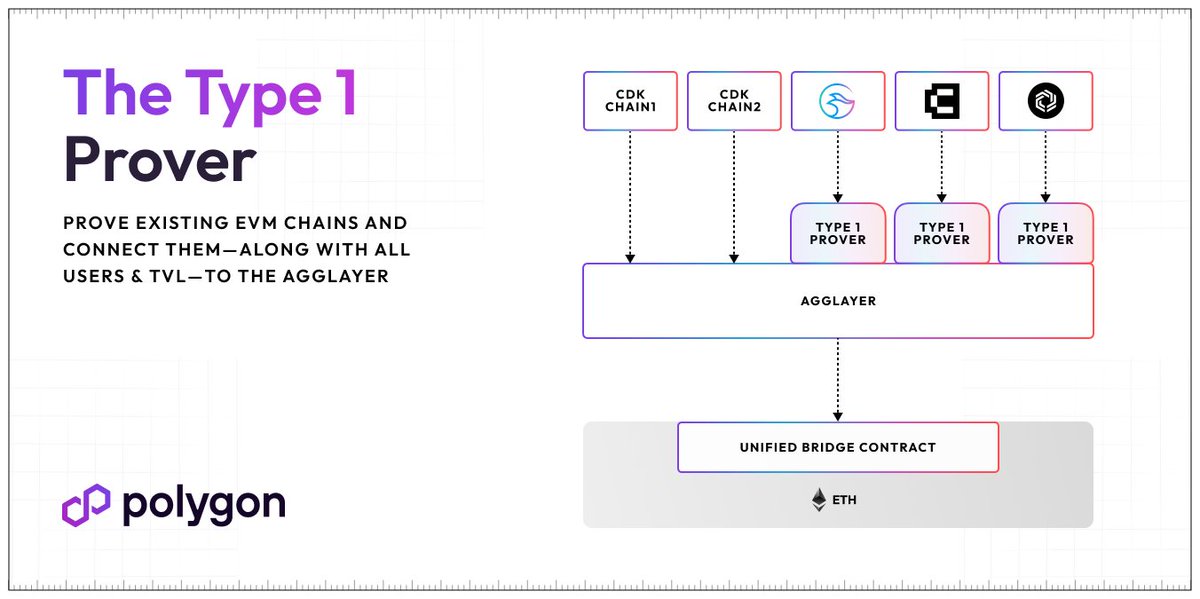
Releasing the Type-1 upgrade to the zkEVM prover, the next generation of Polygon’s proving tech. It can generate proofs for any EVM chain—sidechain, optimistic rollup, even Ethereum itself.
When proving Ethereum mainnet blocks, avg per-transaction costs are $0.002 - $0.003.
Developed with @Toposware, the Type 1 is open source and available today.
Together with the AggLayer, the Type 1 prover will allow EVM chains to upgrade to ZK and access the shared state, liquidity, and user-base of the Polygon ecosystem.
What makes it a Type 1? Ethereum equivalence. The Type 1 prover preserves all of Ethereum’s execution logic. In practice, this means that any EVM chain can become a ZK Layer 2, without having to fork or make modifications.
The Type 1 zkEVM prover will be another config available to projects building with Polygon CDK, the modular toolkit for spinning up ZK L2s. All chains building with the modular toolkit can leverage the Type 1 to connect to the AggLayer, while taking advantage of lower costs, lower latency, and better UX. Projects like @Immutable zkEVM, @MantaNetwork, and @CantoPublic are planning to do exactly this.
There are more performance optimizations and a Type 2 mode coming. Right now, the Type 1 can prove existing Ethereum blocks at an average per-tx cost of $0.002 to $0.003. With Plonky3 and additional zkEVM improvements, there will be a 30 to 50X reduction in cost over the next year.
Read on for use cases and in-depth performance benchmarks: https://t.co/jBiQZEC6FK