🎉 Our diffusion-model monograph ���The Principles of Diffusion Models》 now has an official website!
🔗 Link in thread
💡 Two highlights:
1️⃣ Blog Post: a big-picture walkthrough from diffusion models → fast generation & flow map models;
2️⃣ Teaching Guide: lightweight course prep notes for instructors using the book
Feel free to share + tag folks who may be interested.
If you’re considering using it for teaching, reach out please — happy to chat and help! 🚀
(w/ @DrYangSong, @gimdong58085414, @mittu1204, and @StefanoErmon)
Sofiene Kammoun, Xavier Alameda-Pineda, Simon Leglaive, "Modeling strategies for speech enhancement in the latent space of a neural audio codec," https://t.co/avw3H1EmVz
We are seeking reviewers for speech & language processing at ICASSP'26.
Please consider nominating yourself or a colleague, and help spread the word!
Reviewing is a great first step to contribute to the community :)
🚨 Open PhD Position (fully funded) – Grenoble, France
Join us at @GipsaLab (@CNRS, @UGrenobleAlpes collab. @RobotLearnInria) to explore how Speech Language Models can learn like children: through physical and social interaction🧠🤖🎙️
Details 👉 https://t.co/hqljEQ3pT4
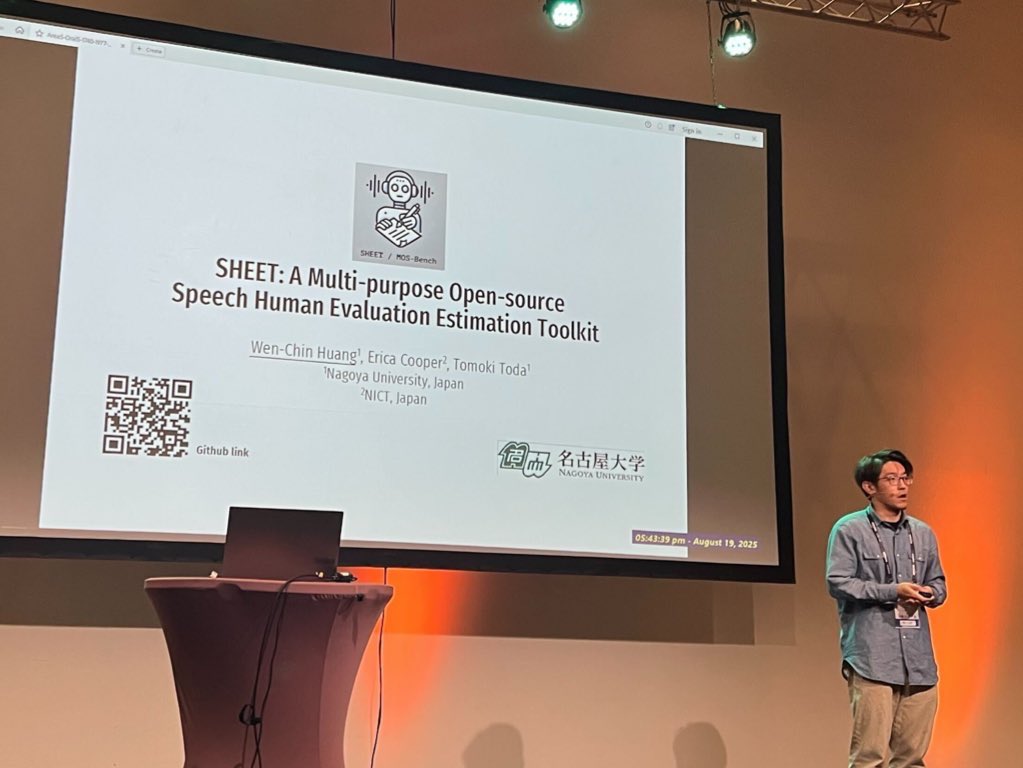
Enjoyed a great INTERSPEECH 2025 experience! (my first since 2019 at Austria😮💨) Kudos to the organizers!
Please find our tutorial slides here: https://t.co/IWPMxQZBxZ
Also if you work on MOS prediction make sure you check out SHEET! https://t.co/lgIuRke4mz
New video on the details of diffusion models: https://t.co/rRjJehNuF3
Produced by @welchlabs, this is the first in a small series of 3b1b this summer. I enjoyed providing editorial feedback throughout the last several months, and couldn't be happier with the result.
@chimechallenge
⭐⭐ We are happy to announce the release of the tasks for the 9th CHiME Speech Separation and Recognition Challenge (CHiME-9).
⚡⚡ Please visit the CHiME Challenge website for details https://t.co/6MVwD7RKlv ⚡⚡
PESTO 2.0 è rilasciato! 🥳🥳🥳
With Brazilian chef @torres_be_ (and others), we revisit this traditional italian sauce, invented in Milan at @ISMIRConf 2023 🇮🇹
And you can taste it in REAL-TIME at home (~5 ms latency) ⏱️
1/6
``AnCoGen: Analysis, Control and Generation of Speech with a Masked Autoencoder,'' Samir Sadok, Simon Leglaive, Laurent Girin, Ga\"el Richard, Xavier Alameda-Pineda, https://t.co/LJHU381fTs
In my keynote at @ISMIRConf yesterday I played video messages from musicians asking the assembled AI researchers not to train on their music without their consent.
It’s testament to the respect the ISMIR community has for musicians that the reaction was overwhelmingly positive. Many in the AI music + MIR community reject unlicensed training, just like most musicians do.
Don’t think the debate is creators vs. the AI community. Many AI researchers feel very uncomfortable with the actions a handful of AI companies are taking.
Huge thanks to ISMIR for having me 🙏
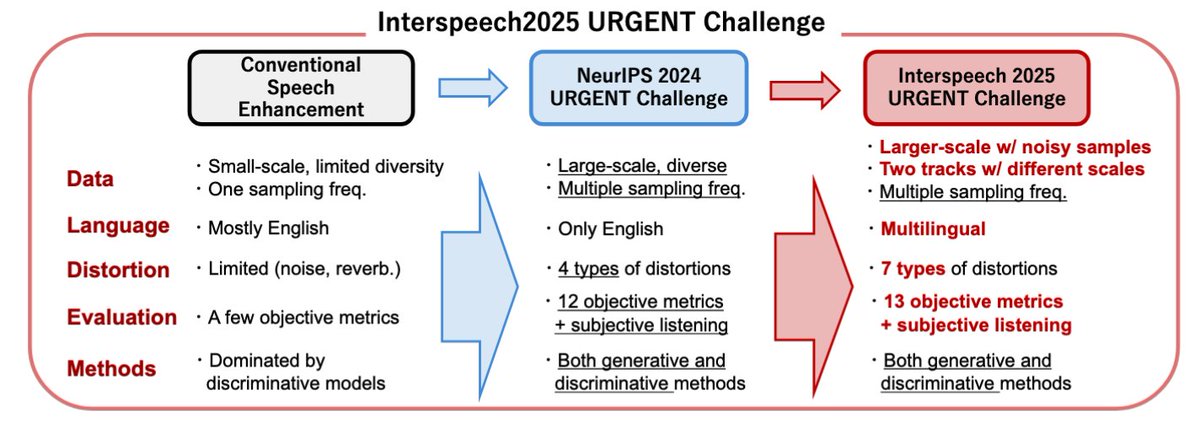
We are thrilled to announce the Interspeech 2025 URGENT Challenge, starting on 11/15!
Join us in building universal speech enhancement models to tackle in-the-wild speech data using large-scale, multilingual data. Details: https://t.co/bZrAqCYwQa
During my postdoc at Cornell (2017–2020), i worked on machine listening of flight calls for bird migration monitoring as part of the NSF project BIRDVOX
This IEEE TASLP article concludes the project
https://t.co/ZZ8LBliBcD
Great piece of work led by @FrancoisRozet in which we revisit the good old EM algorithm to learn diffusion models from corrupted data only. Bonus: This also includes a new posterior sampling scheme for diffusion models!
We're organizing a special issue at Computer Speech & Language about Multi-Speaker, Multi-Microphone, and Multi-Modal Distant Speech Recognition.
Deadline: December 2, 2024
https://t.co/sNDziQ3FQK
@chimechallenge
Thrilled to have contributed to the evaluation of speech enhancement methods in the CHiME-7 UDASE task, now published in Computer Speech & Language. 📚🔊 #CHiMEChallenge
Read more: https://t.co/XkPoQzAz4N
How can learned quantized representations help to address human mesh recovery?
In VQ-HPS, to be presented at #ECCV2024, we frame HMR as a classification task in a quantized latent space. (1/6)
BUDDy: Single-Channel Blind Unsupervised Dereverberation with Diffusion Models
We present a fully unsupervised method for blind speech dereverberation using a diffusion prior and a parametric subband filter
Paper 📜 https://t.co/DUebD8CyDt
Audio/Code 🔊 https://t.co/j0TluESlsK
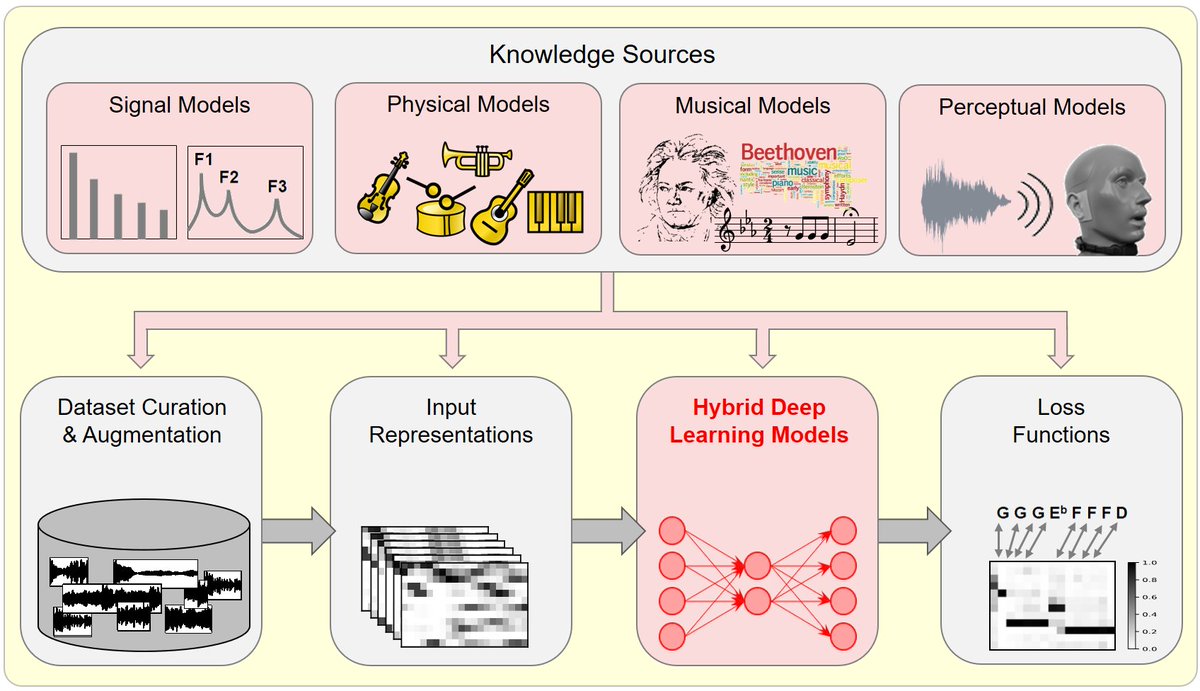
"Model-based deep learning for music information research"
to appear in IEEE Signal Processing Magazine
with G. Richard, Y.-H. Yang, and M. Müller
I wrote about differentiable scattering transforms and perceptual–neural–physical sound matching (PNP)
https://t.co/lqs1a0u8NQ