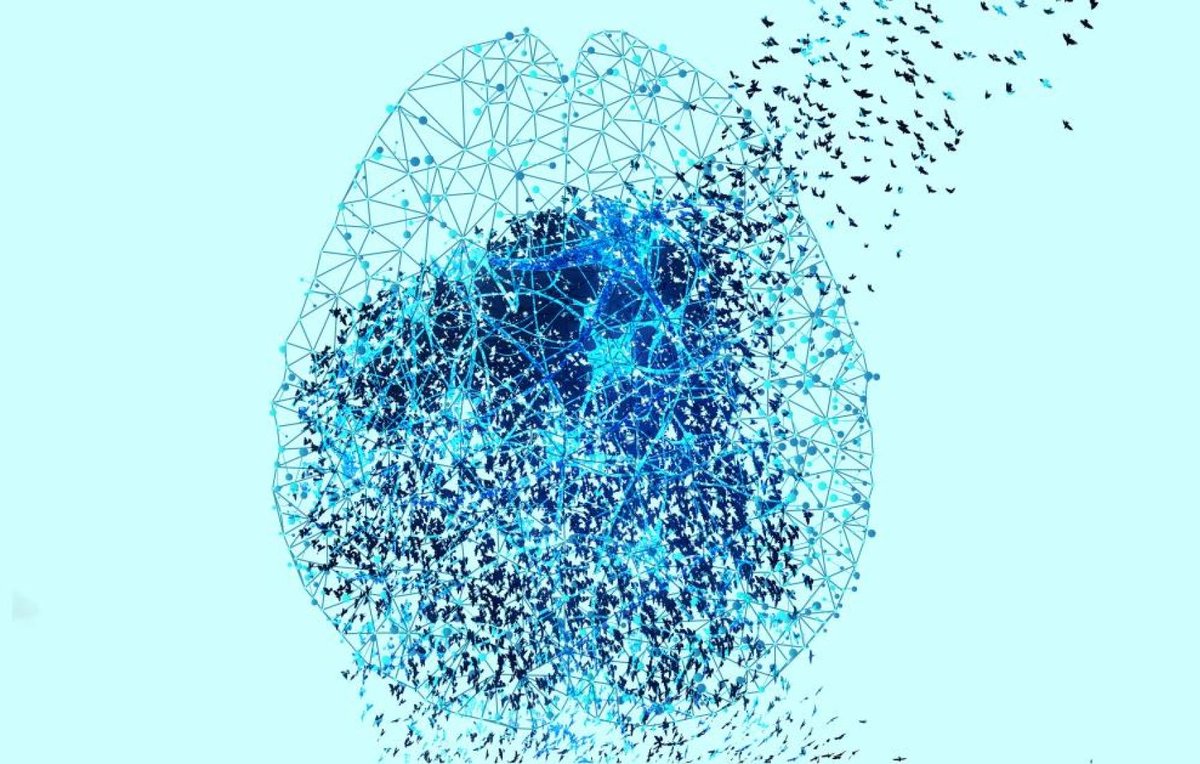
“If we had consciousness in AI, it’d be God,” said Ken Nakayama, (@UCBerkeley/@Harvard) somewhat in jest, comparing properties of biological and AI consciousness, at the Simons Institute workshop on Topics in Intelligence: World Models and Social Reasoning https://t.co/j1FP2CIYmr
2/2 But "Bayes theory is just a law of the universe. Any system that works optimally in the world has to obey Bayes theorem. So, it’s going to be really hard to find a situation where Bayes theorem isn’t a good model," said @gallantlab of @UCBerkeley at the Simons Institute.
1/2 Generative world model (GWM) theories are correlated with theories that aren't world model theories, such as the Bayesian brain theory, said @gallantlab at the Simons Institute workshop on Topics in Intelligence: World Models and Social Reasoning. https://t.co/D4cnn2uxIa
2/2 "We already have the solution..Everybody knew that recurrent neural networks [would] eventually have to come back...They solve the memory problem from the ground up," said @phillip_isola of @MIT at the Simons Institute. Video: https://t.co/wya3tswqjF
1/2 The Return of RNNs. "AI is still lacking a good memory mechanism...We are in this era of 'attention is all you need' but I don't think that's going to cut it," said @phillip_isola at the Simons Institute worskhop on Topics in Intelligence: World Models and Social Reasoning
Four AI systems were each given ten problems contributed by leading mathematicians. Their solutions were evaluated by thirty experts in a gathering last week.
#1stproof
https://t.co/d74ilyUy2N
2/2 But "Bayes theory is just a law of the universe. Any system that works optimally in the world has to obey Bayes theorem. So, it’s going to be really hard to find a situation where Bayes theorem isn’t a good model," said @gallantlab of @UCBerkeley at the Simons Institute.
1/2 Generative world model (GWM) theories are correlated with theories that aren't world model theories, such as the Bayesian brain theory, said @gallantlab at the Simons Institute workshop on Topics in Intelligence: World Models and Social Reasoning. https://t.co/D4cnn2uxIa
4/4 "Nobody knows and the evidence sucks. Nobody has any idea in the brain which of these two groups of theories is true, and it's really a horror show of sad, vague results," @gallantlab at the Simons Institute w/shop on Topics in Intelligence: World Models and Social Reasoning
3/4 "Or is the brain actually instantiating some underlying model of the causes of the events that occur in the world that is really low-dimensional, highly compressed, highly efficient representation of the structure of the world," asked @gallantlab at the Simons Institute.
2/4 "Is the brain just picking up on correlations and predicting the next state of the world based on the correlation structure of the world?"—Jack Gallant (@gallantlab@UCBerkeley) at the Simons Institute workshop on Topics in Intelligence: World Models and Social Reasoning
1/4 World models are all the rage in both neuroscience and AI. But does the brain really build world models? Jack Gallant (@gallantlab@UCBerkeley) asked at the Simons Institute workshop on Topics in Intelligence: World Models and Social Reasoning. Video: https://t.co/D4cnn2uxIa
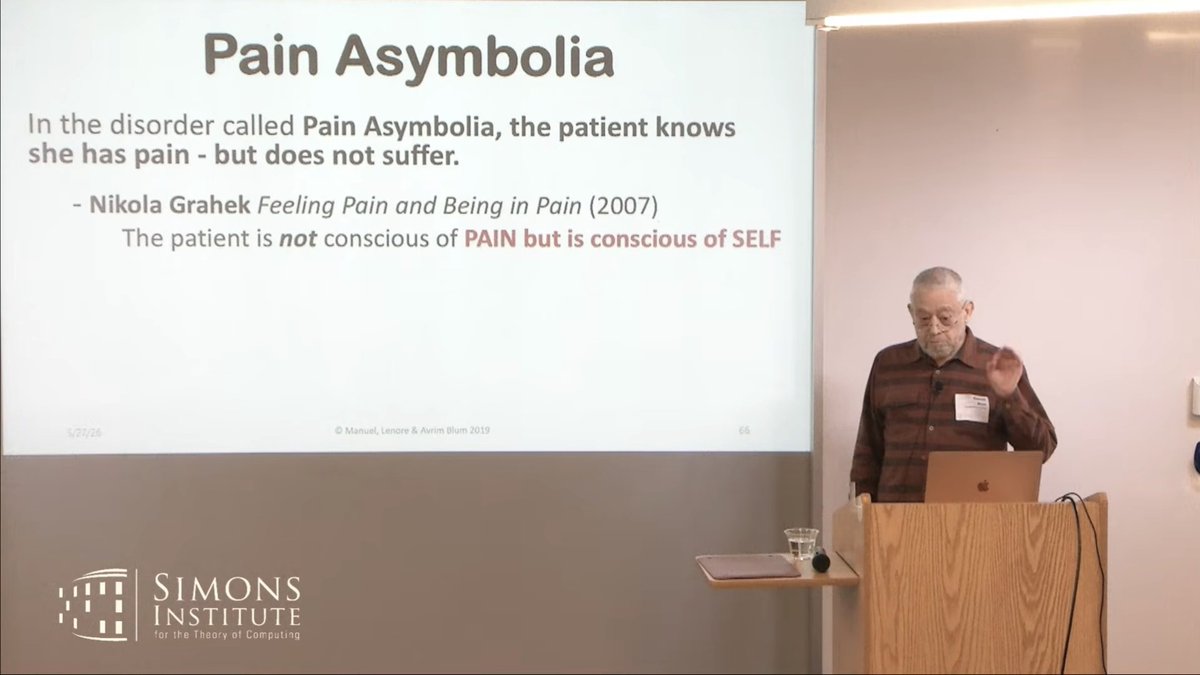
1/3 "Our conclusion is that AI consciousness is inevitable." In back-to-back talks, Manuel Blum and @BlumLenore of @CarnegieMellon discuss the Conscious Turing Machine and AI consciousness at the Simons Institute workshop on The Role of TCS in Modern Machine Learning
2/3 Manuel Blum spoke of The Conscious Turing Machine (CTM), a formally defined Theoretical model of Consciousness, which offers an explanation for, among other things, the suffering of pain. Video: https://t.co/12IS4j9CKr
Some events coming up related to the #1stproof project (hosted by @Harvard this time):
June 3
Introduction to First Proof: A Conversation https://t.co/Fsz6D9Dk2u
June 10
First Proof, Second Batch: Results https://t.co/4UnRprrgXs
Avi Wigderson is the only person in history to have won both a Turing Award (computer science) and Abel Prize (math). I interviewed him all about his field. We discussed:
• His intuition on a proof of P vs NP
• Why we use SAT solvers for most NP problems
• Zero knowledge proofs and their impact
• Quantum computation and implications
• Math and computer science's relationship
Where to watch:
��� YouTube: https://t.co/zViqAulFCo
• Spotify: https://t.co/iat08Xob17
• Apple Podcasts: https://t.co/jOYDGtGVnt
• Transcript: https://t.co/k4zS7yOhnw
Thank you to this episode's sponsors for supporting my work:
• WorkOS: makes your app Enterprise Ready with easy to use APIs to add SSO, SCIM, RBAC, and more in just a few lines of code, check them out at https://t.co/y8noBzFEem
Timestamps:
00:00 - Intro
01:08 - P vs NP
14:51 - What if you relaxed correctness
25:38 - Why NP complete problems are equivalent
30:33 - Space vs time complexity
43:06 - Why people use SAT solvers
45:53 - Randomness is a resource
55:48 - Randomness depends on computational power
01:21:20 - Zero knowledge proofs and their significance
01:38:30 - Quantum computation and why it matters
01:56:24 - Math vs computer science
02:08:16 - Major breakthroughs and his experience
02:12:31 - Advice for his younger self
02:14:48 - Outro
2/2 "The trick is actually fixing the evaluations. It’s going to be a problem of the way we evaluate language models. We need to reward them for being humble, and saying occasionally, ‘I don’t know,’ or asking a question," said @OpenAI's Adam Kalai at the Simons Institute.
1/2 Are LLMs doomed to hallucinate? No, says @OpenAI's Adam Kalai at the Simons Institute workshop on The Role of TCS in Modern Machine Learning. "I don’t think it’s an inevitable problem. We can drastically reduce the amount of hallucinations." Video: https://t.co/38AjteLtqr.







![SimonsInstitute's tweet photo. 2/2 "We already have the solution..Everybody knew that recurrent neural networks [would] eventually have to come back...They solve the memory problem from the ground up," said @phillip_isola of @MIT at the Simons Institute. Video: https://t.co/wya3tswqjF https://t.co/xmJN75mDK6](https://pbs.twimg.com/media/HKpGK6GaAAAVvEN.jpg)