Singular Perpetuals now Live! Trade 9 major cryptos with up to 50x leverage. 🌐
✅ Low Liquidation Risk with quality price feeds
✅ Save on trading costs with minimal spreads
✅ Easy swaps via a simple interface
Elevate your trading at https://t.co/pNKJ32a9qi . Experience efficiency & security in every trade!
#SingularPerpetuals #BTC #ETH #AVAX #SOL #singulardex
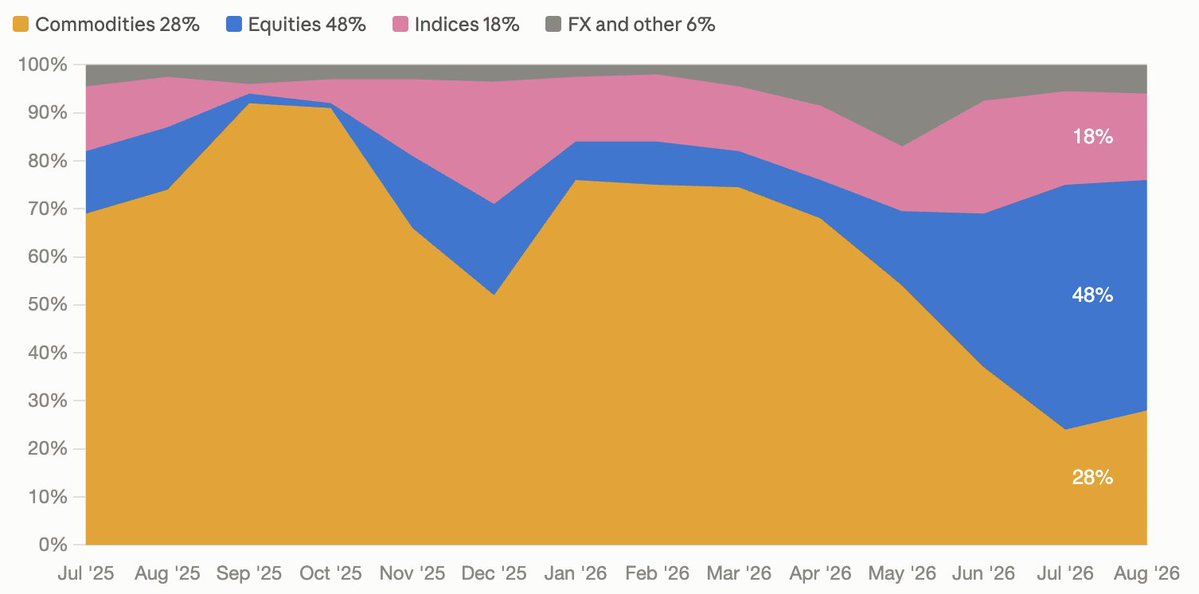
Open interest moved first. Equity OI passed commodities in June ($1.6B vs $1.2B), and equity volume followed a month later. By August, equity OI stood at $2.2B against $1.6B for commodities. Total OI grew nearly 30x, from $161M in July 2025 to $4.8B, and stayed near its record high even as volume pulled back from July's $145.1B peak (this is still small next to traditional derivatives, which trade in the tens of trillions per month).
The next question is whether RWA perps become a standard offering at traditional brokers and exchanges. One note on access: only one US-regulated venue is approved to trade a single perp today, and most exchanges restrict US persons from true perpetual futures.
RWA perps just became one of the fastest-growing products in crypto. Monthly trading volume on perpetual futures tied to stocks, gold and other traditional assets hit $117.3B in August, up 44x in a year. Open interest reached $4.8B.
These contracts give exposure to traditional asset prices without owning the asset. No expiry, and some venues trade 24/7, including weekends when stock exchanges and major commodity futures markets are closed.
Wall Street’s next derivatives market is quietly moving onchain.
A year ago, RWA perpetuals were barely a category.
Now:
• $117.3B traded in August
• 44× growth in 12 months
• $4.8B in open interest
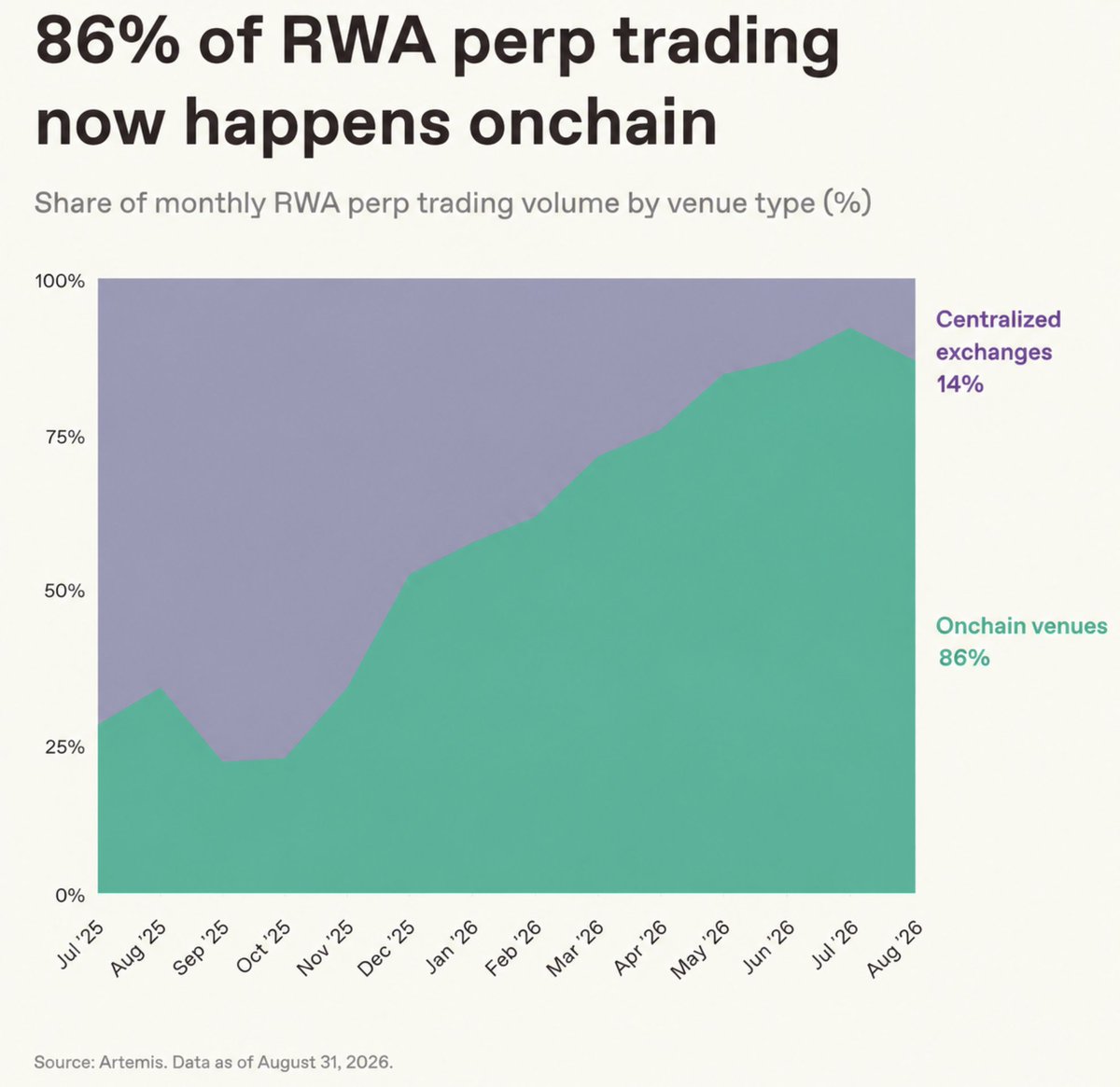
• 86% of volume is now onchain
• roughly $101B/month is already bypassing centralized exchanges
And this isn’t just crypto traders speculating on gold.
Stocks, commodities, indices, FX — even pre-IPO markets — are increasingly being turned into 24/7 perpetual markets settled on crypto rails.
@HyperliquidX 's HIP-3 shows how quickly the model can scale. HIP-3 RWA volume went from $12.7B in Q4 2025 to $130.9B in Q1 2026 — more than 10× in a single quarter.
By Q2, Hyperliquid reported $213B of RWA volume, with RWAs representing 32.2% of its trading activity, versus just 1.8% in Q4 2025. During one July week, RWAs actually became Hyperliquid’s largest trading category, generating $25.1B and 52% of its total volume.
The interesting part isn’t tokenizing a stock certificate.
It’s rebuilding the trading layer of traditional finance:
24/7 markets. Stablecoin collateral. Permissionless listings. Instant settlement. Global distribution.
The first major RWA product may not be tokenized ownership at all.
It may be derivatives.
#RWA #DeFi #Perpetuals #Tokenization #OnchainFinance #Hyperliquid #DigitalAssets
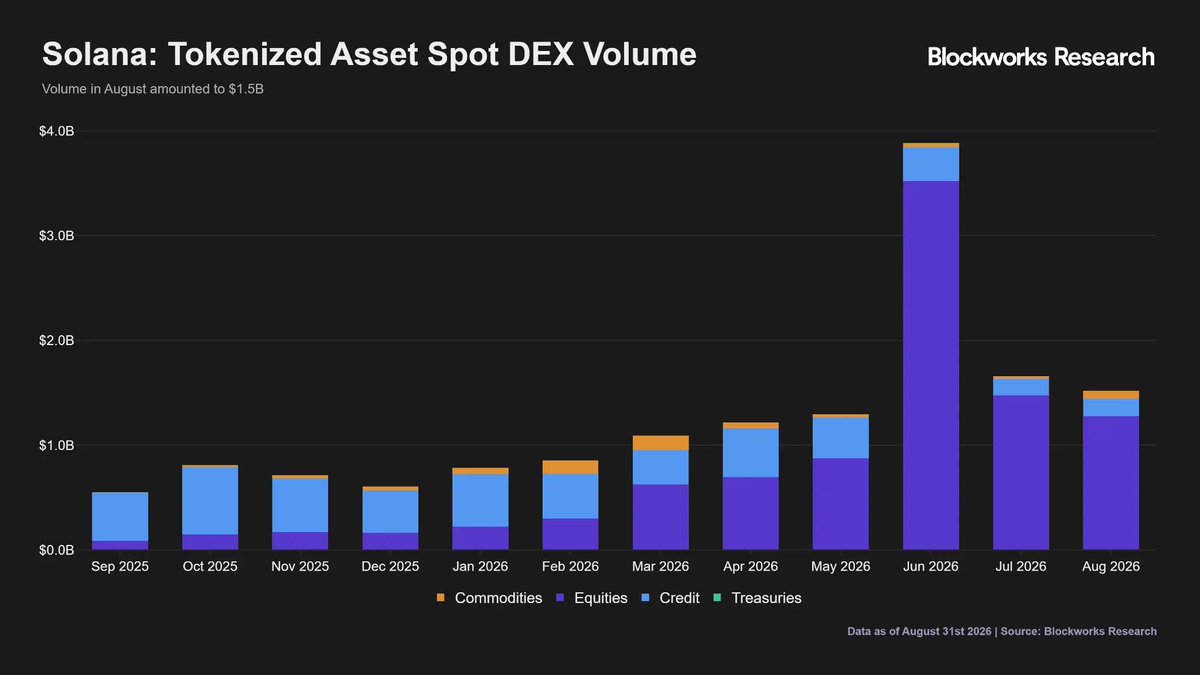
Tokenized asset volume on Solana had its breakout moment in June; spot DEX volume spiked from ~$1.3B in May to nearly $4B, almost entirely driven by tokenized equities overtaking credit as the dominant category. Volume normalized to $1.6B in July and $1.5B in August, still miles above the $0.5 - 0.8 B range from late 2025.
The structural shift matters more than the spike: Solana is increasingly a venue for trading tokenized real-world assets, not just memecoins and crypto-native speculation. Three signals, one direction; Solana is quietly regaining ground across revenue share, holder economics, and RWA activity at the same time.
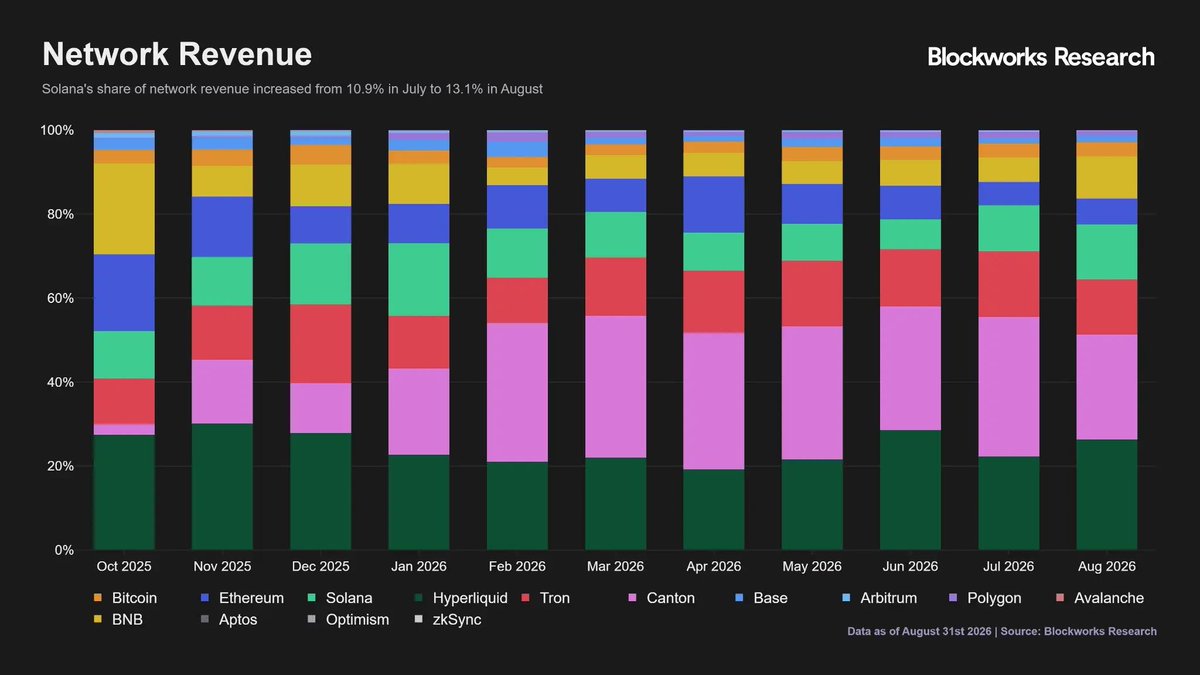
Solana just clawed back a larger share of onchain network revenue; from 10.9% in July to 13.1% in August, a 2.2pp jump reversing months of relative decline against Hyperliquid, Canton and Ethereum.
Network revenue overall stays concentrated in a handful of ecosystems (Hyperliquid, Canton, Tron, Solana, Ethereum). Ethereum's share slipped over the same months while BNB jumped in August, and Hyperliquid held its position as the largest single contributor at roughly a quarter of total revenue. The bigger picture: onchain economic activity is spreading across more networks, not just concentrating in Ethereum. One caveat; this is share of a percentage pool, so a rising share doesn't guarantee absolute revenue rose by the same amount.
One month isn't a trend, though. Whether this holds through September is the real signal to watch; network revenue can stay strong while holder economics lag behind it, exactly as the past year showed. A durable reversal here matters more than the headline number itself.
BlackRock, the world’s largest asset manager with over $15 trillion in AUM, is paying attention to the convergence of AI and digital assets.
The signal is getting harder to ignore.
Our latest research paper explores the growing connection between AI and digital assets and explains why broad AI adoption may drive new demand, utility and applications across the digital asset economy. https://t.co/z5T88Orble
Our latest research paper explores the growing connection between AI and digital assets and explains why broad AI adoption may drive new demand, utility and applications across the digital asset economy. https://t.co/z5T88Orble
The frontend path is being built in parallel. Teams like Dream are targeting retail directly, abstracting options down to picking an asset, direction, strike and expiry; no greeks knowledge required.
If a team building on Derive cracks distribution, taker flow on Derive scales fast. Most projects competing in this sector, Derive included, are still trading at depressed valuations relative to the size of the opportunity.
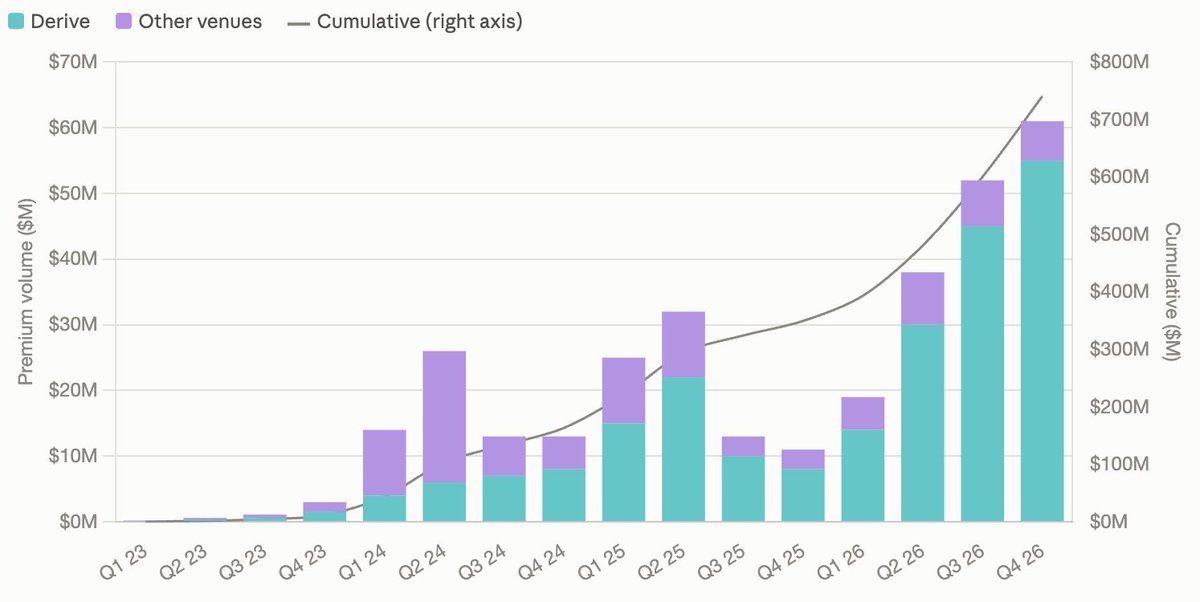
Onchain options are crypto derivatives' largest remaining whitespace. Retail demand is already proven at massive scale in TradFi options and onchain, the constraints holding this sector back are no longer regulation, infrastructure, or maker liquidity. The sector just hit a new monthly ATH in August, quietly climbing out of the 2021-2024 exodus.
Derive commands 95% of onchain options market share by premium volume, pole position, and not close. Quotes on majors are frequently competitive with Deribit; quotes on HYPE straight up beat it. Still, onchain options are just 4.3% of Deribit's notional volume over the last 30 days. That gap is the opportunity.
There are two paths to winning retail taker flow at scale: structured products/vaults that abstract options complexity away entirely, or a frontend sleek enough for retail paired with real distribution.
v3 attacks the vault path directly, and the RWA angle is the real unlock. Onchain stocks barely have a value proposition today; weak yield, thin liquidity, wrapper products with no shareholder rights. A covered call vault paying 5-10% APY on tokenized TSLA changes that math entirely; yield that doesn't exist offchain, for the first time giving people a real reason to hold RWAs onchain.
Record supply, accelerating growth, rising participation, round-the-clock volume. Tokenization is quietly becoming the hottest trend in crypto, worth watching whether this becomes the liquidity channel that carries the next cycle.
Tokenized stocks just hit a fresh all-time high. $2.9B in total market cap as of August, up 12% month-over-month, up 262% year-to-date. The growth curve tells the story: from $0.4B in Sep 2025 to $2.95B by August 2026, roughly 7x in under a year, with the pace accelerating rather than flattening.
September looks set to break the record again. DEX volume is up 19% over the last week, alongside a 30% increase in weekly onchain tokenized asset holders, new activity, not just existing capital rotating. Jupiter, the largest onchain platform, saw volume grow 24% over the last month, with 59% of it happening during weekends and off-hours.