Now that privacy is back at the center of crypto, it is worth revisiting one of the industry’s most practical privacy technologies, one that has been hiding in plain sight: payment channel networks.
They may not sound as exciting as privacy coins or ZK-based privacy protocols, but they do the job nonetheless.
Unlike conventional blockchain transactions, where every payment is permanently recorded on a public ledger, two parties inside a payment channel can exchange thousands of payments privately, without publishing each one onchain.
Even better, much of that privacy is preserved when payments are routed between people who do not share a direct channel.
Fiber, for example, uses Sphinx onion routing. The sender wraps the payment route in layers of encryption so that each routing node learns only where the payment came from and where it needs to go next, not the full path connecting the sender and recipient.
Fiber also supports private channels, which are not publicly advertised to the broader P2P network.
They can still be used by the parties who know about them, but they do not appear in the public map that nodes use to discover payment routes.
Admittedly, none of this is entirely new. Lightning has offered broadly similar privacy properties for almost a decade.
But Fiber extends this model to a much broader payment environment: stablecoins and multi-asset payments, atomic swaps, cross-network payments, and more expressive channel constructions.
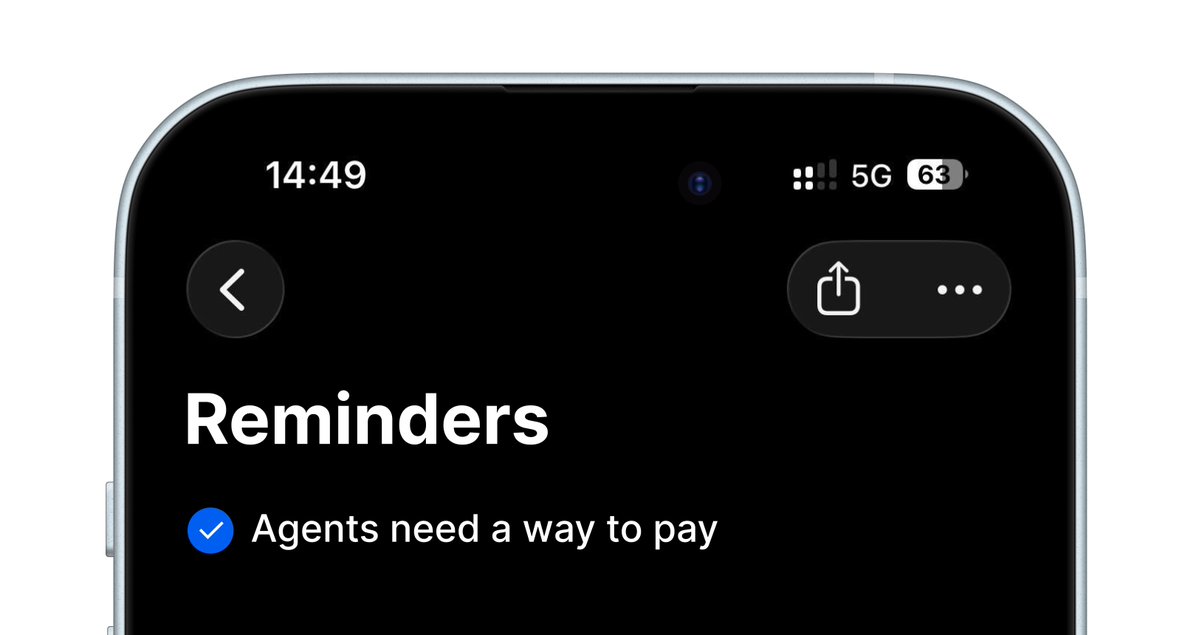
Think instant, near-zero-fee, private stablecoin payments between machines, requested through x402 and settled over Fiber. 🙂
1.4 billion people across Africa, Southeast Asia, and Latin America on Fiber in the making? 🤩🤫
DULAR
STABLECOIN
RWA
$CKB @NervosNetwork@RyptoCrypto@realsixfig@FiberDevs
https://t.co/4euBLMSlz1
Straight from @Coinbase’s April paper on quantum computing and blockchains. 👇
“Crypto-agility is a highly recommended practice in general [...] even more so in the context of PQC.”
Now guess which chains were designed to switch cryptographic algorithms without disrupting operations🧠
Hint: there’s only one.
CKB Has No Plan — But We Do.
Our previous posts about roadmaps generated some controversy.
We’re grateful to have your attention.
Because this distinction matters.
CKB doesn’t have a roadmap because it is public infrastructure, not a product operated by a company.
The goal of any serious blockchain is not endless reinvention. It is to become a stable, secure, and predictable infrastructure that others can build on for decades.
That said, CKBA absolutely has plans.
CKBA exists to coordinate stakeholders and grow the CKB ecosystem across the areas that matter most.
That means organized work to attract builders, identify use cases, improve developer onboarding, fund ecosystem initiatives, pursue partnerships, clearly communicate CKB’s value, and actively engage the teams, companies, and communities that can drive real usage on the network.
Having reorganized and unified several teams under a single structure puts us in a stronger position than ever to execute on these goals.
A ton of work is already underway, especially on the Fiber front: improving the stack and documentation, advancing Lightning interoperability and liquidity management, and identifying and removing blockers for adoption.
Work is also ongoing on the design and implementation of the DAO's on-chain treasury and voting mechanisms.
And while there are many other initiatives in the pipeline that we’ll share when the time is right, there’s one that demands immediate attention 👇
Three months ago, Google Quantum AI published a bombshell paper showing that quantum attacks against secp256k1—the elliptic curve behind the signatures used by most blockchains—may require far fewer resources than previously estimated.
In simple terms, the paper made the quantum threat to cryptocurrencies harder to ignore.
The industry conversation that followed was, as expected, hard to miss — and yet it missed CKB.
No mention in the paper, no mention in the con im versations on X and various forums, no mention anywhere.
To put it bluntly, this is a huge communication failure on our part.
CKB is the only cryptographically agile blockchain in existence, and therefore one of the few that’s already quantum ready.
It’s the only chain where devs can bring new post-quantum signature schemes permissionlessly.
No need for soft or hard forks. No need to pick a single PQ scheme and bake it in as a precompile.
CKB is the only chain that can switch between different crypto primitives without disrupting operations or requiring significant infrastructure redesign.
It’s the true embodiment of crypto-agility — yet barely anyone was aware of it.
So, our first course of action on the communication front is to remedy that.
We’ll run a comprehensive marketing campaign that’ll put CKB at the forefront of the Quantum x Blockchain discussion and position it as one of the few projects with a future-proof solution.
And we want all of you involved.
If you care about CKB and want to help push this forward, reach out.
If you’re a developer, researcher, writer, designer, translator, community organizer, content creator, or just someone willing to help amplify the message, we want to hear from you.
This campaign should not be about what CKBA has to say.
It should be about making CKB impossible to ignore.
We’ll be opening channels for community participation soon. In the meantime, reply here, DM us, or join the discussion on Nervos Talk.
CKB is already prepared for a future that necessitates post-quantum cryptographic methods.
No hard forks are needed, no governance debates.
If you're concerned about the impact of quantum computing, you should learn about CKB.
https://t.co/R7RJsCRFH1
LIVE ON DAY 1: The Chainlink data standard now supports @megaeth's MEGA token.
Chainlink Data Feeds & Streams are unlocking the distribution of MEGA across onchain finance, with initial users including @DecibelTrade, @GMX_IO, @katanaperps, & more.
Just use Chainlink.
For institutions, capital sitting idle is capital working against you.
Lynq solves this by enabling instant payments and real-time collateral management, reducing counterparty risk and improving capital efficiency.
Johann Eid joins The Rollup to break down what circuit breakers, rate limits, and 16-node minimum architecture mean for DeFi's future and much more.
@EidJohann is the Chief Business Officer at @chainlink, the leading decentralized oracle and cross-chain infrastructure provider.
The Rollup is where the leaders of digital assets and finance converge. Live from the financial capital of the world.
Timestamps:
00:00 Intro
01:10 Security By Default Explained
03:20 Why the Space Changed
09:15 Chainlink's 16 Node Minimum
10:30 Why Two-of-Two Is Not Enough
13:05 Cross-Chain Complexity Added Risk
15:00 Composability vs. Risk
17:00 Circuit Breakers Explained
19:00 Censorship vs. Safety Tradeoff
22:30 SOC2 & ISO Certifications
25:00 Economic vs. Cryptographic Security
27:20 CCIP Next Release
29:00 DeFi in Five Years
31:05 Arbitrum Freezing Funds
this is the right kind of l2 progress: less slogan work, more boring interfaces that let normal apps touch channels without learning protocol internals.
https://t.co/21blDJNcPm


![ckba_build's tweet photo. Straight from @Coinbase’s April paper on quantum computing and blockchains. 👇
“Crypto-agility is a highly recommended practice in general [...] even more so in the context of PQC.”
Now guess which chains were designed to switch cryptographic algorithms without disrupting operations🧠
Hint: there’s only one.](https://pbs.twimg.com/media/HJ_Qy5xXoAECMVe.png)