Guys, even if you are in a stable job, try and be interviewed for positions once in a while o. It keeps you sharp and up-to-date and lets you know your current market value.
Don’t be like me that hasn’t been interviewed for a position in 25 years, and when they ask you “Why do you believe you are the best man for the job”, don’t go and say…
“Because I am Ezemmuo and I know things.”😀
On the issue of NNPC and N11 trillion Security payment...
In 2022:
NNPC disclosed to have spent N126 billion on behalf of the federation. No specific mention of what the expense is for.
In 2023:
NNPC disclosed spending N3 trillion on behalf of the federation. No specific mention of what the expense is for.
In 2024:
NNPC disclosed spending N5.7 trillion on behalf of the federation.
The 2024 disclosure tells us that the payment relate to advance payment to federation and security cost incurred in protecting the oil & gas assets.
NNPC mentioned two (2) things here:
- Advance payment to federation, and
- Security cost.
Unfortunately we can't separate which one is advance payment and which one is security cost.
In 2025:
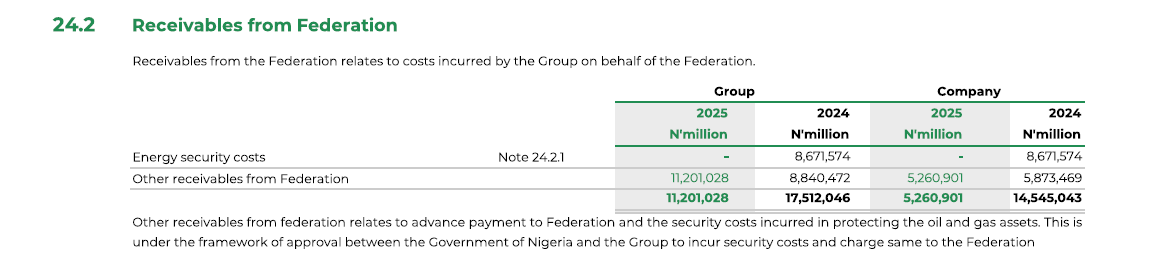
NNPC disclosed spending N2.3 trillion on behalf of the federation.
The 2025 disclosure mentioned that the payment is advance to federation and security cost incurred in protecting oil & gas asset. It further mention that the payment is under an approved framework between the NNPC group and the Government to charge such payment on behalf of federation.
In summary, payment relating to security cost and advance payment to federation are:
2022 = N126 billion
2023 = N3 trillion
2024 = N5.7 trillion
2025 = N2.3 trillion
Total = N11.2 trillion
If you study the trend from 2022 to 2025 of NNPC AFS, you will notice the improvement with respect to the disclosure in the accounts.
It is important for NNPC to be as transparent as possible in disclosing big figure payments. Writing 2 line statement explaining trillions of naira transaction is not going to be acceptable as it will just create controversy everyday.
How much do you pay for security and to whom?
How much do you give advance to federation?
I also try to understand the NNPC accounting side, they are making payment on behalf of the federation.
When NNPC make those payments, I believe it's:
Cr - Bank (executing the payment on behalf of the federation)
Dr - Receivables (expecting federation to refund them back)
But I don't quite agree with such treatment because most times, it mask material figures and try to separate NNPC from the federation when in reality, some aspect of the financial statement do not.
For example - The total revenue that NNPC declared (N34tr) is for the group meaning both federation asset and NNPC sole asset. If that is case, why are they making receivables from federation separate? Are you not federation too or representing them?
The treatment I would have expected from NNPC is:
Dr - Security expenses (security expense paid for asset protection)
Cr - Bank (payment execution)
This would have showed the actual expense made for the federation or on behalf of them (whatever the case, NNPC is acting for both).............. But then, I differ to those who have superior information on why they did such.
I am sure this number will continue to grow and we will wait to see how much it will be for next year.
@budgetOdogwu What then happens to the "Aramco dream", if all acreages are handed over to foreigners?
By the way, all highlighted in parentheses are still JVs.
@HabuSadeik "Nigeria LNG limited" or "NLNG" but not "Nigeria Liquefied Natural Gas"
"TotalEnergies" but not "Total"
More about ensuring consistency, protecting brand equity, maintaining legal accuracy, and reinforcing corporate identity.
@modovictorekene@fkeyamo@mikeachimugu01 Not to excuse bad behaviours, but poor pay and high expectations don't mix. Pay them well first. Then if anyone still chooses to mess things up, apply proper consequence management without looking back.
@CyrusAdemola@HabuSadeik Most deepwater acreages (if not all) are governed by PSCs or Sole Risk arrangements. Under these, NNPC Ltd. is the concessionaire, not an equity partner with the operator. The contractor, not NNPC Ltd., owns the participating interest and funds the operations (PIA, s.64(b)).
NNPCL has stakes in all deep water projects in Nigeria.
Also, most NNPC capex are spread thing across different midstream and downstream sectors in the country, mostly gas and pipeline.
Also, I always assumed the oil firm's model is actually to partner with players (usually foreign firms) in most of these exploration efforts in the upstream.
I can't remember the last time NNPC itself champions any exploratory effort in the upstream sector, let alone deep water.
@eta_habyb Correct. However, federation crude sales are broader than equity crude alone. They comprise royalties, petroleum taxes (direct & indirect), and profit oil/equity share. So, while price increases raise federation receipts, each component accrues under its own statutory framework.
@fimiletoks I agree the delayed passage of the PIA slowed major deepwater investments. Egina (PML 3), approved in 2008, reached FID in 2013.
With Bonga North (OML 118) reaching a $5bn FID in Dec. 2024, BSWA cannot be described as the first deepwater PSC project to approach FID since '2008'.
@Odins_Asgard@EMOGY_@FinPlanKaluAja1 On a side note, it's no more DPR; it's NUPRC. Also, gas reinjection isn't a one-size-fits-all solution. Its feasibility depends on reservoir characteristics, field development plans & project economics. Where viable markets exist, commercialization is typically the better option.
@Odins_Asgard@EMOGY_@FinPlanKaluAja1 The challenge isn't only infrastructure. Gas monetization starts with a viable market: creditworthy offtakers, GSAs, processing & evacuation infrastructure, & a regulatory framework that supports investment. Build pipelines without demand, & you simply create stranded assets.