Sirius now supports binary logistic regression alongside linear regression.
Predict continuous values or classify probabilities. The right model for the right problem.
More models. More use cases. Same privacy.
Crypto-shredding.
Destroy the key → the dataset becomes permanently unrecoverable, even by us.
The data disappears.
The on-chain proof doesn’t.
Verifiable existence. Verifiable destruction.
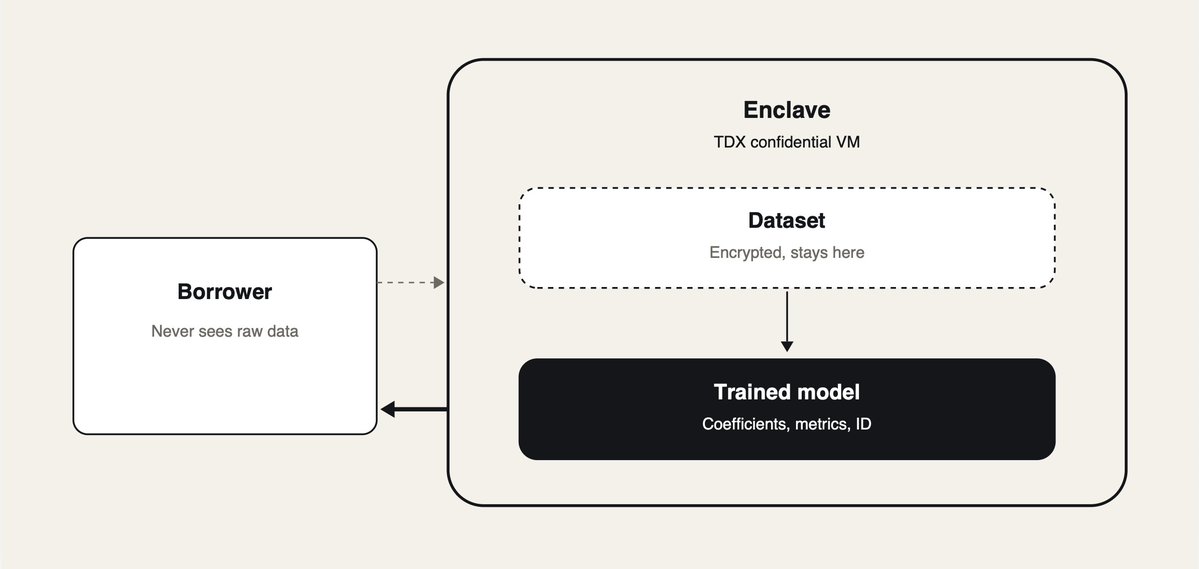
The borrower-side flow is now live end to end on testnet.
Compute travels to the dataset, not the other way around the borrower never touches the raw data.
What comes back is the trained model: coefficients, metrics and a verifiable content ID, ready to evaluate against your own test set.
Sirius currently relies on 3 core contracts.
SiriusEscrow
Atomic settlement between the data owner and user through a SHA-256 hashlock.
SiriusKybRegistry
Onchain verification of valid KYB status, including expiration and revocation.
SiriusDatasetRegistry
Records dataset provenance without putting the dataset itself onchain.
The blockchain doesn't store private data or run ML workloads.
It handles what it's actually good at: settlement, identity & provenance.
The most important part of Sirius doesn't happen onchain. It happens offchain.
A dataset goes through:
AES-256-GCM encryption client-side
Encrypted blob stored on IPFS
Decryption only inside a confidential enclave
Model training in memory
Authorized output leaves, dataset doesn’t
The goal is simple:
Sirius shouldn't be able to read your data, neither should the buyer.
The data doesn't go to the model.
The model goes to the data.
Renting data to a stranger creates an obvious problem:
Who trusts who first?
The buyer doesn't want to pay before receiving the output.
The provider doesn't want to provide compute without knowing they'll get paid.
Sirius uses a SHA-256 hashlock to bind both events together.
The output is encrypted using two components:
→ a key generated client-side
→ a secret generated inside the enclave
The buyer receives the encrypted output before paying but can't unlock it.
The transaction that reveals the secret is also the transaction that settles payment.
Payment = delivery.
Not two trust-based events.
One atomic onchain event.
Today, a data owner basically has 2 options:
Keep the data → $0 revenue, asset sits idle
Sell the data → lose control the second it's downloaded
Neither makes sense.
So we're building a third option: don't sell the data, rent the compute around it.
More soon
Sirius is entering @RobinhoodApp through @virtuals_io.
Sirius is building the confidential data layer for AI.
The data stays encrypted.
The model comes to the data.
The owner stays in control.
Private data. Confidential compute. Onchain settlement.
CA: 0x72E936815982A577386e8fcDe94f5C9335836C88
https://t.co/AqSgY3K7vr
The world's most valuable data is also the data nobody can use.
Healthcare. Finance. Insurance. Industry.
Deep history, real-world outcomes, high-quality labels.
Exactly what AI needs and exactly what regulation makes nearly impossible to share.
Our thesis with Sirius is simple:
What if you could extract value from a dataset without ever sharing it?
That's what we're building
https://t.co/KtFIvVgdtz