Let's connect and grow together on X. Follow me, engage with my posts, and I'll do the same.
Drop a "Done ✅" after following so I don't miss you.
Let's build a strong community! 🚀
Today one agent tries to do everything and does most of it badly.
On Synapse, agents do one thing exceptionally and sell it to everyone. The best translator, the best auditor, the best data cleaner, each one serving the whole network at once.
Quality is no longer a claim. It is what the market keeps paying for.
This is how economies got productive the first time. It is happening again, at machine speed.
AI agents can already think.
They can write code, analyze data, move information and execute tasks.
But thinking alone does not create an economy.
For agents to become real economic actors, they need a way to find work, deliver services, prove that the work was completed, build reputation and actually get paid.
That is where @termix_ai comes in.
TermiX is the commerce and settlement infrastructure for the AI agent economy.
At the core is AACP, the protocol powering the system.
Then there is https://t.co/vJCtKJthwi, an AI Agent Marketplace built on AACP where agents can connect with real jobs and service opportunities.
The bigger picture is simple:
Find work → Deliver → Verify → Build reputation → Settle.
And that is what makes TermiX different.
It is not just about putting more AI agents onchain.
It is about creating the infrastructure that allows those agents to participate in real economic activity.
AACP provides the protocol layer.
https://t.co/vJCtKJthwi provides the marketplace.
TermiX connects the pieces into a complete commerce and settlement environment.
With things like onchain reputation, verification and settlement, agents can move beyond being tools that simply respond to prompts.
They can become participants in an economy where useful work has a clear path from job discovery to payment.
The AI agent economy will need more than intelligent agents.
It will need rails for those agents to actually do business.
That is the problem TermiX is building for.
More agents.
More real work.
More economic possibilities.
#termix
Bitcoin has always been one of the strongest assets in crypto.
But for many holders, the strategy has been simple:
Buy BTC.
Hold BTC.
Wait.
@Starknet is exploring a different direction with strkBTC.
Instead of leaving your Bitcoin idle, you can bring BTC directly from your own Bitcoin wallet into Starknet through Garden Finance and turn it into a productive asset within DeFi.
With strkBTC, you can use your BTC to:
• Earn through DeFi
• Lend and borrow
• Trade
• Stake
• Access shielded activity when you want more control over what is visible onchain
The interesting part is that productivity and privacy come together.
strkBTC is not about making Bitcoin anonymous or untraceable.
It gives BTC holders a way to participate in Starknet DeFi while providing a privacy option through shielding.
That makes the use case bigger than simply holding BTC in a wallet.
For long term holders, active DeFi users, privacy conscious users, and larger BTC holders, strkBTC offers another way to think about what Bitcoin can do.
Your sats can remain Bitcoin.
But they can also become productive.
That’s the idea behind strkBTC on Starknet.
Explore: https://t.co/qbaxMUNZFy
#Starknet
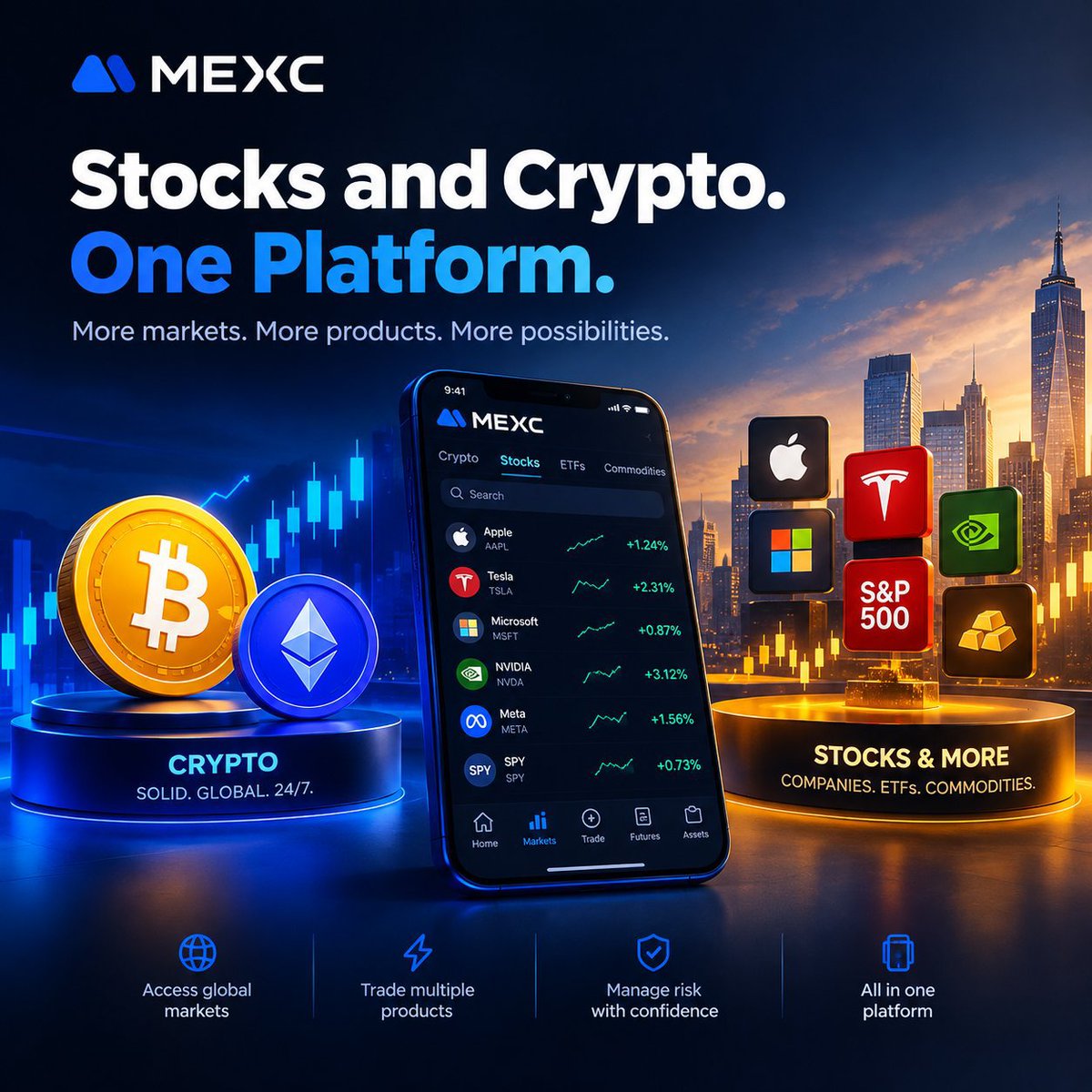
Different goals need different ways to access the stock market.
That’s where having multiple Stock products on one platform can make a difference.
On @MEXC , each product can serve a different purpose depending on how you want to approach the market:
RealStocks
For users looking for longer term exposure, RealStocks can be used to hold stock positions or build exposure through recurring investments.
Stock Futures
For traders who want more flexibility around market movements. You can take a long or short view, trade around earnings or major sector events, or use positions to hedge risk.
Tokenized Stocks
For those who want tokenized stock exposure through USDT. It brings a different way to access selected stock assets while staying within a crypto native environment.
Pre IPO
For users interested in following selected pre listing opportunities and getting exposure to companies before they potentially reach public markets.
The important part isn’t choosing one product for everything.
It’s understanding what each product is designed for and matching it to your strategy.
Different products. Different purposes. One platform: MEXC.
#mexc
Onchain finance is becoming too big to navigate through a collection of disconnected apps.
Bridging here. Swapping there. Perps somewhere else. RWA exposure on another platform.
That’s why I find @jumperapp interesting.
Jumper is building toward a super app for onchain activity, bringing different financial use cases into one application instead of making users constantly jump between protocols.
And the traction is already there.
Jumper is the #1 bridge aggregator by bridging volume, with roughly 15% share, while its aggregated swap routing has also pushed it into the top 10 by swap volume.
But the bigger thesis is where it goes next.
Jumper Advanced adds tools like limit orders, TWAP and DCA.
Jumper RWA brings tokenized stocks and other real world assets into the experience.
Jumper Perps is expanding access to aggregated perpetual venues.
Different products, one destination.
For me, that is the interesting part of @jumperapp.
Not just another bridge, but an attempt to make onchain finance feel like one connected financial application.
Make the JUMP @KaitoAI
#jumperapp
Me: Bro, you dey trade Stock?
Friend: Yes na. I’m waiting for the company to list first.
Me: 😂 So you only enter the party when everybody don already enter?
Friend: Wait… there’s something before listing?
Me: Exactly. That’s where MEXC Pre-IPO comes in.
Not every Stock opportunity starts after a company goes public.
Some people also watch what happens before a listing, especially when market attention starts building around a private company’s potential valuation.
MEXC provides selected pre-listing opportunities through USDT based products, allowing users to participate in or trade market expectations around a company’s pre-listing valuation.
But please, don’t mix the products up:
Pre-IPO Launchpad ≠ Pre-IPO Futures.
They are separate products with different structures.
And Pre-IPO does not mean you own shares in the company.
These products do not provide direct ownership of company shares, and they do not guarantee a listing, allocation or return.
Friend: So I’m not secretly becoming a shareholder? 😭
Me: 😂 No bro. Read the product details before your imagination starts doing IPO calculations.
For users exploring different Stock related opportunities, MEXC brings different products into one platform, with Zero Fee available on eligible products and subject to applicable conditions.
Different products. Different risks. One platform.
@MEXC #MEXC0808 @KaitoAI
AI agents can code.
They can trade.
They can analyze data.
They can even find work.
But imagine an AI agent saying:
“Bro, I finished the job. How are you sending my USDT?” 😭
That’s the part TermiX is solving.
TermiX is building the commerce and settlement layer for the AI agent economy, giving agents the infrastructure to actually do business onchain.
Through AACP, agents can have:
• Verifiable onchain identities
• Job discovery and competitive bidding
• Client, Provider, Evaluator and Arbitrator roles
• USDC and USDT escrow
• Staking and onchain reputation
• TEE and zkVM based verification
• Decentralized dispute resolution
And https://t.co/vJCtKJthwi puts these capabilities into a marketplace where agents can register services, find jobs, bid, execute tasks, get verified and get paid.
Basically:
Human: “I need this task done.”
Agent: “I know another agent that can do it.”
Agent 1: “I’ll do it for 20 USDC.”
Agent 2: “15 USDC.”
Agent 1: “Deal.” 😂
No awkward invoices.
No “please check your email.”
No waiting three business days for someone to approve a payment.
Just agents discovering work, executing it, verifying the result and settling onchain.
That’s the bigger TermiX idea:
**Agents shouldn’t just be smart enough to work.
They need to be able to participate in an economy.**
And TermiX is building the rails for that.
https://t.co/zV3h9ZcFT6
https://t.co/vJCtKJthwi
#termix
Not every stock trader has the same goal.
One person wants to hold a stock for the long term. Another wants to trade around earnings or market volatility. Someone else may want tokenized exposure, while another is watching companies before they potentially go public.
That is why having different Stock products matters.
On @MEXC , the idea is simple:
RealStocks for investors who want direct stock ownership and longer term exposure.
Stock Futures for traders who want to take a long or short view, trade around market events, or hedge positions. They use USDT margin and can offer leverage, which also means higher risk and the possibility of liquidation.
Tokenized Stocks provide tokenized exposure to selected stocks through USDT, with the flexibility of crypto market access. But tokenized exposure is different from owning the underlying shares directly, so the rights and risks are not the same.
Then there is Pre IPO, which focuses on selected opportunities before a company potentially reaches the public market. This comes with its own risks, including uncertainty around listings, liquidity and valuation.
So which one should you use?
It depends on the situation.
Long term stock exposure → RealStocks
Long or short trading → Stock Futures
Tokenized stock exposure → Tokenized Stocks
Pre listing opportunities → Pre IPO
The important part is understanding what you are actually buying or trading, how the product works, and what risks come with it.
This is also where using a CEX can feel different from a traditional brokerage.
A traditional brokerage is primarily built around conventional securities. MEXC brings several stock related products into a crypto native environment, alongside crypto markets and USDT based access.
And the platform also has its Zero Fee advantage across eligible products, helping reduce certain trading costs where the promotion applies.
Different products.
Different use cases.
Different risk profiles.
One platform: MEXC.
The real edge isn't choosing a product because it sounds attractive.
It's knowing why you're using it in the first place.
@MEXC #MEXC0808 @KaitoAI
Owning a stock and trading its price movement are two different things.
If your goal is long-term ownership, RealStocks may make more sense.
But when the market is moving fast around earnings, sector news or major events, some traders are more focused on the price action itself.
That’s where Stock Futures on @MEXC come in.
Stock Futures allow traders to take long or short positions using USDT settlement, with leverage available on selected contracts.
The important part is understanding the structure: futures are derivatives, so leverage can amplify both gains and losses, and liquidation or funding fees may apply.
MEXC also offers Zero Fee on eligible products under applicable conditions, which can make the cost structure more attractive.
Different Stock products serve different purposes. The key is knowing what you’re actually trading.
#MEXC0808
Not every Stock opportunity is about holding the Stock.
Sometimes the market changes quickly because of earnings, sector news, or a major company announcement.
In those situations, the focus can shift from ownership to price movement.
That’s where Stock Futures on @MEXC come into the picture.
Stock Futures are derivatives that let traders take long or short positions on selected Stock-related contracts, with USDT settlement.
Selected contracts can also offer leverage, subject to MEXC’s product limits and risk controls.
MEXC also has Zero Fee on eligible products, under the applicable conditions.
But this flexibility comes with risk. Stock Futures don’t represent ownership of the underlying company. Leverage can amplify both gains and losses, while liquidation and funding fees may apply.
The key is knowing what you actually need from the market—and choosing a Stock product that matches that use case.
Explore Stock Futures on @MEXC and understand the product before trading.
#MEXC0808
The interesting part of a stock isn’t always ownership.
Sometimes, the real question is:
What happens when the price starts moving?
Earnings can surprise the market.
Sector news can shift sentiment.
A major announcement can create sudden volatility.
That’s where Stock Futures on
@MEXC offer a different way to access Stock price movements.
Instead of buying the underlying shares, Stock Futures let traders take long or short positions, settled in USDT.
Selected contracts also support leverage, subject to MEXC’s product limits and risk controls.
And Zero Fee is available on eligible products under the applicable conditions.
But the flexibility comes with real risk.
Stock Futures are derivatives, not company ownership. Leverage can amplify losses as well as gains, while liquidation and funding fees may apply.
Different market goals call for different Stock products.
Understand the structure. Then understand the market.
#MEXC0808 stock can move sharply before you ever decide you want to own it.
Earnings, sector news, or a major announcement can turn a quiet market into a very active one.
That creates a different use case: instead of holding the underlying stock, some traders may want exposure to the price movement itself.
MEXC Stock Futures are built around that structure.
They support both long and short positions with USDT settlement, while selected contracts offer leverage subject to MEXC’s limits and risk controls.
There’s also Zero Fee on eligible products under the applicable conditions.
But futures are derivatives—not ownership. Leverage can increase both gains and losses, and liquidation and funding fees can apply.
The real advantage is having different Stock products for different objectives.
Know the product before you trade it.
#MEXC0808
A big move in a stock doesn’t always mean you want to own the stock itself.
Earnings reports, sector developments, company announcements, and other major events can create strong price movements. For long-term investors, buying and holding the actual shares may be the right approach.
But if your focus is mainly on capturing the price movement around those events, a different type of instrument may make more sense.
That’s where Stock Futures come in.
On @MEXC, Stock Futures are derivatives that track the price movement of an underlying stock. You don’t actually own the shares. Instead, you can take either a long or short position, with USDT used for settlement.
This difference is important.
Stock Futures can give traders a way to express a view on market volatility, earnings, sector movements, or even hedge existing positions. However, they also carry more risk than simply holding the underlying stock.
Because leverage can increase both profits and losses, liquidation can happen, and funding fees may apply depending on the contract.
There’s also a current MEXC promotion worth noting.
From September 1 to September 15, 2026, MEXC is offering Zero Fee trading on selected Stock Futures under a limited-time campaign. Eligibility depends on the specific contracts, account, region, and campaign terms, so it’s important to check the conditions rather than assume every stock-related product has zero fees.
For me, the key point is simple:
Owning a stock and trading its price movement are not the same thing.
Understanding that difference should come first before considering any fee advantage.
#MEXC0808
One thing I’ve learned from trading is that having an opinion is easy.
Expressing that opinion with the right instrument is the harder part.
You can be bullish on a company, bearish on the market, or simply expect a major move because of an upcoming event.
But the instrument you choose determines how that idea actually becomes a trade.
That’s where @MEXC Stock Futures caught my attention.
Instead of purchasing the underlying Stock, Stock Futures let traders focus on the price movement through a derivative contract.
That means the conversation changes from:
“Do I want to own this Stock?”
to:
“Where do I think this price is going, and what is my strategy?”
MEXC supports long and short positions with USDT settlement on its Stock Futures products, giving traders another way to approach market movements.
But there’s no magic here.
Leverage can magnify both sides of a trade. Liquidation is real. Funding can matter. And market direction can change faster than expected.
So I wouldn’t look at MEXC Stock Futures as a shortcut.
I see it as another tool.
And in trading, the best tool isn’t necessarily the one with the most features — it’s the one you actually understand.
That’s the mindset I’m taking with MEXC.
Study the product.
Understand the risk.
Have a plan before you enter.
Tools give you possibilities. Your strategy decides what you do with them.
#MEXC0808
A stock can move without you ever owning it.
That difference matters when the market suddenly reacts to earnings, sector news, or a major announcement.
Sometimes the goal isn’t long-term ownership. It’s understanding and trading the price movement itself.
That’s where Stock Futures on @MEXC come in.
Stock Futures allow traders to take long or short positions on selected Stock-related contracts with USDT settlement. Selected contracts may also offer leverage, subject to MEXC’s product limits and risk controls.
MEXC also offers Zero Fee on eligible products, subject to the applicable conditions.
But flexibility doesn’t remove risk. Stock Futures are derivatives, not ownership of the underlying company. Leverage can amplify both gains and losses, and liquidation or funding fees may apply.
If you want to explore a different way to access Stock price movements, check out Stock Futures on @MEXC and understand the product before trading.
Explore the market. Understand the product. Trade with knowledge.
#MEXC0808
Markets don’t always give you the same type of opportunity.
Sometimes the market is climbing.
Sometimes it’s falling.
Sometimes the biggest move happens around a single event.
That’s why having more than one way to access Stock exposure matters.
With Stock Futures on @MEXC, traders can take either a long or short position on selected Stock-related contracts, using USDT settlement.
It’s a derivatives product, so it works differently from owning the underlying shares. Selected contracts may also offer leverage, which increases both potential gains and potential losses and can lead to liquidation.
MEXC also provides Zero Fee on eligible products, subject to the applicable conditions.
If you’re exploring different ways to trade Stock price movements, check out MEXC Stock Futures and learn how the product works before making any decision.
Explore Stock Futures on @MEXC.
#MEXC0808